Get your patient on Vyvgart (Efgartigimod Alfa)
Vyvgart patient education
Patient toolkit
Dosage & administration

Vyvgart prescribing information

INDICATIONS AND USAGE
VYVGART is indicated for the treatment of adult patients with generalized myasthenia gravis (gMG).
DOSAGE AND ADMINISTRATION
- Evaluate the need to administer age-appropriate vaccines according to immunization guidelines before initiation of a new treatment cycle with VYVGART. (2.1 )
- The recommended dosage is 10 mg/kg administered as an intravenous infusion over one hour once weekly for 4 weeks. In patients weighing 120 kg or more, the recommended dose is 1,200 mg per infusion. (2.2 )
- Administer subsequent treatment cycles based on clinical evaluation. (2.2 )
- Dilute with 0.9% Sodium Chloride Injection prior to administration. (2.3 )
- Administer as an intravenous infusion over one hour via a 0.2 micron in-line filter. (2.3 )
Recommended Vaccination
Evaluate the need to administer age-appropriate vaccines according to immunization guidelines before initiation of a new treatment cycle with VYVGART. Because VYVGART causes transient reduction in IgG levels, vaccination with live vaccines is not recommended during treatment with VYVGART [see Dosage and Administration (2.2) and Warnings and Precautions (5.1) ] .
Recommended Dose and Dose Schedules
Dilute VYVGART prior to administration. Administer via intravenous infusion only [see Dosage and Administration (2.3) ] .
The recommended dosage of VYVGART is 10 mg/kg administered as an intravenous infusion over one hour once weekly for 4 weeks. In patients weighing 120 kg or more, the recommended dose of VYVGART is 1,200 mg (3 vials) per infusion.
Administer subsequent treatment cycles based on clinical evaluation.
If a scheduled infusion is missed, VYVGART may be administered up to 3 days after the scheduled time point. Thereafter, resume the original dosing schedule until the treatment cycle is completed.
Preparation and Administration Instructions
Prior to administration, dilute VYVGART single-dose vials in 0.9% Sodium Chloride Injection to make a total volume to be administered of 125 mL (see Preparation ) .
Check that the VYVGART solution is clear to slightly opalescent and colorless to slightly yellow. Parenteral drug products should be inspected visually for particulate matter and discoloration prior to administration, whenever solution and container permit. Do not use if opaque particles, discoloration, or other foreign particles are present.
Use aseptic technique when preparing the VYVGART diluted solution for intravenous infusion. Each vial is for single-dose only.
Discard any unused portion.
Preparation
- Calculate the dose (mg), total drug volume (mL) of VYVGART solution required, and the number of vials needed based on the recommended dose according to the patient's body weight [see Dosage and Administration (2.2) ] . Each vial contains a total of 400 mg of VYVGART at a concentration of 20 mg per mL.
- Gently withdraw the calculated dose of VYVGART from the vial(s) with a sterile syringe and needle. Discard any unused portion of the vials.
- Dilute the withdrawn VYVGART with 0.9% Sodium Chloride Injection to make a total volume of 125 mL for intravenous infusion.
- Gently invert the infusion bag containing the diluted VYVGART without shaking to ensure thorough mixing of the product and the diluent.
- The diluted solution can be administered using polyethylene (PE), polyvinyl chloride (PVC), ethylene vinyl acetate (EVA), or ethylene/polypropylene copolymer bags (polyolefins bags), and with PE, PVC, EVA, or polyurethane/polypropylene infusion lines.
Storage Conditions of the Diluted Solution
- VYVGART does not contain preservatives. Administer immediately after dilution and complete the infusion within 4 hours of dilution.
- If immediate use is not possible, the diluted solution may be stored refrigerated at 2°C to 8°C (36°F to 46°F) for up to 8 hours. Do not freeze. Protect from light. Allow the diluted drug to reach room temperature before administration. Complete the infusion within 4 hours of removal from the refrigerator. Do not heat the diluted drug in any manner other than via ambient air.
Administration
- VYVGART should be administered via intravenous infusion by a healthcare professional.
- Visually inspect VYVGART diluted solution for particles or discoloration prior to administration. Do not use if it is discolored, or if opaque or foreign particles are seen.
- Infuse the total 125 mL of diluted solution intravenously over one hour via a 0.2 micron in-line filter.
- After administration of VYVGART, flush the entire line with 0.9% Sodium Chloride Injection.
- Monitor patients during administration and for 1 hour thereafter for clinical signs and symptoms of hypersensitivity reactions. If a hypersensitivity reaction occurs during administration, discontinue administration of VYVGART and institute appropriate supportive measures [see Warnings and Precautions (5.2) ].
- Do not inject other medications into infusion side ports or mix with VYVGART.
DOSAGE FORMS AND STRENGTHS
Injection: 400 mg/20 mL (20 mg/mL) as a colorless to slightly yellow, clear to slightly opalescent solution, in a single-dose vial.
USE IN SPECIFIC POPULATIONS
Pregnancy
Pregnancy Exposure Registry
There is a pregnancy exposure registry that monitors pregnancy outcomes in women exposed to VYVGART during pregnancy. Healthcare providers and patients may call 1-855-272-6524 or go to https://www.Vyvgartpregnancy.com to enroll in or to obtain information about the registry.
Risk Summary
There are no available data on the use of VYVGART during pregnancy. There is no evidence of adverse developmental outcomes following the administration of VYVGART at up to 100 mg/kg/day in rats and rabbits (see Data ).
The background rate of major birth defects and miscarriage in the indicated population is unknown. In the U.S. general population, the estimated background rate of major birth defects and miscarriage in clinically recognized pregnancies is 2% to 4% and 15% to 20%, respectively.
Clinical Considerations
Fetal/Neonatal Adverse Reactions
Monoclonal antibodies are increasingly transported across the placenta as pregnancy progresses, with the largest amount transferred during the third trimester. Therefore, efgartigimod alfa-fcab may be transmitted from the mother to the developing fetus.
As VYVGART is expected to reduce maternal IgG antibody levels, reduction in passive protection to the newborn is anticipated. Risk and benefits should be considered prior to administering live vaccines to infants exposed to VYVGART in utero [see Warnings and Precautions (5.1) ].
Data
Animal Data
Intravenous administration of efgartigimod alfa-fcab (0, 30, or 100 mg/kg/day) to pregnant rats and rabbits throughout organogenesis resulted in no adverse effects on embryofetal development in either species. The doses tested are 3 and 10 times the recommended human dose (RHD) of 10 mg/kg, on a body weight (mg/kg) basis.
Intravenous administration of efgartigimod alfa-fcab (0, 30, or 100 mg/kg/day) to rats throughout gestation and lactation resulted in no adverse effects on pre- or postnatal development. The doses tested are 3 and 10 times the recommended human dose (RHD) of 10 mg/kg, on a body weight (mg/kg) basis.
Lactation
Risk Summary
There is no information regarding the presence of efgartigimod alfa-fcab in human milk, the effects on the breastfed infant, or the effects on milk production. Maternal IgG is known to be present in human milk.
The developmental and health benefits of breastfeeding should be considered along with the mother's clinical need for VYVGART and any potential adverse effects on the breastfed infant from VYVGART or from the underlying maternal condition.
Pediatric Use
Safety and effectiveness in pediatric patients have not been established.
Geriatric Use
Clinical studies of VYVGART did not include sufficient numbers of patients aged 65 and older to determine whether they respond differently from younger adult patients.
Renal Impairment
No dose adjustment of VYVGART is needed for patients with mild renal impairment. There are insufficient data to evaluate the impact of moderate renal impairment (eGFR 30-59 mL/min/1.73 m 2 ) and severe renal impairment (eGFR <30 mL/min/1.73 m 2 ) on pharmacokinetic parameters of efgartigimod alfa-fcab [see Clinical Pharmacology (12.3) ].
CONTRAINDICATIONS
VYVGART is contraindicated in patients with serious hypersensitivity to efgartigimod alfa products or to any of the excipients of VYVGART . Reactions have included anaphylaxis and hypotension leading to syncope [see Warnings and Precautions (5.2) ] .
WARNINGS AND PRECAUTIONS
- Infections: Delay administration of VYVGART to patients with an active infection. Monitor for signs and symptoms of infection in patients treated with VYVGART. If serious infection occurs, administer appropriate treatment and consider withholding VYVGART until the infection has resolved. (5.1 )
- Hypersensitivity Reactions: Anaphylaxis, hypotension leading to syncope, angioedema, dyspnea, and rash have occurred. If a hypersensitivity reaction occurs, the healthcare professional should institute appropriate measures if needed or the patient should seek medical attention. (4 , 5.2 )
- Infusion-Related Reactions: If a severe infusion-related reaction occurs, discontinue the infusion and initiate appropriate therapy; consider risks and benefits of readministering. If a mild to moderate infusion-related reaction occurs, consider rechallenging with close clinical observation, slower infusion rates, and pre-medications. (5.3 )
Infections
VYVGART may increase the risk of infection. The most common infections observed in Study 1 were urinary tract infection (10% of VYVGART-treated patients compared to 5% of placebo-treated patients) and respiratory tract infections (33% of VYVGART-treated patients compared to 29% of placebo-treated patients) [see Adverse Reactions (6.1) and Clinical Studies (14) ] . A higher frequency of patients who received VYVGART compared to placebo were observed to have below normal levels for white blood cell counts (12% versus 5%, respectively), lymphocyte counts (28% versus 19%, respectively), and neutrophil counts (13% versus 6%, respectively). The majority of infections and hematologic abnormalities were mild to moderate in severity. Delay VYVGART administration in patients with an active infection until the infection is resolved. During treatment with VYVGART, monitor for clinical signs and symptoms of infections. If serious infection occurs, administer appropriate treatment and consider withholding VYVGART until the infection has resolved.
Immunization
Evaluate the need to administer age-appropriate vaccines according to immunization guidelines before initiation of a new treatment cycle with VYVGART. The safety of immunization with live vaccines and the immune response to vaccination during treatment with VYVGART are unknown. Because VYVGART causes a reduction in IgG levels, vaccination with live vaccines is not recommended during treatment with VYVGART.
Hypersensitivity Reactions
In clinical trials, hypersensitivity reactions, including rash, angioedema, and dyspnea were observed in VYVGART-treated patients. Hypersensitivity reactions were mild or moderate, occurred within one hour to three weeks of administration, and did not lead to treatment discontinuation.
Anaphylaxis and hypotension leading to syncope have been reported in postmarketing experience with VYVGART. Anaphylaxis and hypotension occurred during or within an hour of administration and led to infusion discontinuation and in some cases to permanent treatment discontinuation.
Monitor patients during administration and for 1 hour thereafter for clinical signs and symptoms of hypersensitivity reactions. If a hypersensitivity reaction occurs, the healthcare professional should institute appropriate measures if needed or the patient should seek medical attention. VYVGART is contraindicated in patients with a history of serious hypersensitivity to efgartigimod alfa products or to any of the excipients of VYVGART [see Contraindications (4) ] .
Infusion-Related Reactions
Infusion-related reactions have been reported with VYVGART in postmarketing experience. The most frequent symptoms and signs were hypertension, chills, shivering, and thoracic, abdominal, and back pain. Infusion-related reactions occurred during or within an hour of administration and led to infusion discontinuation. If a severe infusion-related reaction occurs during administration, discontinue VYVGART infusion and initiate appropriate therapy. Consider the risks and benefits of readministering VYVGART following a severe infusion-related reaction. If a mild to moderate infusion-related reaction occurs, patients may be rechallenged with close clinical observation, slower infusion rates, and pre-medications.
ADVERSE REACTIONS
The following clinically significant adverse reactions are described elsewhere in the labeling:
- Infections [see Warnings and Precautions (5.1) ]
- Hypersensitivity Reactions [see Warnings and Precautions (5.2) ]
- Infusion-Related Reactions [see Warnings and Precautions (5.3) ]
Clinical Trials Experience
Because clinical trials are conducted under widely varying conditions, adverse reaction rates observed in the clinical trials of a drug cannot be directly compared to rates in the clinical trials of another drug and may not reflect the rates observed in practice.
In clinical studies, the safety of VYVGART in adult patients with gMG has been evaluated in 364 patients who received at least one dose of VYVGART.
In a placebo-controlled study (Study 1) in patients with gMG, 84 patients received VYVGART 10 mg/kg [see Clinical Studies (14) ]. Of these 84 patients, approximately 75% were female, 82% were White, 11% were Asian, and 8% were of Hispanic or Latino ethnicity. The mean age at study entry was 46 years (range 19 to 78).
The minimum time to initiate a subsequent cycle, specified by study protocol, was 28 days from the last administration of the previous treatment cycle. On average, VYVGART-treated patients received 2 cycles in Study 1. The mean and median times to the second treatment cycle were 54 days and 50 days from the last administration of the first treatment cycle, respectively, for VYVGART-treated patients.
Adverse reactions reported in at least 5% of patients treated with VYVGART and more frequently than placebo are summarized in Table 1. The most common adverse reactions (reported in at least 10% of VYVGART-treated patients) were respiratory tract infection, headache, and urinary tract infection.
| Adverse reaction | VYVGART (N=84) % | Placebo (N=83) % |
|---|---|---|
| Respiratory tract infection | 33 | 29 |
| Headache Headache includes migraine and procedural headache. | 32 | 29 |
| Urinary tract infection | 10 | 5 |
| Paraesthesia Paraesthesia includes oral hypoesthesia, hypoesthesia, and hyperesthesia. | 7 | 5 |
| Myalgia | 6 | 1 |
In the placebo-controlled study in patients with gMG who are anti-acetylcholine receptor (AChR) antibody negative (Study 2), 119 patients received one cycle of once-weekly administrations for 4 weeks of either VYVGART 10 mg/kg (n=58) or placebo (n=61). The overall safety profile in Study 2 was consistent with the known safety profile of VYVGART in patients with gMG, except for nausea, which occurred in 7% of anti-AChR antibody negative patients who received VYVGART compared to 5% of patients who received placebo.
The safety of initiating subsequent cycles between 7 and 28 days from the last administration of the previous treatment cycle was assessed in another study in 60 patients with gMG (78% AChR antibody positive and 22% anti-AChR antibody negative). Of these patients, 63% were exposed to treatment for over a year when cycles were initiated less than 4 weeks after the last administration. Safety in these patients was similar to that seen in Study 1.
Postmarketing Experience
The following adverse reactions have been identified during postapproval use of VYVGART. Because these reactions are reported voluntarily from a population of uncertain size, it is not always possible to reliably estimate their frequency or establish a causal relationship to drug exposure.
Immune System Disorders: Hypersensitivity reactions including anaphylaxis and hypotension, and infusion-related reactions [see Warnings and Precautions (5.2 , 5.3) ].
DRUG INTERACTIONS
Closely monitor for reduced effectiveness of medications that bind to the human neonatal Fc receptor. When concomitant long-term use of such medications is essential for patient care, consider discontinuing VYVGART and using alternative therapies. (7 )
Effect of VYVGART on Other Drugs
Concomitant use of VYVGART with medications that bind to the human neonatal Fc receptor (FcRn) (e.g., immunoglobulin products, monoclonal antibodies, or antibody derivates containing the human Fc domain of the IgG subclass) may lower systemic exposures and reduce effectiveness of such medications. Closely monitor for reduced effectiveness of medications that bind to the human neonatal Fc receptor. When concomitant long-term use of such medications is essential for patient care, consider discontinuing VYVGART and using alternative therapies.
DESCRIPTION
Efgartigimod alfa-fcab is a human immunoglobulin G1 (IgG1) -derived Fc fragment (fragment, crystallized) of the za allotype. The efgartigimod alfa-fcab Fc fragment is a homodimer consisting of two identical peptide chains each consisting of 227 amino acids linked together by two interchain disulfide bonds with affinity for FcRn. The molecular weight of efgartigimod alfa-fcab is approximately 54 kDa.
VYVGART (efgartigimod alfa-fcab) injection is a sterile, preservative free, clear to slightly opalescent, colorless to slightly yellow solution supplied in a single-dose vial for infusion after dilution.
Each 20 mL single-dose vial contains 400 mg of efgartigimod alfa-fcab at a concentration of 20 mg/mL. In addition, each mL of solution contains arginine hydrochloride (10.5 mg), histidine (1.4 mg), L- histidine hydrochloride monohydrate (2.2 mg), methionine (1.5 mg), polysorbate 80 (0.4 mg), sodium chloride (4.1 mg), sucrose (20.5 mg), and Water for Injection, USP, at a pH of 6.0.
CLINICAL PHARMACOLOGY
Mechanism of Action
Efgartigimod alfa-fcab is a human IgG1 antibody fragment that binds to the neonatal Fc receptor (FcRn), resulting in the reduction of circulating IgG.
Pharmacodynamics
In Study 1 [see Clinical Studies (14) ], the pharmacological effect of efgartigimod alfa-fcab was assessed by measuring the decrease in serum IgG levels and anti-AChR autoantibody levels. In patients testing positive for anti-AChR antibodies and who were treated with VYVGART, there was a reduction in total IgG levels relative to baseline. Decrease in anti-AChR autoantibody levels followed a similar pattern.
In Study 2 [see Clinical Studies (14) ], the pharmacological effect of efgartigimod alfa-fcab was assessed by measuring the decrease in serum IgG levels and anti-muscle-specific tyrosine kinase (MuSK) autoantibody levels. In patients testing negative for anti-AChR antibodies who were treated with VYVGART, there was a reduction in total IgG levels relative to baseline. In patients testing positive for anti-MuSK antibodies, decreases in anti-MuSK autoantibodies levels followed a similar pattern as total IgG levels.
Pharmacokinetics
Efgartigimod alfa-fcab exhibits linear pharmacokinetics, and following single doses of efgartigimod alfa-fcab, exposures increase proportionally up to 50 mg/kg (5 times the recommended dosage).
Distribution
The volume of distribution is 15 to 20L.
Metabolism and Elimination
Efgartigimod alfa-fcab is expected to be degraded by proteolytic enzymes into small peptides and amino acids.
The terminal half-life is 80 to 120 hours (3 to 5 days).
After a single intravenous dose of 10 mg/kg efgartigimod alfa-fcab in healthy subjects, less than 0.1% of the administered dose was recovered in urine.
Specific Populations
Age, Sex, and Race
A population pharmacokinetics analysis assessing the effects of age, sex, and race did not suggest any clinically significant impact of these covariates on efgartigimod alfa-fcab exposures.
Patients with Renal Impairment
No dedicated pharmacokinetic study has been performed in patients with renal impairment.
A population PK analysis of data from the VYVGART clinical studies indicated that patients with mild renal impairment (eGFR 60-89 mL/min/1.72m²) had 22% increase in exposure relative to the exposure in patients with normal renal function [see Use in Specific Populations (8.6) ].
Patients with Hepatic Impairment
No dedicated pharmacokinetic study has been performed in patients with hepatic impairment. Hepatic impairment is not expected to affect the pharmacokinetics of efgartigimod alfa-fcab.
Drug Interaction Studies
Clinical drug interactions studies have not been performed with efgartigimod alfa-fcab.
P450 Enzymes
Efgartigimod alfa-fcab is not metabolized by cytochrome P450 enzymes; therefore, interactions with concomitant medications that are substrates, inducers, or inhibitors of cytochrome P450 enzymes are unlikely.
Drug Interactions with Other Drugs or Biological Products
Efgartigimod alfa-fcab may decrease concentrations of compounds that bind to the human FcRn [see Drug Interactions (7.1) ].
Immunogenicity
The observed incidence of anti-drug antibodies is highly dependent on the sensitivity and specificity of the assay. Differences in assay methods preclude meaningful comparisons of the incidence of anti-drug antibodies in the studies described below with the incidence of anti-drug antibodies in other studies, including those of VYVGART or of other efgartigimod products.
In up to 26 weeks of treatment in Study 1, 20% (17/83) of patients developed antibodies to VYVGART. Seven percent (6/83) of patients developed neutralizing antibodies.
In part A of Study 2, in up to 8 weeks following the initiation of a treatment period with 4 weekly administrations, 18% (10/57) of patients developed antibodies to VYVGART. None of the patients developed neutralizing antibodies.
The available data are too limited to make definitive conclusions regarding immunogenicity and the effect on pharmacokinetics, safety, or efficacy of VYVGART.
NONCLINICAL TOXICOLOGY
Carcinogenesis, Mutagenesis, Impairment of Fertility
Carcinogenesis and Mutagenesis
No studies have been conducted to assess the carcinogenic potential of efgartigimod alfa-fcab.
No studies have been conducted to assess the genotoxic potential of efgartigimod alfa-fcab.
Impairment of Fertility
Intravenous administration of efgartigimod alfa-fcab (0, 30, or 100 mg/kg/day) to male and female rats prior to and during mating and continuing in females through gestation day 7 resulted in no adverse effects on fertility. The doses tested are 3 and 10 times the recommended human dose (RHD) of 10 mg/kg, on a body weight (mg/kg) basis.
CLINICAL STUDIES
The efficacy of VYVGART for the treatment of adult patients with generalized myasthenia gravis (gMG) was established in two multicenter, randomized, double-blind, placebo-controlled trials, one in adults who are anti-AChR antibody positive (Study 1) and one in adults who are anti-AChR antibody negative (Study 2).
Study 1The efficacy of VYVGART for the treatment of gMG in adults who are anti-AChR antibody positive was established in a 26-week, multicenter, randomized, double-blind, placebo-controlled trial (Study 1; NCT03669588).
Study 1 enrolled patients who met the following criteria at screening:
- Myasthenia Gravis Foundation of America (MGFA) Clinical Classification Class II to IV
- MG-Activities of Daily Living (MG-ADL) total score of ≥ 5
- On stable dose of MG therapy prior to screening, that included acetylcholinesterase (AChE) inhibitors, steroids, or non-steroidal immunosuppressive therapies (NSISTs), either in combination or alone
- IgG levels of at least 6 g/L
A total of 167 patients were enrolled in Study 1 and were randomized to receive either VYVGART 10 mg/kg (1,200 mg for those weighing 120 kg or more) (n=84) or placebo (n=83). Baseline characteristics were similar between treatment groups. Patients had a median age of 46 years at screening (range: 19 to 81 years) and a median time since diagnosis of 7 years. Seventy-one percent were female, and 84% were White. Median MG-ADL total score was 9, and median Quantitative Myasthenia Gravis (QMG) total score was 16. The majority of patients (n=65 for VYVGART; n=64 for placebo) were positive for anti-AChR antibodies.
At baseline, over 80% of patients in each group received AChE inhibitors, over 70% in each treatment group received steroids, and approximately 60% in each treatment group received NSISTs, at stable doses.
Patients were treated with VYVGART at the recommended dosage regimen [see Dosage and Administration (2.2) ] . Subsequent treatment cycles were administered based on clinical evaluation, but no sooner than 28 days from the last administration of the previous treatment cycle.
The efficacy of VYVGART was measured using the Myasthenia Gravis-Specific Activities of Daily Living scale (MG-ADL) which assesses the impact of gMG on daily functions of 8 signs or symptoms that are typically affected in gMG. Each item is assessed on a 4-point scale where a score of 0 represents normal function and a score of 3 represents loss of ability to perform that function. A total score ranges from 0 to 24, with the higher scores indicating more impairment. In this study, an MG-ADL responder was defined as a patient with a 2-point or greater reduction in the total MG-ADL score compared to the treatment cycle baseline for at least 4 consecutive weeks, with the first reduction occurring no later than 1 week after the last infusion of the cycle.
The primary efficacy endpoint was the comparison of the percentage of MG-ADL responders during the first treatment cycle between treatment groups in the anti-AChR antibody positive population. A statistically significant difference favoring VYVGART was observed in the MG-ADL responder rate during the first treatment cycle (67.7% in the VYVGART-treated group vs 29.7% in the placebo-treated group [p <0.0001]).
The efficacy of VYVGART was also measured using the Quantitative Myasthenia Gravis (QMG) total score which is a 13-item categorical grading system that assesses muscle weakness. Each item is assessed on a 4-point scale where a score of 0 represents no weakness and a score of 3 represents severe weakness. A total possible score ranges from 0 to 39, where higher scores indicate more severe impairment. In this study, a QMG responder was defined as a patient who had a 3-point or greater reduction in the total QMG score compared to the treatment cycle baseline for at least 4 consecutive weeks, with the first reduction occurring no later than 1 week after last infusion of the cycle.
The secondary endpoint was the comparison of the percentage of QMG responders during the first treatment cycle between both treatment groups in the anti-AChR antibody positive patients. A statistically significant difference favoring VYVGART was observed in the QMG responder rate during the first treatment cycle (63.1% in the VYVGART-treated group vs 14.1% in the placebo-treated group [p <0.0001]).
The results are presented in Table 2.
| VYVGART n=65 % | Placebo n=64 % | P-value | Odds Ratio (95% CI) | |
|---|---|---|---|---|
| MG-ADL=Myasthenia Gravis Activities of Daily Living; QMG =Quantitative Myasthenia Gravis; mITT=modified intent-to-treat; n=number of patients for whom the observation was reported; CI = confidence interval; Logistic regression stratified for anti-AChR antibody status (if applicable), Japanese/Non-Japanese and standard of care, with baseline MG-ADL as covariate / QMG as covariates Two-sided exact p-value | ||||
| MG-ADL Responders | 67.7 | 29.7 | < 0.0001 | 4.951 (2.213, 11.528) |
| QMG Responders | 63.1 | 14.1 | < 0.0001 | 10.842 (4.179, 31.200) |
Figure 1 shows the mean change from baseline on the MG-ADL during cycle 1.
| Figure 1: Mean Change in Total MG-ADL From Cycle 1 Baseline Over Time in anti-AChR antibody Positive Patients (mITT Analysis Set) |
 |
Figure 2 shows the distribution of response on the MG-ADL and QMG during cycle 1, four weeks after the first infusion with VYVGART.
| Figure 2: Percentage of Patients with MG-ADL and QMG Total Score Change 4 Weeks Post Initial Infusion of the First Cycle in anti-AChR antibody Positive Population |
 |
The efficacy of VYVGART for the treatment of adult patients with gMG who are anti-AChR antibody negative was established in an 8-week, randomized double-blind, placebo-controlled study (Study 2 Part A; NCT06298552). Patients were treated with VYVGART with the recommended dosage regimen [see Dosage and Administration (2.1) ] .
Study 2 enrolled patients with gMG who met the following criteria at screening:
- MGFA Clinical Classification Class II to IV
- MG-ADL total score of at least 5
- On stable doses of MG therapy prior to screening, that included AChE inhibitors, steroids or NSISTs, either in combination or alone
- IgG levels of at least 4 g/L
In Study 2 Part A, a total of 119 patients were randomized 1:1 to receive once-weekly infusions for 4 weeks of either VYVGART 10 mg/kg (1,200 mg for those weighing 120 kg or more) (n=58) or placebo (n=61). Subsequent treatment cycles were administered in the open-label Part B of the study per the recommended dosage regimen for two cycles followed by variable inter-treatment periods no shorter than 7 days for additional cycles for up to two years.
Baseline characteristics were similar between treatment groups. The median age was 50 years at screening (range: 21 to 80 years; median 49 years for patients treated with VYVGART and 52 years for placebo) and the median time since diagnosis was 4 years. Seventy six percent of patients were female, and 80% were White, 14% were Asian, and 3% were Black or African American. At baseline, the median MG-ADL total score was 9, and median QMG total score was 14.
At baseline, over 75% of patients in each treatment group received AChE inhibitors and over 60% in each treatment group received steroids at stable doses. There were more patients receiving NSISTs in the VYVGART arm (53%) than those in the placebo arm (36%).
Sixty-one percent of patients were triple seronegative (i.e., anti-AChR, anti-MuSK, and anti-low-density lipoprotein receptor-related protein 4 [LRP4] antibodies negative). Thirty-four percent of patients were positive for anti-MuSK antibodies, and 5% of patients were positive for anti-LRP4 antibodies.
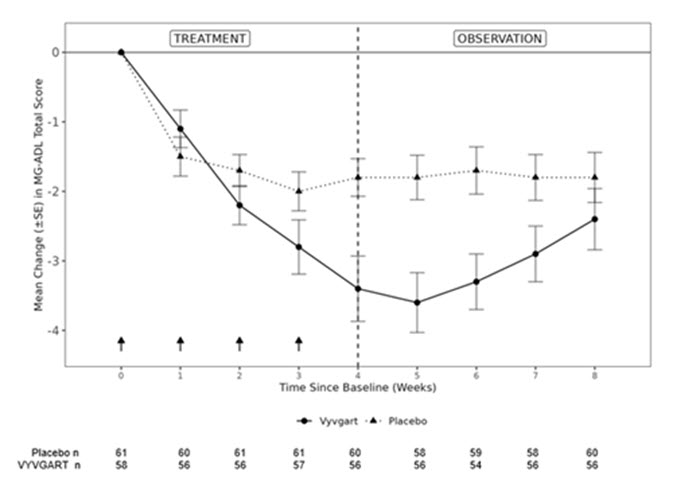
The primary efficacy endpoint was the comparison of the mean change from baseline at Week 4 between treatment groups in the MG-ADL total score. A statistically significant difference favoring VYVGART was observed (LS mean difference [95% CI] = - 1.46 [-2.50 to -0.41]; p-value = 0.0068).
Figure 3 shows the mean change from baseline to Week 8 in MG-ADL total score in Study 2 Part A.
| SE = standard error, MG-ADL = Myasthenia Gravis Activities of Daily Living. NOTE: Arrows indicate the timepoints at which the treatment was given. The dotted line at week 4 displays the start of the observation period, i.e., no shorter than 7 days from the last administration. |
| Figure 3: Mean Change From Baseline in MG-ADL Total Score Over 8 Weeks in Study 2 Part A |
 |
HOW SUPPLIED/STORAGE AND HANDLING
VYVGART (efgartigimod alfa-fcab) injection is a preservative free, sterile, colorless to slightly yellow, clear to slightly opalescent solution supplied as 400 mg/20 mL (20 mg/mL) in one single-dose vial per carton (NDC 73475-3041-5).
Store VYVGART vials refrigerated at 2°C to 8°C (36°F to 46°F) in the original carton to protect from light until time of use. Do not freeze. Do not shake.
Refer to Dosage and Administration (2.3) for information on stability and storage of the diluted solutions of VYVGART.
Mechanism of Action
Efgartigimod alfa-fcab is a human IgG1 antibody fragment that binds to the neonatal Fc receptor (FcRn), resulting in the reduction of circulating IgG.
