Get your patient on Ampicillin Sodium And Sulbactam Sodium - Ampicillin Sodium And Sulbactam Sodium injection, Powder, For Solution (Ampicillin Sodium And Sulbactam Sodium)
Ampicillin Sodium And Sulbactam Sodium - Ampicillin Sodium And Sulbactam Sodium injection, Powder, For Solution prescribing information

INDICATIONS AND USAGE
Ampicillin and sulbactam for injection is indicated for the treatment of infections due to susceptible strains of the designated microorganisms in the conditions listed below.
Skin and Skin Structure Infections caused by beta-lactamase producing strains of Staphylococcus aureus , Escherichia coli ,• Klebsiella spp.• (including K. pneumoniae• ), Proteus mirabilis ,• Bacteroides fragilis ,• Enterobacter spp.,• and Acinetobacter calcoaceticus.•
NOTE: For information on use in pediatric patients (see PRECAUTIONS – Pediatric Use and CLINICAL STUDIES sections).
Intra-Abdominal Infections caused by beta-lactamase producing strains of Escherichia coli , Klebsiella spp. (including K. pneumoniae• ), Bacteroides spp. (including B. fragilis ), and Enterobacter spp.•
Gynecological Infections caused by beta-lactamase producing strains of Escherichia coli,• and Bacteroides spp.• (including B. fragilis• ).
• Efficacy for this organism in this organ system was studied in fewer than 10 infections.
While ampicillin and sulbactam for injection is indicated only for the conditions listed above, infections caused by ampicillin-susceptible organisms are also amenable to treatment with ampicillin and sulbactam for injection due to its ampicillin content. Therefore, mixed infections caused by ampicillin-susceptible organisms and beta-lactamase producing organisms susceptible to ampicillin and sulbactam for injection should not require the addition of another antibacterial.
Appropriate culture and susceptibility tests should be performed before treatment in order to isolate and identify the organisms causing infection and to determine their susceptibility to ampicillin and sulbactam for injection.
Therapy may be instituted prior to obtaining the results from bacteriological and susceptibility studies when there is reason to believe the infection may involve any of the beta-lactamase producing organisms listed above in the indicated organ systems. Once the results are known, therapy should be adjusted if appropriate.
To reduce the development of drug-resistant bacteria and maintain effectiveness of ampicillin and sulbactam for injection and other antibacterial drugs, ampicillin and sulbactam for injection should be used only to treat infections that are proven or strongly suspected to be caused by susceptible bacteria. When culture and susceptibility information are available, they should be considered in selecting or modifying antibacterial therapy. In the absence of such data, local epidemiology and susceptibility patterns may contribute to the empiric selection of therapy.
DOSAGE AND ADMINISTRATION
Ampicillin and sulbactam for injection may be administered by either the IV or the IM routes.
For IV administration, the dose can be given by slow intravenous injection over at least 10 - 15 minutes or can also be delivered in greater dilutions with 50 - 100 mL of a compatible diluent as an intravenous infusion over 15 - 30 minutes.
Ampicillin and sulbactam for injection may be administered by deep intramuscular injection. (see DIRECTIONS FOR USE-Preparation for Intramuscular Injection section).
The recommended adult dosage of ampicillin and sulbactam for injection is 1.5 g (1 g ampicillin as the sodium salt plus 0.5 g sulbactam as the sodium salt) to 3 g (2 g ampicillin as the sodium salt plus 1 g sulbactam as the sodium salt) every six hours. This 1.5 to 3 g range represents the total of ampicillin content plus the sulbactam content of ampicillin and sulbactam for injection, and corresponds to a range of 1 g ampicillin/0.5 g sulbactam to 2 g ampicillin/1 g sulbactam. The total dose of sulbactam should not exceed 4 grams per day.
Pediatric Patients 1 Year of Age or Older: The recommended daily dose of ampicillin and sulbactam for injection in pediatric patients is 300 mg per kg of body weight administered via intravenous infusion in equally divided doses every 6 hours. This 300 mg/kg/day dosage represents the total ampicillin content plus the sulbactam content of ampicillin and sulbactam for injection, and corresponds to 200 mg ampicillin/100 mg sulbactam per kg per day. The safety and efficacy of ampicillin and sulbactam for injection administered via intramuscular injection in pediatric patients have not been established. Pediatric patients weighing 40 kg or more should be dosed according to adult recommendations, and the total dose of sulbactam should not exceed 4 grams per day. The course of intravenous therapy should not routinely exceed 14 days. In clinical trials, most children received a course of oral antimicrobials following initial treatment with intravenous ampicillin and sulbactam for injection. (see CLINICAL STUDIES section).
Impaired Renal Function
In patients with impairment of renal function the elimination kinetics of ampicillin and sulbactam are similarly affected, hence the ratio of one to the other will remain constant whatever the renal function. The dose of ampicillin and sulbactam for injection in such patients should be administered less frequently in accordance with the usual practice for ampicillin and according to the following recommendations:
TABLE 3
Ampicillin and Sulbactam for Injection Dosage Guide for Patients with Renal Impairment
| Creatinine Clearance (mL/min/1.73m 2 ) | Ampicillin/Sulbactam Half-Life (Hours) | Recommended Ampicillin and Sulbactam for Injection Dosage |
|---|---|---|
≥30 | 1 | 1.5 - 3 g q 6h - q 8h |
15 - 29 | 5 | 1.5 - 3 g q 12h |
5 - 14 | 9 | 1.5 - 3 g q 24h |
When only serum creatinine is available, the following formula (based on sex, weight, and age of the patient) may be used to convert this value into creatinine clearance. The serum creatinine should represent a steady state of renal function.
Males weight (kg) × (140 – age) 72 × serum creatinine
Females 0.85 × above value
CONTRAINDICATIONS
The use of ampicillin and sulbactam is contraindicated in individuals with a history of serious hypersensitivity reactions (e.g., anaphylaxis or Stevens-Johnson syndrome) to ampicillin, sulbactam or to other beta-lactam antibacterial drugs (e.g., penicillins and cephalosporins).
Ampicillin and sulbactam is contraindicated in patients with a previous history of cholestatic jaundice/hepatic dysfunction associated with ampicillin and sulbactam.
ADVERSE REACTIONS
Adult Patients: Ampicillin and sulbactam is generally well tolerated. The following adverse reactions have been reported in clinical trials.
Local Adverse Reactions
Pain at IM injection site – 16%
Pain at IV injection site – 3%
Thrombophlebitis – 3%
Phlebitis – 1.2%
Systemic Adverse Reactions
The most frequently reported adverse reactions were diarrhea in 3% of the patients and rash in less than 2% of the patients.
Additional systemic reactions reported in less than 1% of the patients were: itching, nausea, vomiting, candidiasis, fatigue, malaise, headache, chest pain, flatulence, abdominal distension, glossitis, urine retention, dysuria, edema, facial swelling, erythema, chills, tightness in throat, substernal pain, epistaxis and mucosal bleeding.
Pediatric Patients: Available safety data for pediatric patients treated with ampicillin and sulbactam demonstrate a similar adverse events profile to those observed in adult patients. Additionally, atypical lymphocytosis has been observed in one pediatric patient receiving ampicillin and sulbactam.
Adverse Laboratory Changes
Adverse laboratory changes without regard to drug relationship that were reported during clinical trials were:
Hepatic: Increased AST (SGOT), ALT (SGPT), alkaline phosphatase, and LDH.
Hematologic: Decreased hemoglobin, hematocrit, RBC, WBC, neutrophils, lymphocytes, platelets and increased lymphocytes, monocytes, basophils, eosinophils, and platelets.
Blood Chemistry: Decreased serum albumin and total proteins.
Renal: Increased BUN and creatinine.
Urinalysis: Presence of RBC’s and hyaline casts in urine.
Postmarketing Experience
In addition to adverse reactions reported from clinical trials, the following have been identified during post-marketing use of ampicillin sodium/sulbactam sodium or other products containing ampicillin. Because they are reported voluntarily from a population of unknown size, estimates of frequency cannot be made. These events have been chosen for inclusion due to a combination of their seriousness, frequency, or potential causal connection to ampicillin sodium/sulbactam sodium.
Infections and Infestations: Clostridioides difficile-associated diarrhea (see WARNINGS section).
Blood and Lymphatic System Disorders: Hemolytic anemia, thrombocytopenic purpura, and agranulocytosis have been reported. These reactions are usually reversible on discontinuation of therapy and are believed to be hypersensitivity phenomena. Some individuals have developed positive direct Coombs Tests during treatment with ampicillin and sulbactam, as with other beta-lactam antibacterials.
Gastrointestinal Disorders: Abdominal pain, cholestatic hepatitis, cholestasis, hyperbilirubinemia, jaundice, abnormal hepatic function, melena, gastritis, stomatitis, dyspepsia, black “hairy” tongue (see CONTRAINDICATIONS and WARNINGS sections).
General Disorders and Administration Site Conditions: Injection site reaction
Immune System Disorders: Serious and fatal hypersensitivity (anaphylactic) reactions (see WARNINGS section), Acute myocardial ischemia with or without myocardial infarction may occur as part of an allergic reaction.
Nervous System Disorders: Convulsion and dizziness
Renal and Urinary Disorders: Tubulointerstitial nephritis
Musculoskeletal and Connective Tissue Disorders: Arthralgia
Respiratory, Thoracic and Mediastinal Disorders: Dyspnea
Skin and Subcutaneous Tissue Disorders: Toxic epidermal necrolysis, Stevens-Johnson syndrome,drug reaction with eosinophilia and systemic symptoms (DRESS), angioedema, Acute generalized exanthematous pustulosis (AGEP), erythema multiforme, exfoliative dermatitis, and urticaria (see CONTRAINDICATIONS and WARNINGS sections), and linear IgA bullous dermatosis.
To report SUSPECTED ADVERSE REACTIONS, contact Steriscience at (1-888-278-1784) or FDA at 1-800-FDA-1088 or www.fda.gov/medwatch for voluntary reporting of adverse reactions.
DESCRIPTION
Ampicillin and sulbactam for injection, USP is an injectable antibacterial combination consisting of the semisynthetic antibacterial ampicillin sodium and the beta-lactamase inhibitor sulbactam sodium for intravenous and intramuscular administration.
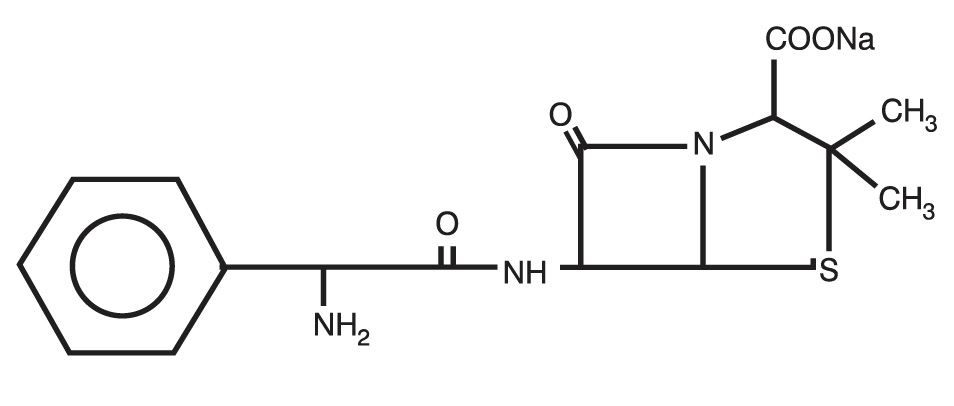
Ampicillin sodium is derived from the penicillin nucleus, 6-aminopenicillanic acid. Chemically, it is monosodium (2S,5R,6R)-6-[(R)-2-amino-2-phenylacetamido]-3, 3-dimethyl-7-oxo-4-thia-1-azabicyclo [3.2.0]heptane-2-carboxylate and has a molecular weight of 371.39. Its chemical formula is C 16 H 18 N 3 NaO 4 S.
The structural formula is:
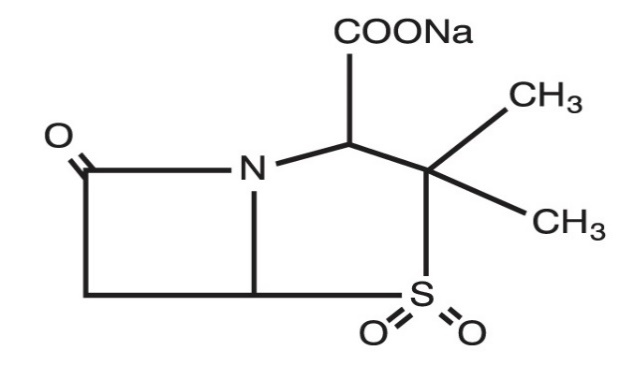
Sulbactam sodium is a derivative of the basic penicillin nucleus. Chemically, sulbactam sodium is sodium penicillinate sulfone; sodium (2S,5R)-3,3-dimethyl-7-oxo-4-thia-1-azabicyclo [3.2.0] heptane-2-carboxylate 4,4-dioxide. Its chemical formula is C 8 H 10 NNaO 5 S with a molecular weight of 255.22.
The structural formula is:
Ampicillin and sulbactam for injection, USP, ampicillin sodium/sulbactam sodium parenteral combination, is available as a white to off-white dry powder for reconstitution. Ampicillin and sulbactam for injection, USP dry powder is freely soluble in aqueous diluents to yield pale yellow to yellow solutions containing ampicillin sodium and sulbactam sodium equivalent to 250 mg ampicillin per mL and 125 mg sulbactam per mL. The pH of the solutions is between 8.0 and 10.0.
Dilute solutions (up to 30 mg ampicillin and 15 mg sulbactam per mL) are essentially colorless to pale yellow. The pH of dilute solutions remains the same.
1.5 g of ampicillin and sulbactam for injection, USP (1 g ampicillin as the sodium salt plus 0.5 g sulbactam as the sodium salt) parenteral contains approximately 115 mg (5 mEq) of sodium.
3 g of ampicillin and sulbactam for injection, USP (2 g ampicillin as the sodium salt plus 1 g sulbactam as the sodium salt) parenteral contains approximately 230 mg (10 mEq) of sodium.
CLINICAL PHARMACOLOGY
General: Immediately after completion of a 15-minute intravenous infusion of ampicillin and sulbactam, peak serum concentrations of ampicillin and sulbactam are attained. Ampicillin serum levels are similar to those produced by the administration of equivalent amounts of ampicillin alone. Peak ampicillin serum levels ranging from 109 to 150 mcg/mL are attained after administration of 2,000 mg of ampicillin plus 1,000 mg sulbactam and 40 to 71 mcg/mL after administration of 1,000 mg ampicillin plus 500 mg sulbactam. The corresponding mean peak serum levels for sulbactam range from 48 to 88 mcg/mL and 21 to 40 mcg/mL, respectively. After an intramuscular injection of 1,000 mg ampicillin plus 500 mg sulbactam, peak ampicillin serum levels ranging from 8 to 37 mcg/mL and peak sulbactam serum levels ranging from 6 to 24 mcg/mL are attained.
The mean serum half-life of both drugs is approximately 1 hour in healthy volunteers.
Approximately 75 to 85% of both ampicillin and sulbactam are excreted unchanged in the urine during the first 8 hours after administration of ampicillin and sulbactam to individuals with normal renal function. Somewhat higher and more prolonged serum levels of ampicillin and sulbactam can be achieved with the concurrent administration of probenecid.
In patients with impaired renal function the elimination kinetics of ampicillin and sulbactam are similarly affected, hence the ratio of one to the other will remain constant whatever the renal function. The dose of ampicillin and sulbactam in such patients should be administered less frequently in accordance with the usual practice for ampicillin (see DOSAGE and ADMINISTRATION section).
Ampicillin has been found to be approximately 28% reversibly bound to human serum protein and sulbactam approximately 38% reversibly bound.
The following average levels of ampicillin and sulbactam were measured in the tissues and fluids listed:
TABLE 1
Concentration of Ampicillin and Sulbactam in Various Body Tissues and Fluids
| Fluid or Tissue | Dose (grams) Ampicillin/Sulbactam | Concentration (mcg/mL or mcg/g) Ampicillin/Sulbactam |
|---|---|---|
Peritoneal Fluid | 0.5/0.5 IV | 7/14 |
Blister Fluid (Cantharides) | 0.5/0.5 IV | 8/20 |
Tissue Fluid | 1/0.5 IV | 8/4 |
Intestinal Mucosa | 0.5/0.5 IV | 11/18 |
Appendix | 2/1 IV | 3/40 |
Penetration of both ampicillin and sulbactam into cerebrospinal fluid in the presence of inflamed meninges has been demonstrated after IV administration of ampicillin and sulbactam.
The pharmacokinetics of ampicillin and sulbactam in pediatric patients receiving ampicillin and sulbactam are similar to those observed in adults. Immediately after a 15-minute infusion of 50 to 75 mg ampicillin and sulbactam/kg body weight, peak serum and plasma concentrations of 82 to 446 mcg ampicillin/mL and 44 to 203 mcg sulbactam/mL were obtained. Mean half-life values were approximately 1 hour.
CLINICAL STUDIES
Skin and Skin Structure Infections in Pediatric Patients: Data from a controlled clinical trial conducted in pediatric patients provided evidence supporting the safety and efficacy of ampicillin and sulbactam for the treatment of skin and skin structure infections. Of 99 pediatric patients evaluable for clinical efficacy, 60 patients received a regimen containing intravenous ampicillin and sulbactam, and 39 patients received a regimen containing intravenous cefuroxime. This trial demonstrated similar outcomes (assessed at an appropriate interval after discontinuation of all antimicrobial therapy) for ampicillin and sulbactam- and cefuroxime-treated patients:
TABLE 2
| Thera p eutic Re g imen | Clinical Success | Clinical Failure |
|---|---|---|
Ampicillin and Sulbactam | 51/60 (85%) | 9/60 (15%) |
Cefuroxime | 34/39 (87%) | 5/39 (13%) |
Most patients received a course of oral antimicrobials following initial treatment with intravenous administration of parenteral antimicrobials. The study protocol required that the following three criteria be met prior to transition from intravenous to oral antimicrobial therapy: (1) receipt of a minimum of 72 hours of intravenous therapy; (2) no documented fever for prior 24 hours; and (3) improvement or resolution of the signs and symptoms of infection.
The choice of oral antimicrobial agent used in this trial was determined by susceptibility testing of the original pathogen, if isolated, to oral agents available. The course of oral antimicrobial therapy should not routinely exceed 14 days.
HOW SUPPLIED
Ampicillin and sulbactam for injection, USP is supplied as a sterile white to off-white dry powder in glass vials. The following packages are available:
Vials containing 1.5 g equivalent of ampicillin and sulbactam for injection, USP (1 g ampicillin as the sodium salt plus 0.5 g sulbactam as the sodium salt).
Box of one vial NDC 82449-513-01
Box of 10 vials NDC 82449-513-02
Vials containing 3 g equivalent of ampicillin and sulbactam for injection, USP (2 g ampicillin as the sodium salt plus 1 g sulbactam as the sodium salt).
Box of one vial NDC 82449-514-01
Box of 10 vials NDC 82449-514-02
Ampicillin and Sulbactam for Injection, USP sterile powder is to be stored at 20° to 25°C (68° to 77°F). [See USP Controlled Room Temperature.] prior to reconstitution.
