Get your patient on Bromfenac 0.075%- Bromfenac solution/ Drops (Bromfenac)
Bromfenac 0.075%- Bromfenac solution/ Drops prescribing information

INDICATIONS AND USAGE
Bromfenac ophthalmic solution 0.075% is indicated for the treatment of postoperative inflammation and prevention of ocular pain in patients undergoing cataract surgery.
DOSAGE AND ADMINISTRATION
Instill one drop of bromfenac ophthalmic solution to the affected eye twice daily (morning and evening) beginning 1 day prior to surgery, the day of surgery, and 14 days postsurgery. (2.1)
Recommended Dosing
One drop of bromfenac ophthalmic solution should be applied to the affected eye twice daily (morning and evening) 1 day prior to surgery, the day of surgery, and 14 days postsurgery.
Use with Other Topical Ophthalmic Medications
Bromfenac ophthalmic solution should be administered at least 5 minutes after instillation of other topical medications. Bromfenac ophthalmic solution may be administered in conjunction with other topical ophthalmic medications such as alpha-agonists, beta-blockers, carbonic anhydrase inhibitors, cycloplegics, and mydriatics.
DOSAGE FORM AND STRENGTHS
Topical ophthalmic solution: bromfenac 0.075%.
USE IN SPECIFIC POPULATIONS
Pregnancy
Risk Summary There are no adequate and well-controlled studies in pregnant women to inform any drug associated risks. Treatment of pregnant rats and rabbits with oral bromfenac did not produce teratogenic effects at clinically relevant doses. Clinical Considerations Because of the known effects of prostaglandin biosynthesis-inhibiting drugs on the fetal cardiovascular system (closure of ductus arteriosus), the use of bromfenac ophthalmic solution during late pregnancy should be avoided.
Data Animal Data Treatment of rats with bromfenac at oral doses up to 0.9 mg/kg/day (195 times a unilateral daily human ophthalmic dose on a mg/m 2 basis, assuming 100% absorbed) and rabbits at oral doses up to 7.5 mg/kg/day (3243 times a unilateral daily dose on a mg/m 2 basis) produced no structural teratogenicity in reproduction studies. However, embryo-fetal lethality, neonatal mortality and reduced postnatal growth were produced in rats at 0.9 mg/kg/day, and embryo-fetal lethality was produced in rabbits at 7.5 mg/kg/day. Because animal reproduction studies are not always predictive of human response, this drug should be used during pregnancy only if the potential benefit justifies the potential risk to the fetus.
Lactation
There are no data on the presence of bromfenac in human milk, the effects on the breastfed infant, or the effects on milk production; however, systemic exposure to bromfenac from ocular administration is low [see Clinical Pharmacology (12.3)]. The developmental and health benefits of breastfeeding should be considered along with the mother’s clinical need for bromfenac and any potential adverse effects on the breast-fed child from bromfenac or from the underlying maternal condition.
Pediatric Use
Safety and efficacy in pediatric patients below the age of 18 years have not been established.
Geriatric Use
There is no evidence that the efficacy or safety profiles for bromfenac ophthalmic solution differ in patients 65 years of age and older compared to younger adult patients.
CONTRAINDICATIONS
None
WARNINGS AND PRECAUTIONS
- Slow or Delayed Healing (5.1)
- Potential for Cross-Sensitivity (5.2)
- Increased Bleeding Time of Ocular Tissue (5.3)
- Keratitis and Corneal Effects (5.4)
- Contact Lens Wear (5.5)
Slow or Delayed Healing
All topical nonsteroidal anti-inflammatory drugs (NSAIDs), including bromfenac ophthalmic solution 0.075%, may slow or delay healing. Topical corticosteroids are also known to slow or delay healing. Concomitant use of topical NSAIDs and topical steroids may increase the potential for healing problems.
Potential for Cross-Sensitivity
There is the potential for cross-sensitivity to acetylsalicylic acid, phenylacetic acid derivatives, and other NSAIDs, including bromfenac ophthalmic solution 0.075%. Therefore, caution should be used when treating individuals who have previously exhibited sensitivities to these drugs.
Increased Bleeding Time of Ocular Tissue
With some NSAIDs, including bromfenac ophthalmic solution 0.075%, there exists the potential for increased bleeding time due to interference with platelet aggregation. There have been reports that ocularly applied NSAIDs may cause increased bleeding of ocular tissues (including hyphemas) in conjunction with ocular surgery.
It is recommended that bromfenac ophthalmic solution be used with caution in patients with known bleeding tendencies or who are receiving other medications which may prolong bleeding time.
Keratitis and Corneal Reactions
Use of topical NSAIDs may result in keratitis. In some susceptible patients, continued use of topical NSAIDs may result in epithelial breakdown, corneal thinning, corneal erosion, corneal ulceration or corneal perforation. These events may be sight threatening. Patients with evidence of corneal epithelial breakdown should immediately discontinue use of topical NSAIDs, including bromfenac ophthalmic solution 0.075%, and should be closely monitored for corneal health.
Postmarketing experience with topical NSAIDs suggests that patients with complicated ocular surgeries, corneal denervation, corneal epithelial defects, diabetes mellitus, ocular surface diseases (e.g., dry eye syndrome), rheumatoid arthritis, or repeat ocular surgeries within a short period of time may be at increased risk for corneal adverse events which may become sight threatening. Topical NSAIDs should be used with caution in these patients.
Postmarketing experience with topical NSAIDs also suggests that use more than 24 hours prior to surgery or use beyond 14 days postsurgery may increase patient risk for the occurrence and severity of corneal adverse events.
Contact Lens Wear
Bromfenac ophthalmic solution should not be administered while wearing contact lenses. The preservative in bromfenac ophthalmic solution, benzalkonium chloride, may be absorbed by soft contact lenses.
ADVERSE REACTIONS
The following serious adverse reactions are described elsewhere in the labeling: • Slow or Delayed Healing [ see Warnings and Precautions (5.1) ] • Potential for Cross-Sensitivity [ see Warnings and Precautions (5.2) ] • Increased Bleeding Time of Ocular Tissue [ see Warnings and Precautions (5.3) ] • Keratitis and Corneal Reactions [ see Warnings and Precautions (5.4) ] • Contact Lens Wear [ see Warnings and Precautions (5.5) ]
Clinical Trials Experience
Because clinical trials are conducted under widely varying conditions, adverse reaction rates observed in the clinical trials of a drug cannot be directly compared to rates in the clinical trials of another drug and may not reflect the rates observed in clinical practice. The most commonly reported adverse reactions in 1 to 8% of patients were: anterior chamber inflammation, headache, vitreous floaters, iritis, eye pain and ocular hypertension.
DESCRIPTION
Bromfenac ophthalmic solution 0.075% is a sterile aqueous, topical NSAID, formulated in DuraSite ® for ophthalmic use. The USAN name for bromfenac sodium sesquihydrate is bromfenac sodium. Bromfenac sodium is designated chemically as sodium [2-amino-3-(4-bromobenzoyl) phenyl] acetate sesquihydrate, with an empirical formula of C 15 H 11 BrNNaO 3 • 1½H 2 O. The structural formula for bromfenac sodium sesquihydrate is:
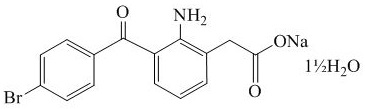 Bromfenac sodium is a bright orange to yellow powder. The molecular weight of bromfenac sodium sesquihydrate is 383.17. Bromfenac ophthalmic solution is a greenish-yellow to dark yellow viscous liquid with an osmolality of approximately 290 mOsmol/kg. Active: Each mL contains bromfenac sodium sesquihydrate 0.87 mg, which is equivalent to bromfenac free acid 0.76 mg. Preservative: benzalkonium chloride 0.005% Inactives: boric acid, sodium borate, citric acid anhydrous, sodium citrate dihydrate, poloxamer 407, polycarbophil, sodium chloride, edetate disodium dihydrate, sodium hydroxide (to adjust pH to 8.3), and water for injection (USP).
CLINICAL PHARMACOLOGY
Mechanism of Action
Bromfenac is a nonsteroidal anti-inflammatory drug (NSAID) that has anti-inflammatory activity. The mechanism of its action is thought to be due to its ability to block prostaglandin synthesis by inhibiting cyclooxygenase 1 and 2. Prostaglandins have been shown in many animal models to be mediators of certain kinds of intraocular inflammation. In studies performed in animal eyes, prostaglandins have been shown to produce disruption of the blood-aqueous humor barrier, vasodilation, increased vascular permeability, leukocytosis, and increased intraocular pressure.
Pharmacokinetics
Following bilateral topical ocular twice-daily dosing of Bromfenac 0.075% ophthalmic solution, the plasma concentrations of bromfenac ranged from below the limit of quantification (LOQ = 0.20 ng/mL) to 2.42 ng/mL at 30 to 60 minutes post-dose.
NONCLINICAL TOXICOLOGY
Carcinogenesis, Mutagenesis and Impairment of Fertility
Long-term carcinogenicity studies in rats and mice given oral doses of bromfenac up to 0.6 mg/kg/day (129 times a unilateral daily dose assuming 100% absorbed, on a mg/m 2 basis) and 5 mg/kg/day (540 times a unilateral daily dose on a mg/m 2 basis), respectively revealed no significant increases in tumor incidence. Bromfenac did not show mutagenic potential in various mutagenicity studies, including the bacterial reverse mutation, chromosomal aberration, and micronucleus tests. Bromfenac did not impair fertility when administered orally to male and female rats at doses up to 0.9 mg/kg/day and 0.3 mg/kg/day, respectively (195 and 65 times a unilateral daily dose, respectively, on a mg/m 2 basis).
CLINICAL STUDIES
Ocular Inflammation and Pain
Clinical efficacy was evaluated in 2 multi-centered, randomized, double-masked, parallel group, placebo-controlled US trials in which subjects requiring cataract surgery were assigned to receive bromfenac ophthalmic solution or vehicle. Patients undergoing cataract surgery self-administered bromfenac ophthalmic solution or vehicle twice daily, beginning 1 day prior to surgery, continuing the day of surgery and for 14 days after surgery. Clearance of ocular inflammation was assessed on Days 1, 8, 15, and 29 using slit lamp biomicroscopy. The primary efficacy endpoint was the proportion of subjects with anterior chamber cell (ACC) grade 0 at Day 15. The secondary efficacy endpoint was the proportion of subjects who were pain free after cataract surgery as assessed using a Visual Analog Scale.
Proportion of Subjects with Cleared Ocular Inflammation, ACC Grade 0 | ||||
Visit | Bromfenac Ophthalmic Solution | Vehicle | Treatment Difference (95% CI) | |
Study 1 | Day 8 | 54/168 (32.1%) | 7/85 (8.2%) | 23.9% (14.7%, 33.1%) |
Day 15 | 96/168 (57.1%) | 16/85 (18.8%) | 38.3% (27.1%, 49.5%) | |
Study 2 | Day 8 | 40/168 (23.8%) | 8/85 (9.4%) | 1 4.4% (5.5%, 23.3%) |
Day 15 | 64/168 (38.1%) | 19/85 (22.4%) | 1 5.7% (4.2%, 27.3%) | |
Proportion of Subjects who were Pain Free | ||||
Study 1 | Day 1 | 129/168 (76.8%) | 41/85 (48.2%) | 28.6% (16.2%, 40.9%) |
Study 2 | Day 1 | 138/168 (82.1%) | 53/85 (62.4%) | 19.8% (8.0%, 31.6%) |
HOW SUPPLIED/STORAGE AND HANDLING
Bromfenac ophthalmic solution 0.075% is supplied in white opaque low density polyethylene (LDPE) plastic bottles and translucent dropper tips, and gray high density polyethylene (HDPE) eyedropper caps. A white tamper evident overcap is provided. Each bottle is provided in a sealed foil laminated pouch. 5 mL in a 7.5 mL bottle (NDC No. 49708-755-41) STORAGE Store at 15°C to 25°C (59°F to 77°F). After opening, bromfenac ophthalmic solution can be used until the expiration date on the bottle. Discard after treatment completion.
Mechanism of Action
Bromfenac is a nonsteroidal anti-inflammatory drug (NSAID) that has anti-inflammatory activity. The mechanism of its action is thought to be due to its ability to block prostaglandin synthesis by inhibiting cyclooxygenase 1 and 2. Prostaglandins have been shown in many animal models to be mediators of certain kinds of intraocular inflammation. In studies performed in animal eyes, prostaglandins have been shown to produce disruption of the blood-aqueous humor barrier, vasodilation, increased vascular permeability, leukocytosis, and increased intraocular pressure.
