Get your patient on Carglumic Acid - Carglumic Acid tablet, For Suspension (Carglumic Acid)
Carglumic Acid - Carglumic Acid tablet, For Suspension prescribing information

INDICATIONS & USAGE
Carglumic acid tablets for oral suspension is a carbamoyl phosphate synthetase 1 (CPS 1) activator indicated in pediatric and adult patients as:
- Adjunctive therapy to standard of care for the treatment of acute hyperammonemia due to N-acetylglutamate synthase (NAGS) deficiency. (1.1)
- Maintenance therapy for the treatment of chronic hyperammonemia due to NAGS deficiency. (1.1)
Acute and Chronic Hyperammonemia due to N-acetylglutamate Synthase (NAGS) Deficiency
Carglumic acid tablets for oral suspension are indicated in adult and pediatric patients as:
- Adjunctive therapy to standard of care for the treatment of acute hyperammonemia due to NAGS deficiency.
- Maintenance therapy for the treatment of chronic hyperammonemia due to NAGS deficiency.
DOSAGE & ADMINISTRATION
Acute Hyperammonemia due to NAGS deficiency (2.2)
- The recommended dosage in adult and pediatric patients is 100 mg/kg to 250 mg/kg orally daily. Divide the daily dosage into 2 to 4 doses.
Chronic Hyperammonemia due to NAGS deficiency (2.2)
- The recommended dosage in adult and pediatric patients is 10 mg/kg to 100 mg/kg orally daily. Divide the daily dosage into 2 to 4 doses.
Therapeutic Monitoring for NAGS Deficiency (2.2)
- Closely monitor plasma ammonia and titrate dosage to maintain the ammonia level within normal range for the patient’s age, taking into consideration their clinical condition.
Patients with Renal Impairment (2.4)
- See Full Prescribing Information for Instructions on Dosage Adjustment.
Preparation and Administration (2.5)
- Disperse Carglumic acid tablets for oral suspension in water. Do not swallow whole or crushed.
- Take immediately before meals or feedings.
- For additional instructions on preparation and administration orally or through a nasogastric tube or gastrostomy tube, see Full Prescribing Information.
Important Administration Instructions
- Disperse carglumic acid tablets for oral suspension in water. Do not swallow whole or crush [see Dosage and Administration (2.5)].
- Carglumic acid tablets for oral suspension may be administered by mouth or via a nasogastric or gastrostomy tube [see Dosage and Administration (2.5)].
Recommended Dosage for Acute or Chronic Hyperammonemia due to NAGS Deficiency
Treatment Initiation Initiate carglumic acid tablets for oral suspension treatment as soon as the diagnosis of NAGS deficiency is suspected, which may be as soon as at birth, and supervised by a healthcare provider experienced in the treatment of metabolic disorders.
Dosage for Acute Hyperammonemia due to NAGS Deficiency
- The recommended dosage of carglumic acid tablets for oral suspension in adult and pediatric patients for acute hyperammonemia due to NAGS deficiency is (based on actual body weight) 100 mg/kg to 250 mg/kg orally daily.
- Divide the daily dosage into 2 to 4 doses and round to the nearest 100 mg (i.e., half of a carglumic acid tablet for oral suspension).
- During acute hyperammonemic episodes, administer carglumic acid tablets for oral suspension with other ammonia lowering therapies, such as alternate pathway medications, hemodialysis, and protein restriction.
Dosage for Chronic Hyperammonemia due to NAGS Deficiency
- The recommended dosage of carglumic acid tablets for oral suspension in adult and pediatric patients for chronic hyperammonemia due to NAGS deficiency is (based on actual body weight) 10 mg/kg to 100 mg/kg orally daily.
- Divide the daily dosage into 2 to 4 doses and round to the nearest 100 mg (i.e., half of a Carglumic acid tablet for oral suspension).
- During maintenance therapy, the concomitant use of other ammonia lowering therapies and protein restriction may be needed based on plasma ammonia levels.
Therapeutic Monitoring Closely monitor plasma ammonia levels. Titrate the Carglumic acid tablets for oral suspension dosage to maintain the plasma ammonia level within the normal range for the patient’s age, taking into consideration their clinical condition (e.g., nutritional requirements, protein intake, growth parameters, etc.).
Adjust the recommended dosage in patients with moderate or severe renal impairment [see Dosage and Administration (2.4)].
Dosage Adjustment in Patients with Renal Impairment
No dosage adjustment is warranted in patients with mild renal impairment (eGFR 60-89 mL/min/1.73 m 2 ). The recommended dosage of Carglumic acid tablets for oral suspension in patients with moderate or severe renal impairment is shown below.
| Moderate Renal Impairment (eGFR 30-59 mL/min/1.73 m 2 ) | Severe Renal Impairment (eGFR 15-29 mL/min/1.73 m 2 ) | |
| Acute Hyperammonemia due to NAGS Deficiency | 50 mg/kg/day to 125 mg/kg/day divided into 2 to 4 doses and rounded to the nearest 50 mg (i.e., one-quarter of a Carglumic acid tablet for oral suspension) | 15 mg/kg/day to 60 mg/kg/day divided into 2 to 4 doses and rounded to the nearest 50 mg (i.e., one-quarter of a Carglumic acid tablet for oral suspension) |
| Chronic Hyperammonemia due to NAGS Deficiency | 5 mg/kg/day to 50 mg/kg/day divided into 2 to 4 doses and rounded to the nearest 50 mg (i.e., one-quarter of a Carglumic acid tablet for oral suspension) | 2 mg/kg/day to 25 mg/kg/day divided into 2 to 4 doses and rounded to the nearest 50 mg (i.e., one-quarter of a Carglumic acid tablet for oral suspension) |
Preparation and Administration
Overview
- Disperse Carglumic acid tablets for oral suspension in water. Do not swallow whole or crush.
- Carglumic acid tablets for oral suspension do not dissolve completely in water, and undissolved particles of the tablet may remain in the mixing container.
- Take Carglumic acid tablets for oral suspension immediately before meals or feedings.
- The Carglumic acid tablet suspension has a slightly acidic taste.
- For all preparations, use in foods or liquids other than water has not been studied and is not recommended.
Oral Administration
For oral administration, administer Carglumic acid tablets for oral suspension as follows:
- Add a minimum of 2.5 mL of water into a small cup for each Carglumic acid tablet for oral suspension or each ½ or ¼ Carglumic acid tablet for oral suspension needed for the prescribed dose.
- Add the Carglumic acid tablets for oral suspension to the water in the cup.
- Carefully stir the tablet and water mixture.
- Swallow the mixture immediately. Pieces of the tablet may remain in the cup.
- Rinse the cup with additional water and swallow the mixture immediately. Repeat as needed until no pieces of the tablet are left in the cup.
Use of an Oral Syringe for Oral Administration
For administration via an oral syringe, administer Carglumic acid tablets for oral suspension as follows:
- Add a minimum of 2.5 mL of water into a small cup for each Carglumic acid tablet for oral suspension or each ½ or ¼ Carglumic acid tablet for oral suspension needed for the prescribed dose.
- Add the Carglumic acid tablets for oral suspension to the water in the cup.
- Carefully stir the tablet and water mixture.
- Draw up the mixture in an oral syringe and administer immediately. Pieces of the tablet may remain in the oral syringe.
- Refill the oral syringe with a minimum volume of water (1 mL to 2 mL) and administer immediately.
- Flush the oral syringe again, as needed, until no pieces of the tablet are left in the syringe.
Use of Nasogastric Tube (NG Tube) or Gastrostomy Tube (G-Tube) for Feeding Tube Administration
For patients who have a NG tube or G-tube in place, administer Carglumic acid tablets for oral suspension as follows:
- Add a minimum of 2.5 mL of water into a small cup for each Carglumic acid tablet for oral suspension or each ½ or ¼ Carglumic acid tablet for oral suspension needed for the prescribed dose.
- Add the Carglumic acid tablets for oral suspension to the water in the cup.
- Carefully stir the tablet and water mixture.
- Draw up the mixture into a catheter-tip syringe.
- Administer the mixture immediately through the NG tube or G-tube. Pieces of the tablet may remain in the catheter-tip syringe or the feeding tube.
- Flush immediately with 1 to 2 mL of additional water to clear the NG tube or G-tube.
- Flush the NG tube or G-tube again, as needed, until no pieces of the tablet are left in the syringe or the feeding tube.
DOSAGE FORMS & STRENGTHS
Tablets for oral suspension: 200 mg of carglumic acid, white to off-white, elongated, functionally scored with 3 lines (for splitting into 4 equal portions) and coded "120" on one side and ''N" on other side.
USE IN SPECIFIC POPULATIONS
Pregnancy
Risk Summary
Although rare case reports of Carglumic acid tablets for oral suspension use in pregnant women are insufficient to inform a drug-associated risk of major birth defects, miscarriage, or adverse maternal or fetal outcomes, untreated NAGS deficiency can result in irreversible neurologic damage and death in pregnant women [see Clinical Considerations].
In an animal reproduction study, decreased survival and growth occurred in offspring born to rats that received carglumic acid at a dose approximately 38 times the maximum reported human maintenance dose.
The estimated background risk of major birth defects and miscarriage for the indicated population is unknown. All pregnancies have a background risk of birth defect, miscarriage, or other adverse outcomes. In the U.S. general population, the estimated background risk of major birth defects and miscarriage in clinically recognized pregnancies is 2% to 4% and 15% to 20%, respectively.
Clinical Considerations
Disease-associated maternal and/or embryo/fetal risk
Pregnant women with urea cycle disorders may experience an increase in catabolic stress which can trigger a hyperammonemic crisis both in the intrapartum and in the post-partum (3-14 days post-partum) periods. Maternal complications related to hyperammonemic crisis can include neurological impairment, coma and in some cases death.
Data
Animal Data
No effects on embryo-fetal development were observed in pregnant rats treated with up to 2000 mg/kg/day (approximately 38 times the maximum reported human maintenance dose [100 mg/kg/day] based on AUC [area under the plasma concentration-time curve]) from two weeks prior to mating through organogenesis or in pregnant rabbits treated with up to 1000 mg/kg/day (approximately 6 times the maximum reported human maintenance dose [100 mg/kg/day] based on AUC) during organogenesis.
In a pre-and post-natal developmental study, female rats received oral carglumic acid from organogenesis through lactation at doses of 500 mg/kg/day and 2000 mg/kg/day. Decreased growth of offspring was observed at 500 mg/kg/day and higher (approximately 38 times the maximum reported human maintenance dose [100 mg/kg/day] based on AUC), and reduction in offspring survival during lactation was observed at 2000 mg/kg/day (approximately 38 times the maximum reported human maintenance dose [100 mg/kg/day] based on AUC). No effects on physical and sexual development, learning and memory, or reproductive performance were observed through maturation of the surviving offspring at maternal doses up to 2000 mg/kg/day. The high dose (2000 mg/kg/day) produced maternal toxicity (impaired weight gain and approximately 10% mortality).
Lactation
Risk Summary
It is not known whether carglumic acid is present in human milk. There are no available data on the effects of carglumic acid on the breastfed infant or the effects on milk production. Carglumic acid is present in milk from treated rats. When a drug is present in animal milk, it is likely that the drug will be present in human milk.
The developmental and health benefits of breastfeeding should be considered along with the mother’s clinical need for Carglumic acid tablets for oral suspension and any potential adverse effects on the breastfed child from Carglumic acid tablets for oral suspension or from the underlying maternal condition.
Pediatric Use
The safety and effectiveness of Carglumic acid tablets for oral suspension for the treatment of pediatric patients (birth to 17 years of age) with acute or chronic hyperammonemia due to NAGS deficiency have been established, and the information on these uses are discussed throughout the labeling. There are insufficient data to determine if there is a difference in clinical or biochemical responses between adult and pediatric patients treated with Carglumic acid tablets for oral suspension.
Geriatric Use
Clinical studies of Carglumic acid tablets for oral suspension did not include patients 65 years of age and older to determine whether they respond differently from younger patients.
Renal Impairment
Plasma concentrations of carglumic acid increased in patients with renal impairment [see Clinical Pharmacology (12.3)] . Reduce the Carglumic acid tablets for oral suspension dosage in patients with moderate or severe renal impairment [see Dosage and Administration (2.4)] . The pharmacokinetics of carglumic acid have not been evaluated in patients with end stage renal disease.
CONTRAINDICATIONS
None
ADVERSE REACTIONS
- NAGS deficiency: Most common adverse reactions (≥13%) are vomiting, abdominal pain, pyrexia, tonsillitis, anemia, diarrhea, ear infection, infections, nasopharyngitis, hemoglobin decreased, and headache. (6.1)
To report SUSPECTED ADVERSE REACTIONS, contact Eton Pharmaceuticals, Inc. at 1-855-224-0233, or FDA at 1-800-FDA-1088 or www.fda.gov/medwatch .
Clinical Trials Experience
Because clinical trials are conducted under widely varying conditions, adverse reaction rates observed in the clinical trials of a drug cannot be directly compared to rates in the clinical trials of another drug and may not reflect the rates observed in practice.
Acute and Chronic Hyperammonemia due to NAGS Deficiency
In a retrospective case series of 23 NAGS deficiency patients treated with Carglumic acid tablets for oral suspension, 17 of the 23 patients reported an adverse reaction. The most common adverse reactions (occurring in ≥ 13% of patients) were vomiting, abdominal pain, pyrexia, tonsillitis, anemia, diarrhea, ear infection, infections, nasopharyngitis, hemoglobin decreased, and headache.
Table 1 summarizes adverse reactions occurring in 2 or more patients treated with Carglumic acid tablets for oral suspension.
Table 1: Adverse Reactions Reported in ≥ 2 Patients with NAGS deficiency Treated with Carglumic acid tablets for oral suspension in the Retrospective Case Series
| Adverse Reaction | Number of Patients (N) (%) |
| Vomiting | 6 (26) |
| Abdominal pain | 4 (17) |
| Pyrexia | 4 (17) |
| Tonsillitis | 4 (17) |
| Anemia | 3 (13) |
| Diarrhea | 3 (13) |
| Ear infection | 3 (13) |
| Infections | 3 (13) |
| Nasopharyngitis | 3 (13) |
| Hemoglobin decreased | 3 (13) |
| Headache | 3 (13) |
| Dysgeusia | 2 (9) |
| Asthenia | 2 (9) |
| Hyperhidrosis | 2 (9) |
| Influenza | 2 (9) |
| Pneumonia | 2 (9) |
| Weight decreased | 2 (9) |
| Anorexia | 2 (9) |
| Somnolence | 2 (9) |
| Rash | 2 (9) |
Postmarketing Experience
The following adverse reactions have been identified during postapproval use of Carglumic acid tablets for oral suspension. Because these reactions are reported voluntarily from a population of uncertain size, it is not always possible to reliably estimate their frequency or to establish a causal relationship to drug exposure.
Psychiatric disorders : mania
Skin and subcutaneous tissue disorders : pruritus, rash including rash erythematous, rash maculopapular, rash pustular
DESCRIPTION
Carglumic acid tablets for oral suspension contain 200 mg of carglumic acid. Carglumic acid, the active substance, is a carbamoyl phosphate synthetase 1 (CPS 1) activator and is soluble in boiling water, slightly soluble in cold water, and practically insoluble in organic solvents.
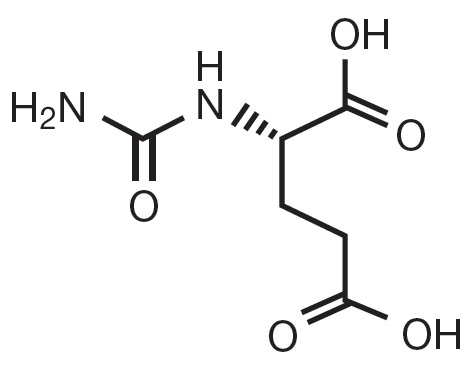
The chemical name of carglumic acid is N-carbamoyl-L-glutamic acid or (2S)-2-(carbamoylamino) pentanedioic acid. The empirical formula is C 6 H 10 N 2 O 5 and the molecular weight is 190.16.
The structural formula is:
The inactive ingredients of Carglumic acid tablets for oral suspension are croscarmellose sodium, microcrystalline cellulose, colloidal silicon dioxide, sodium lauryl sulfate, sodium stearyl fumarate, magnesium stearate, mannitol and povidone.
CLINICAL PHARMACOLOGY
Mechanism of Action
Carglumic acid is a synthetic structural analogue of N-acetylglutamate (NAG) which is produced from glutamate and acetyl-CoA in a reaction catalyzed by N-acetylglutamate synthase (NAGS), a mitochondrial liver enzyme. NAG acts as the essential allosteric activator of carbamoyl phosphate synthetase 1 (CPS 1), a mitochondrial liver enzyme which catalyzes the first reaction of the urea cycle. The urea cycle, whose role is the disposition of ammonia, includes a series of biochemical reactions in the liver resulting in the conversion of ammonia into urea, which is then excreted through the urine. Carglumic acid acts as a CPS1 activator, improves or restores the function of the urea cycle, and facilitates ammonia detoxification and urea production.
Pharmacodynamics
In a retrospective review of the clinical course in 23 patients with NAGS deficiency, carglumic acid reduced plasma ammonia levels within 24 hours when administered with and without concomitant ammonia lowering therapies. No dose-response relationship has been identified.
Cardiac Electrophysiology
The effect of carglumic acid was evaluated in a Phase 1, randomized study in 76 healthy volunteers. The study suggests a lack of clinically relevant QT prolongation effect at the highest therapeutic dose level (250 mg/kg/day).
Pharmacokinetics
The pharmacokinetics of carglumic acid in healthy subjects following an intravenous (IV) infusion over 2 hours at 8 mg/kg or an oral administration at 100 mg/kg are summarized in Table 3.
Table 3 : Mean (SD) Pharmacokinetic Parameter Values of Carglumic Acid in Healthy Subjects
| PK parameter | IV infusion 8mg/kg (N=10) | Oral 100 mg/kg (N=12) |
| C max (ng/mL) | 8613 (558) | 3284 (321) |
| T max (hr) # | 2 (1-2) | 3 (2-4) |
| AUC (ng•hr/mL) | 24501 (1613) | 31426 (2150) |
| T 1/2 (hr) | 31 (3) | 25 (2) |
| CL (L/hr/kg) | 0.34 (0.02) | N/A |
| V d (L/kg) | 15 (1) | N/A |
# Median (range); N/A, not applicable
Absorption
Following an oral administration of Carglumic acid tablets for oral suspension 100 mg/kg in healthy subjects, the absolute bioavailability was approximately 10%.
Distribution
Carglumic acid is not bound to plasma proteins.
Elimination
Carglumic acid is predominantly excreted by the kidneys as unchanged product.
Metabolism
A proportion of carglumic acid may be metabolized by the intestinal bacterial flora.
The likely end product of carglumic acid metabolism is carbon dioxide, eliminated through the lungs.
Excretion
Following an oral administration of radiolabeled Carglumic acid tablets for oral suspension at 100 mg/kg, 9% of the dose is excreted unchanged in the urine and up to 60% of the dose is recovered unchanged in the feces.
Specific Populations
Patients with Renal Impairment
The pharmacokinetics of carglumic acid in subjects with renal impairment were compared with healthy subjects with normal renal function following oral administration of a single dose of carglumic acid tablet for oral suspension 40 mg/kg or 80 mg/kg. The Cmax and AUC0-t of carglumic acid are summarized in Table 4. The geometric mean ratio (90% CI) of Cmax in subjects with mild, moderate, and severe renal impairment relative to those in their matched control subjects with normal renal function were approximately 1.3 (0.95, 1.86), 2.0 (1.62, 2.50), and 4.4 (3.11, 6.28), respectively. The geometric mean ratio (90% CI) of AUC0-t in subjects with mild, moderate, and severe renal impairment relative to those in their matched control subjects with normal renal function were approximately 1.4 (1.09, 1.73), 2.8 (2.27, 3.47), and 6.9 (5.21, 9.24), respectively [see Dosage and Administration (2.4)].
Table 4: Mean (SD) C max and AUC 0- t of Carglumic Acid Following Single Oral Dose Administration of Carglumic acid tablets for oral suspension 80 mg/kg or 40 mg/kg in Subjects with Renal Impairment and Matched Healthy Control Subjects with Normal Renal Function
| PK Parameters | Normal Renal Function 1a : eGFR ≥ 90 mL/min/1.73m 2 (N=8) | Mild Renal Impairment: eGFR 60-89 mL/min/1.73m 2 (N=8) | Moderate Renal Impairment: eGFR 30-59 mL/min/1.73m 2 (N=8) | Normal Renal Function 1b : eGFR ≥ 90 mL/min/1.73m 2 (N=8) | Severe Renal Impairment: eGFR 15-29 mL/min/1.73m 2 (N=8) |
| 80 mg/kg | 40 mg/kg | ||||
| C max (ng/mL) | 2983 (552) | 4310 (1937) | 6129 (1854) | 1890 (901) | 8377 (3815) |
| AUC 0-t (ng•hr/mL) | 28313 (6204) | 39545 (12109) | 79766 (19708) | 20212 (6186) | 143075 (55910) |
Treatment groups 1a and 1b represent two separate matched control groups of healthy subjects with normal renal function.
Drug Interaction Studies
Based on in vitro studies, carglumic acid is not an inducer of CYP1A1/2, CYP2B6, CYP2C, and CYP3A4/5 enzymes, and not an inhibitor of CYP1A2, CYP2A6, CYP2B6, CYP2C8, CYP2C9, CYP2C19, CYP2D6, CYP2E1, and CYP3A4/5 enzymes.
Based on in vitro studies, carglumic acid is a substrate of the human OAT1 transporter. Carglumic acid is not a substrate of MDR1, BCRP, MATE1, MATE2-K, OAT1, OAT3, OATP1B1, OATP1B3, OCT1, and OCT2. Carglumic acid is not an inhibitor of human BSEP, BCRP, MDR1, MATE1, MATE2-K, OAT1, OAT3, OATP1B1, OATP1B3, OCT1, and OCT2 transporters.
NONCLINICAL TOXICOLOGY
Carcinogenesis & Mutagenesis & Impairment Of Fertility
The carcinogenic potential of carglumic acid was assessed in a 2-year carcinogenicity study in rats. Carglumic acid was not tumorigenic at oral doses up to 1000 mg/kg/day (approximately 34 times the maximum reported human maintenance dose [100 mg/kg/day] based on AUC).
Carglumic acid was negative in the Ames test, chromosomal aberration assay in human lymphocytes, and the in vivo micronucleus assay in rats.
There were no effects on fertility or reproductive performance in female rats at oral doses up to 2000 mg/kg/day (approximately 38 times the maximum reported human maintenance dose [100 mg/kg/day] based on AUC). In a separate study, mating and fertility were unaffected in male rats at oral doses up to 1000 mg/kg/day (approximately 34 times the maximum reported human maintenance dose [100 mg/kg/day] based on AUC).
CLINICAL STUDIES
Acute and Chronic Hyperammonemia due to NAGS Deficiency
The efficacy of Carglumic acid tablets for oral suspension in the treatment of acute and chronic hyperammonemia due to NAGS deficiency was evaluated in a retrospective case series of 23 NAGS deficiency patients treated with Carglumic acid tablets for oral suspension over a median duration of 7.9 years (range 0.6 to 20.8 years). For acute treatment, patients received Carglumic acid tablets for oral suspension at 100 mg/kg/day to 250 mg/kg/day orally administered in 2 to 4 divided doses. For maintenance treatment, the dosage was reduced over time based on plasma ammonia level and clinical response.
The baseline characteristics of the patient population are shown in Table 5.
Table 5: Baseline Characteristics of 23 NAGS Deficiency Patients Treated with Carglumic acid tablets for oral suspension
| Patients N=23 | ||
| Sex | Male | 14 (61%) |
| Female | 9 (39%) | |
| Age at initiation of Carglumic acid tablets for oral suspension therapy (years) | Mean (SD) | 2 (4) |
| Min-Max | 0-13 | |
| Age groups at initiation of Carglumic acid tablets for oral suspension therapy | <30 days | 9 (39%) |
| >30 days - 11 months | 9 (39%) | |
| ≥1 - 13 years | 5 (22%) | |
| NAGS gene mutations by DNA testing | Homozygous | 14 (61%) |
| Heterozygous | 4 (17%) | |
| Not available | 5 (22%) | |
| Patients current treatment status | On-going | 18 (78%) |
| Discontinued | 5 (22%) | |
The clinical and biochemical data in the 23-patient case series were retrospectively collected, unblinded, and uncontrolled and preclude formal statistical testing. Short-term efficacy was evaluated using mean and median change in plasma ammonia levels from baseline to days 1 to 3. Persistence of the effect was evaluated using long-term mean and median change in plasma ammonia level. Of the 23 NAGS deficiency patients in the case series, 13 patients had documented plasma ammonia levels prior to Carglumic acid tablets for oral suspension treatment and after long-term treatment with Carglumic acid tablets for oral suspension and were evaluable. Table 5 summarizes the plasma ammonia levels at baseline, days 1 to 3 post- Carglumic acid tablets for oral suspension treatment, and long-term Carglumic acid tablets for oral suspension treatment (mean 8 years) in the 13 evaluable patients.
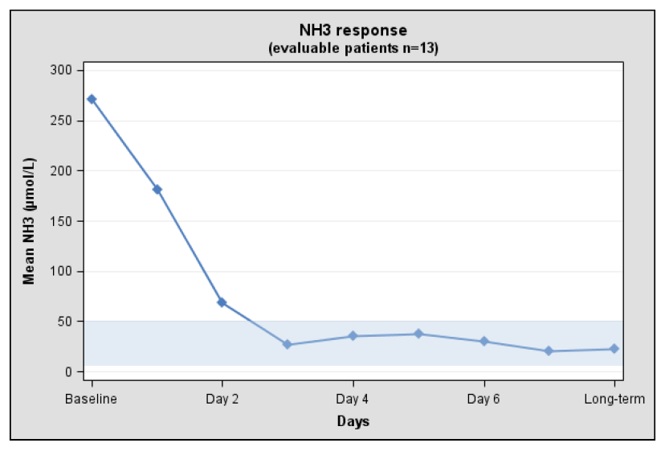
All 13 patients had increased plasma ammonia levels at baseline (mean 271 micromol/L; normal range: 5 to 50 micromol/L). By day 3 and with long-term treatment, normal plasma ammonia levels were attained (Table 6).
Table 6: Plasma Ammonia Levels in NAGS Deficiency Patients at Baseline and After Treatment with Carglumic acid tablets for oral suspension
| Timepoint | Patients (N = 13) | Ammonia level (micromol/L) |
| Baseline (prior to first dose of Carglumic acid tablets for oral suspension) | N | 13 |
| Mean (SD) | 271 (359) | |
| Median | 157 | |
| Range | 72-1428 | |
| Missing Data | 0 | |
| Day 1 | N | 10 |
| Mean (SD) | 181 (358) | |
| Median | 65 | |
| Range | 25-1190 | |
| Missing Data | 3 | |
| Day 2 | N | 8 |
| Mean (SD) | 69 (78) | |
| Median | 44 | |
| Range | 11-255 | |
| Missing Data | 5 | |
| Day 3 | N | 5 |
| Mean (SD) | 27 (11) | |
| Median | 25 | |
| Range | 12-42 | |
| Missing Data | 8 | |
| Long-term treatment (mean duration 8 years; median duration 6 years; range 1-16 years based on last available value while on Carglumic acid tablets for oral suspension treatment) | N | 13 |
| Mean (SD) | 23 (7) | |
| Median | 24 | |
| Range | 9-34 | |
| Missing Data | 0 |
The mean plasma ammonia level at baseline and the decline that is observed after treatment with Carglumic acid tablets for oral suspension in 13 evaluable patients with NAGS deficiency is illustrated in Figure 1.
Figure 1: Mean Plasma Ammonia in 13 Evaluable NAGS Deficiency Patients at Baseline and After Treatment with Carglumic acid tablets for oral suspension
HOW SUPPLIED/STORAGE AND HANDLING
How Supplied
Carglumic Acid Tablet for Oral Suspension is supplied as a white to off-white elongated 200 mg tablet for oral suspension, functionally scored with 3 lines for splitting into 4 equal portions, and coded "120" on one side and ''N" on other side.
Carglumic Acid Tablets for Oral Suspension are supplied in a high density polyethylene bottle with a child resistant cap and desiccant unit. Each bottle contains 60 tablets.
Bottles of 60 tablets: NDC 71863-114-60
Storage
Store at 20° to 25°C (68° to 77°F) [See USP Controlled Room Temperature] in the original unopened bottle.
After first opening of the container:
- Store at room temperature between 20° to 25°C (68° to 77°F). Do not refrigerate.
- Keep the bottle tightly closed between openings in order to protect from moisture.
- Write the date of opening on the bottle.
- Do not use carglumic acid tablets for oral suspension after the expiration date stated on the bottle.
- Discard bottle after 90 days from first opening.
Mechanism of Action
Carglumic acid is a synthetic structural analogue of N-acetylglutamate (NAG) which is produced from glutamate and acetyl-CoA in a reaction catalyzed by N-acetylglutamate synthase (NAGS), a mitochondrial liver enzyme. NAG acts as the essential allosteric activator of carbamoyl phosphate synthetase 1 (CPS 1), a mitochondrial liver enzyme which catalyzes the first reaction of the urea cycle. The urea cycle, whose role is the disposition of ammonia, includes a series of biochemical reactions in the liver resulting in the conversion of ammonia into urea, which is then excreted through the urine. Carglumic acid acts as a CPS1 activator, improves or restores the function of the urea cycle, and facilitates ammonia detoxification and urea production.