Chlorpromazine Hydrochloride - Chlorpromazine Hydrochloride injection prescribing information

WARNING
Increased Mortality in Elderly Patients with Dementia-Related Psychosis Elderly patients with dementia-related psychosis treated with antipsychotic drugs are at an increased risk of death. Analyses of seventeen placebo-controlled trials (modal duration of 10 weeks), largely in patients taking atypical antipsychotic drugs, revealed a risk of death in drug- treated patients of between 1.6 to 1.7 times the risk of death in placebo-treated patients. Over the course of a typical 10-week controlled trial, the rate of death in drug-treated patients was about 4.5%, compared to a rate of about 2.6% in the placebo group. Although the causes of death were varied, most of the deaths appeared to be either cardiovascular (e.g., heart failure, sudden death) or infectious (e.g., pneumonia) in nature. Observational studies suggest that, similar to atypical antipsychotic drugs, treatment with conventional antipsychotic drugs may increase mortality. The extent to which the findings of increased mortality in observational studies may be attributed to the antipsychotic drug as opposed to some characteristic(s) of the patients is not clear. Chlorpromazine hydrochloride injection is not approved for the treatment of patients with dementia-related psychosis ( see WARNINGS ).
INDICATIONS AND USAGE
For the treatment of schizophrenia; to control nausea and vomiting; for relief of restlessness and apprehension before surgery; for acute intermittent porphyria; as an adjunct in the treatment of tetanus; to control the manifestations of the manic type of manic-depressive illness; for relief of intractable hiccups; for the treatment of severe behavioral problems in children (1 to 12 years of age) marked by combativeness and/or explosive hyperexcitable behavior (out of proportion to immediate provocations), and in the short-term treatment of hyperactive children who show excessive motor activity with accompanying conduct disorders consisting of some or all of the following symptoms: impulsivity, difficulty sustaining attention, aggressivity, mood lability, and poor frustration tolerance.
DOSAGE AND ADMINISTRATION
Adults Adjust dosage to individual and the severity of his condition, recognizing that the milligram for milligram potency relationship among all dosage forms has not been precisely established clinically. It is important to increase dosage until symptoms are controlled. Dosage should be increased more gradually in debilitated or emaciated patients. In continued therapy, gradually reduce dosage to the lowest effective maintenance level, after symptoms have been controlled for a reasonable period. Increase parenteral dosage only if hypotension has not occurred. Before using intramuscularly, see Important Notes on Injection . ELDERLY PATIENTS In general, dosages in the lower range are sufficient for most elderly patients. Since they appear to be more susceptible to hypotension and neuromuscular reactions, such patients should be observed closely. Dosage should be tailored to the individual, response carefully monitored, and dosage adjusted accordingly. Dosage should be increased more gradually in elderly patients. PSYCHOTIC DISORDERS Increase dosage gradually until symptoms are controlled. Maximum improvement may not be seen for weeks or even months. Continue optimum dosage for 2 weeks; then gradually reduce dosage to the lowest effective maintenance level. Daily dosage of 200 mg is not unusual. Some patients require higher dosages (e.g., 800 mg daily is not uncommon in discharged mental patients). Hospitalized Patients: Acute Schizophrenic or Manic States Intramuscular: 25 mg (1 mL). If necessary, give additional 25 to 50 mg injection in 1 hour. Increase subsequent intramuscular doses gradually over several days–up to 400 mg q4 to 6h in exceptionally severe cases–until patient is controlled. Usually the patient becomes quiet and cooperative within 24 to 48 hours and oral doses may be substituted. Prompt Control of Severe Symptoms Intramuscular: 25 mg (1 mL). If necessary, repeat in 1 hour. Subsequent doses should be oral, 25 to 50 mg tid. NAUSEA AND VOMITING Intramuscular: 25 mg (1 mL). If no hypotension occurs, give 25 to 50 mg q3 to 4h prn, until vomiting stops. Then switch to oral dosage. During Surgery Intramuscular: 12.5 mg (0.5 mL). Repeat in 1 / 2 hour if necessary and if no hypotension occurs. Intravenous: 2 mg per fractional injection, at 2-minute intervals. Do not exceed 25 mg. Dilute to 1 mg / mL, i.e., 1 mL (25 mg) mixed with 24 mL of saline. PRESURGICAL APPREHENSION Intramuscular : 12.5 to 25 mg (0.5 to 1 mL), 1 to 2 hours before operation. INTRACTABLE HICCUPS If symptoms persist for 2 to 3 days after trial with oral therapy, give 25 to 50 mg (1 to 2 mL) intramuscularly. Should symptoms persist, use slow intravenous infusion with patient flat in bed: 25 to 50 mg (1 to 2 mL) in 500 to 1,000 mL of saline. Follow blood pressure closely. ACUTE INTERMITTENT PORPHYRIA Intramuscular : 25 mg (1 mL) tid or qid until patient can take oral therapy. TETANUS Intramuscular : 25 to 50 mg (1 to 2 mL) given 3 or 4 times daily, usually in conjunction with barbiturates. Total doses and frequency of administration must be determined by the patient’s response, starting with low doses and increasing gradually. Intravenous: 25 to 50 mg (1 to 2 mL). Dilute to at least 1 mg per mL and administer at a rate of 1 mg per minute. Pediatric Patients (6 months to 12 years of age) Chlorpromazine should generally not be used in pediatric patients under 6 months of age except where potentially lifesaving. It should not be used in conditions for which specific pediatric dosages have not been established. SEVERE BEHAVIORAL PROBLEMS Outpatients Select route of administration according to severity of patient’s condition and increase dosage gradually as required. Intramuscular: 1 / 4 mg / lb body weight q6 to 8h, prn. Hospitalized Patients As with outpatients, start with low doses and increase dosage gradually. In severe behavior disorders, higher dosages (50 to 100 mg daily, and in older children, 200 mg daily or more) may be necessary. There is little evidence that behavior improvement in severely disturbed mentally retarded patients is further enhanced by doses beyond 500 mg per day. Maximum Intramuscular Dosage: Patients up to 5 years (or 50 lbs.), not over 40 mg / day; 5 to 12 years (or 50 to 100 lbs.), not over 75 mg / day except in unmanageable cases. NAUSEA AND VOMITING Dosage and frequency of administration should be adjusted according to the severity of the symptoms and response of the patient. The duration of activity following intramuscular administration may last up to 12 hours. Subsequent doses may be given by the same route if necessary. Intramuscular: 1 / 4 mg / lb body weight q6 to 8h, prn. Maximum Intramuscular Dosage: Pediatric patients 6 months to 5 years (or 50 lbs.), not over 40 mg / day; 5 to 12 years (or 50 to 100 lbs.), not over 75 mg / day except in severe cases. During Surgery Intramuscular: 1 / 8 mg / lb body weight. Repeat in 1 / 2 hour if necessary and if no hypotension occurs. Intravenous: 1 mg per fractional injection at 2-minute intervals and not exceeding recommended intramuscular dosage. Always dilute to 1 mg / mL, i.e., 1 mL (25 mg) mixed with 24 mL of saline. PRESURGICAL APPREHENSION 1 / 4 mg / lb body weight Intramuscular 1 to 2 hours before operation. TETANUS Intramuscular or Intravenous: 1 / 4 mg / lb body weight q6 to 8h. When given intravenously, dilute to at least 1 mg / mL and administer at a rate of 1 mg per 2 minutes. In patients up to 50 lbs., do not exceed 40 mg daily; 50 to 100 lbs., do not exceed 75 mg except in severe cases. Important Notes on Injection Inject slowly, deep into upper outer quadrant of buttock. Because of possible hypotensive effects, reserve parenteral administration for bedfast patients or for acute ambulatory cases, and keep patient lying down for at least 1 / 2 hour after injection. If irritation is a problem, dilute injection with saline or 2% procaine; mixing with other agents in the syringe is not recommended. Subcutaneous injection is not advised. AVOID INJECTING UNDILUTED CHLORPROMAZINE HYDROCHLORIDE INJECTION INTO VEIN. INTRAVENOUS ROUTE IS ONLY FOR SEVERE HICCUPS, SURGERY AND TETANUS. Because of the possibility of contact dermatitis, avoid getting solution on hands or clothing. Parenteral drug products should be inspected visually for particulate matter and discoloration prior to administration, whenever solution and container permit.
CONTRAINDICATIONS
Do not use in patients with known hypersensitivity to phenothiazines. Do not use in comatose states or in the presence of large amounts of central nervous system depressants (alcohol, barbiturates, narcotics, etc.).
ADVERSE REACTIONS
Note: Some adverse effects of chlorpromazine may be more likely to occur, or occur with greater intensity, in patients with special medical problems, e.g., patients with mitral insufficiency or pheochromocytoma have experienced severe hypotension following recommended doses. Drowsiness, usually mild to moderate, may occur, particularly during the first or second week, after which it generally disappears. If troublesome, dosage may be lowered. Jaundice Overall incidence has been low, regardless of indication or dosage. Most investigators conclude it is a sensitivity reaction. Most cases occur between the second and fourth weeks of therapy. The clinical picture resembles infectious hepatitis, with laboratory features of obstructive jaundice, rather than those of parenchymal damage. It is usually promptly reversible on withdrawal of the medication; however, chronic jaundice has been reported. There is no conclusive evidence that preexisting liver disease makes patients more susceptible to jaundice. Alcoholics with cirrhosis have been successfully treated with chlorpromazine without complications. Nevertheless, the medication should be used cautiously in patients with liver disease. Patients who have experienced jaundice with a phenothiazine should not, if possible, be reexposed to chlorpromazine or other phenothiazines. If fever with grippe-like symptoms occurs, appropriate liver studies should be conducted. If tests indicate an abnormality, stop treatment. Liver function tests in jaundice induced by the drug may mimic extrahepatic obstruction; withhold exploratory laparotomy until extrahepatic obstruction is confirmed. Hematological Disorders, including agranulocytosis, eosinophilia, leukopenia, hemolytic anemia, aplastic anemia, thrombocytopenic purpura and pancytopenia have been reported. AGRANULOCYTOSIS Warn patients to report the sudden appearance of sore throat or other signs of infection. If white blood cell and differential counts indicate cellular depression, stop treatment and start antibiotic and other suitable therapy. Most cases have occurred between the 4 th and 10 th weeks of therapy; patients should be watched closely during that period. Moderate suppression of white blood cells is not an indication for stopping treatment unless accompanied by the symptoms described above. Cardiovascular HYPOTENSIVE EFFECTS Postural hypotension, simple tachycardia, momentary fainting and dizziness may occur after the first injection; occasionally after subsequent injections; rarely, after the first oral dose. Usually recovery is spontaneous and symptoms disappear within 1 / 2 to 2 hours. Occasionally, these effects may be more severe and prolonged, producing a shock-like condition. To minimize hypotension after injection, keep patient lying down and observe for at least 1 / 2 hour. To control hypotension, place patient in head-low position with legs raised. If a vasoconstrictor is required, norepinephrine and phenylephrine are the most suitable. Other pressor agents, including epinephrine, should not be used as they may cause a paradoxical further lowering of blood pressure. EKG CHANGES Particularly nonspecific, usually reversible Q and T wave distortions–have been observed in some patients receiving phenothiazine tranquilizers, including chlorpromazine. Note: Sudden death, apparently due to cardiac arrest, has been reported. CNS Reactions NEUROMUSCULAR (EXTRAPYRAMIDAL) REACTIONS Neuromuscular reactions include dystonia, motor restlessness, pseudo-parkinsonism and tardive dyskinesia, and appear to be dose-related. They are discussed in the following paragraphs: Dystonia Class effect: Symptoms of dystonia, prolonged abnormal contractions of muscle groups, may occur in susceptible individuals during the first few days of treatment. Dystonic symptoms include: spasm of the neck muscles, sometimes progressing to tightness of the throat, swallowing difficulty, difficulty breathing, and/or protrusion of the tongue. While these symptoms can occur at low doses, they occur more frequently and with greater severity with high potency and at higher doses of first generation antipsychotic drugs. An elevated risk of acute dystonia is observed in males and younger age groups. Motor Restlessness Symptoms may include agitation or jitteriness and sometimes insomnia. These symptoms often disappear spontaneously. At times these symptoms may be similar to the original neurotic or psychotic symptoms. Dosage should not be increased until these side effects have subsided. If these symptoms become too troublesome, they can usually be controlled by a reduction of dosage or change of drug. Treatment with anti-parkinsonian agents, benzodiazepines or propranolol may be helpful. Pseudo-parkinsonism Symptoms may include: mask-like facies, drooling, tremors, pillrolling motion, cogwheel rigidity and shuffling gait. In most cases, these symptoms are readily controlled when an anti-parkinsonism agent is administered concomitantly. Anti-parkinsonism agents should be used only when required. Generally, therapy of a few weeks to 2 or 3 months will suffice. After this time, patients should be evaluated to determine their need for continued treatment. (Note: Levodopa has not been found effective in antipsychotic-induced pseudo-parkinsonism.) Occasionally it is necessary to lower the dosage of chlorpromazine or to discontinue the drug. Tardive Dyskinesia As with all antipsychotic agents, tardive dyskinesia may appear in some patients on long-term therapy or may appear after drug therapy has been discontinued. The syndrome can also develop, although much less frequently, after relatively brief treatment periods at low doses. This syndrome appears in all age groups. Although its prevalence appears to be highest among elderly patients, especially elderly women, it is impossible to rely upon prevalence estimates to predict at the inception of antipsychotic treatment which patients are likely to develop the syndrome. The symptoms are persistent and in some patients appear to be irreversible. The syndrome is characterized by rhythmical involuntary movements of the tongue, face, mouth or jaw (e.g., protrusion of tongue, puffing of cheeks, puckering of mouth, chewing movements). Sometimes these may be accompanied by involuntary movements of extremities. In rare instances, these involuntary movements of the extremities are the only manifestations of tardive dyskinesia. A variant of tardive dyskinesia, tardive dystonia, has also been described. There is no known effective treatment for tardive dyskinesia; anti-parkinsonism agents do not alleviate the symptoms of this syndrome. If clinically feasible, it is suggested that all antipsychotic agents be discontinued if these symptoms appear. Should it be necessary to reinstitute treatment, or increase the dosage of the agent, or switch to a different antipsychotic agent, the syndrome may be masked. It has been reported that fine vermicular movements of the tongue may be an early sign of the syndrome and if the medication is stopped at that time the syndrome may not develop. ADVERSE BEHAVIORAL EFFECTS Psychotic symptoms and catatonic-like states have been reported rarely. OTHER CNS EFFECTS Neuroleptic Malignant Syndrome (NMS) has been reported in association with antipsychotic drugs (see WARNINGS ). Cerebral edema has been reported. Convulsive seizures ( petit mal and grand mal ) have been reported, particularly in patients with EEG abnormalities or history of such disorders. Abnormality of the cerebrospinal fluid proteins has also been reported. Allergic Reactions of a mild urticarial type or photosensitivity are seen. Avoid undue exposure to sun. More severe reactions, including exfoliative dermatitis and toxic epidermal necrolysis (TEN), have been reported occasionally. Contact dermatitis has been reported in nursing personnel; accordingly, the use of rubber gloves when administering chlorpromazine injectable is recommended. In addition, asthma, laryngeal edema, angioneurotic edema and anaphylactoid reactions have been reported. Endocrine Disorders Lactation and moderate breast engorgement may occur in females on large doses. If persistent, lower dosage or withdraw drug. False-positive pregnancy tests have been reported, but are less likely to occur when a serum test is used. Amenorrhea and gynecomastia have also been reported. Hyperglycemia, hypoglycemia and glycosuria have been reported. Autonomic Reactions Occasional dry mouth; nasal congestion; nausea; obstipation; constipation; adynamic ileus; urinary retention; priapism; miosis and mydriasis; atonic colon; ejaculatory disorders / impotence. Special Considerations in Long-Term Therapy Skin pigmentation and ocular changes have occurred in some patients taking substantial doses of chlorpromazine for prolonged periods. SKIN PIGMENTATION Rare instances of skin pigmentation have been observed in hospitalized mental patients, primarily females who have received the drug usually for 3 years or more in dosages ranging from 500 mg to 1,500 mg daily. The pigmentary changes, restricted to exposed areas of the body, range from an almost imperceptible darkening of the skin to a slate gray color, sometimes with a violet hue. Histological examination reveals a pigment, chiefly in the dermis, which is probably a melanin-like complex. The pigmentation may fade following discontinuance of the drug. OCULAR CHANGES Ocular changes have occurred more frequently than skin pigmentation and have been observed both in pigmented and nonpigmented patients receiving chlorpromazine usually for 2 years or more in dosages of 300 mg daily and higher. Eye changes are characterized by deposition of fine particulate matter in the lens and cornea. In more advanced cases, star-shaped opacities have also been observed in the anterior portion of the lens. The nature of the eye deposits has not yet been determined. A small number of patients with more severe ocular changes have had some visual impairment. In addition to these corneal and lenticular changes, epithelial keratopathy and pigmentary retinopathy have been reported. Reports suggest that the eye lesions may regress after withdrawal of the drug. Since the occurrence of eye changes seems to be related to the dosage levels and / or duration of therapy, it is suggested that long-term patients on moderate to high dosage levels have periodic ocular examinations. ETIOLOGY The etiology of both of these reactions is not clear, but exposure to light, along with dosage / duration of therapy, appears to be the most significant factor. If either of these reactions is observed, the physician should weigh the benefits of continued therapy against the possible risks and, on the merits of the individual case, determine whether or not to continue present therapy, lower the dosage, or withdraw the drug. Other Adverse Reactions Mild fever may occur after large intramuscular doses. Hyperpyrexia has been reported. Increases in appetite and weight sometimes occur. Peripheral edema and a systemic lupus erythematosus-like syndrome have been reported. Note: There have been occasional reports of sudden death in patients receiving phenothiazines. In some cases, the cause appeared to be cardiac arrest or asphyxia due to failure of the cough reflex.
DESCRIPTION
Chlorpromazine hydrochloride, USP is white or slightly creamy white, crystalline powder chemically designated as 2-Chloro-10-[3-(dimethylamino)propyl]-phenothiazine monohydrochloride and has the following structural formula: 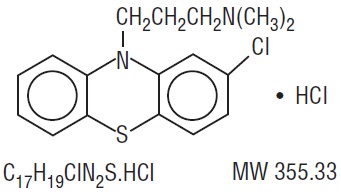 Chlorpromazine hydrochloride injection, USP is a clear, slightly yellow colored solution intended for deep intramuscular use. Each mL contains chlorpromazine hydrochloride USP 25 mg, ascorbic acid 2 mg, sodium metabisulfite 1 mg, sodium sulfite 1 mg and sodium chloride 6 mg in Water for Injection. pH is between 3.4 to 5.4.
CLINICAL PHARMACOLOGY
The precise mechanism whereby the therapeutic effects of chlorpromazine are produced is not known. The principal pharmacological actions are psychotropic. It also exerts sedative and antiemetic activity. Chlorpromazine has actions at all levels of the central nervous system-primarily at subcortical levels-as well as on multiple organ systems. Chlorpromazine has strong antiadrenergic and weaker peripheral anticholinergic activity; ganglionic blocking action is relatively slight. It also possesses slight antihistaminic and antiserotonin activity.
HOW SUPPLIED
Chlorpromazine hydrochloride injection USP, 25 mg / mL is a clear, slightly yellow colored solution essentially free from visible particles and is available in the following packages : 25 mg per mL 1 mL ampule NDC 55150-318-25 packaged in carton of 25 50 mg per 2 mL (25 mg / mL) 2 mL ampule NDC 55150-319-25 packaged in carton of 25 Storage Protect from light, or discoloration may occur. Slight yellowing will not alter potency. Discard if markedly discolored. Store at 20° to 25°C (68° to 77°F) [see USP Controlled Room Temperature]. Protect from freezing. To report SUSPECTED ADVERSE REACTIONS, contact Eugia US LLC at 1-866-850-2876, or the FDA at 1-800-FDA-1088 or www.fda.gov/medwatch. Distributed by: Eugia US LLC 279 Princeton-Hightstown Rd. E. Windsor, NJ 08520 Manufactured by: Eugia Pharma Specialities Limited Hyderabad - 500032 India Revised: June 2023
