Get your patient on Dactinomycin - Dactinomycin injection, Powder, Lyophilized, For Solution (Dactinomycin)
Dactinomycin - Dactinomycin injection, Powder, Lyophilized, For Solution prescribing information

INDICATIONS AND USAGE
Dactinomycin for injection is an actinomycin indicated for the treatment of:
- adult and pediatric patients with Wilms tumor, as part of a multi-phase, combination chemotherapy regimen. (1.1 )
- adult and pediatric patients with rhabdomyosarcoma, as part of a multiphase, combination chemotherapy regimen. (1.2 )
- adult and pediatric patients with Ewing sarcoma, as part of a multi-phase, combination chemotherapy regimen. (1.3 )
- adult and pediatric patients with metastatic, nonseminomatous testicular cancer, as part of a multi-phase, combination chemotherapy regimen. (1.4 )
- post-menarchal patients with gestational trophoblastic neoplasia, as a single agent or as part of a combination chemotherapy regimen. (1.5 )
- adult patients with locally recurrent or locoregional solid malignancies, as a component of palliative or adjunctive regional perfusion. (1.6 )
Wilms Tumor
Dactinomycin for injection is indicated for the treatment of adult and pediatric patients with Wilms tumor, as part of a multi-phase, combination chemotherapy regimen.
Rhabdomyosarcoma
Dactinomycin for injection is indicated for the treatment of adult and pediatric patients with rhabdomyosarcoma, as part of a multi-phase, combination chemotherapy regimen.
Ewing Sarcoma
Dactinomycin for injection is indicated for the treatment of adult and pediatric patients with Ewing sarcoma, as part of a multi-phase, combination chemotherapy regimen.
Metastatic Nonseminomatous Testicular Cancer
Dactinomycin for injection is indicated for the treatment of adult and pediatric patients with metastatic, nonseminomatous testicular cancer, as part of a multi-phase, combination chemotherapy regimen.
Gestational Trophoblastic Neoplasia
Dactinomycin for injection is indicated for the treatment of post-menarchal patients with gestational trophoblastic neoplasia, as a single agent or as part of a combination chemotherapy regimen.
Regional Perfusion in Locally Recurrent and Locoregional Solid Malignancies
Dactinomycin for injection is indicated for the treatment of adult patients with locally recurrent or locoregional solid malignancies, as a component of palliative or adjunctive regional perfusion.
DOSAGE AND ADMINISTRATION
- Wilms Tumor: The recommended dose is 45 mcg/kg intravenously once every 3 to 6 weeks for up to 26 weeks, as part of a multi-agent combination chemotherapy regimen. (2.1 )
- Rhabdomyosarcoma: The recommended dose is 15 mcg/kg intravenously once daily for 5 days every 3 to 9 weeks for up to 112 weeks, as part of a multi-agent combination chemotherapy regimen. (2.2 )
- Ewing Sarcoma: The recommended dose is 1250 mcg/m 2 intravenously once every 3 weeks for 51 weeks, as part of a multi-agent combination chemotherapy regimen. (2.3 )
- Metastatic Nonseminomatous Testicular Cancer: The recommended dose is 1000 mcg/m 2 intravenously every 3 weeks, as part of cisplatin-based, multi-drug chemotherapy regimen. (2.4 )
- Gestational Trophoblastic Neoplasia: o Non-metastatic and Low-risk Metastatic Disease: The recommended dose is 12 mcg/kg intravenously daily for 5 days, as a single agent. (2.5 ) o High-risk Metastatic Disease: The recommended dose is 500 mcg intravenously on Days 1 and 2 every 2 weeks for up to 8 weeks, as part of a multi-agent combination chemotherapy regimen. (2.5 )
- Regional Perfusion in Locally Recurrent and Locoregional Solid Malignancies: o Lower Extremity or Pelvis: The recommend dose is 50 mcg/kg once with melphalan. (2.6 ) o Upper Extremity: The recommended dose is 35 mcg/kg once with melphalan. (2.6 )
Recommended Dosage for Wilms Tumor
The recommended dose of dactinomycin for injection, as part of a multi-agent combination chemotherapy regimen, is 45 mcg/kg intravenously once every 3 to 6 weeks for up to 26 weeks.
Recommended Dosage for Rhabdomyosarcoma
The recommended dose of dactinomycin for injection, as part of a multi-agent combination chemotherapy regimen, is 15 mcg/kg intravenously once daily for 5 days every 3 to 9 weeks for up to 112 weeks.
Recommended Dosage for Ewing Sarcoma
The recommended dose of dactinomycin for injection, as part of a multi-agent combination chemotherapy regimen, is 1,250 mcg/m 2 intravenously once every 3 weeks for 51 weeks.
Recommended Dosage for Metastatic Nonseminomatous Testicular Cancer
The recommended dose of dactinomycin for injection, as part of a cisplatin-based, multi-agent combination chemotherapy regimen, is 1,000 mcg/m 2 intravenously once every 3 weeks for 12 weeks.
Recommended Dosage for Gestational Trophoblastic Neoplasia
The recommended dose of dactinomycin for injection for nonmetastatic and low-risk metastatic disease is 12 mcg/kg intravenously daily for five days as a single agent.
The recommended dose of dactinomycin for injection, as part of a multi-agent combination chemotherapy regimen, for high-risk metastatic disease is 500 mcg intravenously on Days 1 and 2 every 2 weeks for up to 8 weeks.
Recommended Dosage for Regional Perfusion in Locally Recurrent and Locoregional Solid Malignancies
The recommended dose of dactinomycin for injection, in combination with melphalan, is 50 mcg/kg once for lower extremity or pelvis. The recommended dose of dactinomycin for injection, in combination with melphalan, is 35 mcg/kg once for upper extremity. Calculate the dose for obese or edematous patients based on ideal body weight.
Preparation and Administration
o Dactinomycin for injection is a cytotoxic drug. Follow applicable special handling and disposal procedures. 1 o Visually inspect the vials for particulate matter and discoloration, whenever solution and container permit. Preparation • Reconstitute each vial by adding 1.1 mL of Sterile Water for Injection without preservative using aseptic techniques. • The reconstituted product should be a clear, gold-colored solution at a concentration of 500 mcg/mL. • Further dilute the reconstituted product with 5% Dextrose Injection or 0.9% Sodium Chloride Injection to yield concentrations greater than 10 mcg/mL. • Store at room temperature for no more than 4 hours from reconstitution to completion of injection or infusion. Discard after 4 hours. • Dactinomycin for injection does not contain a preservative. Discard any unused portions. Administration • Administer the diluted reconstituted product intravenously over 10 to 15 minutes. • Do not use in-line filters with a cellulose ester membrane. Management of Extravasation • Discontinue dactinomycin for injection for burning or stinging sensation or other evidence indicating perivenous infiltration or extravasation. • Manage confirmed or suspected extravasation as follows: o Terminate the injection or infusion immediately and restart in another vein. o Intermittent application of ice to the site for 15 minutes 4 times daily for 3 days [see Warnings and Precautions (5.3) ].
DOSAGE FORMS AND STRENGTHS
For injection: 500 mcg as a sterile, amorphous yellow to orange, lyophilized powder in a single-dose vial.
USE IN SPECIFIC POPULATIONS
- Lactation: Advise not to breastfeed. (8.2 )
Pregnancy
Risk Summary
Based on findings from animal studies and its mechanism of action dactinomycin can cause fetal harm when administered to a pregnant woman [see Clinical Pharmacology (12.1) ] . In animal reproduction studies, administration of dactinomycin to pregnant animals during the period of organogenesis was teratogenic, resulting in malformations at doses lower than the recommended human dose (see Data) . Advise pregnant women of the potential risk to a fetus [see Use in Special Populations (8.3) ]. In the U.S. general population, the estimated background risk of major birth defects and miscarriage in clinically recognized pregnancies is 2% to 4% and 15% to 20%, respectively. Data Animal Data Dactinomycin was teratogenic in animals. Administration of dactinomycin to pregnant rats, rabbits, and hamsters during the period of organogenesis, increased the incidence of fetal malformations and caused embryotoxicity at doses (based on body surface area) as low as 0.2 times the clinical dose of 1,250 mcg/m 2 .
Lactation
Risk Summary There are no data on the presence of dactinomycin or its metabolites in human milk or their effects on the breastfed infant or on milk production. Because of the potential for serious adverse reactions in breastfed infants from dactinomycin, advise women not to breastfeed during treatment with dactinomycin for injection and, based on limited published data regarding the dactinomycin half-life, for 14 days after the final dose.
Females and Males of Reproductive Potential
Pregnancy Testing Verify the pregnancy status of females of reproductive potential prior to initiating dactinomycin [see Use in Specific Population (8.1) ]. Contraception Dactinomycin can cause fetal harm when administered to a pregnant woman [see Use in Specific Populations (8.1) ]. Females Advise females of reproductive potential to use effective contraception during treatment with dactinomycin and for at least 6 months after the final dose. Males Because of the potential for genotoxicity, advise males with female partners of reproductive potential to use effective contraception during treatment with dactinomycin and for 3 months after the final dose [see
Pediatric Use
The safety and effectiveness of dactinomycin have been established in pediatric patients with Wilms tumor, rhabdomyosarcoma, Ewing sarcoma, and metastatic nonseminomatous testicular cancer. The safety and effectiveness of dactinomycin have been established in post-menarchal pediatric patients with gestational trophoblastic neoplasia. The safety and effectiveness of dactinomycin have not been established in pediatric patients undergoing regional perfusion for locally recurrent or locoregional solid malignancies.
Geriatric Use
Clinical studies of dactinomycin did not include sufficient numbers of subjects aged 65 and over to determine whether they respond differently from younger subjects.
CONTRAINDICATIONS
None.
WARNINGS AND PRECAUTIONS
- Secondary Malignancy or Leukemia: Increased risk of secondary malignancies following treatment. (5.1 )
- Veno-occlusive Disease: Can cause severe or fatal VOD. Monitor for elevations in AST, ALT, total bilirubin, hepatomegaly, weight gain, or ascites. Consider delaying next dose. (5.2 )
- Extravasation: Immediately interrupt the injection or infusion and apply ice. (2.7 , 5.3 )
- Myelosuppression: Monitor blood cell counts before each cycle. Delay next dose if severe myelosuppression has not improved. (5.4 )
- Immunizations: Vaccination with live viral vaccines is not recommended before or during treatment. (5.5 )
- Severe Mucocutaneous Reactions: Discontinue treatment (5.6 )
- Renal Toxicity: Monitor creatinine and electrolytes frequently. (5.7 )
- Hepatotoxicity: Monitor transaminases, alkaline phosphatase and bilirubin prior to and during treatment. (5.8 )
- Potentiation of Radiation Toxicity and Radiation Recall: Reduce dose by 50% during concomitant radiation. Use caution when administering within two months of radiation. (5.9 )
- Embryo-fetal Toxicity: Can cause fetal harm. Advise patients of the potential risk to a fetus and to use effective contraception. (5.10 , 8.1 , 8.3 )
Secondary Malignancy or Leukemia
The risk of developing secondary malignancies, including leukemia, is increased following treatment with dactinomycin.
Veno-occlusive Disease
Severe and fatal hepatic veno-occlusive disease (VOD) can occur with dactinomycin. Risk factors for the development of VOD include age younger than 4 years or concomitant radiotherapy. After treatment with dactinomycin for injection, monitor frequently for signs and symptoms of VOD; these include elevations in AST, ALT, total bilirubin, hepatomegaly, weight gain, or ascites. If patients develop VOD, considering delaying next dose of dactinomycin. Resume, reduce dose or permanently discontinue based on severity of reaction and disease being treated.
Extravasation
Extravasation of dactinomycin for injection can result in severe local tissue injury manifesting as blistering, ulcerations and persistent pain requiring wide excision surgery followed by split-thickness skin grafting. If any signs or symptoms of extravasation occur, immediately interrupt the injection or infusion. Apply ice to the site intermittently for 15 minutes, 4 times a day for 3 days [see Dosage and Administration (2.7) ] . Observe closely and consult plastic surgery if necessary based on severity of reaction.
Myelosuppression
Severe and fatal myelosuppression, which may include neutropenia, thrombocytopenia and anemia, can occur with dactinomycin for injection. The nadir in neutrophil counts generally occurs 14 to 21 days after administration. Obtain complete blood counts prior to each treatment cycle. Delay next dose of dactinomycin for injection if severe myelosuppression has not improved. Consider dose reduction for patients with prolonged myelosuppression based on severity of reaction and disease being treated.
Immunizations
The safety with live viral vaccines following dactinomycin for injection has not been studied and vaccination with live virus vaccines is not recommended before or during treatment.
Severe Mucocutaneous Reactions
Severe mucocutaneous reactions, such as Steven-Johnson syndrome and Toxic Epidermal Necrolysis (TEN), can occur with dactinomycin for injection. Permanently discontinue dactinomycin for injection in patients who experience a severe mucocutaneous reaction.
Renal Toxicity
Abnormalities of renal function can occur with dactinomycin for injection. Monitor creatinine and electrolytes frequently during dactinomycin for injection therapy.
Hepatotoxicity
Hepatotoxicity can occur with dactinomycin for injection. Monitor AST, ALT, alkaline phosphatase, and bilirubin prior to and during dactinomycin for injection therapy.
Potentiation of Radiation Toxicity and Radiation Recall
Dactinomycin for injection can increase radiation-induced gastrointestinal toxicity, myelosuppression, or erythema and vesiculation of the skin or buccal and pharyngeal mucosa. Reduce the dose of dactinomycin for injection by 50% during concomitant radiation.
Radiation recall, affecting previously treated radiation fields, can occur in patients who receive dactinomycin for injection after prior radiation therapy. Although the risk can occur with distant radiation exposure, the risk appears highest when dactinomycin for injection is administered within two months of prior radiation.
Embryo-Fetal Toxicity
Based on findings from animal studies and its mechanism of action, dactinomycin for injection can cause fetal harm when administered to a pregnant woman. In animal reproduction studies, administration of dactinomycin to pregnant animals during the period of organogenesis was teratogenic, resulting in malformations at doses lower than the recommended human dose.
Advise pregnant women of the potential risk to the fetus. Advise females of reproductive potential to use effective contraception during treatment with dactinomycin for injection and for at least 6 months after the final dose. Advise males with female partners of reproductive potential to use effective contraception during treatment with dactinomycin for injection and for 3 months after the final dose [see Use in Specific Populations (8.1 , 8.3) ] .
ADVERSE REACTIONS
The following serious adverse reactions are described elsewhere in the labeling: • Secondary Malignancy and Leukemia [see Warnings and Precautions (5.1) ] • Veno-occlusive Disease [see Warnings and Precautions (5.2) ] • Extravasation [see Warnings and Precautions (5.3) ] • Myelosuppression [see Warnings and Precautions (5.4) ] • Immunizations [see Warning and Precautions (5.5) ] • Severe Mucocutaneous Reactions [see Warnings and Precautions (5.6) ] • Renal Toxicity [see Warnings and Precautions (5.7) ] • Hepatotoxicity [see Warnings and Precautions (5.8) ] • Potentiation of Radiation Toxicity and Radiation Recall [see Warnings and Precautions (5.9) ] Common adverse reactions are: infection, alopecia, rash, dysphagia, fatigue, fever, nausea, vomiting, anemia, neutropenia, thrombocytopenia, mucositis, and hepatotoxicity. The following adverse reactions have been identified in clinical studies or postmarketing reports. Because some of these reactions were reported voluntarily from a population of uncertain size, it is not always possible to reliably estimate their frequency or establish a causal relationship to drug exposure. Infections : infections including sepsis with fatal outcome Hematologic : anemia, leukopenia, thrombocytopenia, pancytopenia, reticulocytopenia, neutropenia, febrile neutropenia, disseminated intravascular coagulation Immune system : hypersensitivity Metabolism and nutrition : anorexia, hypocalcemia, tumor lysis syndrome Nervous system : peripheral neuropathy Ocular: optic neuropathy Vascular: thrombophlebitis, hemorrhage Respiratory, thoracic and mediastinal : pneumonitis, pneumothorax Gastrointestinal: nausea, vomiting, abdominal pain, diarrhea, constipation, gastrointestinal ulceration, cheilitis, dysphagia, esophagitis, ulcerative stomatitis, ascites, proctitis, mucositis Hepatobiliary : liver function test abnormalities, hepatomegaly, hepatitis, hepatic failure with reports of death, hepatic veno-occlusive disease Dermatologic: alopecia, rash, dermatitis, acne, erythema multiforme, Stevens Johnson Syndrome, radiation recall, toxic epidermal necrolysis Musculoskeletal and connective tissue: myalgia, growth retardation Renal and urinary: renal impairment, renal failure General: fatigue, fever, malaise
DESCRIPTION
Dactinomycin USP is one of the actinomycins, a group of antibiotics produced by various species of Streptomyces . Dactinomycin USP is the principal component of the mixture of actinomycins produced by Streptomyces parvullus . Unlike other species of Streptomyces , this organism yields an essentially pure substance that contains only traces of similar compounds differing in amino acid content of the peptide side chains. The empirical formula is C 62 H 86 N 12 O 16 and the structural formula is:
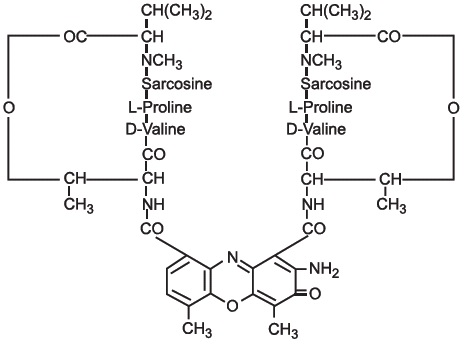
Dactinomycin for Injection, USP is a sterile, yellow to orange, lyophilized powder for injection by intravenous route or by regional perfusion after reconstitution. Each vial contains 0.5 mg (500 mcg) of dactinomycin USP and 20 mg of mannitol.
CLINICAL PHARMACOLOGY
Mechanism of Action
Dactinomycin is a cytotoxic actinomycin that binds DNA and inhibits RNA synthesis. The cytotoxic activity of dactinomycin has been demonstrated in animal models of different human cancers.
Pharmacodynamics
Dactinomycin exposure-response relationships and the time course of pharmacodynamics response are unknown.
Pharmacokinetics
The distribution and excretion of radiolabeled dactinomycin ( 3 H actinomycin D) were assessed in three adult patients with malignant melanoma. Distribution 3 H actinomycin D is concentrated in nucleated cells and does not penetrate the blood-brain barrier. Elimination Excretion Following administration of radiolabeled dactinomycin, approximately 30% was recovered in urine and feces in one week. Specific Populations Pediatric Patients Published studies and population analyses in patients ≤ 21 years of age with cancer report a trend of increasing systemic dactinomycin clearance with increasing body weight. Drug Interaction Studies Published in vitro studies report that dactinomycin may be a substrate of the P-glycoprotein and OATP1B3 transporter systems.
NONCLINICAL TOXICOLOGY
Carcinogenesis, Mutagenesis, Impairment of Fertility
Dactinomycin is a carcinogen in animals. Local sarcomas were produced in mice and rats after repeated subcutaneous or intraperitoneal injections. Mesenchymal tumors occurred in male rats given intraperitoneal injections of 50 mcg/kg, 2 to 5 times per week, for 18 weeks, at doses(based on body surface area) 0.5 times the clinical dose of 1,250 mcg/m 2 . Dactinomycin was mutagenic in several in vitro and in vivo test systems including human fibroblasts and leukocytes, and HeLa cells. DNA damage and cytogenetic effects have been demonstrated in the mouse and the rat.
HOW SUPPLIED/STORAGE AND HANDLING
Dactinomycin for injection, USP is a lyophilized powder. In the dry form the compound is an amorphous yellow to orange powder. The solution is clear, gold or yellow to orange colored and essentially free from visible particles. Dactinomycin for injection, USP is supplied in vials containing 0.5 mg (500 micrograms) of dactinomycin USP and 20.0 mg of mannitol. NDC 55150-431-01: 0.5 mg/vial in 2 mL single-dose vial; individually boxed Storage: Store at 20º to 25ºC (68º to 77ºF); [see USP Controlled Room Temperature]. Protect from light and humidity. Special Handling: Animal studies have shown dactinomycin to be corrosive to skin, irritating to the eyes and mucous membranes of the respiratory tract and highly toxic by the oral route. It has also been shown to be carcinogenic, mutagenic, embryotoxic and teratogenic. Due to the drug’s toxic properties, appropriate precautions including the use of appropriate safety equipment are recommended for the preparation of dactinomycin for injection for parenteral administration. Inhalation of dust or vapors and contact with skin or mucous membranes, especially those of the eyes, must be avoided. Avoid exposure during pregnancy. The National Institutes of Health presently recommends that the preparation of injectable antineoplastic drugs should be performed in a Class II laminar flow biological safety cabinet. Personnel preparing drugs of this class should wear chemical resistant, impervious gloves, safety goggles, outer garments and shoe covers. Additional body garments should be used based upon the task being performed (e.g., sleevelets, apron, gauntlets, disposable suits) to avoid exposed skin surfaces and inhalation of vapors and dust. Appropriate techniques should be used to remove potentially contaminated clothing. Several other guidelines for proper handling and disposal of antineoplastic drugs have been published and should be considered. 1 Accidental Contact Measures: Should accidental eye contact occur, copious irrigation for at least 15 minutes with water, normal saline or a balanced salt ophthalmic irrigating solution should be instituted immediately, followed by prompt ophthalmologic consultation. Should accidental skin contact occur, the affected part must be irrigated immediately with copious amounts of water for at least 15 minutes while removing contaminated clothing and shoes. Medical attention should be sought immediately. Contaminated clothing should be destroyed and shoes cleaned thoroughly before reuse (see PRECAUTIONS, General and DOSAGE AND ADMINISTRATION, Preparation of Solution for Intravenous Administration). The vial stopper is not made with natural rubber latex.
Mechanism of Action
Dactinomycin is a cytotoxic actinomycin that binds DNA and inhibits RNA synthesis. The cytotoxic activity of dactinomycin has been demonstrated in animal models of different human cancers.
