Get your patient on Desmopressin Acetate - Desmopressin Acetate solution (Desmopressin Acetate)
Desmopressin Acetate - Desmopressin Acetate solution prescribing information

INDICATIONS AND USAGE
Desmopressin nasal spray solution is indicated as antidiuretic replacement therapy in the management of central diabetes insipidus in adults and pediatric patients 4 years of age and older.
Limitations of Use: Desmopressin nasal spray solution is not indicated for:
- • Treatment of nephrogenic diabetes insipidus, • Treatment of primary nocturnal enuresis [ see Warnings and Precautions (5.1) ], • Use in patients with conditions that compromise the intranasal route of administration (e.g., severe nasal congestion and blockage, nasal mucosa atrophy, severe atrophic rhinitis, recent nasal surgery such as transsphenoidal hypophysectomy) [see Warnings and Precautions (5.2) ], • Use in patients with an impaired level of consciousness, • Use in patients requiring doses less than 10 mcg or doses that are not multiples of 10 mcg [see Dosage Forms and Strengths (3)].
DOSAGE AND ADMINISTRATION
- For intranasal use only (2.1 )
- Instruct patients to prime pump prior to use (2.1 )
- Adults: 10 mcg to 40 mcg daily (either as a single dose or divided into two or three daily doses) (2.2 )
- Pediatrics: 10 mcg once daily into one nostril up to 30 mcg once daily (or 30 mcg divided as 20 mcg during the morning and 10 mcg at night) (2.2 )
- See the Full Prescribing Information for recommendations for switching between desmopressin acetate formulations (2.3 )
Important Administration Instructions
Administer desmopressin nasal spray solution by intranasal use only. Instruct patients about appropriate fluid restriction during desmopressin nasal spray solution treatment [see Warnings and Precautions (5.1) ].
Must prime the spray pump prior to the first use. Instruct patients to:
- Prime pump by pressing down on pump five times (if the spray pump is not used for one week, re-prime the pump by pressing down on the pump once).
- Discard desmopressin nasal spray solution after 50 sprays since the amount delivered thereafter may be substantially less than the recommended dosage.
Recommended Dosage
The use of desmopressin nasal spray solution is not indicated for patients who require less than 10 mcg doses or doses that are not multiples of 10 mcg because the spray pump can only deliver doses of 10 mcg [see Indications and Usage (1) ] . If other doses are required, use another desmopressin acetate product.
Individualize the dosage of desmopressin nasal spray solution for each patient with particular attention in pediatric and elderly patients and adjust according to the diurnal pattern of response to limit nocturia and to ensure fluid intake with respect to urine output is not excessive [see Warnings and Precautions (5.1) ]. Monitor continued response to desmopressin nasal spray solution by urine volume and osmolality to ensure adequate diuresis to limit the risk of hyponatremia, and include measurements of serum sodium and plasma osmolality as needed.
Adults
The recommended dosage in adults is 10 mcg once daily into one nostril up to 40 mcg once daily (or 40 mcg divided into two or three daily doses). If administered more than once a day, adjust for an adequate diurnal rhythm of urine output.
Pediatric Patients
- • For pediatric patients requiring doses less than 10 mcg, desmopressin nasal spray solution is not indicated.
- • For pediatric patients 4 years of age and older, the recommended starting dosage of desmopressin nasal spray solution is 10 mcg once daily into one nostril. The dose can be titrated up to 30 mcg once daily (or 30 mcg divided into two daily doses, typically with 20 mcg given in the morning and 10 mcg given at nighttime). If administered more than once a day, adjust for an adequate diurnal rhythm of urine output.
Because administration of desmopressin acetate can be associated with decreased responsiveness with prolonged use, consider increasing the dosage of desmopressin nasal spray solution if patients demonstrate decreased response over a long period of time.
Switching Between Desmopressin Acetate Formulations
When switching from the desmopressin acetate injection to desmopressin nasal spray solution, administer 10 times the amount of desmopressin acetate, rounding down to the nearest 10 mcg.
When switching from the desmopressin acetate tablets to desmopressin nasal spray solution, individual dose titration is required because intranasal desmopressin is approximately 10 to 40 fold more potent than oral (tablet) desmopressin.
DOSAGE FORMS AND STRENGTHS
Desmopressin Nasal Spray Solution, USP pump delivers 10 mcg (0.1 mL) of desmopressin acetate per spray.
Desmopressin Nasal Spray Solution, USP is available as a 5 mL bottle with spray pump delivering 50 sprays.
USE IN SPECIFIC POPULATIONS
Pregnancy
Risk Summary
Prolonged experience with desmopressin in pregnant women over several decades, based on the available published data and case reports, did not identify a drug associated risk of major birth defects, miscarriage or adverse maternal or fetal outcomes. In addition, in vitro studies with human placenta demonstrate poor placental transfer of desmopressin. No adverse developmental outcomes were observed in animal reproduction studies with administration of desmopressin during organogenesis to pregnant rats and rabbits at doses approximately <1 and 38 times, respectively, the maximum recommended human dose based on body surface area (mg/m 2 ) (see Data).
The estimated background risk of major birth defects and miscarriage for the indicated population are unknown. In the US general population, the estimated background risk of major birth defects and miscarriage in clinically recognized pregnancies is 2-4% and 15-20%, respectively.
Data
Animal Data
Desmopressin acetate at up to 50 ng/kg/day was given by subcutaneous injection to pregnant rats, from gestation day 1 to 20 during the period of early embryonic development and organogenesis without teratogenic effects. Desmopressin acetate at up to 10 mcg/kg/day was given to pregnant rabbits by subcutaneous injection from gestation day 6 to 18 during fetal organogenesis without teratogenic effects. These doses of desmopressin acetate represent approximately <1 times (rat) and 38 times (rabbit) the maximum recommended human dose based on body surface area (mg/m 2 ).
Lactation
Risk Summary
Breastfeeding is not expected to result in clinically relevant exposure of the infant to desmopressin following maternal intranasal administration. Desmopressin is poorly transferred into human breastmilk at negligible amounts (see Data). There is no information on the effects of desmopressin on the breastfed infant or on milk production. The developmental and health benefits of breastfeeding should be considered along with the mother’s clinical need for desmopressin nasal spray solution and any potential adverse effects on the breastfed infant from desmopressin nasal spray solution or from the underlying maternal condition.
Data
A trial was conducted in six healthy lactating women, at greater than 4 months postpartum, to evaluate intranasal administration of 300 mcg single dose of another desmopressin product (7.5 times the recommended adult dose of desmopressin nasal spray solution). Samples of maternal plasma and breastmilk were obtained at 0, 30, 60, 120, 240, 360 and 480 min after the drug administration. At 8 hours after dose intake, the levels in the milk ranged between 4.16 and 101 pg/ml, and the plasma levels ranged between 40 and 242 pg/ml. The total amount of desmopressin present in the milk over the 8 hours ranged between 491 pg and 16 ng, which corresponds to 0.0001 - 0.005% of the administered dose to the breastfeeding mother.
Pediatric Use
Desmopressin nasal spray solution is indicated as antidiuretic replacement therapy in the management of central diabetes insipidus in pediatric patients 4 years of age and older. Desmopressin nasal spray solution is not indicated in pediatric patients less than 4 years of age.
Use of desmopressin nasal spray solution in pediatric patients 4 years of age and older is supported by evidence from adults and pediatric patients with central diabetes insipidus. Use in pediatric patients requires careful fluid intake restriction to prevent possible water intoxication with hyponatremia [see Warnings and Precautions (5.1 )].
Geriatric Use
Clinical studies of desmopressin nasal spray solution did not include sufficient numbers of subjects aged 65 and over to determine whether they respond differently from younger subjects. In general, dose selection for an elderly patient should be cautious, usually starting at a low end of the dosing range, reflecting the greater frequency of decreased hepatic, renal, or cardiac function, and of concomitant disease or drug therapy.
Because elderly patients are more likely to have renal impairment, care should be taken in dose selection, and monitoring renal function is recommended [see Contraindications (4) , Use in Specific Populations (8.6) ].
Use of desmopressin nasal spray solution in geriatric patients requires careful fluid intake restriction to prevent possible water intoxication with hyponatremia [see Warnings and Precautions (5.1) ].
Renal Impairment
Desmopressin acetate is substantially excreted by the kidney, and the risk of adverse reactions may be greater in patients with renal impairment than patients with normal renal function. Desmopressin nasal spray solution is contraindicated in patients with estimated CLcr by Cockcroft-Gault equation less than 50 mL/min [see Clinical Pharmacology (12.1 , 12.3 ), Contraindications (4) ].
CONTRAINDICATIONS
Desmopressin nasal spray solution is contraindicated in patients with:
- Known hypersensitivity to desmopressin acetate or to any of the components of desmopressin nasal spray solution. Severe allergic reactions and anaphylaxis have been reported [see Adverse Reactions (6) ].
- Renal impairment defined as estimated creatinine clearance (CLcr) by Cockcroft-Gault equation less than 50 mL/min [see Use in Specific Populations (8.6) and Clinical Pharmacology (12.3) ] .
- Hyponatremia or a history of hyponatremia [see Warnings and Precautions (5.1) ] .
WARNINGS AND PRECAUTIONS
Hyponatremia
Excessive fluid intake when urine output is limited by the antidiuretic effect of desmopressin may lead to water intoxication with hyponatremia. Cases of hyponatremia have been reported from postmarketing experience in patients treated with desmopressin acetate. Unless properly diagnosed and treated, hyponatremia can be fatal.
All patients receiving desmopressin nasal spray solution should be observed for the following signs or symptoms associated with hyponatremia: headache, nausea/vomiting, decreased serum sodium, weight gain, restlessness, fatigue, lethargy, disorientation, depressed reflexes, loss appetite, irritability, muscle weakness, muscle spasms or cramps and abnormal mental status such as hallucinations, decreased consciousness, and confusion. Severe symptoms due to an extreme decrease in serum sodium and plasma osmolality may include one or a combination of the following: seizure, coma, and/or respiratory arrest.
In order to decrease the risk of water intoxication with hyponatremia, fluid restriction is recommended. Careful fluid intake restriction is particularly important in pediatric and geriatric patients because these patients are at greater risk of developing hyponatremia [see Use in Specific Populations (8.4 , 8.5) ]. More frequent monitoring of serum sodium levels is recommended in the following patients: those with conditions associated with fluid and electrolyte imbalance, such as cystic fibrosis, heart failure, renal disorders, habitual or psychogenic polydipsia or those taking concomitant drugs that may cause hyponatremia [see Drug Interactions (7.1) ].
Desmopressin nasal spray solution is not an indicated formulation for the treatment of primary nocturnal enuresis due to a higher risk of hyponatremia and hyponatremic convulsions with the use of the nasal spray formulation compared to desmopressin tablets seen in postmarketing reports [see Indications and Usage (1) ].
Altered Absorption in Patients with Nasal Mucosa Abnormalities
Chronic administration of desmopressin nasal spray solution may result in changes to nasal mucosa. Nasal mucosa abnormalities (such as scarring and edema) due to chronic administration, or due to other causes (nasal blockage, nasal mucosal atrophy, severe atrophic rhinitis, recent nasal surgery such as transsphenoidal hypophysectomy) may cause erratic, unreliable absorption. Avoid use of desmopressin nasal spray solution in such patients [see Indications and Usage (1) ] and consider use of other formulations of desmopressin acetate given by other routes of administration.
ADVERSE REACTIONS
The following serious reactions are described below and elsewhere in the labeling:
- Hyponatremia [see Warnings and Precautions (5.1) ].
- Altered Absorption in Patients with Changes in Nasal Mucosa [see Warnings and Precautions (5.2) ] .
The following adverse reactions have been identified during post-approval use of desmopressin acetate. Because these reactions are reported voluntarily from a population of uncertain size, it is not always possible to reliably estimate their frequency or establish a causal relationship to drug exposure:
Increase in blood pressure, headache, nasal congestion, rhinitis, nosebleed, sore throat, cough, upper respiratory infections, nausea, flushing, and abdominal cramps.
Water intoxication with hyponatremia.
Hyponatremic convulsions associated with concomitant use of the following medications: oxybutynin and imipramine [see Drug Interactions (7.1) ] .
Severe allergic reactions and anaphylaxis [see Contraindications (4) ].
DRUG INTERACTIONS
Other Drugs that may Increase Risk of Hyponatremia
The concomitant administration of desmopressin nasal spray solution with other drugs that may increase the risk of water intoxication with hyponatremia, (e.g., tricyclic antidepressants, selective serotonin re-uptake inhibitors, chlorpromazine, opiate analgesics, NSAIDs, lamotrigine, oxybutynin and carbamazepine) requires more frequent serum sodium monitoring [see Warnings and Precautions (5.1) and Adverse Reactions (6) ] .
Other Vasoconstrictors
Desmopressin acetate can elevate blood pressure. Use of large doses of desmopressin nasal spray solution with other vasoconstrictors may require a reduction of the desmopressin nasal spray solution dosage [see Adverse Reactions (6) ].
DESCRIPTION
Desmopressin Nasal Spray Solution, USP is a vasopressin analogue of the natural pituitary hormone 8-arginine vasopressin (ADH), an antidiuretic hormone affecting renal water conservation. It is chemically defined as follows:
Molecular weight: 1183.34
Empirical formula: C 46 H 64 N 14 O 12 S 2 •C 2 H 4 O 2 •3H 2 O

1-(3-mercaptopropionic acid)-8-D-arginine vasopressin monoacetate (salt) trihydrate.
Desmopressin Nasal Spray Solution, USP is an aqueous solution for intranasal use. Each mL contains: ACTIVE: Desmopressin Acetate 0.1 mg (0.01%); INACTIVES: Purified Water and Sodium Chloride. Hydrochloric Acid may be added to adjust pH (3.5 - 6.0). PRESERVATIVE ADDED: Chlorobutanol 0.5%.
CLINICAL PHARMACOLOGY
Mechanism of Action
The antidiuretic effects of desmopressin are mediated by stimulation of vasopressin 2 (V2) receptors, thereby increasing water re-absorption in the kidney, and hence reducing urine production. Desmopressin is a replacement hormone for antidiuretic hormone in the treatment of central diabetes insipidus. The change in structure of arginine vasopressin to desmopressin acetate resulted in a decreased vasopressor action and decreased actions on visceral smooth muscle relative to the enhanced antidiuretic activity, so that clinically effective antidiuretic doses were usually below threshold levels for effects on vascular or visceral smooth muscle.
Pharmacodynamics
The use of desmopressin nasal spray solution in patients with central diabetes insipidus reduces urinary output, increases urine osmolality, and decreases plasma osmolality.
Pharmacokinetics
Absorption: Desmopressin acetate is absorbed through the nasal mucosa.
Elimination: Desmopressin acetate exhibits a biphasic elimination profile, with half-lives of 7.8 and 75.5 minutes for the initial and terminal phases, respectively.
Specific Populations
Renal Impairment : Desmopressin acetate is mainly excreted in the urine. A pharmacokinetic study was conducted in subjects with normal renal function and patients with mild, moderate, and severe renal impairment (n=24, 6 subjects each group) with a single 2 mcg dose of desmopressin acetate injection (this results in approximately 20 times the exposure of 10 mcg of desmopressin nasal spray solution). The terminal half-life was 2.8 hours in subjects with normal renal function, 4.0 hours in mild renal impairment, 6.6 hours in moderate renal impairment and 8.7 hours in severe renal impairment. In patients with mild, moderate and severe renal impairment, mean desmopressin exposure was 1.5 fold, 2.4 fold and 3.6 fold higher, respectively compared to that of subjects with normal renal function [see Contraindications (4) , Use in Specific Populations (8.6) ].
NONCLINICAL TOXICOLOGY
Carcinogenesis, Mutagenesis, Impairment of Fertility
Studies with desmopressin acetate have not been performed to evaluate carcinogenic potential, mutagenic potential, or effects on fertility.
HOW SUPPLIED/STORAGE AND HANDLING
How Supplied
Desmopressin Nasal Spray Solution, USP is available as a 5 mL bottle containing an aqueous solution with the spray pump delivering 50 sprays of 10 mcg (0.1 mL) (NDC 24208-342-05).
Storage and Handling
Store in refrigerator at 2° to 8°C (36° to 46°F).
When traveling, product will maintain stability for up to 3 weeks when stored at room temperature, 22°C (72°F).
STORE BOTTLE IN UPRIGHT POSITION.
Instructions for Use
Desmopressin Nasal Spray Solution, 10 mcg per 0.1 mL
For Intranasal Use Only
Read these instructions before using desmopressin nasal spray solution, and each time you get a refill. There may be new information. This information does not take the place of talking to your healthcare provider about your medical condition or treatment.
Children should be helped by an adult when using desmopressin nasal spray solution, to make sure the right amount of medicine is used.
The parts of your desmopressin nasal spray solution pump (see Figure A):
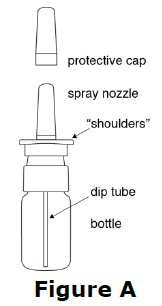
Priming your desmopressin nasal spray solution:
Your desmopressin nasal spray pump must be primed before you use it for the first time.
- Remove the protective cap (see Figure B).
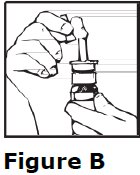
- Press down on the shoulders at the top of your desmopressin nasal spray solution pump 5 times. Hold the spray nozzle tip away from your face and eyes (see Figure C).
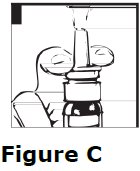
- After your desmopressin nasal spray pump is primed, it will spray 10 micrograms (1 dose) of medicine each time it is pressed.
Using your desmopressin nasal spray:
- Step 1. Remove the protective cap.
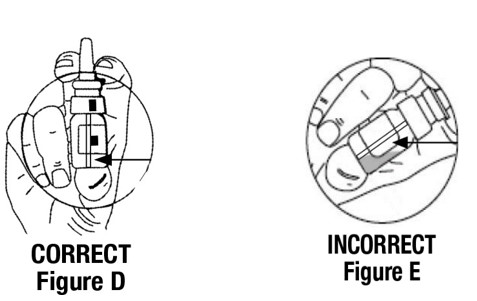
- Step 2. To make sure you get the right dose of medicine, hold bottle upright as shown in Figure D and place the spray nozzle tip of your desmopressin nasal spray solution into your nostril. Press the spray pump 1 time for 1 dose. If 2 doses are prescribed, spray each nostril 1 time. It is very important that you hold the bottle upright while giving the medicine. You may need to lean your head slightly forward to prevent tilting the bottle. Tilting the bottle, especially when less than half of the solution is left in the bottle, may cause the pump to not work the right way (see Figure E).
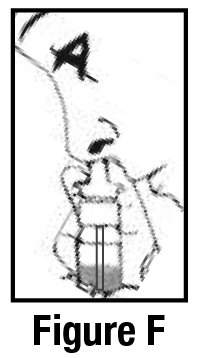
- Step 3. Put the spray nozzle tip of your desmopressin nasal spray solution into your nostril and press the spray pump 1 time for 1 dose (see Figure F). If 2 doses are prescribed, spray each nostril 1 time.
- Step 4. Put the protective cap back on the spray nozzle tip when you finish using your desmopressin nasal spray.
Keeping track of your Nasal Sprays:
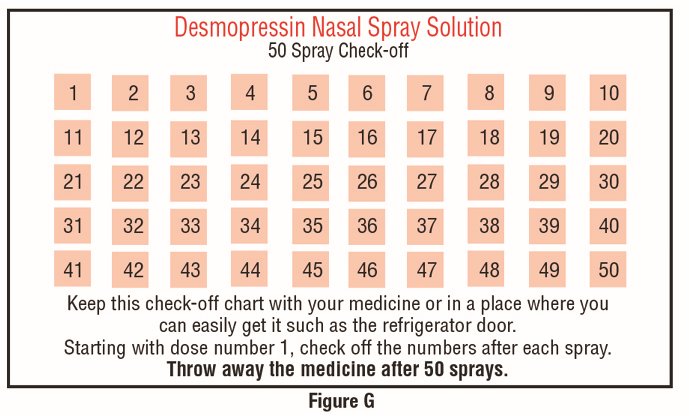
- Use the check-off chart to help you keep track of the number of sprays of desmopressin nasal spray solution used (see Figure G).
- Keep this chart with your desmopressin nasal spray solution or put it in a place where you can easily get it.
- Check off number 1 on the chart with your first dose of desmopressin nasal spray solution. Check off the numbers after each use of your desmopressin nasal spray solution. If your healthcare provider prescribed a dose of 2 sprays, then 2 numbers should be checked off.
- Your desmopressin nasal spray solution holds 50 sprays with the right amount of medicine in each spray.
- If any medicine is left in your desmopressin nasal spray solution after 50 sprays, do not use it. You may not get the right amount of medicine.
- Throw away your desmopressin nasal spray solution after 50 sprays.
- Do not count the priming sprays. Your desmopressin nasal spray solution has been filled with extra medicine for your priming sprays.
- Do not try to remove any medicine from your desmopressin nasal spray solution pump and place it in another bottle.
How should I store desmopressin nasal spray solution?
- Store desmopressin nasal spray solution in the refrigerator between 36°F to 46°F (2°C to 8°C).
- When traveling, desmopressin nasal spray solution can be stored at room temperature up to 72°F (22°C ) for up to 3 weeks.
- Store desmopressin nasal spray solution standing upright.
This Instructions for Use has been approved by the U.S. Food and Drug Administration.
Distributed by:
Bausch + Lomb, a division of
Bausch Health US, LLC
Bridgewater, NJ 08807 USA
Manufactured by:
Bausch Health Companies Inc.
Laval, Quebec H7L 4A8, Canada
© 2021 Bausch & Lomb Incorporated or its affiliates
9685502
Rev: September 2021
Mechanism of Action
The antidiuretic effects of desmopressin are mediated by stimulation of vasopressin 2 (V2) receptors, thereby increasing water re-absorption in the kidney, and hence reducing urine production. Desmopressin is a replacement hormone for antidiuretic hormone in the treatment of central diabetes insipidus. The change in structure of arginine vasopressin to desmopressin acetate resulted in a decreased vasopressor action and decreased actions on visceral smooth muscle relative to the enhanced antidiuretic activity, so that clinically effective antidiuretic doses were usually below threshold levels for effects on vascular or visceral smooth muscle.
