Get your patient on Diphenhydramine - Diphenhydramine Hydrochloride injection, Solution (Diphenhydramine Hydrochloride)
Diphenhydramine - Diphenhydramine Hydrochloride injection, Solution prescribing information

INDICATIONS AND USAGE:
Diphenhydramine hydrochloride in the injectable form is effective in adults and pediatric patients, other than premature infants and neonates, for the following conditions when diphenhydramine hydrochloride in the oral form is impractical.
Antihistaminic
For amelioration of allergic reactions to blood or plasma, in anaphylaxis as an adjunct to epinephrine and other standard measures after the acute symptoms have been controlled, and for other uncomplicated allergic conditions of the immediate type when oral therapy is impossible or contraindicated.
Motion Sickness
For active treatment of motion sickness.
Antiparkinsonism
For use in parkinsonism, when oral therapy is impossible or contraindicated, as follows: parkinsonism in the elderly who are unable to tolerate more potent agents; mild cases of parkinsonism in other age groups, and in other cases of parkinsonism in combination with centrally acting anticholinergic agents.
DOSAGE AND ADMINISTRATION:
THIS PRODUCT IS FOR INTRAVENOUS OR INTRAMUSCULAR ADMINISTRATION ONLY.
Diphenhydramine hydrochloride in the injectable form is indicated when the oral form is impractical.
Parenteral drug products should be inspected visually for particulate matter and discoloration prior to administration, whenever solution and container permit.
DOSAGE SHOULD BE INDIVIDUALIZED ACCORDING TO THE NEEDS AND THE RESPONSE OF THE PATIENT.
Pediatric Patients, other than premature infants and neonates: 5 mg/kg/24 hr or 150 mg/m 2 /24 hr. Maximum daily dosage is 300 mg. Divide into four doses, administered intravenously at a rate generally not exceeding 25 mg/min, or deep intramuscularly.
Adults: 10 to 50 mg intravenously at a rate generally not exceeding 25 mg/min, or deep intramuscularly, 100 mg if required; maximum daily dosage is 400 mg.
CONTRAINDICATIONS:
Use in Neonates or Premature Infants
This drug should not be used in neonates or premature infants.
Use in Nursing Mothers
Because of the higher risk of antihistamines for infants generally, and for neonates and prematures in particular, antihistamine therapy is contraindicated in nursing mothers.
Use as a Local Anesthetic
Because of the risk of local necrosis, this drug should not be used as a local anesthetic. Antihistamines are also contraindicated in the following conditions: Hypersensitivity to diphenhydramine hydrochloride and other antihistamines of similar chemical structure.
ADVERSE REACTIONS:
The most frequent adverse reactions are underscored.
- General: Urticaria, drug rash, anaphylactic shock, photosensitivity, excessive perspiration, chills, dryness of mouth, nose and throat.
- Cardiovascular System: Hypotension, headache, palpitations, tachycardia, extrasystoles.
- Hematologic System: Hemolytic anemia, thrombocytopenia, agranulocytosis.
- Nervous System: Sedation , sleepiness , dizziness , disturbed coordination , fatigue, confusion, restlessness, excitation, nervousness, tremor, irritability, insomnia, euphoria, paresthesia, blurred vision, diplopia, vertigo, tinnitus, acute labyrinthitis, neuritis, convulsions.
- GI System: Epigastric distress , anorexia, nausea, vomiting, diarrhea, constipation.
- GU System: Urinary frequency, difficult urination, urinary retention, early menses.
- Respiratory System: Thickening of bronchial secretions , tightness of chest or throat and wheezing, nasal stuffiness.
DESCRIPTION:
Diphenhydramine hydrochloride is an antihistamine drug having the chemical name 2-(Diphenylmethoxy)-N,N-dimethylethylamine hydrochloride. It occurs as a white, crystalline powder, is freely soluble in water and alcohol.
The structural formula is as follows:
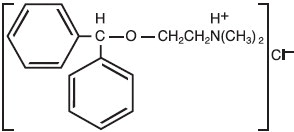
C 17 H 21 NO•HCl M.W. 291.82
Diphenhydramine hydrochloride in the parenteral form is a sterile, pyrogen-free solution available in a concentration of 50 mg of diphenhydramine hydrochloride per mL. pH 4.0 to 6.5; sodium hydroxide and/or hydrochloric acid added, if needed, for pH adjustment.
CLINICAL PHARMACOLOGY:
Diphenhydramine hydrochloride is an antihistamine with anticholinergic (drying) and sedative side effects. Antihistamines appear to compete with histamine for cell receptor sites on effector cells.
Diphenhydramine hydrochloride in the injectable form has a rapid onset of action. Diphenhydramine hydrochloride is widely distributed throughout the body, including the CNS. A portion of the drug is excreted unchanged in the urine, while the rest is metabolized via the liver. Detailed information on the pharmacokinetics of diphenhydramine hydrochloride injection is not available.
HOW SUPPLIED:
DiphenhydrAMINE Hydrochloride Injection, USP in parenteral form is supplied as:
| Product Code | Unit of Sale | Strength | Each |
| PRX660401 | NDC 63323-664-16 Unit of 25 | 50 mg per mL 1 mL fill in a 2 mL vial. | NDC 63323-664-41 1 mL Single Dose Vial |
It is supplied as a sterile, pyrogen-free solution containing 50 mg diphenhydramine hydrochloride in each milliliter of solution.
The container closure is not made with natural rubber latex.
Store at 20° to 25°C (68° to 77°F) [see USP Controlled Room Temperature].
Protect from light. Keep from freezing. PREMIERProRx ® is a registered trademark of Premier Healthcare Alliance, L.P., used under license.
