Get your patient on Glycopyrrolate - Glycopyrrolate tablet (Glycopyrrolate)
Glycopyrrolate - Glycopyrrolate tablet prescribing information

INDICATIONS
For use as adjunctive therapy in the treatment of peptic ulcer.
DOSAGE AND ADMINISTRATION
The dosage of glycopyrrolate should be adjusted to the needs of the individual patient to assure symptomatic control with a minimum of adverse reactions. The presently recommended maximum daily dosage of glycopyrrolate is 8 mg.
Glycopyrrolate Tablets 1 mg. The recommended initial dosage of glycopyrrolate for adults is one tablet three times daily (in the morning, early afternoon, and at bedtime). Some patients may require two tablets at bedtime to assure overnight control of symptoms. For maintenance, a dosage of one tablet twice a day is frequently adequate.
Glycopyrrolate Tablets 2 mg. The recommended dosage of glycopyrrolate for adults is one tablet two or three times daily at equally spaced intervals.
Glycopyrrolate tablets are not recommended for use in pediatric patients under the age of 12 years.
CONTRAINDICATIONS
Glaucoma; obstructive uropathy (for example, bladder neck obstruction due to prostatic hypertrophy); obstructive disease of the gastrointestinal tract (as in achalasia, pyloroduodenal stenosis, etc.); paralytic ileus; intestinal atony of the elderly or debilitated patient; unstable cardiovascular status in acute hemorrhage; severe ulcerative colitis; toxic megacolon complicating ulcerative colitis; myasthenia gravis. Glycopyrrolate tablets are contraindicated in those patients with a hypersensitivity to glycopyrrolate.
ADVERSE REACTIONS
Anticholinergics produce certain effects, most of which are extensions of their fundamental pharmacological actions. Adverse reactions to anticholinergics in general may include xerostomia; decreased sweating; urinary hesitancy and retention; blurred vision; tachycardia; palpitations; dilatation of the pupil; cycloplegia; increased ocular tension; loss of taste; headaches; nervousness; mental confusion; drowsiness; weakness; dizziness; insomnia; nausea; vomiting; constipation; bloated feeling; impotence; suppression of lactation; severe allergic reaction or drug idiosyncrasies including anaphylaxis, urticaria and other dermal manifestations.
Glycopyrrolate is chemically a quaternary ammonium compound; hence, its passage across lipid membranes, such as the blood-brain barrier, is limited in contrast to atropine sulfate and scopolamine hydrobromide. For this reason the occurrence of CNS related side effects is lower, in comparison to their incidence following administration of anticholinergics which are chemically tertiary amines that can cross this barrier readily.
DRUG INTERACTIONS
There are no known drug interactions.
DESCRIPTION
Glycopyrrolate tablets contain the synthetic anticholinergic glycopyrrolate. Glycopyrrolate is a quaternary ammonium compound with the following chemical name:
3-[(cyclopentylhydroxyphenylacetyl)oxy]-1,1-dimethylpyrrolidinium bromide. Its empirical formula is C 19 H 28 BrNO 3 , its molecular weight is 398.33, and its structural formula is: 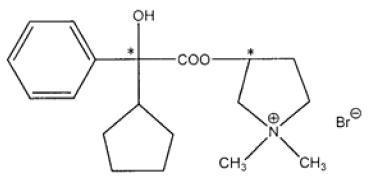
Each 1 mg tablet contains: Glycopyrrolate, USP 1mg
Each 2 mg tablet contains: Glycopyrrolate, USP 2mg
Inactive Ingredients: Dibasic Calcium Phosphate, Lactose, Magnesium Stearate, Povidone, Sodium Starch Glycolate.
ACTIONS
Glycopyrrolate, like other anticholinergic (antimuscarinic) agents, inhibits the action of acetylcholine on structures innervated by postganglionic cholinergic nerves and on smooth muscles that respond to acetylcholine but lack cholinergic innervation. These peripheral cholinergic receptors are present in the autonomic effector cells of smooth muscle, cardiac muscle, the sino-atrial node, the atrioventricular node, exocrine glands, and, to a limited degree, in the autonomic ganglia. Thus, it diminishes the volume and free acidity of gastric secretions and controls excessive pharyngeal, tracheal, and bronchial secretions.
Glycopyrrolate antagonizes muscarinic symptoms (e.g., bronchorrhea, bronchospasm, bradycardia, and intestinal hypermotility) induced by cholinergic drugs such as the anticholinesterases.
The highly polar quaternary ammonium group of glycopyrrolate limits its passage across lipid membranes, such as the blood-brain barrier, in contrast to atropine sulfate and scopolamine hydrobromide, which are non-polar tertiary amines which penetrate lipid barriers easily.
HOW SUPPLIED
Glycopyrrolate tablets 1 mg are bisected, compressed white, round tablets debossed “K” above the bisect and “400” below the bisect on one side of the tablet, and plain on the other side.
Available in bottles of 100 (NDC 49884-065-01).
Glycopyrrolate tablets 2 mg are bisected, compressed white, round tablets debossed “K” above the bisect and “401” below the bisect on one side of the tablet, and plain on the other side.
Available in bottles of 100 (NDC 49884-066-01).
Store at 20° to 25°C (68° to 77°F); excursions permitted to 15° to 30°C (59 to 86°F) [See USP Controlled Room Temperature].
Keep out of reach of children.
Dispense in a tight container.
Manufactured for: Endo USA Malvern, PA 19355 U.S.A Product of Finland Made in India
Neutral Code: TN/DRUGS/ TN00002121 ©2024 Endo, Inc. or one of its affiliates.
from Active Pharmaceutical Ingredient made in Finland
OS065-01-74-04 Revised: 08/2024
