Get your patient on Hydrochlorothiazide - Hydrochlorothiazide capsule (Hydrochlorothiazide)
Hydrochlorothiazide - Hydrochlorothiazide capsule prescribing information

INDICATIONS AND USAGE
Hydrochlorothiazide capsules, USP are indicated in the management of hypertension either as the sole therapeutic agent, or in combination with other antihypertensives. Unlike potassium sparing combination diuretic products, hydrochlorothiazide capsules, USP may be used in those patients in whom the development of hyperkalemia cannot be risked, including patients taking ACE inhibitors.
Usage in Pregnancy: The routine use of diuretics in an otherwise healthy woman is inappropriate and exposes mother and fetus to unnecessary hazard. Diuretics do not prevent development of toxemia of pregnancy, and there is no satisfactory evidence that they are useful in the treatment of developed toxemia.
Edema during pregnancy may arise from pathological causes or from the physiologic and mechanical consequences of pregnancy. Diuretics are indicated in pregnancy when edema is due to pathologic causes, just as they are in the absence of pregnancy. Dependent edema in pregnancy resulting from restriction of venous return by the expanded uterus is properly treated through elevation of the lower extremities and use of support hose; use of diuretics to lower intravascular volume in this case is illogical and unnecessary. There is hypervolemia during normal pregnancy which is harmful to neither the fetus nor the mother (in the absence of cardiovascular disease), but which is associated with edema, including generalized edema in the majority of pregnant women. If this edema produces discomfort, increased recumbency will often provide relief. In rare instances this edema may cause extreme discomfort which is not relieved by rest. In these cases a short course of diuretics may provide relief and may be appropriate.
DOSAGE AND ADMINISTRATION
For Control of Hypertension: The adult initial dose of hydrochlorothiazide capsules, USP is one capsule given once daily whether given alone or in combination with other antihypertensives. Total daily doses greater than 50 mg are not recommended.
CONTRAINDICATIONS
Hydrochlorothiazide is contraindicated in patients with anuria. Hypersensitivity to this product or other sulfonamide derived drugs is also contraindicated.
ADVERSE REACTIONS
The adverse reactions associated with hydrochlorothiazide have been shown to be dose related. In controlled clinical trials, the adverse events reported with doses of 12.5 mg hydrochlorothiazide once daily were comparable to placebo. The following adverse reactions have been reported for doses of hydrochlorothiazide 25 mg and greater and, within each category, are listed in the order of decreasing severity.
Body as a whole: Weakness.
Cardiovascular: Hypotension including orthostatic hypotension (may be aggravated by alcohol, barbiturates, narcotics or antihypertensive drugs).
Digestive: Pancreatitis, jaundice (intrahepatic cholestatic jaundice), diarrhea, vomiting, sialadenitis, cramping, constipation, gastric irritation, nausea, anorexia.
Hematologic: Aplastic anemia, agranulocytosis, leukopenia, hemolytic anemia, thrombocytopenia.
Hypersensitivity: Anaphylactic reactions, necrotizing angiitis (vasculitis and cutaneous vasculitis), respiratory distress including pneumonitis and pulmonary edema, photosensitivity, fever, urticaria, rash, purpura.
Metabolic: Electrolyte imbalance (see PRECAUTIONS ), hyperglycemia, glycosuria, hyperuricemia.
Musculoskeletal: Muscle spasm.
Nervous System/Psychiatric: Vertigo, paresthesia, dizziness, headache, restlessness.
Renal: Renal failure, renal dysfunction, interstitial nephritis (see WARNINGS ).
Skin: Erythema multiforme including Stevens-Johnson syndrome, exfoliative dermatitis including toxic epidermal necrolysis, alopecia.
Special Senses: Transient blurred vision, xanthopsia.
Urogenital: Impotence.
Whenever adverse reactions are moderate or severe, thiazide dosage should be reduced or therapy withdrawn.
Alcohol, barbiturates, or narcotics: potentiation of orthostatic hypotension may occur.
Antidiabetic drugs: (oral agents and insulin) dosage adjustment of the antidiabetic drug may be required.
Other antihypertensive drugs: additive effect or potentiation.
Cholestyramine and colestipol resins: Cholestyramine and colestipol resins bind the hydrochlorothiazide and reduce its absorption from the gastrointestinal tract by up to 85 and 43 percent, respectively.
Corticosteroid, ACTH: intensified electrolyte depletion, particularly hypokalemia.
Pressor amines (e.g., norepinephrine): possible decreased response to pressor amines but not sufficient to preclude their use.
Skeletal muscle relaxants, nondepolarizing (e.g., tubocurarine): possible increased responsiveness to the muscle relaxant.
Lithium: generally should not be given with diuretics. Diuretic agents reduce the renal clearance of lithium and greatly increase the risk of lithium toxicity. Refer to the package insert for lithium preparations before use of such preparations with hydrochlorothiazide capsules.
Non-steroidal anti-inflammatory drugs: In some patients, the administration of a non-steroidal anti-inflammatory agent can reduce the diuretic, natriuretic, and antihypertensive effects of loop, potassium-sparing and thiazide diuretics. When hydrochlorothiazide capsules and non-steroidal anti-inflammatory agents are used concomitantly, the patients should be observed closely to determine if the desired effect of the diuretic is obtained.
Drug/Laboratory Test Interactions: Thiazides should be discontinued before carrying out tests for parathyroid function (see PRECAUTIONS , General ).
DESCRIPTION
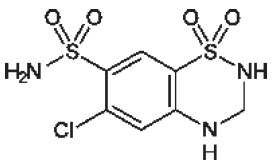
Hydrochlorothiazide (hydrochlorothiazide, USP 12.5 mg) is the 3,4-dihydro derivative of chlorothiazide. Its chemical name is 6-chloro-3,4-dihydro-2 H -1,2,4-benzothiadiazine-7- sulfonamide 1,1-dioxide. Its empirical formula is C 7 H 8 ClN 3 O 4 S 2 ; its molecular weight is 297.74; and its structural formula is:
It is a white, or practically white, crystalline powder which is slightly soluble in water, but freely soluble in sodium hydroxide solution.
Hydrochlorothiazide capsules, USP are supplied as 12.5 mg capsules for oral use.
Inactive ingredients: colloidal silicon dioxide, corn starch, lactose monohydrate, magnesium stearate. The hard gelatin shell consists of gelatin, titanium dioxide, sodium lauryl sulfate, FD&C Blue #1. The capsules are printed with black ink containing shellac, dehydrated alcohol, isopropyl alcohol, butyl alcohol, propylene glycol, strong ammonia solution, black iron oxide, and potassium hydroxide.
CLINICAL PHARMACOLOGY
Hydrochlorothiazide blocks the reabsorption of sodium and chloride ions, and it thereby increases the quantity of sodium traversing the distal tubule and the volume of water excreted. A portion of the additional sodium presented to the distal tubule is exchanged there for potassium and hydrogen ions. With continued use of hydrochlorothiazide and depletion of sodium, compensatory mechanisms tend to increase this exchange and may produce excessive loss of potassium, hydrogen and chloride ions.
Hydrochlorothiazide also decreases the excretion of calcium and uric acid, may increase the excretion of iodide and may reduce glomerular filtration rate. Metabolic toxicities associated with excessive electrolyte changes caused by hydrochlorothiazide have been shown to be dose-related.
Pharmacokinetics and Metabolism:
Hydrochlorothiazide is well absorbed (65% to 75%) following oral administration. Absorption of hydrochlorothiazide is reduced in patients with congestive heart failure.
Peak plasma concentrations are observed within 1 to 5 hours of dosing, and range from 70 to 490 ng/mL following oral doses of 12.5 to 100 mg. Plasma concentrations are linearly related to the administered dose. Concentrations of hydrochlorothiazide are 1.6 to 1.8 times higher in whole blood than in plasma. Binding to serum proteins has been reported to be approximately 40% to 68%. The plasma elimination half-life has been reported to be 6 to 15 hours. Hydrochlorothiazide is eliminated primarily by renal pathways. Following oral doses of 12.5 to 100 mg, 55% to 77% of the administered dose appears in urine and greater than 95% of the absorbed dose is excreted in urine as unchanged drug. In patients with renal disease, plasma concentrations of hydrochlorothiazide are increased and the elimination half-life is prolonged.
When hydrochlorothiazide capsules, USP are administered with food, its bioavailability is reduced by 10%, the maximum plasma concentration is reduced by 20%, and the time to maximum concentration increases from 1.6 to 2.9 hours.
Pharmacodynamics:
Acute antihypertensive effects of thiazides are thought to result from a reduction in blood volume and cardiac output, secondary to a natriuretic effect, although a direct vasodilatory mechanism has also been proposed. With chronic administration, plasma volume returns toward normal, but peripheral vascular resistance is decreased. The exact mechanism of the antihypertensive effect of hydrochlorothiazide is not known.
Thiazides do not affect normal blood pressure. Onset of action occurs within 2 hours of dosing, peak effect is observed at about 4 hours, and activity persists for up to 24 hours.
Clinical Studies:
In an 87 patient 4-week double-blind, placebo controlled, parallel group trial, patients who received hydrochlorothiazide capsules, USP had reductions in seated systolic and diastolic blood pressure that were significantly greater than those seen in patients who received placebo. In published placebo-controlled trials comparing 12.5 mg of hydrochlorothiazide to 25 mg, the 12.5 mg dose preserved most of the placebo-corrected blood pressure reduction seen with 25 mg.
HOW SUPPLIED
Hydrochlorothiazide Capsules, USP contain a white to off white powder filled in size “4” hard gelatin capsules with opaque light blue colored cap and opaque light blue colored body imprinted “SG” on cap and “146” on body with black ink. They are supplied in bottles of 30 (NDC 50228-146-30), bottles of 100 (NDC 50228-146-01), bottles of 500 (NDC 50228-146-05) and the bottles of 1,000 (NDC 50228-146-10).
Dispense in a tight, light-resistant container as defined in the USP.
Keep out of reach of children.
Store at 20° to 25°C (68° to 77°F). [See USP controlled room temperature.] Protect from light, moisture, freezing, -20°C (-4°F). Keep container tightly closed.
Dispense the Prescribing Information at: https://sciegenpharm.com/medication-guide/
Rx only
For all medical inquiries contact:
ScieGen Pharmaceuticals Inc.
1-855-724-3436
Manufactured by:
ScieGen Pharmaceuticals Inc.
Hauppauge, NY 11788
Revised: 11/2025
Barcode:
