Get your patient on Imipramine Hydrochloride - Imipramine Hydrochloride tablet (Imipramine Hydrochloride)
Imipramine Hydrochloride - Imipramine Hydrochloride tablet prescribing information

Suicidality and Antidepressant Drugs Antidepressants increased the risk compared to placebo of suicidal thinking and behavior (suicidality) in children, adolescents, and young adults in short-term studies of major depressive disorder (MDD) and other psychiatric disorders. Anyone considering the use of imipramine hydrochloride or any other antidepressant in a child, adolescent, or young adult must balance this risk with the clinical need. Short-term studies did not show an increase in the risk of suicidality with antidepressants compared to placebo in adults beyond age 24; there was a reduction in risk with antidepressants compared to placebo in adults aged 65 and older. Depression and certain other psychiatric disorders are themselves associated with increases in the risk of suicide. Patients of all ages who are started on antidepressant therapy should be monitored appropriately and observed closely for clinical worsening, suicidality, or unusual changes in behavior. Families and caregivers should be advised of the need for close observation and communication with the prescriber. Imipramine hydrochloride is not approved for use in pediatric patients. (See WARNINGS: Clinical Worsening and Suicide Risk , PRECAUTIONS: Information for Patients , and PRECAUTIONS: Pediatric Use )
INDICATIONS AND USAGE
Depression -For the relief of symptoms of depression. Endogenous depression is more likely to be alleviated than other depressive states. One to three weeks of treatment may be needed before optimal therapeutic effects are evident.
Childhood Enuresis -May be useful as temporary adjunctive therapy in reducing enuresis in children aged 6 years and older, after possible organic causes have been excluded by appropriate tests. In patients having daytime symptoms of frequency and urgency, examination should include voiding cystourethrography and cystoscopy, as necessary. The effectiveness of treatment may decrease with continued drug administration.
DOSAGE AND ADMINISTRATION
Depression Lower dosages are recommended for elderly patients and adolescents. Lower dosages are also recommended for outpatients as compared to hospitalized patients who will be under close supervision. Dosage should be initiated at a low level and increased gradually, noting carefully the clinical response and any evidence of intolerance. Following remission, maintenance medication may be required for a longer period of time, at the lowest dose that will maintain remission.
Usual Adult Dose: Hospitalized patients -Initially, 100 mg/day in divided doses gradually increased to 200 mg/day as required. If no response after two weeks, increase to 250 to 300 mg/day.
Outpatients -Initially, 75 mg/day increased to 150 mg/day. Dosages over 200 mg/day are not recommended. Maintenance, 50 to 150 mg/day.
Adolescent and Geriatric Patients -Initially, 30 to 40 mg/day; it is generally not necessary to exceed 100 mg/day.
Childhood Enuresis Initially, an oral dose of 25 mg/day should be tried in children aged 6 and older. Medication should be given one hour before bedtime. If a satisfactory response does not occur within one week, increase the dose to 50 mg nightly in children under 12 years; children over 12 may receive up to 75 mg nightly. A daily dose greater than 75 mg does not enhance efficacy and tends to increase side effects. Evidence suggests that in early night bedwetters, the drug is more effective given earlier and in divided amounts, i.e., 25 mg in midafternoon, repeated at bedtime. Consideration should be given to instituting a drug free period following an adequate therapeutic trial with a favorable response. Dosage should be tapered off gradually rather than abruptly discontinued; this may reduce the tendency to relapse. Children who relapse when the drug is discontinued do not always respond to a subsequent course of treatment.
A dose of 2.5 mg/kg/day should not be exceeded. ECG changes of unknown significance have been reported in pediatric patients with doses twice this amount.
The safety and effectiveness of imipramine hydrochloride as temporary adjunctive therapy for nocturnal enuresis in children less than 6 years of age has not been established.
CONTRAINDICATIONS
The concomitant use of monoamine oxidase inhibiting compounds is contraindicated. Hyperpyretic crises or severe convulsive seizures may occur in patients receiving such combinations. The potentiation of adverse effects can be serious, or even fatal. When it is desired to substitute imipramine hydrochloride in patients receiving a monoamine oxidase inhibitor, as long an interval should elapse as the clinical situation will allow, with a minimum of 14 days. Initial dosage should be low and increases should be gradual and cautiously prescribed.
The drug is contraindicated during the acute recovery period after a myocardial infarction. Patients with a known hypersensitivity to this compound should not be given the drug. The possibility of cross-sensitivity to other dibenzazepine compounds should be kept in mind.
ADVERSE REACTIONS
Note- Although the listing which follows includes a few adverse reactions which have not been reported with this specific drug, the pharmacological similarities among the tricyclic antidepressant drugs require that each of the reactions be considered when imipramine hydrochloride is administered.
Cardiovascular : Orthostatic hypotension, hypertension, tachycardia, palpitation, myocardial infarction, arrhythmias, heart block, ECG changes, precipitation of congestive heart failure, stroke.
Psychiatric : Confusional states (especially in the elderly) with hallucinations, disorientation, delusions; anxiety, restlessness, agitation; insomnia and nightmares; hypomania; exacerbation of psychosis.
Neurological : Numbness, tingling, paresthesias of extremities; incoordination, ataxia, tremors; peripheral neuropathy; extrapyramidal symptoms; seizures, alterations in EEG patterns; tinnitus.
Anticholinergic : Dry mouth, and, rarely, associated sublingual adenitis; blurred vision, disturbances of accommodation, mydriasis; constipation, paralytic ileus; urinary retention, delayed micturition, dilation of the urinary tract.
Allergic : Skin rash, petechiae, urticaria, itching, photosensitization; edema (general or of face and tongue); drug fever; cross-sensitivity with desipramine.
Hematologic : Bone marrow depression including agranulocytosis; eosinophilia; purpura; thrombocytopenia.
Gastrointestinal : Nausea and vomiting, anorexia, epigastric distress, diarrhea; peculiar taste, stomatitis, abdominal cramps, black tongue.
Endocrine : Gynecomastia in the male; breast enlargement and galactorrhea in the female; increased or decreased libido, impotence; testicular swelling; elevation or depression of blood sugar levels; inappropriate antidiuretic hormone (ADH) secretion syndrome.
Other : Jaundice (simulating obstructive); altered liver function; weight gain or loss; perspiration; flushing; urinary frequency; drowsiness, dizziness, weakness and fatigue; headache; parotid swelling; alopecia; proneness to falling, hyponatremia.
Withdrawal Symptoms : Though not indicative of addiction, abrupt cessation of treatment after prolonged therapy may produce nausea, headache, and malaise.
Note -In enuretic children treated with imipramine hydrochloride the most common adverse reactions have been nervousness, sleep disorders, tiredness, and mild gastrointestinal disturbances. These usually disappear during continued drug administration or when dosage is decreased. Other reactions which have been reported include constipation, convulsions, anxiety, emotional instability, syncope, and collapse. All of the adverse effects reported with adult use should be considered.
Postmarketing Experience
The following adverse drug reaction has been reported during post-approval use of imipramine hydrochloride. Because this reaction is reported voluntarily from a population of uncertain size, it is not always possible to reliably estimate frequency.
Eye disorders: angle-closure glaucoma
Drug Interactions
Drugs Metabolized by P450 2D6 : The biochemical activity of the drug metabolizing isozyme cytochrome P450 2D6 (debrisoquin hydroxylase) is reduced in a subset of the Caucasian population (about 7% to 10% of Caucasians are so-called "poor metabolizers"); reliable estimates of the prevalence of reduced P450 2D6 isozyme activity among Asian, African, and other populations are not yet available. Poor metabolizers have higher than expected plasma concentrations of tricyclic antidepressants (TCAs) when given usual doses. Depending on the fraction of drug metabolized by P450 2D6, the increase in plasma concentration may be small, or quite large (8-fold increase in plasma AUC of the TCA).
In addition, certain drugs inhibit the activity of this isozyme and make normal metabolizers resemble poor metabolizers. An individual who is stable on a given dose of TCA may become abruptly toxic when given one of these inhibiting drugs as concomitant therapy. The drugs that inhibit cytochrome P450 2D6 include some that are not metabolized by the enzyme (quinidine; cimetidine) and many that are substrates for P450 2D6 (many other antidepressants, phenothiazines, and the Type 1C antiarrhythmics propafenone and flecainide). While all the selective serotonin reuptake inhibitors (SSRIs), e.g., fluoxetine, sertraline, and paroxetine, inhibit P450 2D6, they may vary in the extent of inhibition. The extent to which SSRI-TCA interaction may pose clinical problems will depend on the degree of inhibition and the pharmacokinetics of the SSRI involved. Nevertheless, caution is indicated in the coadministration of TCAs with any of the SSRIs and also in switching from one class to the other. Of particular importance, sufficient time must elapse before initiating TCA treatment in a patient being withdrawn from fluoxetine, given the long half-life of the parent and active metabolite (at least 5 weeks may be necessary).
Concomitant use of tricyclic antidepressants with drugs that can inhibit cytochrome P450 2D6 may require lower doses than usually prescribed for either the tricyclic antidepressant or the other drug. Furthermore, whenever one of these other drugs is withdrawn from co-therapy, an increased dose of tricyclic antidepressant may be required. It is desirable to monitor TCA plasma levels whenever a TCA is going to be co-administered with another drug known to be an inhibitor of P450 2D6.
The plasma concentration of imipramine may increase when the drug is given concomitantly with hepatic enzyme inhibitors (e.g., cimetidine, fluoxetine) and decrease by concomitant administration with hepatic enzyme inducers (e.g., barbiturates, phenytoin), and adjustment of the dosage of imipramine may therefore be necessary.
In occasional susceptible patients or in those receiving anticholinergic drugs (including antiparkinsonism agents) in addition, the atropine-like effects may become more pronounced (e.g., paralytic ileus). Close supervision and careful adjustment of dosage is required when imipramine hydrochloride is administered concomitantly with anticholinergic drugs.
Avoid the use of preparations, such as decongestants and local anesthetics, that contain any sympathomimetic amine (e.g., epinephrine, norepinephrine), since it has been reported that tricyclic antidepressants can potentiate the effects of catecholamines.
Caution should be exercised when imipramine hydrochloride is used with agents that lower blood pressure. Imipramine hydrochloride may potentiate the effects of CNS depressant drugs.
Patients should be warned that imipramine hydrochloride may enhance the CNS depressant effects of alcohol. ( see WARNINGS .)
DESCRIPTION
Imipramine hydrochloride is supplied in tablet form for oral administration.
Imipramine hydrochloride USP, the original tricyclic antidepressant, is a member of the dibenzazepine group of compounds. It is designated 5-[3-(Dimethylamino)propyl]-10,11-dihydro-5 H -dibenz [b, f ]azepine monohydrochloride. Its structural formula is:
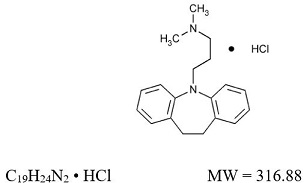
Imipramine hydrochloride USP is a white to off-white, odorless, or practically odorless crystalline powder. It is freely soluble in water and in alcohol, soluble in acetone, and insoluble in ether and in benzene.
Inactive Ingredients: Carnauba wax powder, colloidal silicon dioxide, FD & C yellow #6 Aluminum lake, hypromellose (10 mg), lactose monohydrate, lecithin (25 mg), magnesium stearate, microcrystalline cellulose, polyethylene glycol, polysorbate 80 (10 mg), polyvinyl alcohol (25 mg and 50 mg), sodium starch glycolate, talc, titanium dioxide, and yellow iron oxide (25 mg and 50 mg).
CLINICAL PHARMACOLOGY
The mechanism of action of imipramine hydrochloride is not definitely known. However, it does not act primarily by stimulation of the central nervous system. The clinical effect is hypothesized as being due to potentiation of adrenergic synapses by blocking uptake of norepinephrine at nerve endings. The mode of action of the drug in controlling childhood enuresis is thought to be apart from its antidepressant effect.
HOW SUPPLIED
Imipramine Hydrochloride Tablets, USP
10 mg – Peach, round, film coated, biconvex tablets debossed “425” on one side and “O” on the other. Available in: Bottles of 100 ………..…… … NDC-69584-425-10 Bottles of 1000 ………..……… NDC-69584-425-90
25 mg – Light orange, round, film coated, biconvex tablets debossed “426” on one side and “O” on the other. Available in: Bottles of 100 ……..……… … NDC-69584-426-10 Bottles of 1000 ………..……… NDC-69584-426-90
50 mg – Orange, round, film coated, biconvex tablets debossed “427” on one side and “O” on the other. Available in: Bottles of 100 …………..… … NDC-69584-427-10 Bottles of 1000 ………..……… NDC-69584-427-90
Store at 20°C to 25°C (68° to 77°F) [See USP Controlled Room Temperature].
Dispense in a tight container (USP) with a child-resistant closure.
