Get your patient on Ivermectin - Ivermectin tablet (Ivermectin)
Ivermectin - Ivermectin tablet prescribing information

INDICATIONS AND USAGE
Ivermectin is indicated for the treatment of the following infections:
Strongyloidiasis of the intestinal tract
Ivermectin is indicated for the treatment of intestinal (i.e., nondisseminated) strongyloidiasis due to the nematode parasite Strongyloides stercoralis .
This indication is based on clinical studies of both comparative and open-label designs, in which 64-100% of infected patients were cured following a single 200-mcg/kg dose of ivermectin (See CLINICAL PHARMACOLOGY, Clinical Studies ).
Onchocerciasis
Ivermectin is indicated for the treatment of onchocerciasis due to the nematode parasite Onchocerca volvulus .
This indication is based on randomized, double-blind, placebo-controlled and comparative studies conducted in 1427 patients in onchocerciasis-endemic areas of West Africa. The comparative studies used diethylcarbamazine citrate (DEC-C).
NOTE: Ivermectin has no activity against adult Onchocerca volvulus parasites. The adult parasites reside in subcutaneous nodules which are infrequently palpable. Surgical excision of these nodules (nodulectomy) may be considered in the management of patients with onchocerciasis, since this procedure will eliminate the microfilariae-producing adult parasites.
DOSAGE AND ADMINISTRATION
Strongyloidiasis
The recommended dosage of ivermectin tablets for the treatment of strongyloidiasis is a single oral dose designed to provide approximately 200 mcg of ivermectin per kg of body weight. See Table 1 for dosage guidelines. Patients should take tablets on an empty stomach with water (See CLINICAL PHARMACOLOGY, Pharmacokinetics ). In general, additional doses are not necessary. However, follow-up stool examinations should be performed to verify eradication of infection (See CLINICAL PHARMACOLOGY, Clinical Studies ).
| Body Weight (kg) | Single Oral Dose Number of 3-mg Tablets |
| 15-24 | 1 tablet |
| 25-35 | 2 tablets |
| 36-50 | 3 tablets |
| 51-65 | 4 tablets |
| 66-79 | 5 tablets |
| ≥ 80 | 200 mcg/kg |
Onchocerciasis
The recommended dosage of ivermectin Tablets for the treatment of onchocerciasis is a single oral dose designed to provide approximately 150 mcg of ivermectin per kg of body weight. See Table 2 for dosage guidelines. Patients should take tablets on an empty stomach with water (See CLINICAL PHARMACOLOGY, Pharmacokinetics ). In mass distribution campaigns in international treatment programs, the most commonly used dose interval is 12 months. For the treatment of individual patients, retreatment may be considered at intervals as short as 3 months.
| Body Weight (kg) | Single Oral Dose Number of 3-mg Tablets |
| 15-25 | 1 tablet |
| 26-44 | 2 tablets |
| 45-64 | 3 tablets |
| 65-84 | 4 tablets |
| ≥ 85 | 150 mcg/kg |
CONTRAINDICATIONS
Ivermectin tablets are contraindicated in patients who are hypersensitive to any component of this product.
ADVERSE REACTIONS
Strongyloidiasis
In four clinical studies involving a total of 109 patients given either one or two doses of 170 to 200 mcg/kg of ivermectin, the following adverse reactions were reported as possibly, probably, or definitely related to ivermectin:
Body as a Whole: asthenia/fatigue (0.9%), abdominal pain (0.9%)
Gastrointestinal: anorexia (0.9%), constipation (0.9%), diarrhea (1.8%), nausea (1.8%), vomiting (0.9%)
Nervous System/Psychiatric: dizziness (2.8%), somnolence (0.9%), vertigo (0.9%), tremor (0.9%)
Skin: pruritus (2.8%), rash (0.9%), and urticaria (0.9%).
In comparative trials, patients treated with ivermectin experienced more abdominal distention and chest discomfort than patients treated with albendazole. However, ivermectin was better tolerated than thiabendazole in comparative studies involving 37 patients treated with thiabendazole.
The Mazzotti-type and ophthalmologic reactions associated with the treatment of onchocerciasis or the disease itself would not be expected to occur in strongyloidiasis patients treated with ivermectin (See ADVERSE REACTIONS, Onchocerciasis ).
Laboratory Test Findings
In clinical trials involving 109 patients given either one or two doses of 170 to 200 mcg/kg ivermectin, the following laboratory abnormalities were seen regardless of drug relationship: elevation in ALT and/or AST (2%), decrease in leukocyte count (3%). Leukopenia and anemia were seen in one patient.
Onchocerciasis
In clinical trials involving 963 adult patients treated with 100 to 200 mcg/kg ivermectin tablets, worsening of the following Mazzotti reactions during the first 4 days post-treatment were reported: arthralgia/synovitis (9.3%), axillary lymph node enlargement and tenderness (11.0% and 4.4%, respectively), cervical lymph node enlargement and tenderness (5.3% and 1.2%, respectively), inguinal lymph node enlargement and tenderness (12.6% and 13.9%, respectively), other lymph node enlargement and tenderness (3.0% and 1.9%, respectively), pruritus (27.5%), skin involvement including edema, papular and pustular or frank urticarial rash (22.7%), and fever (22.6%) (See WARNINGS ).
In clinical trials, ophthalmological conditions were examined in 963 adult patients before treatment, at day 3, and months 3 and 6 after treatment with 100 to 200 mcg/kg ivermectin. Changes observed were primarily deterioration from baseline 3 days post-treatment. Most changes either returned to baseline condition or improved over baseline severity at the month 3 and 6 visits. The percentages of patients with worsening of the following conditions at day 3, month 3 and 6, respectively, were: limbitis: 5.5%, 4.8%, and 3.5% and punctate opacity: 1.8%, 1.8%, and 1.4%. The corresponding percentages for patients treated with placebo were: limbitis: 6.2%, 9.9%, and 9.4% and punctate opacity: 2.0%, 6.4%, and 7.2% (See WARNINGS ).
In clinical trials involving 963 adult patients who received 100 to 200 mcg/kg ivermectin, the following clinical adverse reactions were reported as possibly, probably, or definitely related to the drug in ≥ 1% of the patients: facial edema (1.2%), peripheral edema (3.2%), orthostatic hypotension (1.1%), and tachycardia (3.5%). Drug-related headache and myalgia occurred in < 1% of patients (0.2% and 0.4%, respectively). However, these were the most common adverse experiences reported overall during these trials regardless of causality (22.3% and 19.7%, respectively).
A similar safety profile was observed in an open study in pediatric patients ages 6 to 13.
The following ophthalmological side effects do occur due to the disease itself but have also been reported after treatment with ivermectin: abnormal sensation in the eyes, eyelid edema, anterior uveitis, conjunctivitis, limbitis, keratitis, and chorioretinitis or choroiditis. These have rarely been severe or associated with loss of vision and have generally resolved without corticosteroid treatment.
Laboratory Test Findings
In controlled clinical trials, the following laboratory adverse experiences were reported as possibly, probably, or definitely related to the drug in ≥ 1% of the patients: eosinophilia (3%) and hemoglobin increase (1%).
Post-Marketing Experience
The following adverse reactions have been reported since the drug was registered overseas:
Onchocerciasis
Conjunctival hemorrhage
All Indications
Hypotension (mainly orthostatic hypotension), worsening of bronchial asthma, toxic epidermal necrolysis, Stevens-Johnson syndrome, seizures, hepatitis, elevation of liver enzymes, and elevation of bilirubin.
Neurotoxicity including alteration of consciousness of variable severity (e.g., somnolence/drowsiness, stupor, and coma), confusion, disorientation, and death (see WARNINGS ).
Drug Interactions
Post-marketing reports of increased INR (International Normalized Ratio) have been rarely reported when ivermectin was co-administered with warfarin.
DESCRIPTION
Ivermectin is a semisynthetic, anthelmintic agent for oral administration. Ivermectin is derived from the avermectins, a class of highly active broad-spectrum, anti-parasitic agents isolated from the fermentation products of Streptomyces avermitilis . Ivermectin is a mixture containing at least 90% 5- O -demethyl-22,23-dihydroavermectin A 1a and less than 10% 5- O- demethyl-25-de(1-methylpropyl)-22,23-dihydro-25-(1-methylethyl)avermectin A 1a , generally referred to as 22,23-dihydroavermectin B 1a and B 1b , or H 2 B 1a and H 2 B 1b , respectively. The respective empirical formulas are C 48 H 74 O 14 and C 47 H 72 O 14 , with molecular weights of 875.10 and 861.07, respectively. The structural formulas are:
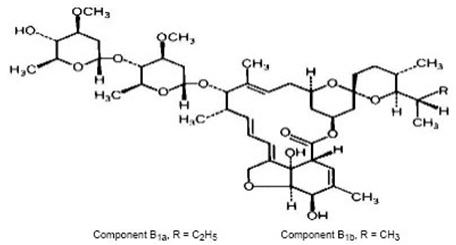
Ivermectin is a white to yellowish-white, nonhygroscopic, crystalline powder with a melting point of about 155°C. It is insoluble in water but is freely soluble in methanol and soluble in 95% ethanol.
Ivermectin tablets are available as 3-mg tablets containing the following inactive ingredients: colloidal silicon dioxide, croscarmellose sodium, magnesium stearate, microcrystalline cellulose, and pregelatinized starch.
CLINICAL PHARMACOLOGY
Pharmacokinetics
Following oral administration of ivermectin, plasma concentrations are approximately proportional to the dose. In two studies, after single 12-mg doses of ivermectin tablets in fasting healthy volunteers (representing a mean dose of 165 mcg/kg), the mean peak plasma concentrations of the major component (H 2 B 1a ) were 46.6 (±21.9) (range: 16.4 - 101.1) and 30.6 (±15.6) (range: 13.9 - 68.4) ng/mL, respectively, at approximately 4 hours after dosing. Ivermectin is metabolized in the liver, and ivermectin and/or its metabolites are excreted almost exclusively in the feces over an estimated 12 days, with less than 1% of the administered dose excreted in the urine. The plasma half-life of ivermectin in man is approximately 18 hours following oral administration.
The safety and pharmacokinetic properties of ivermectin were further assessed in a multiple-dose clinical pharmacokinetic study involving healthy volunteers. Subjects received oral doses of 30 to 120 mg (333 to 2000 mcg/kg) ivermectin in a fasted state or 30 mg (333 to 600 mcg/kg) ivermectin following a standard high-fat (48.6 g of fat) meal. Administration of 30 mg ivermectin following a high-fat meal resulted in an approximate 2.5-fold increase in bioavailability relative to administration of 30 mg ivermectin in the fasted state.
In vitro studies using human liver microsomes and recombinant CYP450 enzymes have shown that ivermectin is primarily metabolized by CYP3A4. Depending on the in vitro method used, CYP2D6 and CYP2E1 were also shown to be involved in the metabolism of ivermectin but to a significantly lower extent compared to CYP3A4. The findings of in vitro studies using human liver microsomes suggest that clinically relevant concentrations of ivermectin do not significantly inhibit the metabolizing activities of CYP3A4, CYP2D6, CYP2C9, CYP1A2, and CYP2E1.
Microbiology
Ivermectin is a member of the avermectin class of broad-spectrum antiparasitic agents which have a unique mode of action. Compounds of the class bind selectively and with high affinity to glutamate-gated chloride ion channels which occur in invertebrate nerve and muscle cells. This leads to an increase in the permeability of the cell membrane to chloride ions with hyperpolarization of the nerve or muscle cell, resulting in paralysis and death of the parasite. Compounds of this class may also interact with other ligand-gated chloride channels, such as those gated by the neurotransmitter gamma-aminobutyric acid (GABA).
The selective activity of compounds of this class is attributable to the facts that some mammals do not have glutamate-gated chloride channels and that the avermectins have a low affinity for mammalian ligand-gated chloride channels. In addition, ivermectin does not readily cross the blood-brain barrier in humans.
Ivermectin is active against various life-cycle stages of many but not all nematodes. It is active against the tissue microfilariae of Onchocerca volvulus but not against the adult form. Its activity against Strongyloides stercoralis is limited to the intestinal stages.
Clinical Studies
Stongyloidiasis
Two controlled clinical studies using albendazole as the comparative agent were carried out in international sites where albendazole is approved for the treatment of strongyloidiasis of the gastrointestinal tract, and three controlled studies were carried out in the U.S. and internationally using thiabendazole as the comparative agent. Efficacy, as measured by cure rate, was defined as the absence of larvae in at least two follow-up stool examinations 3 to 4 weeks post-therapy. Based on this criterion, efficacy was significantly greater for ivermectin (a single dose of 170 to 200 mcg/kg) than for albendazole (200 mg b.i.d. for 3 days). Ivermectin tablets administered as a single dose of 200 mcg/kg for 1 day was as efficacious as thiabendazole administered at 25 mg/kg b.i.d. for 3 days.
Summary of Cure Rates for Ivermectin Versus Comparative Agents in the Treatment of Strongyloidiasis
| Cure Rate• (%) | ||
| Ivermectin † | Comparative Agent | |
| Albendazole ‡ Comparative | ||
| International Study | 24/26 (92) | 12/22 (55) |
| WHO Study | 126/152 (83) | 67/149 (45) |
| Thiabendazole § Comparative | ||
| International Study | 9/14 (64) | 13/15 (87) |
| US Studies | 14/14 (100) | 16/17 (94) |
•Number and % of evaluable patients
†170-200 mcg/kg
‡200 mg b.i.d. for 3 days
§25 mg/kg b.i.d. for 3 days
In one study conducted in France, a non-endemic area where there was no possibility of reinfection, several patients were observed to have recrudescence of Strongyloides larvae in their stool as long as 106 days following ivermectin therapy. Therefore, at least three stool examinations should be conducted over the three months following treatment to ensure eradication. If recrudescence of larvae is observed, retreatment with ivermectin is indicated. Concentration techniques (such as using a Baermann apparatus) should be employed when performing these stool examinations, as the number of Strongyloides larvae per gram of feces may be very low.
Onchocerciasis
The evaluation of ivermectin in the treatment of onchocerciasis is based on the results of clinical studies involving 1278 patients. In a double-blind, placebo-controlled study involving adult patients with moderate to severe onchocercal infection, patients who received a single dose of 150 mcg/kg ivermectin tablets experienced an 83.2% and 99.5% decrease in skin microfilariae count (geometric mean) 3 days and 3 months after the dose, respectively. A marked reduction of >90% was maintained for up to 12 months after the single dose. As with other microfilaricidal drugs, there was an increase in the microfilariae count in the anterior chamber of the eye at day 3 after treatment in some patients. However, at 3 and 6 months after the dose, a significantly greater percentage of patients treated with ivermectin had decreases in microfilariae count in the anterior chamber than patients treated with placebo.
In a separate open study involving pediatric patients ages 6 to 13 (n=103; weight range: 17-41 kg), similar decreases in skin microfilariae counts were observed for up to 12 months after dosing.
Clinical Studies
Stongyloidiasis
Two controlled clinical studies using albendazole as the comparative agent were carried out in international sites where albendazole is approved for the treatment of strongyloidiasis of the gastrointestinal tract, and three controlled studies were carried out in the U.S. and internationally using thiabendazole as the comparative agent. Efficacy, as measured by cure rate, was defined as the absence of larvae in at least two follow-up stool examinations 3 to 4 weeks post-therapy. Based on this criterion, efficacy was significantly greater for ivermectin (a single dose of 170 to 200 mcg/kg) than for albendazole (200 mg b.i.d. for 3 days). Ivermectin tablets administered as a single dose of 200 mcg/kg for 1 day was as efficacious as thiabendazole administered at 25 mg/kg b.i.d. for 3 days.
Summary of Cure Rates for Ivermectin Versus Comparative Agents in the Treatment of Strongyloidiasis
| Cure Rate• (%) | ||
| Ivermectin † | Comparative Agent | |
| Albendazole ‡ Comparative | ||
| International Study | 24/26 (92) | 12/22 (55) |
| WHO Study | 126/152 (83) | 67/149 (45) |
| Thiabendazole § Comparative | ||
| International Study | 9/14 (64) | 13/15 (87) |
| US Studies | 14/14 (100) | 16/17 (94) |
•Number and % of evaluable patients
†170-200 mcg/kg
‡200 mg b.i.d. for 3 days
§25 mg/kg b.i.d. for 3 days
In one study conducted in France, a non-endemic area where there was no possibility of reinfection, several patients were observed to have recrudescence of Strongyloides larvae in their stool as long as 106 days following ivermectin therapy. Therefore, at least three stool examinations should be conducted over the three months following treatment to ensure eradication. If recrudescence of larvae is observed, retreatment with ivermectin is indicated. Concentration techniques (such as using a Baermann apparatus) should be employed when performing these stool examinations, as the number of Strongyloides larvae per gram of feces may be very low.
Onchocerciasis
The evaluation of ivermectin in the treatment of onchocerciasis is based on the results of clinical studies involving 1278 patients. In a double-blind, placebo-controlled study involving adult patients with moderate to severe onchocercal infection, patients who received a single dose of 150 mcg/kg ivermectin tablets experienced an 83.2% and 99.5% decrease in skin microfilariae count (geometric mean) 3 days and 3 months after the dose, respectively. A marked reduction of >90% was maintained for up to 12 months after the single dose. As with other microfilaricidal drugs, there was an increase in the microfilariae count in the anterior chamber of the eye at day 3 after treatment in some patients. However, at 3 and 6 months after the dose, a significantly greater percentage of patients treated with ivermectin had decreases in microfilariae count in the anterior chamber than patients treated with placebo.
In a separate open study involving pediatric patients ages 6 to 13 (n=103; weight range: 17-41 kg), similar decreases in skin microfilariae counts were observed for up to 12 months after dosing.
HOW SUPPLIED
Ivermectin tablets USP, 3 mg are white, round, flat, bevel-edged tablets debossed with "806" on one side and plain on the other side. They are supplied as follows: NDC 42799-806-01 unit dose packages of 20.
Storage
Store at temperatures below 30°C (86°F).
