Get your patient on Megatope - Iodinated I-131 Albumin injection, Solution (Iodinated I-131 Albumin)
Megatope - Iodinated I-131 Albumin injection, Solution prescribing information

INDICATIONS AND USAGE
MEGATOPE is indicated in adults for use in determinations of total blood and plasma volumes.
DOSAGE AND ADMINISTRATION
Premedication Administer 10 drops of Strong Iodine Solution, USP (e.g., Lugol’s Solution) three times daily, beginning at least 24 hours before administration of MEGATOPE and continue for 1 week or 2 weeks thereafter to minimize the uptake of iodine-131.
Recommended Dosage The recommended dose of MEGATOPE for total blood or plasma volume determination in adult patients is from 0.185 MBq to 1.85 MBq (5 microCi to 50 microCi) administered intravenously.
When a procedure such as a blood volume is to be repeated, do not exceed 7.4 MBq (200 microCi) in any 1 week.
Administration Instructions • Measure the patient dose using a suitable dose calibrator immediately prior to administration. • Use a shielded syringe for withdrawing and injecting MEGATOPE. • Parenteral drug products should be inspected visually for particulate matter and discoloration prior to administration whenever solution and container permit. MEGATOPE is a colorless to very pale yellow solution. Do not use MEGATOPE if excessive coloration is present. • The expiration date given on the MEGATOPE vial label pertains to the stability of MEGATOPE and not to the radioactivity level.
Blood Volume Determination Preparation of Reference Solution 1. Remove the amount from the vial to be used in the procedure identical in volume to the dose to be administered to the patient. 2. Prepare a reference solution using 0.9% Sodium Chloride Injection, USP as a diluent. The recommended dilution is 1:4,000 [Dilution Factor (DF) = 4,000]. 3. Determine the radioactivity concentration (net cpm/mL) of the reference solution. 4. Assay the reference solution and the blood samples (Step 3 of Administration of Dose ) using the same geometric configuration.
Administration of Dose 1. Inject the dose into a large vein in patient’s arm. Measure the residual radioactivity in the syringe and needle. 2. Do not reuse the syringe. Dispose the syringe in accordance with the US Nuclear Regulatory Commission or Agreement State regulations pertaining to the disposal of radioactive waste. 3. At 5 minutes and 15 minutes after injecting the dose, withdraw blood samples from the patient’s other arm with a sterile heparinized syringe.
Calculation of Blood Volume 1. Take a known aliquot from each blood sample and determine radioactivity concentration in net cpm/mL. 2. Plot the 5-minute and 15- minute sample counts (net cpm/mL) on semilog graph paper using the average count value of each sample and determine the radioactivity concentration at injection time (zero time) by drawing a straight line through the 15-minute and 5-minute points to zero time. The x ordinate of the graph is the sample withdrawal time and the logarithmic y ordinate is radioactivity concentration in net cpm/mL. 3. Calculate patient’s blood volume (in mL) using the following formula:
Net cpm/mL reference solution x DF• = blood volume (in mL)
Net cpm/mL patient's blood sample
•DF: Dilution factor of reference solution
Sample Blood Volume Calculations Volume of blood sample aliquot = 1 mL Volume of reference solution aliquot = 1 mL Net counts at zero time = 48,100 Net counts obtained from reference solution aliquot = 52,430
Using the formula above gives 52,430 x 4,000 = 4,360 mL 48,100
Serial Blood Volume Determinations • Use a low dose of MEGATOPE to permit repetitions as often as required by clinical circumstances. • In each determination after the first dose, correct the background radioactivity remaining in the blood from former determinations by subtracting the radioactivity concentration of a blood sample obtained before the injection of MEGATOPE (i.e., background blood sample) from the radioactivity concentration of a post-injection blood sample.
Background Blood Sample 1. Prior to injecting MEGATOPE, withdraw background blood sample from large vein in patient’s arm with a sterile heparinized syringe. 2. Leaving needle in patient’s vein, detach syringe containing blood sample. 3. Attach syringe containing the dose of MEGATOPE to the indwelling needle and administer (see instructions under Blood Volume Determination, Administration of Dose ). 4. Determine radioactivity concentration in net cpm/mL of aliquots taken from background and post-injection blood samples, and from the reference solution.
Calculation of Blood Volume Subtract the radioactivity concentration (net cpm/mL) per aliquot of the background blood sample from the radioactivity concentration per aliquot of the blood sample obtained after the injection of MEGATOPE. The formula for calculating each blood volume determination after the first one thus becomes:
Net cpm/mL reference solution x DF• = blood volume (in mL) Net cpm/mL Net cpm/mL postinjection minus background blood sample blood sample
•DF: Dilution Factor of reference solution
Plasma Volume Determination The procedure is essentially the same as that for blood volume determination, except that the blood sample drawn from the patient is centrifuged, the red blood cells are removed, and net cpm /mL of the plasma is determined. The formula for calculation of plasma volume, therefore, is:
Net cpm/mL reference solution x DF• = plasma volume (in mL) Net cpm/mL patient's plasma sample
•DF: Dilution factor of reference solution
Radiation Dosimetry The estimated absorbed radiation doses to an adult patient from an intravenous injection of 1.85 MBq (50 microCi) of MEGATOPE are shown in Table 4.
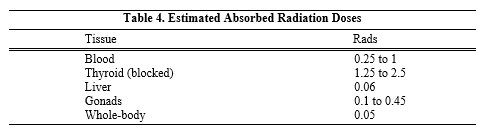
Method of Calculation: Hine GJ, Johnston RE: Absorbed Doses from Radionuclides, J. Nucl Med 11:468-469,1970.
CONTRAINDICATIONS
None Known.
ADVERSE REACTIONS
The following adverse reactions have been identified with the use of radioiodinated albumin products. Because these reactions are reported voluntarily from a population of uncertain size, it is not always possible to reliably estimate their frequency or establish a causal relationship to drug exposure.
Immune System Disorders: Hypersensitivity
DESCRIPTION
Chemical Characteristics MEGATOPE (iodinated I 131 albumin) injection is a sterile, nonpyrogenic, radioactive diagnostic agent for intravenous use. Each mL contains albumin human (approximately 10 mg), dibasic sodium phosphate (16 mg), guanidine hydrochloride (not more than 0.4 mg), monobasic sodium phosphate (1.6 mg), sodium chloride for isotonicity, and benzyl alcohol (9 mg) as a preservative. The stabilizers acetyltryptophanate and sodium caprylate have a concentration of less than 0.89 mM. The pH has been adjusted to 7.2 to 7.8 with sodium hydroxide or hydrochloric acid. Each vial contains 37 MBq/mL (1,000 microCi/mL) of radioactivity as iodinated I 131 albumin at time of calibration (see HOW SUPPLIED).
Physical Characteristics Iodine-131 decays by beta and gamma emissions with a physical half-life of 8.02 days. Photons that are useful for detection and imaging studies are listed in Table 1.
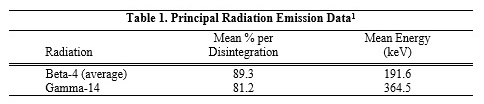
1 Evaluated Nuclear Structure Data File of the Oak Ridge Nuclear Data Project DOE (1985).
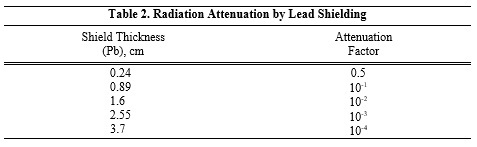
External Radiation The specific gamma ray constant for iodine-131 is 2.2 R/hour-millicurie at 1 cm. The first half-value layer is 0.24 cm lead (Pb). A range of values for the relative attenuation of the radiation emitted by this radionuclide that result from interposition of various thicknesses of Pb is shown in Table 2. To facilitate control of the radiation exposure from this radionuclide, the use of a 2.55 cm thickness of Pb will attenuate the radiation emitted by a factor of about 1,000.
To correct for physical decay of iodine-131, the fractions that remain at selected intervals after the time of calibration are shown in Table 3.
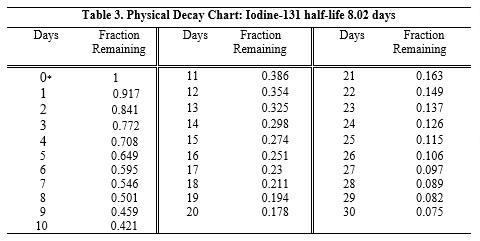
• Calibration time
CLINICAL PHARMACOLOGY
Following intravenous injection, iodinated I 131 albumin is distributed throughout the intravascular pool within 10 minutes; extravascular distribution takes place more slowly. Iodinated I 131 albumin also can be detected in the lymph and in certain body tissues within 10 minutes after injection, but maximum distribution of radioactivity throughout the extravascular space does not occur until two to four days after administration. The time at which extravascular activity is maximal has been designated as the “equilibrium time.” When this point has been reached, the radioactivity remaining in the intravascular and extravascular spaces decreases slowly and exponentially in parallel fashion.
The administered radioactivity is eliminated almost entirely in the urine, only about 2 percent of the total dose ultimately appears in the feces.
The biologic half-life of iodinated I 131 albumin is dependent upon a number of factors, and published studies have varied considerably in their reporting of this figure. It has ranged, in the literature, from below 10 days to over 20 days. One important factor affecting the biologic half-life is the initial rate of excretion, and this depends in part on the quality of the iodinated I 131 albumin. With MEGATOPE, the biologic half-life in normal individuals has been reported to be approximately 14 days.
HOW SUPPLIED
MEGATOPE (iodinated I 131 albumin) injection is a colorless to very pale yellow solution available in multiple-dose vials containing the following amounts of radioactivity on the date of calibration:

Complete radioassay data for each vial are provided on the MEGATOPE vial label.