Get your patient on Methamphetamine Hydrochloride - Methamphetamine Hydrochloride tablet (Methamphetamine Hydrochloride)
Methamphetamine Hydrochloride - Methamphetamine Hydrochloride tablet prescribing information

Methamphetamine has a high potential for abuse and misuse, which can lead to the development of a substance use disorder, including addiction. Misuse and abuse of CNS stimulants, including methamphetamine, can result in overdose and death [see Overdosage (10 )] , and this risk is increased with higher doses or unapproved methods of administration, such as snorting or injection.
Before prescribing methamphetamine, assess each patient’s risk for abuse, misuse, and addiction. Educate patients and their families about these risks, proper storage of the drug, and proper disposal of any unused drug. Throughout methamphetamine treatment, reassess each patient’s risk of abuse, misuse, and addiction and frequently monitor for signs and symptoms of abuse, misuse, and addiction [see Warnings and Precautions (5.1 ) and Drug Abuse and Dependence (9.2 )] .
INDICATIONS AND USAGE
Methamphetamine hydrochloride tablets are indicated for the treatment of Attention Deficit Hyperactivity Disorder (ADHD) in pediatric patients 6 years of age and older.
DOSAGE AND ADMINISTRATION
- Administer methamphetamine hydrochloride tablets orally once daily or in two divided doses daily. Avoid administration late in the evening due to the risk of insomnia. (2.2 )
- Recommended starting dosage is 5 mg once or twice daily. (2.3 )
- Daily dosage may be increased in 5 mg increments at weekly intervals depending on clinical response. (2.3 )
- The recommended dosage range is 20 mg to 25 mg daily. (2.3 )
Pretreatment Screening
Prior to treating patients with methamphetamine hydrochloride tablets, assess:
- for the presence of cardiac disease (i.e., perform a careful history, family history of sudden death or ventricular arrhythmia, and physical examination) [see Warnings and Precautions (5.2 )] .
- the family history and clinically evaluate patients for motor or verbal tics or Tourette’s syndrome before initiating methamphetamine hydrochloride tablets [see Warnings and Precautions (5.9 )] .
Important Dosing Information
Administer methamphetamine hydrochloride tablets orally once daily or in two divided doses daily. Avoid taking methamphetamine hydrochloride tablets late in the evening due to the risk of insomnia.
Recommended Dosage
For pediatric patients 6 years of age and older, the recommended starting dosage is 5 mg methamphetamine hydrochloride tablets once or twice daily. The daily dosage may be increased in increments of 5 mg at weekly intervals based on clinical response of the patient. The recommended dosage range is 20 mg to 25 mg daily.
Dosage Modifications Due to Drug Interactions
Agents that alter urinary pH can impact excretion and alter blood levels of amphetamine. Acidifying agents (e.g., ascorbic acid) decrease blood levels, while alkalinizing agents (e.g., sodium bicarbonate) increase blood levels. Adjust methamphetamine hydrochloride tablets dosage based on clinical response [see Drug Interactions (7.1 )] .
DOSAGE FORMS AND STRENGTHS
Tablets: 5 mg of methamphetamine hydrochloride as a round, white to off-white, biconvex, debossed tablet with “54” on one side and “681” on the other side.
USE IN SPECIFIC POPULATIONS
Pregnancy
Pregnancy Exposure Registry
There is a pregnancy exposure registry that monitors pregnancy outcomes in women exposed to ADHD medications, including methamphetamine hydrochloride tablets, during pregnancy. Healthcare providers are encouraged to advise patients to register by contacting the National Pregnancy Registry for ADHD Medications at 1-866-961-2388 or visiting online at www.womensmentalhealth.org/research/pregnancyregistry/adhd-medications/.
Risk Summary
Available data from epidemiologic studies and postmarketing reports on use of methamphetamine and amphetamine in pregnant women over decades of use have not identified a drug-associated risk of major birth defects or miscarriage. Neonates exposed to amphetamines in utero are at risk for withdrawal symptoms following delivery. Adverse pregnancy outcomes including premature delivery and low birth weight have been seen in infants born to mothers taking amphetamines during pregnancy (see Clinical Considerations) .
In animals, administration of methamphetamine during organogenesis resulted in developmental toxicity, including neonatal death and fetal malformations, at doses equivalent to the maximum recommended human dose (MRHD) on a mg/m 2 basis. Oral administration of methamphetamine to rats during pregnancy, pregnancy and lactation, or lactation resulted in developmental toxicity in the offspring, including, neonatal mortality and delayed development, at a maternal dose similar to the MRHD on a mg/m 2 basis.
The background risk of major birth defects and miscarriage for the indicated population is unknown. All pregnancies have a risk of birth defect, loss, or other adverse outcomes. In the U.S. general population, the estimated background risk of birth defects and miscarriage in clinically recognized pregnancies is 2% to 4% and 15% to 20%, respectively.
Clinical Considerations
Fetal/Neonatal Adverse Reactions
Amphetamines, such as methamphetamine, cause vasoconstriction and thereby decrease placental perfusion. In addition, amphetamines can stimulate uterine contractions, increasing the risk of premature delivery. Infants born to mothers taking amphetamines during pregnancy have an increased risk of premature delivery and low birth weight.
Monitor infants born to mothers taking methamphetamine for symptoms of withdrawal such as feeding difficulties, irritability, agitation, and excessive drowsiness.
Data
Animal Data
Based on published data, methamphetamine administration during the period of organogenesis caused malformations and pup mortality in mammals at doses equivalent to the maximum recommended human dose (MRHD) on a mg/m 2 basis. Oral administration of methamphetamine (0, or 3.75 mg/kg) to pregnant rats during gestation, throughout gestation and lactation, or only during lactation resulted in an increase in neonatal pup mortality. Delayed somatic development (pinna unfolding and eye opening) and impairments in neurobehavioral development (righting reflex, incline plane test, and forelimb grip strength) were observed in the pups. The dose with adverse effects was equivalent to the MRHD of 25 mg on a mg/m 2 basis.
Lactation
Risk Summary
Based on limited case reports in the published literature, methamphetamine and its active metabolite, amphetamine, are present in human milk. There are no reports of adverse effects on the breastfed infant. Long-term neurodevelopmental effects on infants from amphetamine exposure are unknown. It is possible that large doses of amphetamine might interfere with milk production, especially in women whose lactation is not well established. Because of the potential for serious adverse reactions in nursing infants, advise patients that breastfeeding is not recommended during treatment with methamphetamine hydrochloride tablets.
Pediatric Use
The safety and effectiveness of methamphetamine hydrochloride tablets for the treatment of ADHD have been established in pediatric patients aged 6 years and older.
The safety and effectiveness of methamphetamine hydrochloride tablets have not been established in pediatric patients younger than 6 years old.
Growth Suppression
Growth should be monitored during treatment with stimulants, including methamphetamine hydrochloride tablets. Pediatric patients who are not growing or gaining weight as expected may need to have their treatment interrupted [see Warnings and Precautions (5.5 ), Adverse Reactions (6 )] .
Geriatric Use
Clinical studies of methamphetamine hydrochloride tablets did not include sufficient numbers of subjects age 65 years and over to determine whether elderly subjects respond differently from younger subjects.
CONTRAINDICATIONS
Methamphetamine hydrochloride tablets are contraindicated in patients with:
- known hypersensitivity to amphetamine, or other components of methamphetamine hydrochloride tablets. Hypersensitivity reactions such as angioedema and anaphylactic reactions have been reported in patients treated with other amphetamine products [see Adverse Reactions (6 )] .
- taking monoamine oxidase inhibitors (MAOIs), or within 14 days following discontinuation of treatment with an MAOIs (including MAOIs such as linezolid or intravenous methylene blue), because of the risk of hypertensive crisis [see Drug Interactions (7.1 )] .
WARNINGS AND PRECAUTIONS
- Risks to Patients with Serious Cardiac Disease: Avoid use in patients with known structural cardiac abnormalities, cardiomyopathy, serious cardiac arrhythmias, coronary artery disease, or other serious cardiac disease. (5.2 )
- Increased Blood Pressure and Heart Rate: Monitor blood pressure and pulse. (5.3 )
- Psychiatric Adverse Reactions: Prior to initiating methamphetamine hydrochloride tablets, screen patients for risk factors for developing a manic episode. If new psychotic or manic symptoms occur, consider discontinuing methamphetamine hydrochloride tablets. (5.4 )
- Long-Term Suppression of Growth in Pediatric Patients: Closely monitor growth (height and weight) in pediatric patients. Pediatric patients not growing or gaining height or weight as expected may need to have their treatment interrupted. (5.5 )
- Peripheral Vasculopathy, including Raynaud’s Phenomenon: Careful observation for digital changes is necessary during methamphetamine hydrochloride tablets treatment. Further clinical evaluation (e.g., rheumatology referral) may be appropriate for patients who develop signs or symptoms of peripheral vasculopathy. (5.6 )
- Seizures: May lower the convulsive threshold. If a seizure occurs, discontinue methamphetamine hydrochloride tablets. (5.7 )
- Serotonin Syndrome: Increased risk when coadministered with serotonergic agents (e.g., SSRIs, SNRIs, triptans), but also during overdosage situations. If it occurs, discontinue methamphetamine hydrochloride tablets and initiate supportive treatment. (5.8 )
- Motor and Verbal Tics, and Worsening of Tourette’s Syndrome: Before initiating methamphetamine hydrochloride tablets, assess the family history and clinically evaluate patients for tics or Tourette’s syndrome. Regularly monitor patients for the emergence or worsening of tics or Tourette’s syndrome. Discontinue treatment if clinically appropriate. (5.9 )
Abuse, Misuse, and Addiction
Methamphetamine hydrochloride tablets have a high potential for abuse and misuse. The use of methamphetamine hydrochloride tablets exposes individuals to the risks of abuse and misuse, which can lead to the development of a substance use disorder, including addiction. Methamphetamine hydrochloride tablets can be diverted for non-medical use into illicit channels or distribution [see Drug Abuse and Dependence (9.2 , 9.3 )] . Misuse and abuse of CNS stimulants, including methamphetamine hydrochloride tablets, can result in overdose and death [see Overdosage (10 )] , and this risk is increased with higher doses or unapproved methods of administration, such as snorting or injection.
Before prescribing methamphetamine hydrochloride tablets, assess each patient’s risk for abuse, misuse, and addiction. Educate patients and their families about these risks and proper disposal of any unused drug. Advise patients to store methamphetamine hydrochloride tablets in a safe place, preferably locked, and instruct patients to not give methamphetamine hydrochloride tablets to anyone else. Throughout methamphetamine treatment, reassess each patient’s risk of abuse, misuse, and addiction and frequently monitor for signs and symptoms of abuse, misuse, and addiction.
Risks to Patients with Serious Cardiac Disease
Sudden death has been reported in patients with structural cardiac abnormalities or other serious cardiac disease who were treated with CNS stimulants at the recommended ADHD dosages.
Avoid methamphetamine use in patients with known structural cardiac abnormalities, cardiomyopathy, serious heart arrhythmia, coronary artery disease, or other serious heart problems.
Increased Blood Pressure and Heart Rate
CNS stimulants cause an increase in blood pressure (mean increase about 2 to 4 mm Hg) and heart rate (mean increase about 3 to 6 bpm). Some patients may have larger increases.
Monitor all methamphetamine hydrochloride tablets-treated patients for potential tachycardia and hypertension [see Adverse Reactions (6 )] .
Psychiatric Adverse Reactions
Exacerbation of Pre-Existing Psychosis
CNS stimulants may exacerbate symptoms of behavior disturbance and thought disorder in patients with a pre-existing psychotic disorder.
Induction of a Manic Episode in Patients with Bipolar Illness
CNS stimulants may induce a mixed or manic episode in patients with bipolar disorder. Prior to initiating methamphetamine hydrochloride tablets treatment, screen patients for risk factors for developing a manic episode (e.g., comorbid or has a history of depressive symptoms or a family history of suicide, bipolar disorder, or depression).
New Psychotic or Manic Symptoms
CNS stimulants, at recommended doses, may cause psychotic or manic symptoms (e.g., hallucinations, delusional thinking, or mania) in patients without prior history of psychotic illness or mania. In a pooled analysis of multiple short-term, placebo-controlled studies of CNS stimulants, psychotic or manic symptoms occurred in 0.1% of CNS stimulant-treated patients compared to 0% in placebo-treated patients. If such symptoms occur, consider discontinuing methamphetamine hydrochloride tablets.
Long-Term Suppression of Growth in Pediatric Patients
CNS stimulants have been associated with weight loss and slowing of growth rate in pediatric patients. Closely monitor growth (weight and height) in methamphetamine-treated pediatric patients treated with CNS stimulants.
Pediatric patients who are not growing or gaining height or weight as expected may need to have their treatment interrupted.
Peripheral Vasculopathy, including Raynaud’s Phenomenon
CNS stimulants, including methamphetamine hydrochloride tablets, used to treat ADHD are associated with peripheral vasculopathy, including Raynaud’s phenomenon. Signs and symptoms are usually intermittent and mild; however, very rare sequelae include digital ulceration and/or soft tissue breakdown. Effects of peripheral vasculopathy, including Raynaud’s phenomenon, were observed in post-marketing reports at different times and at therapeutic doses in all age groups throughout the course of treatment. Signs and symptoms generally improve after reduction in dose or discontinuation of CNS stimulant.
Careful observation for digital changes is necessary during methamphetamine treatment. Further clinical evaluation (e.g., rheumatology referral) may be appropriate for methamphetamine-treated patients who develop signs or symptoms of peripheral vasculopathy.
Seizures
Methamphetamine hydrochloride tablets may lower the convulsive threshold in patients with prior history of seizure, in patients with prior EEG abnormalities in the absence of seizures, and in patients without a history of seizures and no prior EEG evidence of seizures. In the presence of seizures, methamphetamine hydrochloride tablets should be discontinued.
Serotonin Syndrome
Serotonin syndrome, a potentially life-threatening reaction, may occur when amphetamines are used in combination with other drugs that affect the serotonergic neurotransmitter systems such as monoamine oxidase inhibitors (MAOIs), selective serotonin reuptake inhibitors (SSRIs), serotonin norepinephrine reuptake inhibitors (SNRIs), triptans, tricyclic antidepressants, fentanyl, lithium, tramadol, tryptophan, buspirone, and St. John’s Wort [see Drug Interactions (7.1 )] . The coadministration with cytochrome P450 2D6 (CYP2D6) inhibitors may also increase the risk with increased exposure to methamphetamine hydrochloride tablets. In these situations, consider an alternative nonserotonergic drug or an alternative drug that does not inhibit CYP2D6 [see Drug Interactions (7.1 )] .
Serotonin syndrome symptoms may include mental status changes (e.g., agitation, hallucinations, delirium, and coma), autonomic instability (e.g., tachycardia, labile blood pressure, dizziness, diaphoresis, flushing, hyperthermia), neuromuscular symptoms (e.g., tremor, rigidity, myoclonus, hyperreflexia, incoordination), seizures, and/or gastrointestinal symptoms (e.g., nausea, vomiting, diarrhea).
Concomitant use of methamphetamine hydrochloride tablets with MAOI drugs is contraindicated [see Contraindications (4 )] .
Discontinue treatment with methamphetamine hydrochloride tablets and any concomitant serotonergic agents immediately if the above symptoms occur, and initiate supportive symptomatic treatment. If concomitant use of methamphetamine hydrochloride tablets with other serotonergic drugs or CYP2D6 inhibitors is clinically warranted, initiate methamphetamine hydrochloride tablets with lower doses, monitor patients for the emergence of serotonin syndrome during drug initiation or titration, and inform patients of the increased risk for serotonin syndrome.
Motor and Verbal Tics, and Worsening of Tourette’s Syndrome
CNS stimulants, including amphetamine, have been associated with the onset or exacerbation of motor and verbal tics. Worsening of Tourette’s syndrome has also been reported [see Adverse Reactions (6 )] .
Before initiating methamphetamine hydrochloride tablets, assess the family history and clinically evaluate patients for tics or Tourette’s syndrome. Regularly monitor methamphetamine hydrochloride tablets-treated patients for the emergence or worsening of tics or Tourette’s syndrome, and discontinue treatment if clinically appropriate.
ADVERSE REACTIONS
The following adverse reactions are discussed in greater detail in other sections of the labeling:
- Abuse, Misuse, and Addiction [see Boxed Warning, Warnings and Precautions (5.1 ), Drug Abuse and Dependence (9.2 , 9.3 )]
- Hypersensitivity to amphetamine products or other ingredients of methamphetamine hydrochloride tablets [see Contraindications (4 )]
- Hypertensive Crisis When Used Concomitantly with Monoamine Oxidase Inhibitors [see Contraindications (4 ), Drug Interactions (7.1 )]
- Risks to Patient with Serious Cardiac Disease [see Warnings and Precautions (5.2 )]
- Increased Blood Pressure and Heart Rate [see Warnings and Precautions (5.3 )]
- Psychiatric Adverse Reactions [see Warnings and Precautions (5.4 )]
- Long-Term Suppression of Growth in Pediatric Patients [see Warnings and Precautions (5.5 )]
- Peripheral Vasculopathy, including Raynaud’s Phenomenon [see Warnings and Precautions (5.6 )]
- Seizures [see Warnings and Precautions (5.7 )]
- Serotonin Syndrome [see Warnings and Precautions (5.8 )]
- Motor and Verbal Tics, and Worsening of Tourette’s Syndrome [see Warnings and Precautions (5.9 )]
The following adverse reactions associated with the use of methamphetamine hydrochloride tablets were identified in clinical trials or postmarketing reports. Because these reactions were reported voluntarily from a population of uncertain size, it is not always possible to reliably estimate their frequency or establish a causal relationship to drug exposure.
Cardiovascular: Elevation of blood pressure, tachycardia and palpitation. Fatal cardiorespiratory arrest has been reported, mostly in the context of abuse/misuse
Central Nervous System: Psychotic episodes reported at recommended doses. Dizziness, dysphoria, overstimulation, euphoria, insomnia, tremor, restlessness and headache. Exacerbation of motor and verbal tics and Tourette’s syndrome
Gastrointestinal: Diarrhea, constipation, dryness of mouth, unpleasant taste, intestinal ischemia, and other gastrointestinal disturbances
Hypersensitivity: Urticaria
Endocrine: Impotence and changes in libido; frequent or prolonged erections
Musculoskeletal: Rhabdomyolysis
Metabolism and Nutrition Disorders: Suppression of growth has been reported with the long-term use of stimulants in pediatric patients
Skin and Subcutaneous Tissue Disorders: Alopecia
The following additional adverse reactions have been identified during post approval use of amphetamines:
Allergic: Rash, hypersensitivity reactions, including angioedema and anaphylaxis. Serious skin rashes, including Stevens-Johnson syndrome and toxic epidermal necrolysis have been reported.
Cardiovascular: Dyspnea, sudden death, myocardial infarction. There have been isolated reports of cardiomyopathy associated with chronic amphetamine use
Central Nervous System: dyskinesia, fatigue, aggression, anger, logorrhea, dermatillomania, and paresthesia (including formication)
Eye Disorders: Mydriasis
Vascular Disorders: Raynaud’s phenomenon
DRUG INTERACTIONS
Acidifying and Alkalinizing Agents: Agents that alter GI and urinary pH can alter blood levels of amphetamine. Acidifying agents can decrease amphetamine blood levels, while alkalinizing agents can increase amphetamine blood levels. (7.1 )
Drugs Having Clinically Important Interactions with Methamphetamine Hydrochloride Tablets
Table 1 presents clinically important drug interactions with methamphetamine hydrochloride tablets.
Monoamine Oxidase Inhibitors (MAOI) | |
Clinical Impact: | MAOI antidepressants slow amphetamine metabolism, increasing amphetamines effect on the release of norepinephrine and other monoamines from adrenergic nerve endings causing headaches and other signs of hypertensive crisis. Toxic neurological effects and malignant hyperpyrexia can occur, sometimes with fatal results. |
Intervention: | Concomitant use of methamphetamine hydrochloride tablets with monoamine oxidase inhibitors (MAOIs) or within 14 days after discontinuing MAOI treatment is contraindicated [see Contraindications (4 )] . |
Serotonergic Drugs | |
Clinical Impact: | The concomitant use of amphetamines, including methamphetamine, and serotonergic drugs increases the risk of serotonin syndrome. |
Intervention: | Initiate methamphetamine hydrochloride tablets with lower doses and monitor patients for signs and symptoms of serotonin syndrome, particularly during methamphetamine hydrochloride tablets initiation or dosage increase. If serotonin syndrome occurs, discontinue methamphetamine hydrochloride tablets and the concomitant serotonergic drug(s) [see Warnings and Precautions (5.8 )] . |
Alkalinizing Agents | |
Clinical Impact: | Alkalinizing agents may increase exposure to amphetamines and potentiate the action of amphetamine. |
Intervention: | Avoid co-administration of methamphetamine hydrochloride tablets and gastrointestinal and urinary alkalinizing agents. |
Acidifying Agents | |
Clinical Impact: | Acidifying agents lower blood levels and efficacy of amphetamines. |
Intervention: | Increase dose of methamphetamine hydrochloride tablets based on clinical response. |
Tricyclic Antidepressants | |
Clinical Impact: | May enhance the activity of tricyclic or sympathomimetic agents causing sustained increases in the concentration of d-amphetamine in the brain; cardiovascular effects can be potentiated. |
Intervention: | Monitor frequently and adjust methamphetamine hydrochloride tablets dose or use alternative therapy based on clinical response. |
CYP2D6 Inhibitors | |
Clinical Impact: | Concomitant use of methamphetamine hydrochloride tablets and CYP2D6 inhibitors may increase the exposure of methamphetamine compared to the use of the drug alone, and increase the risk of serotonin syndrome. |
Intervention: | Start with lower doses and monitor patients for signs and symptoms of serotonin syndrome particularly during methamphetamine hydrochloride tablets initiation and after a dosage increase. If serotonin syndrome occurs, discontinue methamphetamine hydrochloride tablets and the CYP2D6 inhibitor [see Warnings and Precautions (5.8 )] . |
Gastric pH Modulators | |
Clinical Impact: | Time to maximum concentration (T max ) of amphetamine is decreased compared to when administered alone. |
Intervention: | Monitor patients for changes in clinical effect and use alternative therapy based on clinical response. |
Guanethidine | |
Clinical Impact: | Methamphetamine may decrease the hypotensive effect of guanethidine . |
Intervention: | Monitor patients and adjust therapy based on clinical response. |
Insulin requirements in diabetes mellitus may be altered in association with the use of methamphetamine and the concomitant dietary regimen.
Drug/Laboratory Test Interactions
Amphetamines can cause a significant elevation in plasma corticosteroid levels. This increase is greatest in the evening. Amphetamines may interfere with urinary steroid determinations.
DESCRIPTION
Methamphetamine hydrochloride, USP, chemically known as (αS)-α-Methylbenzeneethan-(N-methyl)-amine Hydrochloride, is a member of the amphetamine group of sympathomimetic amines. It has the following structural formula:
Methamphetamine hydrochloride tablets, USP contain 5 mg of methamphetamine hydrochloride, USP for oral administration. In addition, each tablet contains the following inactive ingredients: crospovidone, magnesium stearate, microcrystalline cellulose, and povidone.
CLINICAL PHARMACOLOGY
Mechanism of Action
Amphetamines are non-catecholamine sympathomimetic amines with CNS stimulant activity. The exact mode of therapeutic action in the treatment of ADHD is not known.
Pharmacodynamics
Amphetamines block the reuptake of norepinephrine and dopamine into the presynaptic neuron and increase the release of these monoamines into the extraneuronal space.
Pharmacokinetics
Absorption
Methamphetamine is absorbed from the gastrointestinal tract.
Elimination
Metabolism
The primary site of metabolism is in the liver by aromatic hydroxylation, N-dealkylation and deamination. At least seven metabolites have been identified in the urine. The biological half-life has been reported in the range of 4 to 5 hours.
Excretion
Excretion occurs primarily in the urine and is dependent on urine pH. Alkaline urine will significantly increase the drug half-life. Approximately 62% of an oral dose is eliminated in the urine within the first 24 hours with about one-third as intact drug and the remainder as metabolites.
NONCLINICAL TOXICOLOGY
Carcinogenesis, Mutagenesis, Impairment of Fertility
Carcinogenicity and Mutagenesis
Carcinogenicity, mutagenic, or genotoxic potential of methamphetamine has not been fully characterized.
Impairment of Fertility
There have been no adequate studies performed in animals at current standards to evaluate the effect of methamphetamine treatment on fertility. However, published studies in mice and rats exposed to repeated daily dosing of methamphetamine report irregular estrous cycling and decreased ovarian reserve in females, and decreased sperm density, motility, and percent of sperm with normal morphology in males. The clinical significance of these findings is not clear.
HOW SUPPLIED/STORAGE AND HANDLING
Methamphetamine Hydrochloride Tablets, USP
How Supplied 5 mg tablets are supplied as a round, white to off-white, biconvex, debossed tablet with “54” on one side and “681” on the other side.
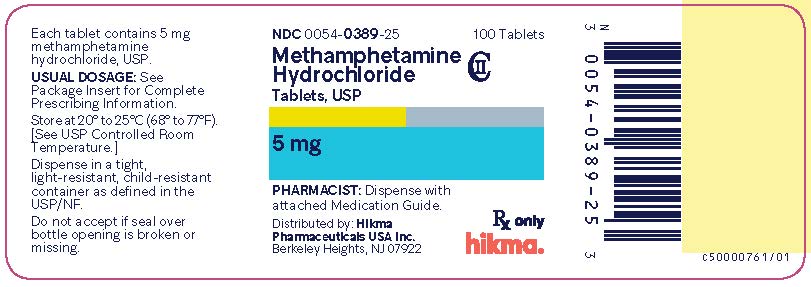
NDC 0054-0389-25: Bottle of 100 tablets
Storage and Handling Recommended Storage: Store at 20°C to 25°C (68°F to 77°F). [See USP Controlled Room Temperature.]
Dispense in a tight, light resistant, child-resistant container as defined in the USP/NF.
Mechanism of Action
Amphetamines are non-catecholamine sympathomimetic amines with CNS stimulant activity. The exact mode of therapeutic action in the treatment of ADHD is not known.
