Get your patient on Nalmefene Hydrochloride - Nalmefene Hydrochloride Injection solution (Nalmefene Hydrochloride Injection)
Nalmefene Hydrochloride - Nalmefene Hydrochloride Injection solution prescribing information

INDICATIONS AND USAGE
Nalmefene Hydrochloride Injection is indicated for the complete or partial reversal of opioid drug effects, including respiratory depression, induced by either natural or synthetic opioids.
Nalmefene Hydrochloride Injection is indicated in the management of known or suspected opioid overdose.
DOSAGE AND ADMINISTRATION
Important Information - Dosage Forms
Nalmefene Hydrochloride Injection is supplied in two concentrations that can be identified by their color coded container labels: a concentration suitable for postoperative use (100 µg/mL) in a blue labeled vial containing ONE (1) mL and a concentration suitable for the management of overdose (1 mg/mL, 10 times as concentrated, 20 times as much drug) in a green labeled vial containing TWO (2) mL. Proper steps should be taken to prevent use of the incorrect concentration.
General Principles Nalmefene hydrochloride injection should be titrated to reverse the undesired effects of opioids. Once adequate reversal has been established, additional administration is not required and may actually be harmful due to unwanted reversal of analgesia or precipitated withdrawal.
Duration of Action The duration of action of nalmefene hydrochloride injection is as long as most opioid analgesics. The apparent duration of action of nalmefene hydrochloride injection will vary, however, depending on the half-life and plasma concentration of the narcotic being reversed, the presence or absence of other drugs affecting the brain or muscles of respiration, and the dose of nalmefene hydrochloride injection administered. Partially reversing doses of nalmefene hydrochloride injection (1 µg/kg) lose their effect as the drug is redistributed through the body, and the effects of these low doses may not last more than 30-60 minutes in the presence of persistent opioid effects. Fully reversing doses (1 mg/70 kg) have been shown to last many hours in both experimental and clinical studies, but may complicate the management of patients who are in pain, at high cardiovascular risk, or who are physically dependent on opioids. The recommended doses represent a compromise between a desirable controlled reversal and the need for prompt response and adequate duration of action. Using higher dosages or shorter intervals between incremental doses is likely to increase the incidence and severity of symptoms related to acute withdrawal such as nausea, vomiting, elevated blood pressure, and anxiety.
Patients Tolerant to or Physically Dependent on Opioids Nalmefene hydrochloride injection may cause acute withdrawal symptoms in individuals who have some degree of tolerance to and dependence on opioids. These patients should be closely observed for symptoms of withdrawal following administration of the initial and subsequent injections of nalmefene hydrochloride injection. Subsequent doses should be administered with intervals of at least 2-5 minutes between doses to allow the full effect of each incremental dose of nalmefene hydrochloride injection to be reached.
Recommended Doses for Reversal of Postoperative Opioid Depression Use 100 µg/mL dosage strength (blue label) and see Table 2 for initial doses. The goal of treatment with nalmefene hydrochloride injection in the postoperative setting is to achieve reversal of excessive opioid effects without inducing a complete reversal and acute pain. This is best accomplished with an initial dose of 0.25 µg/kg followed by 0.25 µg/kg incremental doses at 2-5 minute intervals, stopping as soon as the desired degree of opioid reversal is obtained. A cumulative total dose above 1.0 µg/kg does not provide additional therapeutic effect.
Table 2: Reversal of Postoperative Opioid Depression
Body Weight | mL of Nalmefene 100 µg/mL Solution |
50 kg | 0.125 |
60 kg | 0.150 |
70 kg | 0.175 |
80 kg | 0.200 |
90 kg | 0.225 |
100 kg | 0.250 |
In cases where the patient is known to be at increased cardiovascular risk, it may be desirable to dilute Nalmefene Hydrochloride Injection 1:1 with saline or sterile water and use smaller initial and incremental doses of 0.1 µg/kg.
Management of Known or Suspected Opioid Overdose Use 1.0 mg/mL dosage strength (green label). The recommended initial dose of nalmefene hydrochloride injection for non-opioid dependent patients is 0.5 mg/70 kg. If needed, this may be followed by a second dose of 1.0 mg/70 kg, 2-5 minutes later. If a total dose of 1.5 mg /70 kg has been administered without clinical response, additional Nalmefene Hydrochloride Injection is unlikely to have an effect. Patients should not be given more nalmefene hydrochloride injection than is required to restore the respiratory rate to normal, thus minimizing the likelihood of cardiovascular stress and precipitated withdrawal syndrome. If there is a reasonable suspicion of opioid dependency, a challenge dose of nalmefene hydrochloride injection 0.1 mg/70 kg should be administered initially. If there is no evidence of withdrawal in 2 minutes, the recommended dosing should be followed. Nalmefene hydrochloride injection had no effect in cases where opioids were not responsible for sedation and hypoventilation. Therefore, patients should only be treated with Nalmefene Hydrochloride Injection when the likelihood of an opioid overdose is high, based on a history of opioid overdose or the clinical presentation of respiratory depression with concurrent pupillary constriction.
Repeated Dosing Nalmefene hydrochloride injection is the longest acting of the currently available parenteral opioid antagonists. If recurrence of respiratory depression does occur, the dose should again be titrated to clinical effect using incremental doses to avoid over-reversal.
Hepatic and Renal Disease Hepatic disease and renal failure substantially reduce the clearance of nalmefene (see Pharmacokinetic s ). For single episodes of opioid antagonism, adjustment of nalmefene hydrochloride injection dosage is not required. However, in patients with renal failure, the incremental doses should be delivered slowly (over 60 seconds) to minimize the hypertension and dizziness reported following the abrupt administration of nalmefene to such patients.
Loss of Intravenous Access Should intravenous access be lost or not readily obtainable, a pharmacokinetic study has shown that a single dose of nalmefene hydrochloride injection should be effective within 5-15 minutes after intramuscular or subcutaneous doses of 1.0 mg. (see Pharmacokinetics .)
Special Populations
ELDERLY
Dose proportionality was observed in nalmefene AUC 0-inf following 0.5 to 2 mg intravenous administration to elderly male subjects. Following a 1 mg intravenous nalmefene dose, there were no significant differences between young (19-32 years) and elderly (62-80 years) adult male subjects with respect to plasma clearance, steady-state volume of distribution, or half-life. There was an apparent age-related decrease in the central volume of distribution (young: 3.9 ± 1.1 L/kg, elderly: 2.8 ± 1.1 L/kg) that resulted in a greater initial nalmefene concentration in the elderly group. While initial nalmefene plasma concentrations were transiently higher in the elderly, it would not be anticipated that this population would require dosing adjustment. No clinical adverse events were noted in the elderly following the 1 mg intravenous nalmefene dose.
PATIENTS WITH HEPATIC IMPAIRMENT
Subjects with hepatic disease, when compared to matched normal controls, had a 28.3% decrease in plasma clearance of nalmefene (0.56 ± 0.21 L/hr/kg versus 0.78 ± 0.24 L/hr/kg, respectively). Elimination halflife increased from 10.2 ± 2.2 hours to 11.9 ± 2.0 hours in the hepatically impaired. No dosage adjustment is recommended since nalmefene will be administered as an acute course of therapy.
PATIENTS WITH RENAL IMPAIRMENT
There was a statistically significant 27% decrease in plasma clearance of nalmefene in the end-stage renal disease (ESRD) population during interdialysis (0.57 ± 0.20 L/hr/kg) and a 25% decreased plasma clearance in the ESRD population during intradialysis (0.59 ±0.18 L/hr/kg) compared to normals (0.79 ± 0.24 L/hr/kg). The elimination half-life was prolonged in ESRD patients from 10.2 ± 2.2 hours in normals to 26.1 ± 9.9 hours. (See DOSAGE AND ADMINISTRATION .)
GENDER DIFFERENCES
There has not been sufficient pharmacokinetic study to make a definitive statement as to whether the pharmacokinetics of nalmefene differs between the genders.
CONTRAINDICATIONS
Nalmefene Hydrochloride Injection is contraindicated in patients with a known hypersensitivity to the product.
ADVERSE REACTIONS
Adverse event information was obtained following administration of nalmefene hydrochloride injection to 152 normal volunteers and in controlled clinical trials to 1127 patients for the treatment of opioid overdose or for postoperative opioid reversal. Nalmefene was well tolerated and showed no serious toxicity during experimental administration to healthy individuals, even when given at 15 times the highest recommended dose. In a small number of subjects, at doses exceeding the recommended nalmefene hydrochloride injection dose, nalmefene produced symptoms suggestive of reversal of endogenous opioids, such as have been reported for other narcotic antagonist drugs. These symptoms (nausea, chills, myalgia, dysphoria, abdominal cramps, and joint pain) were usually transient and occurred at very low frequency. Such symptoms of precipitated opioid withdrawal at the recommended clinical doses were seen in both postoperative and overdose patients who were later found to have had histories of covert opioid use. Symptoms of precipitated withdrawal were similar to those seen with other opioid antagonists, were transient following the lower doses used in the postoperative setting, and more prolonged following the administration of the larger doses used in the treatment of overdose. Tachycardia and nausea following the use of nalmefene in the postoperative setting were reported at the same frequencies as for naloxone at equivalent doses. The risk of both these adverse events was low at doses giving partial opioid reversal and increased with increases in dose. Thus, total doses larger than 1.0 µg/kg in the postoperative setting and 1.5 mg/70 kg in the treatment of overdose are not recommended.
Relative Frequencies of Common Adverse Reactions With an Incidence Greater than 1% (all patients, all clinical settings)
Adverse Event | Nalmefene | Naloxone | Placebo |
N=1127 | N=369 | N=77 | |
Nausea | 18% | 18% | 6% |
Vomiting | 9% | 7% | 4% |
Tachycardia | 5% | 8% | |
Hypertension | 5% | 7% | |
Postoperative pain | 4% | 4% | N/A |
Fever | 3% | 4% | |
Dizziness | 3% | 4% | 1% |
Headache | 1% | 1% | 4% |
Chills | 1% | 1% | |
Hypotension | 1% | 1% | |
Vasodilatation | 1% | 1% |
Incidence less than 1% CARDIOVASCULAR: Bradycardia, arrhythmia
DIGESTIVE: Diarrhea, dry mouth
NERVOUS SYSTEM: Somnolence, depression, agitation, nervousness, tremor, confusion, withdrawal syndrome, myoclonus RESPIRATORY: Pharyngitis
SKIN: Pruritus UROGENITAL: Urinary retention The incidence of adverse events was highest in patients who received more than the recommended dose of nalmefene hydrochloride injection. Laboratory findings: Transient increases in CPK were reported as adverse events in 0.5% of the postoperative patients studied. These increases were believed to be related to surgery and not believed to be related to the administration of nalmefene hydrochloride injection. Increases in AST were reported as adverse events in 0.3% of the patients receiving either nalmefene or naloxone. The clinical significance of this finding is unknown. No cases of hepatitis or hepatic injury due to either nalmefene or naloxone were observed in the clinical trials.
Nalmefene Hydrochloride Injection Rx only DESCRIPTION
Nalmefene Hydrochloride Injection, an opioid antagonist, is a 6-methylene analogue of naltrexone. The chemical structure is shown below:
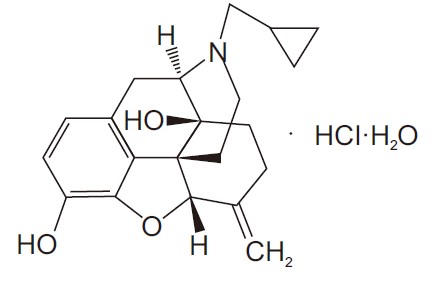
Molecular Formula: C 21 H 25 NO 3 •HCl•H 2 O
Molecular Weight: 393.91, CAS # 1228646-72-7
Chemical Name: 17-(Cyclopropylmethyl)-4,5α-epoxy-6-methylenemorphinan-3,14-diol, hydrochloride salt, monohydrate
Nalmefene hydrochloride is a white to almost white crystalline powder which is freely soluble in water up to 130 mg/mL and slightly soluble in chloroform up to 0.13 mg/mL, with a pK a of 7.6.
Nalmefene Hydrochloride Injection is available as a sterile solution for intravenous, intramuscular, and subcutaneous administration in two concentrations, containing 100 µg or 1.0 mg of nalmefene free base per mL. The 100 µg/mL concentration contains 110.8 µg of nalmefene hydrochloride and the 1.0 mg/mL concentration contains 1.108 mg of nalmefene hydrochloride per mL. Both concentrations contain 9.0 mg of sodium chloride per mL and the pH is adjusted in the range of 3.3-3.5 with hydrochloric acid.
Concentrations and dosages of Nalmefene Hydrochloride Injection are expressed as the free base equivalent of nalmefene.
CLINICAL PHARMACOLOGY
Pharmacodynamics
Nalmefene hydrochloride injection prevents or reverses the effects of opioids, including respiratory depression, sedation, and hypotension. Pharmacodynamic studies have shown that nalmefene hydrochloride injection has a longer duration of action than naloxone at fully reversing doses. Nalmefene hydrochloride injection has no opioid agonist activity.
Nalmefene hydrochloride injection is not known to produce respiratory depression, psychotomimetic effects, or pupillary constriction. No pharmacological activity was observed when nalmefene hydrochloride injection was administered in the absence of opioid agonists.
Nalmefene hydrochloride injection has not been shown to produce tolerance, physical dependence, or abuse potential.
Nalmefene hydrochloride injection can produce acute withdrawal symptoms in individuals who are opioid dependent.
Pharmacokinetics
Nalmefene exhibited dose proportional pharmacokinetics following intravenous administration of 0.5 mg to 2.0 mg. Pharmacokinetic parameters for nalmefene after a 1 mg intravenous administration in adult male volunteers are listed in Table 1.
Table 1: Mean (CV%) Nalmefene Pharmacokinetic Parameters InAdult Males Following a 1 mg Intravenous Dose
| Parameter | Young, N=18 | Elderly, N=11 |
| Age | 19-32 | 62-80 |
| Cp at 5 min. (ng/mL) | 3.7 (29) | 5.8 (38) |
| Vdss (L/kg) | 8.6 (19) | 8.6 (29) |
| Vc (L/kg) | 3.9 (29) | 2.8 (41) |
| AUC0-inf (ng-hr/mL) | 16.6 (27) | 17.3 (14) |
| Terminal T1/2 (hr) | 10.8 (48) | 9.4 (49) |
| Clplasma (L/hr/kg) | 0.8 (23) | 0.8 (18) |
ABSORPTION
Nalmefene was completely bioavailable following intramuscular or subcutaneous administration in 12 male volunteers relative to intravenous nalmefene. The relative bioavailabilities of intramuscular and subcutaneous routes of administration were 101.5% ± 8.1% (Mean ± SD) and 99.7% ± 6.9%, respectively. Nalmefene will be administered primarily as an intravenous bolus, however, nalmefene can be given intra-muscularly (IM) or subcutaneously (SC) if venous access cannot be established. While the time to maximum plasma nalmefene concentration was 2.3 ± 1.1 hours following intramuscular and 1.5 ± 1.2 hours following subcutaneous administrations, therapeutic plasma concentrations are likely to be reached within 5-15 minutes after a 1 mg dose in an emergency. Because of the variability in the speed of absorption for IM & SC dosing, and the inability to titrate to effect, great care should be taken if repeated doses must be given by these routes.
DISTRIBUTION
Following a 1 mg parenteral dose, nalmefene was rapidly distributed. In a study of brain receptor occupancy, a 1 mg dose of nalmefene blocked over 80% of brain opioid receptors within 5 minutes after administration. The apparent volumes of distribution centrally (Vc) and at steady-state (Vdss) are 3.9 ± 1.1 L/kg and 8.6 ± 1.7 L/kg, respectively. Ultrafiltration studies of nalmefene have demonstrated that 45% (CV 4.1%) is bound to plasma proteins over a concentration range of 0.1 to 2 µg/mL. An in vitro determination of the distribution of nalmefene in human blood demonstrated that nalmefene distributed 67% (CV 8.7%) into red blood cells and 39% (CV 6.4%) into plasma. The whole blood to plasma ratio was 1.3 (CV 6.6%) over the nominal concentration range in whole blood from 0.376 to 30 ng/mL.
METABOLISM
Nalmefene is metabolized by the liver, primarily by glucuronide conjugation, and excreted in the urine. Nalmefene is also metabolized to trace amounts of an N- dealkylated metabolite. Nalmefene glucuronide is inactive and the N-dealkylated metabolite has minimal pharmacological activity. Less than 5% of nalmefene is excreted in the urine unchanged. Seventeen percent (17%) of the nalmefene dose is excreted in the feces. The plasma concentration-time profile in some subjects suggests that nalmefene undergoes enterohepatic recycling.
ELIMINATION
After intravenous administration of 1 mg nalmefene hydrochloride injection to normal males (ages 19-32), plasma concentrations declined biexponentially with a redistribution and a terminal elimination half-life of 41 ± 34 minutes and 10.8 ± 5.2 hours, respectively. The systemic clearance of nalmefene is 0.8 ± 0.2 L/hr/kg and the renal clearance is 0.08 ± 0.04 L/hr/kg.
Special Populations
ELDERLY
Dose proportionality was observed in nalmefene AUC 0-inf following 0.5 to 2 mg intravenous administration to elderly male subjects. Following a 1 mg intravenous nalmefene dose, there were no significant differences between young (19-32 years) and elderly (62-80 years) adult male subjects with respect to plasma clearance, steady-state volume of distribution, or half-life. There was an apparent age-related decrease in the central volume of distribution (young: 3.9 ± 1.1 L/kg, elderly: 2.8 ± 1.1 L/kg) that resulted in a greater initial nalmefene concentration in the elderly group. While initial nalmefene plasma concentrations were transiently higher in the elderly, it would not be anticipated that this population would require dosing adjustment. No clinical adverse events were noted in the elderly following the 1 mg intravenous nalmefene dose.
PATIENTS WITH HEPATIC IMPAIRMENT
Subjects with hepatic disease, when compared to matched normal controls, had a 28.3% decrease in plasma clearance of nalmefene (0.56 ± 0.21 L/hr/kg versus 0.78 ± 0.24 L/hr/kg, respectively). Elimination halflife increased from 10.2 ± 2.2 hours to 11.9 ± 2.0 hours in the hepatically impaired. No dosage adjustment is recommended since nalmefene will be administered as an acute course of therapy.
PATIENTS WITH RENAL IMPAIRMENT
There was a statistically significant 27% decrease in plasma clearance of nalmefene in the end-stage renal disease (ESRD) population during interdialysis (0.57 ± 0.20 L/hr/kg) and a 25% decreased plasma clearance in the ESRD population during intradialysis (0.59 ±0.18 L/hr/kg) compared to normals (0.79 ± 0.24 L/hr/kg). The elimination half-life was prolonged in ESRD patients from 10.2 ± 2.2 hours in normals to 26.1 ± 9.9 hours. (See DOSAGE AND ADMINISTRATION .)
GENDER DIFFERENCES
There has not been sufficient pharmacokinetic study to make a definitive statement as to whether the pharmacokinetics of nalmefene differs between the genders.
HOW SUPPLIED
Nalmefene Hydrochloride Injection is available in the following presentations: A single-dose vial containing 1 mL of 100 µg/mL nalmefene base (Blue Label) Box of 1 (NDC 82432-101-01) A single-dose vial containing 2 mL of 1 mg/mL nalmefene base (Green Label) Box of 1 (NDC 82432-102-02) Protect from light, store at 20°C-25°C (68°F to 77°F). [see USP Controlled Room Temperature]
Discard unused portion.
Manufacturer Chengdu Shuode Pharmaceutical Co., Ltd
No. 9 Lekang Road, Shuangliu District Chengdu, Sichuan 610200 China (CHN)
Revision date: 06/27/2023
