Get your patient on Olopatadine Hydrochloride - Olopatadine Hydrochloride solution/ Drops (Olopatadine Hydrochloride)
Olopatadine Hydrochloride - Olopatadine Hydrochloride solution/ Drops prescribing information

INDICATIONSAND USAGE
Olopatadine hydrochloride ophthalmic solution USP, 0.2 % is indicated for the treatment of ocular itching associated with allergic conjunctivitis.
DOSAGE AND ADMINISTRATION
The recommended dose is one drop in each affected eye once a day.
DOSAGE FORMS AND STRENGTHS
Ophthalmic solution 0.2%: each ml contains 2.22 mg of olopatadine hydrochloride.
USE IN SPECIFIC POPULATIONS
Pregnancy
Teratogenic effects: Pregnancy Category C
Olopatadine was found not to be teratogenic in rats and rabbits. However, rats treated at 600 mg/kg/day, or 150,000 times the MROHD and rabbits treated at 400 mg/kg/day, or approximately 100,000 times the MROHD, during organogenesis showed a decrease in live fetuses. In addition, rats treated with 600 mg/kg/day of olopatadine during organogenesis showed a decrease in fetal weight. Further, rats treated with 600 mg/kg/day of olopatadine during late gestation through the lactation period showed a decrease in neonatal survival and body weight. There are, however, no adequate and well- controlled studies in pregnant women. Because animal studies are not always predictive of human responses, this drug should be used in pregnant women only if the potential benefit to the mother justifies the potential risk to the embryo or fetus.
Nursing Mothers
Olopatadine has been identified in the milk of nursing rats following oral administration. It is not known whether topical ocular administration could result in sufficient systemic absorption to produce detectable quantities in the human breast milk. Nevertheless, caution should be exercised when olopatadine hydrochloride ophthalmic solution USP, 0.2% is administered to a nursing mother.
Pediatric Use
Safety and effectiveness in pediatric patients below the age of 2 years have not been established.
Geriatric Use
No overall differences in safety and effectiveness have been observed between elderly and younger patients.
CONTRAINDICATIONS
None.
WARNINGS AND PRECAUTIONS
5.1 For topical ocular use only. Not for injection or oral use. 5.2 Contamination of Tip and Solution As with any eye drop, to prevent contaminating the dropper tip and solution, care should be taken not to touch the eyelids or surrounding areas with the dropper tip of the bottle. Keep bottle tightly closed when not in use. 5.3 Contact Lens Use Patients should be advised not to wear a contact lens if their eye is red. Olopatadine hydrochloride ophthalmic solution USP, 0.2% should not be used to treat contact lens related irritation. The preservative in Olopatadine hydrochloride ophthalmic solution USP 0.2%, benzalkonium chloride, may be absorbed by soft contact lenses. Patients who wear soft contact lenses and whose eyes are not red, should be instructed to wait at least ten minutes after instilling olopatadine hydrochloride ophthalmic solution USP, 0.2% before they insert their contact lenses.
ADVERSE REACTIONS
Symptoms similar to cold syndrome and pharyngitis were reported at an incidence of approximately 10%.
The following adverse experiences have been reported in 5% or less of patients:
Ocular: blurred vision, burning or stinging, conjunctivitis, dry eye, foreign body sensation, hyperemia, hypersensitivity, keratitis, lid edema, pain and ocular pruritus.
Non-ocular: asthenia, back pain, flu syndrome, headache, increased cough, infection, nausea, rhinitis, sinusitis and taste perversion.
Some of these events were similar to the underlying disease being studied.
DESCRIPTION
Olopatadine hydrochloride ophthalmic solution USP, 0.2% is a sterile ophthalmic solution containing olopatadine for topical administration to the eyes. Olopatadine hydrochloride is a white, crystalline, water-soluble powder with a molecular weight of 373.88 and a molecular formula of C21H23NO3 • HCl. The chemical structure is presented below:
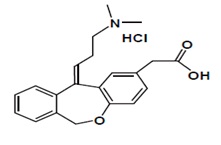
Chemical Name: 11-[(Z)-3(Dimethylamino) propylidene]-6-11dihydrodibenz[b,e] oxepin-2-acetic acid, hydrochloride Each mL of olopatadine hydrochloride ophthalmic solution USP, 0.2% contains: Active : 2.22 mg olopatadine hydrochloride, USP equivalent to 2 mg olopatadine. Inactives: Povidone; Dibasic sodium phosphate; Sodium chloride; Edetate disodium; Benzalkonium chloride 0.01% ( preservative ); Hydrochloric acid/Sodium hydroxide (adjust pH); and Water for Injection. It has a pH of approximately 7 and an osmolality of approximately 300 mOsm/kg.
CLINICAL PHARMACOLOGY
Mechanism of Action
Olopatadine is a mast cell stabilizer and a histamine H1 antagonist. Decreased chemotaxis and inhibition of eosinophil activation has also been demonstrated.
Pharmacokinetics
Systemic bioavailability data upon topical ocular administration of olopatadine hydrochloride ophthalmic solution USP, 0.2% are not available. Following topical ocular administration of olopatadine 0.15% ophthalmic solution in man, olopatadine was shown to have a low systemic exposure. Two studies in normal volunteers (totaling 24 subjects) dosed bilaterally with olopatadine 0.15% ophthalmic solution once every 12 hours for 2 weeks demonstrated plasma concentrations to be generally below the quantitation limit of the assay (< 0.5 ng/mL). Samples in which olopatadine was quantifiable were typically found within 2 hours of dosing and ranged from 0.5 to 1.3 ng/mL. The elimination half-life in plasma following oral dosing was 8 to 12 hours, and elimination was predominantly through renal excretion. Approximately 60 – 70 % of the dose was recovered in the urine as parent drug. Two metabolites, the mono-desmethyl and the N-oxide, were detected at low concentrations in the urine.
NONCLINICAL TOXICOLOGY
Carcinogenesis & Mutagenesis & Impairment Of Fertility
Olopatadine administered orally was not carcinogenic in mice and rats in doses up to 500 mg/kg/day and 200 mg/kg/day, respectively. Based on a 40 μL drop size and a 50 kg person, these doses were approximately 150,000 and 50,000 times higher than the maximum recommended ocular human dose (MROHD). No mutagenic potential was observed when olopatadine was tested in an in vitro bacterial reverse mutation (Ames) test, an in vitro mammalian chromosome aberration assay or an in vivo mouse micronucleus test. Olopatadine administered to male and female rats at oral doses of approximately 100,000 times MROHD level resulted in a slight decrease in the fertility index and reduced implantation rate; no effects on reproductive function were observed at doses of approximately 15,000 times the MROHD level.
CLINICAL STUDIES
Results from clinical studies of up to 12 weeks duration demonstrate that olopatadine hydrochloride ophthalmic solution USP, 0.2% when dosed once a day is effective in the treatment of ocular itching associated with allergic conjunctivitis.
HOW SUPPLIED/STORAGE AND HANDLING
Olopatadine hydrochloride ophthalmic solution USP, 0.2% is supplied in a 5 mL screw neck white bottle with nozzle made with low density polyethylene and white color screw cap made with high density polyethylene Tamper evidence is provided with a tamper evident ring around the closure and neck area of the package. 2.5 mL fill in 5 mL bottle (NDC 62332-502-03) Storage Store at 2°C to 25°C (36°F to 77°F)
Mechanism of Action
Olopatadine is a mast cell stabilizer and a histamine H1 antagonist. Decreased chemotaxis and inhibition of eosinophil activation has also been demonstrated.
