Get your patient on Oxacillin - Oxacillin Sodium injection, Powder, For Solution (Oxacillin Sodium)
Oxacillin - Oxacillin Sodium injection, Powder, For Solution prescribing information

INDICATIONS AND USAGE
Oxacillin is indicated in the treatment of infections caused by penicillinase producing staphylococci which have demonstrated susceptibility to the drug. Cultures and susceptibility tests should be performed initially to determine the causative organism and its susceptibility to the drug (see CLINICAL PHARMACOLOGY -Susceptibility Testing ).
Oxacillin may be used to initiate therapy in suspected cases of resistant staphylococcal infections prior to the availability of susceptibility test results. Oxacillin should not be used in infections caused by organisms susceptible to penicillin G. If the susceptibility tests indicate that the infection is due to an organism other than a resistant Staphylococcus , therapy should not be continued with oxacillin.
To reduce the development of drug-resistant bacteria and maintain the effectiveness of Oxacillin for Injection, USP and other antibacterial drugs, Oxacillin for Injection, USP should be used only to treat or prevent infections that are proven or strongly suspected to be caused by susceptible bacteria. When culture and susceptibility information are available, they should be considered in selecting or modifying antibacterial therapy. In the absence of such data, local epidemiology and susceptibility patterns may contribute to the empiric selection of therapy.
DOSAGE AND ADMINISTRATION
The intent of the pharmacy bulk package for this product is for preparation of solutions for IV infusion only.
Bacteriologic studies to determine the causative organisms and their susceptibility to oxacillin should always be performed. Duration of therapy varies with the type of severity of infection as well as the overall condition of the patient; therefore, it should be determined by the clinical and bacteriological response of the patient. In severe staphylococcal infections, therapy with oxacillin should be continued for at least 14 days. Therapy should be continued for at least 48 hours after the patient has become afebrile, asymptomatic, and cultures are negative. Treatment of endocarditis and osteomyelitis may require a longer duration of therapy.
With intravenous administration, particularly in elderly patients, care should be taken because of the possibility of thrombophlebitis.
RECOMMENDED DOSAGES FOR OXACILLIN FOR INJECTION, USP
| Drug | Adults | Infants and Children < 40 kg (88 lbs) | Other Recommendations |
| Oxacillin | 250 to 500 mg IV every 4 to 6 hours (mild to moderate infections) | 50 mg/kg/day IV in equally divided doses every 6 hours (mild to moderate infections) | |
| Oxacillin | 1 gram IV every 4 to 6 hours (severe infections) | 100 mg/kg/day IV in equally divided doses every 4 to 6 hours (severe infections) | Premature and Neonates 25 mg/kg/day IV |
Directions for Use
For Administration by Intravenous Drip
Reconstitute as directed below (Pharmacy Bulk Package) prior to further dilution.
STABILITY PERIODS FOR OXACILLIN FOR INJECTION, USP
| Concentration mg/mL | Sterile Water for Injection, USP | 0.9% Sodium Chloride Injection, USP | M/6 Molar Sodium Lactate Solution | 5% Dextrose in Water | 5% Dextrose in 0.45% Sodium Chloride | 10% Invert Sugar Injection, USP | Lactated Ringers Solution |
| ROOM TEMPERATURE (25°C) | |||||||
| 10 to 100 | 4 Days | 4 Days | |||||
| 10 to 30 | 24 Hrs | 24 Hrs | |||||
| 0.5 to 2 | 6 Hrs | 6 Hrs | 6 Hrs | ||||
| REFRIGERATION (4°C) | |||||||
| 10 to 100 | 7 Days | 7 Days | |||||
| 10 to 30 | 4 Days | 4 Days | 4 Days | 4 Days | 4 Days | ||
| FROZEN (-15°C) | |||||||
| 50 to 100 | 30 Days | ||||||
| 250/1.5 mL | 30 Days | ||||||
| 100 | 30 Days | ||||||
| 10 to 100 | 30 Days | 30 Days | 30 Days | 30 Days | 30 Days | ||
Stability studies on Oxacillin Sodium at concentrations of 0.5 mg/mL and 2 mg/mL in various intravenous solutions listed below indicate the drug will lose less than 10% activity at room temperature (70°F) during a 6-hour period.
IV Solution
5% Dextrose in Normal Saline 10% D-Fructose in Water 10% Invert Sugar in Normal Saline
10% Invert Sugar Plus 0.3% Potassium Chloride in Water Only those solutions listed above should be used for the intravenous infusion of Oxacillin Sodium. The concentration of the antibiotic should fall within the range specified. The drug concentration and the rate and volume of the infusion should be adjusted so that the total dose of oxacillin is administered before the drug loses its stability in the solution in use.
If another agent is used in conjunction with oxacillin therapy, it should not be physically mixed with oxacillin but should be administered separately.
Pharmacy Bulk Package
This glass Pharmacy Bulk Package bottle contains 10 grams Oxacillin Sodium and is designed for use in the pharmacy in preparing IV admixtures . Add 93 mL Sterile Water for Injection, USP or Sodium Chloride Injection, USP 0.9%. The resulting solution will contain 100 mg oxacillin per mL and will require further dilution.
CAUTION: NOT TO BE DISPENSED AS A UNIT.
Directions for Proper Use of Pharmacy Bulk Package
a. The container closure may be penetrated only one time after reconstitution, utilizing a suitable sterile dispensing set which allows measured distribution of the contents.
b. Use of this product is restricted to a suitable work area, such as a laminar flow hood.
c. Once this container closure has been punctured, withdrawal of the contents should be completed without delay. If prompt fluid transfer cannot be accomplished, discard the contents no later than 4 HOURS after initial closure puncture. This time limit should begin with the introduction of solvent for diluent into the Pharmacy Bulk Package.
Parenteral drug products should be inspected visually for particulate matter and discoloration prior to administration, whenever solution and container permit. Do not add supplementary medication to Oxacillin for Injection, USP.
CONTRAINDICATIONS
A history of a hypersensitivity (anaphylactic) reaction to any penicillin is a contraindication.
ADVERSE REACTIONS
Body as a Whole
The reported incidence of allergic reactions to penicillin ranges from 0.7 to 10 percent (see WARNINGS ). Sensitization is usually the result of treatment but some individuals have had immediate reactions when first treated. In such cases, it is thought that the patients may have had prior exposure to the drug via trace amounts present in milk and vaccines.
Two types of allergic reactions to penicillins are noted clinically, immediate and delayed.
Immediate reactions usually occur within 20 minutes of administration and range in severity from urticaria and pruritus to angioneurotic edema, laryngospasm, bronchospasm, hypotension, vascular collapse and death.
Such immediate anaphylactic reactions are very rare (see WARNINGS ) and usually occur after parenteral therapy but have occurred in patients receiving oral therapy. Another type of immediate reaction, an accelerated reaction, may occur between 20 minutes and 48 hours after administration and may include urticaria, pruritus, and fever. Although laryngeal edema, laryngospasm, and hypotension occasionally occur, fatality is uncommon.
Delayed allergic reactions to penicillin therapy usually occur after 48 hours and sometimes as late as 2 to 4 weeks after initiation of therapy. Manifestations of this type of reaction include serum sickness-like symptoms (i.e., fever, malaise, urticaria, myalgia, arthralgia, abdominal pain) and various skin rashes. Nausea, vomiting, diarrhea, stomatitis, black or hairy tongue, and other symptoms of gastrointestinal irritation may occur, especially during oral penicillin therapy.
Nervous System Reactions
Neurotoxic reactions similar to those observed with penicillin G may occur with large intravenous doses of oxacillin, especially with patients with renal insufficiency.
Urogenital Reactions
Renal tubular damage and interstitial nephritis have been associated with the administration of oxacillin. Manifestations of this reaction may include rash, fever, eosinophilia, hematuria, proteinuria, and renal insufficiency. Nephropathy induced by penicillins does not appear to be dose-related and is generally reversible upon prompt discontinuation of therapy.
Gastrointestinal Reactions
Pseudomembranous colitis has been reported with the use of oxacillin. The onset of pseudomembranous colitis symptoms may occur during or after antibiotic treatment (see WARNINGS ).
Metabolic Reactions
Agranulocytosis, neutropenia, and bone marrow depression have been associated with the use of oxacillin. Hepatotoxicity, characterized by fever, nausea, and vomiting associated with abnormal liver function tests, mainly elevated SGOT levels, has been associated with the use of oxacillin.
To report SUSPECTED ADVERSE REACTIONS, contact Fresenius Kabi USA, LLC at 1-800-551-7176 or FDA at 1-800-FDA-1088 or www.fda.gov/medwatch.
Drug Interactions
Tetracycline, a bacteriostatic antibiotic, may antagonize the bactericidal effect of penicillin and concurrent use of these drugs should be avoided. Oxacillin blood levels may be increased and prolonged by concurrent administration of probenecid which blocks the renal tubular secretion of penicillins. Probenecid decreases the apparent volume of distribution and slows the rate of excretion by competitively inhibiting renal tubular secretion of penicillins. Oxacillin-probenecid therapy should be limited to those infections where very high serum levels of oxacillin are necessary.
DESCRIPTION
Oxacillin for Injection, USP is a semisynthetic penicillin antibiotic derived from the penicillin nucleus, 6-amino-penicillanic acid. It is the sodium salt in parenteral dosage form. Each Pharmacy Bulk Package bottle of Oxacillin for Injection, USP contains oxacillin sodium monohydrate equivalent to 10 grams of oxacillin. The sodium content is 64 mg [2.8 mEq] per gram oxacillin. The product is buffered with 21 mg dibasic sodium phosphate per gram oxacillin. Oxacillin for Injection, USP is a white to off-white powder filled in clear glass bottles. Dilute solutions are essentially clear and colorless to yellow.
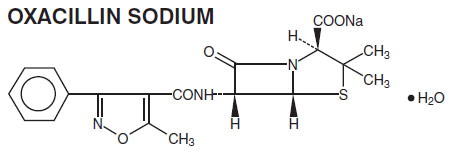
The chemical name of oxacillin sodium is 4-Thia-1-azabicyclo[3.2.0]heptane-2-carboxylic acid, 3,3-dimethyl-6-[[(5-methyl-3-phenyl-4-isoxazolyl)carbonyl]-amino]-7-oxo-, monosodium salt, monohydrate, [2 S (2α,5α,6β)]-. It is resistant to inactivation by the enzyme penicillinase (beta-lactamase). The molecular formula of oxacillin sodium is C 19 H 18 N 3 NaO 5 S•H 2 O. The molecular weight is 441.44. A pharmacy bulk package is a container of a sterile preparation for parenteral use that contains many single doses. The contents of this pharmacy bulk package are intended for use by a pharmacy admixture service for addition to suitable parenteral fluids in the preparation of admixtures for intravenous infusion (see DOSAGE AND ADMINISTRATION, Directions for Proper Use of Pharmacy Bulk Package) . FURTHER DILUTION IS REQUIRED. NOT FOR DIRECT INFUSION.
CLINICAL PHARMACOLOGY
Intravenous administration provides peak serum levels approximately 5 minutes after the injection is completed. Slow I.V. administration of 500 mg gives a peak serum level of 43 mcg/mL after 5 minutes with a half-life of 20 to 30 minutes. Oxacillin sodium, with normal doses, has insignificant concentrations in the cerebrospinal and ascitic fluids. It is found in therapeutic concentrations in the pleural, bile, and amniotic fluids. Oxacillin sodium is rapidly excreted as unchanged drug in the urine by glomerular filtration and active tubular secretion. The elimination half-life for oxacillin is about 0.5 hours. Nonrenal elimination includes hepatic inactivation and excretion in bile.
Oxacillin sodium binds to serum protein, mainly albumin. The degree of protein binding reported varies with the method of study and the investigator, but generally has been found to be 94.2 ± 2.1%. Probenecid blocks the renal tubular secretion of penicillins. Therefore, the concurrent administration of probenecid prolongs the elimination of oxacillin and, consequently, increases the serum concentration. Intravenous injection gives a peak about 5 minutes after the injection is completed. Slow IV dosing with 500 mg gives a 5 minute peak of 43 mcg/mL with a half-life of 20 to 30 minutes.
Microbiology
Mode of Action
Penicillinase-resistant penicillins exert a bactericidal action against penicillin susceptible microorganisms during the state of active multiplication. All penicillins inhibit the biosynthesis of the bacterial cell wall.
Mechanism of Resistance
Resistance to penicillins may be mediated by destruction of the beta-lactam ring by a beta-lactamase, altered affinity of penicillin for target, or decreased penetration of the antibiotic to reach the target site.
Cross Resistance
Resistance to oxacillin (or cefoxitin) implies resistance to all other beta-lactam agents, except newer agents with activity against methicillin-resistant Staphylococcus aureus .
Susceptibility Testing
For specific information regarding susceptibility test interpretive criteria and associated test methods and quality control standards recognized by FDA for this drug, please see: https://www.fda.gov/STIC.
HOW SUPPLIED/STORAGE AND HANDLING
Each Pharmacy Bulk Package bottle of Oxacillin for Injection, USP contains oxacillin sodium monohydrate equivalent to 10 grams of oxacillin and is supplied as follows:
| Product Code | Unit of Sale | Strength |
| 801100 | NDC 63323-811-00 Individually Packaged | 10 grams per Pharmacy Bulk Package Bottle |
Storage Conditions Store dry powder at 20° to 25°C (68° to 77°F) [see USP Controlled Room Temperature]. Sterile, Nonpyrogenic, Preservative-free.
The container closure is not made with natural rubber latex.
