Get your patient on Pentam 300- Pentamidine Isethionate injection, Powder, Lyophilized, For Solution (Pentamidine Isethionate)
Pentam 300- Pentamidine Isethionate injection, Powder, Lyophilized, For Solution prescribing information

INDICATIONS AND USAGE
Pentam 300 (pentamidine isethionate for injection) is indicated for the treatment of pneumonia due to Pneumocystis carinii .
DOSAGE AND ADMINISTRATION
CAUTION: DO NOT USE SODIUM CHLORIDE INJECTION, USP FOR INITIAL RECONSTITUTION BECAUSE PRECIPITATION WILL OCCUR. Pentamidine isethionate should be administered IM or IV only. The recommended regimen for adults and pediatric patients beyond 4 months of age is 4 mg/kg once a day for 14 to 21 days. Therapy for longer than 21 days with pentamidine isethionate has also been used but may be associated with increased toxicity.
Intramuscular Injection
The contents of one vial (300 mg) should be dissolved in 3 mL of Sterile Water for Injection, USP at 22° - 30°C (72° - 86°F). The calculated daily dose should then be withdrawn and administered by deep IM injection.
Intravenous Injection
The contents of one vial (300 mg) should first be dissolved in 3 to 5 mL of Sterile Water for Injection, USP, or 5% Dextrose Injection, USP at 22°- 30°C (72° - 86°F). The calculated dose of pentamidine isethionate should then be withdrawn and diluted further in 50 to 250 mL of 5% Dextrose Injection, USP.
The diluted IV solutions containing pentamidine isethionate should be infused over a period of 60 to 120 minutes.
Aseptic technique should be employed in preparation of all solutions. Parenteral drug products should be inspected visually for particulate matter and discoloration prior to administration whenever solution and container permit.
Stability
After reconstitution with sterile water, the Pentam solution is stable for 48 hours in the original vial at room temperature if protected from light. To avoid crystallization,store at 22° - 30°C (72° - 86°F). Intravenous infusion solutions of pentamidine isethionate at 1 mg/mL and 2.5 mg/mL prepared in 5% Dextrose Injection, USP are stable at room temperature for up to 24 hours.
Intravenous (IV) solutions of pentamidine isethionate have been shown to be incompatible with fluconazole and foscarnet sodium. IV solutions of pentamidine isethionate have been shown to be compatible with IV solutions of zidovudine (AZT) and diltiazem hydrochloride.
CONTRAINDICATIONS
Contraindicated in patients with a history of hypersensitivity to pentamidine isethionate.
ADVERSE REACTIONS
To report SUSPECTED ADVERSE REACTIONS, contact Fresenius Kabi USA, LLC at 1-800-551-7176 or FDA at 1-800-FDA-1088 or www.fda.gov/medwatch.
CAUTION : Fatalities due to severe hypotension, hypoglycemia, acute pancreatitis and cardiac arrhythmias have been reported in patients treated with pentamidine isethionate, both by the IM and IV routes. Nephrotoxic events (increased creatinine, impaired renal function, azotemia, and renal failure) are common with the parenteral administration of pentamidine isethionate. The administration of the drug should, therefore, be limited to the patients in whom Pneumocystis carinii has been demonstrated.
The most frequently reported spontaneous adverse events (1 to 30%) reported in clinical trials, regardless of their relation to pentamidine isethionate therapy were as follows (n=424):
Cardiovascular: Hypotension | 5.0% |
Gastrointestinal: Anorexia/Nausea | 5.9% |
Hematologic: Anemia Leukopenia Thrombocytopenia | 1.2% 10.4% 2.6% |
Hepatic: Elevated liver function tests | 8.7% |
Metabolic: Hypoglycemia | 5.9% |
Neurologic: Confusion/hallucinations | 1.7% |
Skin: Sterile abscess and/or necrosis, pain, or induration at the site of IM injection Rash | 11.1% 3.3% |
Special Senses: Bad taste | 1.7% |
Urogenital: Azotemia Elevated serum creatinine Elevated blood urea nitrogen Impaired renal function | 8.5% 23.6% 6.6% 28.8% |
Adverse events with a frequency of less than 1% incidence were as follows (No causal relationship to treatment has been established for these adverse events):
Body as a whole: | Allergic reaction (i.e. urticaria, itching, rash), anaphylaxis, arthralgia, chills, extrapulmonary pneumocystosis, headache, night sweats, and Stevens-Johnson syndrome. |
Cardiovascular: | Abnormal ST segment of electrocardiogram, cardiac arrhythmias, cerebrovascular accident, hypertension, palpitations, phlebitis, syncope, tachycardia, vasodilatation, vasculitis and ventricular tachycardia. |
Gastrointestinal: | Abdominal pain, diarrhea, dry mouth, dyspepsia, hematochezia, hypersalivation, melena, pancreatitis, splenomegaly, and vomiting. |
Hematological: | Defibrination, eosinophilia, neutropenia, pancytopenia, and prolonged clotting time. |
Hepatic: | Hepatic dysfunction, hepatitis and hepatomegaly |
Metabolic: | Hyperglycemia, hyperkalemia, hypocalcemia, and hypomagnesemia. |
Neurological: | Anxiety, confusion, depression, dizziness, drowsiness, emotional lability, hypesthesia, insomnia, memory loss, neuropathy, nervousness, neuralgia, paranoia, paresthesia, peripheral neuropathy, seizure, tremors, unsteady gait, and vertigo. |
Respiratory system: | Asthma, bronchitis, bronchospasm, chest congestion, chest tightness, coryza, cyanosis, eosinophilic or interstitial pneumonitis, gagging, hemoptysis, hyperventilation, laryngitis, laryngospasm, non-specific lung disorder, nasal congestion, pleuritis, pneumothorax, rales, rhinitis, shortness of breath, and tachypnea. |
Skin: | Desquamation, dry and breaking hair, dry skin, erythema, dermatitis, pruritus, rash, and urticaria. |
Special senses: | Blepharitis, blurred vision, conjunctivitis, contact lens discomfort, eye pain or discomfort, loss of hearing, loss of taste, and loss of smell. |
Urogenital: | Flank pain, hematuria, incontinence, nephritis, renal dysfunction and renal failure. |
From post-marketing clinical experience with pentamidine isethionate, the following adverse events have been reported: cough, diabetes mellitus/ketoacidosis, dyspnea, infiltration (extravasation–see WARNINGS ), and torsades de pointes.
DESCRIPTION
Pentam 300 (pentamidine isethionate for injection), an anti-protozoal agent, is a sterile, nonpyrogenic, lyophilized product. After reconstitution, it should be administered by intramuscular (IM) or intravenous (IV) routes (see DOSAGE AND ADMINISTRATION ). Pentamidine isethionate is a white crystalline powder soluble in water and glycerin, slightly soluble in alcohol and insoluble in ether, acetone, and chloroform. It is chemically designated as 4,4-[1,5-pentanediylbis(oxy)]bis-benzenecarboximidamid with the following structural formula:
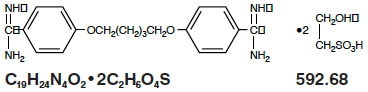
Each vial contains: Pentamidine isethionate . . . . . . . . . . . . . 300 mg
CLINICAL PHARMACOLOGY
Pentamidine isethionate, an aromatic diamidine, is known to have activity against Pneumocystis carinii . The mode of action of pentamidine is not fully understood. In vitro studies indicate that the drug interferes with protozoal nuclear metabolism by inhibition of DNA, RNA, phospholipid and protein synthesis.
Pharmacokinetics
Pharmacokinetic parameters following the administration of 4 mg/kg pentamidine isethionate as a single two-hour intravenous infusion or after a single intramuscular injection to 12 patients with AIDS are presented in the following table:
Mean ± SD | Cmax ng/mL | Clearance L/h | Half-life hours | Vdss L | Concentration ng/mL | |
8 hour | 24 hour | |||||
2 hour I.V. infusion 4 mg/kg (N=6) | 612 ± 371 | 248 ± 91 | 6.4 ± 1.3 | 821 ± 535 | 19.3 ± 16.9 | 2.9 ± 1.4 |
I.M. 4 mg/kg (N=6) | 209 ± 48 | 305 ± 81 | 9.4 ± 2.0 | 2724 ± 1066 | 22.9 ± 8.0 | 6.6 ± 3.5 |
In seven patients treated with daily IM doses of pentamidine at 4 mg/kg for 10 to 12 days, plasma concentrations were between 300 to 500 ng/mL. The concentrations did not appreciably change with time after injection or from day to day. Higher plasma concentrations were encountered in patients with an elevated blood urea nitrogen. The patients continued to excrete decreasing amounts of pentamidine in urine up to 6 to 8 weeks after cessation of the treatment.
Following multiple intravenous administration of pentamidine isethionate (3.7 to 4 mg/kg/day infused over 4 hours) to 6 patients with AIDS being treated for PCP, the pharmacokinetic parameters obtained on Days 1,4 and 7 are summarized in the following table:
Mean ± SD | Cmax• ng/mL | Cmin• ng/mL | Clearance mL/min | Renal Clearance mL/min/1.73 m 2 | Creatinine Clearance mL/min/1.73 m 2 |
Day 1 | 175.3 ± 54 | --- | 5737 ± 1878 | 269 ± 149 | 97 ± 12 |
Day 4 | 210.9 ± 80 | 17.6 ± 9.5 | 3350 ± 1944 | 214 ± 145 | 93 ± 17 |
Day 7 | 256.7 ± 89 | 40.8 ± 16.1 | 1989 ± 566 | 134 ± 60 | 69 ± 17 |
•derived from Lidman
Compared to the mean AUC on Day 1, AUC on Day 4 and Day 7 were about 2 and 3 fold higher, respectively, suggesting that steady state was not achieved by Day 7 of dosing.
In other published reports of pharmacokinetics of pentamidine following daily intravenous doses of 2 to 4 mg/kg/day, clearance ranged from 30 to 40 mL/min/kg and Vdss ranged from 200 to 400 L/kg. Reported values for terminal half-lives of 2.8 to 12 days is suggestive of a deep peripheral compartment. In the urine, up to 12% of the administered dose has been recovered during a dosing interval as unchanged pentamidine.
Tissue distribution was studied in mice given a single intraperitoneal injection of pentamidine at 10 mg/kg. The concentration was highest in the kidneys followed by the liver. In mice, pentamidine was excreted unchanged, primarily via the kidneys with some elimination in the feces. The ratio of amounts excreted in the urine and feces (4:1) was constant over the period of study.
Tissue distribution has also been studied in normal and in renally impaired dogs (N = 3 each) given 13 mg/kg of pentamidine IV, in 2 doses separated by five weeks. The concentration of pentamidine was highest in the liver followed by kidneys and lungs. Pentamidine was concentrated in these organs approximately 70 to 1000 times that of the peak serum concentration. Similar findings were reported in normal and in renally impaired dogs (N = 2 each) given 97.5 mg/kg of pentamidine IV, in 15 daily doses. After repeated doses, the organs showed a further 3 to 7 fold accumulation while serum concentrations remained unchanged.
HOW SUPPLIED
PENTAM ® 300 (pentamidine isethionate for injection)
| Product Code | Unit of Sale | Strength | Each |
| 11310 | NDC 63323-113-10 Unit of 10 | 300 mg | NDC 63323-113-01 Lyophilized Product in Single Dose Vial |
Store dry product at 20° to 25°C (68° to 77°F) [see USP Controlled Room Temperature]. Protect from light.
Preservative Free. Discard unused portion.
