Get your patient on Potassium Chloride In Lactated Ringers And Dextrose - Potassium Chloride, Sodium Chloride, Calcium Chloride, Sodium Lactate, And Dextrose Monohydrate injection, Solution (Potassium Chloride, Sodium Chloride, Calcium Chloride, Sodium Lactate, And Dextrose Monohydrate)
Potassium Chloride In Lactated Ringers And Dextrose - Potassium Chloride, Sodium Chloride, Calcium Chloride, Sodium Lactate, And Dextrose Monohydrate injection, Solution prescribing information

INDICATIONS AND USAGE
This solution is indicated in patients requiring parenteral administration of potassium chloride and the replacement of extracellular losses of fluids and electrolytes with minimal carbohydrate calories.
DOSAGE AND ADMINISTRATION
This solution should be administered only by intravenous infusion and as directed by the physician. The dose and rate of injection are dependent upon the age, weight and clinical condition of the patient. If the serum potassium level is greater than 2.5 mEq/liter, potassium should be given at a rate not to exceed 10 mEq/hour in a concentration less than 30 mEq/liter. Somewhat faster rates and greater concentrations (usually up to 40 mEq/liter) of potassium may be indicated in patients with more severe potassium deficiency. The total 24-hour dose should not generally exceed 200 mEq of potassium.
As reported in the literature, the dosage and constant infusion rate of intravenous dextrose must be selected with caution in pediatric patients, particularly neonates and low birth weight infants, because of the increased risk of hyperglycemia/hypoglycemia.
Drug Interactions
Additives may be incompatible. Consult with pharmacist, if available. When introducing additives, use aseptic technique, mix thoroughly and do not store.
The presence of calcium limits their compatibility with certain drugs that form precipitates of calcium salts, and also prohibits their simultaneous infusion through the same administration set as blood because of the likelihood of coagulation.
Parenteral drug products should be inspected visually for particulate matter and discoloration prior to administration, whenever solution and container permit. (See PRECAUTIONS.)
CONTRAINDICATIONS
Solutions containing potassium chloride are contraindicated in diseases where high potassium levels may be encountered.
Solutions containing lactate are NOT FOR USE IN THE TREATMENT OF LACTIC ACIDOSIS.
ADVERSE REACTIONS
Reactions which may occur because of the solutions or technique of administration include febrile response, infection at the site of injection, venous thrombosis or phlebitis extending from the site of injection, extravasation and hypervolemia.
If an adverse reaction does occur, discontinue the infusion, evaluate the patient, institute appropriate therapeutic countermeasures and save the remainder of the fluid for examination if deemed necessary.
Nausea, vomiting, abdominal pain and diarrhea have been reported with potassium therapy. The signs and symptoms of potassium intoxication include paresthesias of the extremities, flaccid paralysis, listlessness, mental confusion, weakness and heaviness of the legs, hypotension, cardiac arrhythmias, heart block, electrocardiographic abnormalities such as disappearance of P waves, spreading and slurring of the QRS complex with development of a biphasic curve and cardiac arrest.
Potassium-containing solutions are intrinsically irritating to tissues. Therefore, extreme care should be taken to avoid perivascular infiltration. Local tissue necrosis and subsequent sloughing may result if extravasation occurs. Chemical phlebitis and venospasm have also been reported.
Should perivascular infiltration occur, I.V. administration at that site should be discontinued at once. Local infiltration of the affected area with procaine hydrochloride, 1%, to which hyaluronidase may be added, will often reduce venospasm and dilute the potassium remaining in the tissues locally. Local application of heat may also be helpful.
DESCRIPTION
Intravenous solution with potassium chloride (I.V. solutions with KCl) is a sterile and nonpyrogenic solution in water for injection. This solution is for administration by intravenous infusion only.
See Table for summary of content and characteristics of this solution.
The solution contains no bacteriostat, antimicrobial agent or added buffer and is intended only for use as a single-dose injection. When smaller doses are required the unused portion should be discarded.
This solution is a parenteral fluid, nutrient and/or electrolyte replenisher.
Dextrose, USP is chemically designated D-glucose, monohydrate (C 6 H 12 O 6 • H 2 O), a hexose sugar freely soluble in water. It has the following structural formula:
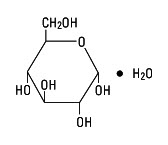
Potassium Chloride, USP is chemically designated KCl, a white granular powder freely soluble in water.
Sodium Chloride, USP is chemically designated NaCl, a white crystalline powder freely soluble in water.
Calcium Chloride, USP is chemically designated calcium chloride dihydrate (CaCl 2 • 2H 2 O), white fragments or granules freely soluble in water.
Sodium Lactate, USP is chemically designated monosodium lactate [CH 3 CH(OH)COONa], a 60% aqueous solution miscible in water. It has the following structural formula:
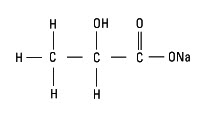
Water for Injection, USP is chemically designated H 2 0.000000000000000e+00
The flexible plastic container is fabricated from a specially formulated polyvinylchloride. Water can permeate from inside the container into the overwrap but not in amounts sufficient to affect the solution significantly. Solutions in contact with the plastic container may leach out certain chemical components from the plastic in very small amounts; however, biological testing was supportive of the safety of the plastic container materials. Exposure to temperatures above 25°C/77°F during transport and storage will lead to minor losses in moisture content. Higher temperatures lead to greater losses. It is unlikely that these minor losses will lead to clinically significant changes within the expiration period.
CLINICAL PHARMACOLOGY
When administered intravenously, this solution provides a source of water and electrolytes with carbohydrate calories.
Solutions containing carbohydrate in the form of dextrose restore blood glucose levels and provide calories. Carbohydrate in the form of dextrose may aid in minimizing liver glycogen depletion and exerts a protein-sparing action. Dextrose injected parenterally undergoes oxidation to carbon dioxide and water.
Calcium chloride in water dissociates to provide calcium (Ca ++ ) and chloride (Cl¯) ions. They are normal constituents of the body fluids and are dependent on various physiologic mechanisms for maintenance of balance between intake and output. Approximately 80% of body calcium is excreted in the feces as insoluble salts; urinary excretion accounts for the remaining 20%.
Sodium lactate provides sodium (Na + ) and lactate (C 3 H 5 O¯) ions. The lactate anion is in equilibrium with pyruvate and has an alkalizing effect resulting from simultaneous removal by the liver of lactate and hydrogen ions. In the liver, lactate is metabolized to glycogen which is ultimately converted to carbon dioxide and water by oxidative metabolism. The sodium (Na + ) ion combines with bicarbonate ion produced from carbon dioxide of the body and thus retains bicarbonate to combat metabolic acidosis (bicarbonate deficiency). The normal plasma level of lactate ranges from 0.9 to 1.9 mEqK/liter.
Intravenous solutions containing potassium chloride are particularly intended to provide needed potassium cation (K + ). Potassium is the chief cation of body cells (160 mEq/liter of intracellular water). It is found in low concentration in plasma and extracellular fluids (3.5 to 5.0 mEq/liter in a healthy adult). Potassium plays an important role in electrolyte balance. Normally about 80 to 90% of the potassium intake is excreted in the urine; the remainder in the stools and to a small extent, in the perspiration. The kidney does not conserve potassium well so that during fasting or in patients on a potassium-free diet, potassium loss from the body continues resulting in potassium depletion. A deficiency of either potassium or chloride will lead to a deficit of the other.
Sodium chloride in water dissociates to provide sodium (Na + ) and chloride (Cl¯) ions. Sodium (Na + ) is the principal cation of the extracellular fluid and plays a large part in the therapy of fluid and electrolyte disturbances. Chloride (Cl¯) has an integral role in buffering action when oxygen and carbon dioxide exchange occurs in the red blood cells. The distribution and excretion of sodium (Na + ) and chloride (Cl¯) are largely under the control of the kidney which maintains a balance between intake and output.
Water is an essential constituent of all body tissues and accounts for approximately 70% of total body weight. Average normal adult daily requirement ranges from two to three liters (1.0 to 1.5 liters each for insensible water loss by perspiration and urine production).
Water balance is maintained by various regulatory mechanisms. Water distribution depends primarily on the concentration of electrolytes in the body compartments and sodium (Na + ) plays a major role in maintaining physiologic equilibrium.
HOW SUPPLIED
Intravenous solution with potassium chloride (I.V. solution with KCl) is supplied in single-dose flexible plastic container. See Table:
Potassium Chloride
in Lactated Ringer’s
and 5% Dextrose
Injection, USP
List No. | mEq Potassium Added | Size (mL) | COMPOSITION (g/L) | Calculated Osmolarity (mOsmol/L) | ||||
Dextrose, Hydrous | Potassium Chloride | Sodium Chloride | Sodium Lactate, Anhydrous | Calcium Chloride Dihydrate | ||||
7111 | 20 mEq | 1000 | 50 | 1.79 | 6 | 3.1 | 0.2 | 563 |
| NDC No. | ||||||||
| 0409-7111-09 | ||||||||
| 0990-7111-09 | ||||||||
Potassium Chloride
in Lactated Ringer’s
and 5% Dextrose
Injection, USP (Continued)
pH | Approx. Ionic Concentrations (mEq/L) | Approx. kcal/L | ||||
Calcium (Ca++) | Sodium (Na + ) | Potassium (K + ) | Chloride (Cl¯) | Lactate | ||
4.9 (3.5 to 6.5) | 2.7 | 130 | 24 | 129 | 28 | 179 |
ICU Medical is transitioning NDC codes from the "0409" to a "0990" labeler code. Both NDC codes are expected to be in the market for a period of time.
May contain HCl for pH adjustment.
Store at 20 to 25°C (68 to 77°F). [See USP Controlled Room Temperature.] Protect from freezing.
Revised: March, 2020
IFU0000167
ICU Medical, Inc., Lake Forest, Illinois, 60045, USA
