Get your patient on Promethazine Hydrochloride - Promethazine Hydrochloride tablet (Promethazine Hydrochloride)
Promethazine Hydrochloride - Promethazine Hydrochloride tablet prescribing information

INDICATIONS AND USAGE
- Promethazine hydrochloride tablets, USP are useful for:
- Perennial and seasonal allergic rhinitis
- Vasomotor rhinitis
- Allergic conjunctivitis due to inhalant allergens and foods
- Mild, uncomplicated allergic skin manifestations of urticarial and angioedema
- Amelioration of allergic reactions to blood or plasma
- Dermographism
- Anaphylactic reactions as adjunctive therapy to epinephrine and other standard measures after the acute manifestations have been controlled
- Preoperative, postoperative and obstetric sedation
- Prevention and control of nausea and vomiting associated with certain types of anesthesia and surgery.
- Therapy adjunctive to meperidine or other analgesics for control of postoperative pain.
- Sedation in both children and adults as well as relief of apprehension and production of light sleep from which the patient can be easily aroused.
- Active and prophylactic treatment of motion sickness
- Antiemetic therapy in postoperative patients
DOSAGE AND ADMINISTRATION
Promethazine Hydrochloride Tablets, USP are contraindicated for children under 2 years of age (see WARNINGS : Black Box Warning and Use in Pediatric Patients ).
Allergy: The average oral dose is 25mg taken before retiring; however, 12.5mg may be taken before meals and on retiring, if necessary. Single 25mg doses at bedtime or 6.25 to 12.5mg taken three times daily will usually suffice. After initiation of treatment, in children or adults, dosage should be adjusted to the smallest amount adequate to relieve symptoms. The administration of promethazine hydrochloride in 25mg doses will control minor transfusion reactions of an allergic nature.
Motion Sickness: The average adult dose is 25mg taken twice daily. The initial dose should be taken one-half to one hour before anticipated travel and be repeated eight to twelve hours later if necessary. On succeeding days of travel, it is recommended that 25mg be given on arising and again before the evening meal. For children, promethazine hydrochloride tablets, USP, syrup, or rectal suppositories, 12.5 to 25mg, twice daily, may be administered.
Nausea and Vomiting: Antiemetics should not be used in vomiting of unknown etiology in children and adolescents (see WARNINGS : Use in Pediatric Patients ).
The average effective dose ofpromethazine hydrochloride tablets, USP for the active therapy of nausea and vomiting in children or adults is 25mg. When oral medication cannot be tolerated, the dose should be given parenterally or by rectal suppository. 12.5 to 25mg doses may be repeated, as necessary, at four-to-six-hour intervals.
For nausea and vomiting in children, the usual dose is 0.5mg per pound of body weight, and the dose should be adjusted to the age and weight of the patient and the severity of the condition being treated.
For prophylaxis of nausea and vomiting, as during surgery and the postoperative period, the average dose is 25mg repeated at four-to-six-hour intervals, as necessary.
Sedation
This product relieves apprehension and induces a quiet sleep from which the patient can be easily aroused. Administration of 12.5 to 25 mg promethazine hydrochloride by the oral route or by rectal suppository at bedtime will provide sedation in children. Adults usually require 25 to 50 mg for nighttime, pre-surgical, or obstetrical sedation.
Pre- and Postoperative Use
Promethazine hydrochloride tablets, USP in 12.5 to 25 mg doses for children and 50 mg doses for adults the night before surgery relieves apprehension and produces a quiet sleep.
For preoperative medication, children require doses of 0.5mg per pound of body weight in combination with an appropriately reduced dose of narcotic or barbiturate and the appropriate dose of an atropine-like drug. Usual adult dosage is 50mg promethazine hydrochloride tablets, USP with an appropriately reduced dose of narcotic or barbiturate and the required amount of a belladonna alkaloid.
Postoperative Sedation and adjunctive use with analgesics may be obtained by the administration of 12.5 to 25mg in children and 25 to 50 mg doses in adults.
Promethazine hydrochloride tablets, USP are contraindicated for children under 2 years of age.
CONTRAINDICATIONS
Promethazine Hydrochloride Tablets, USP are contraindicated for use in pediatric patients less than two years of age.
Promethazine hydrochloride tablets, USP are contraindicated in comatose state, and in individuals know to be hypersensitive or to have had an idiosyncratic reaction to promethazine or to other phenthiazines.
Antihistamines are contraindicated for use in the treatments of lower respiratory tract symptoms including asthma.
ADVERSE REACTIONS
Central Nervous System: Drowsiness is the most prominent CNS effect of this drug. Sedation, somnolence, blurred vision, dizziness; confusion, disorientation, and extrapyramidal symptoms such as oculogyric crisis, torticollis, and tongue protrusion; lassitude, tinnitus, incoordination, fatigue, euphoria, nervousness, diplopia, insomnia, tremors, convulsive seizures, excitation, catanoic-like states, hysteria. Hallucinations have also been reported.
Cardiovascular : Increased or decreased blood pressure, tachycardia, bradycardia, faintness.
Dermatologic : Dermatitis, photosensitivity, urticaria.
Hematologic : Leukopenia, thrombocytopenia, thrombocytopenic purpura, agranulocytosis.
Gastrointestinal : Dry mouth, nausea, vomiting, jaundice.
Respiratory: Asthma, nasal stuffiness, respiratory depression (potentially fatal) and apnea (potentially fatal). (See WARNINGS , Respiratory Depression .)
Other: Angioneurotic edema. Neuroleptic malignant syndrome (potentially fatal) has also been reported. (See WARNINGS , Neuroleptic Malignant Syndrome .)
Paradoxical Reactions:
Hyperexcitability and abnormal movements have been reported in patients following a single administration of promethazine hydrochloride. Consideration should be given to the discontinuation of promethazine hydrochloride and to the use of other drugs if these reactions occur. Respiratory depression, nightmares, delirium, and agitated behavior have also been reported in some of these patients.
Drug Interactions
CNS Depressants: Promethazine hydrochloride tablets, USP may increase, prolong, or intensify the sedative action of other central-nervous-system depressants, such as alcohol, sedatives/hypnotics (including barbiturates), narcotics, narcotic analgesics, general anesthetics, tricyclic antidepressants, and tranquilizers; therefore, such agents should be avoided or administered in reduced dosage to patients receiving Promethazine hydrochloride. When given concomitantly with Promethazine hydrochloride tablets, USP, the dose of barbiturates should be reduced by at least one-half, and the dose of narcotics should be reduced by one-quarter to one-half. Dosage must be individualized. Excessive amounts of Promethazine hydrochloride relative to a narcotic may lead to restlessness and motor hyperactivity in the patient with pain; these symptoms usually disappear with adequate control of the pain.
Epinephrine : Because of the potential for Promethazine hydrochloride tablets, USP to reverse epinephrine’s vasopressor effect, epinephrine should NOT be used to treat hypotension associated with Promethazine hydrochloride tablets, USP overdose.
Anticholinergics: Concomitant use of other agents with anticholinergic properties should be undertaken with caution.
Monoamine Oxidase Inhibitors (MAOI): Drug interactions, including an increased incidence of extrapyramidal effects, have been reported when some MAOI and phenothiazines are used concomitantly. This possibility should be considered with Promethazine hydrochloride tablets, USP.
DESCRIPTION
Each 25 mg promethazine hydrochloride tablet for oral administration contains 25 mg promethazine hydrochloride.
Each 50 mg promethazine hydrochloride tablet for oral administration contains 50 mg promethazine hydrochloride.
Each tablet for oral administration contains 25 mg or 50 mg promethazine hydrochloride, USP. The inactive ingredients include: lactose anhydrous, magnesium stearate, and microcrystalline cellulose. The 50 mg also contains D&C Red # 27 Lake.
Promethazine hydrochloride is a racemic compound; the empirical formula is C17H20N2S•HCl and its molecular weight is 320.88.
Promethazine hydrochloride, a phenothiazine derivative, is designated chemically as 10HPhenothiazine-10-ethanamine, N,N,a-trimethyl-, monohydrochloride, (±)- with the following structural formula:
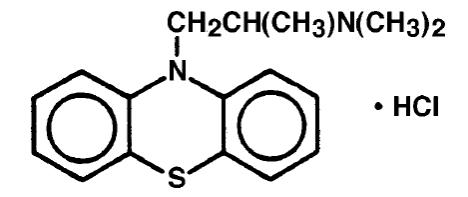
Promethazine hydrochloride occurs as a white to faint yellow, practically odorless, crystalline powder which slowly oxidizes and turns blue on prolonged exposure to air. It is freely soluble in water and soluble in alcohol.
CLINICAL PHARMACOLOGY
Promethazine is a phenothiazine derivative which differs structurally from the antipsychotic phenothiazines by the presence of a branched side chain and no ring substitution. It is thought that this configuration is responsible for its relative lack (1/10 that of chlorpromazine) of dopamine antagonist properties.
Promethazine is an H1 receptor blocking agent. In addition to its antihistaminic action, it provides clinically useful sedative and antiemetic effects.
Promethazine is well absorbed from the gastrointestinal tract. Clinical effects are apparent within 20 minutes after oral administration and generally last four to six hours, although they may persist as long as 12 hours. Promethazine is metabolized by the liver to a variety of compounds; the sulfoxides of promethazine and N-demethylpromethazine are the predominant metabolites appearing in the urine.
HOW SUPPLIED
Promethazine hydrochloride tablets, USP are available as follows:
25 mg: White to off-white, flat faced, beveled edge, round, uncoated tablets, debossed with “AN” above “521” with single line bisect separating them on one side and plain on the other side are supplied as:
Bottles of 100: NDC 10135-0495-01 Bottles of 1000: NDC 10135-0495-10
50 mg : Pink color, biconvex, round tablets, embossed with “AN” above “522” on one side and plain on the other side are supplied as:
Bottles of 100, NDC 10135-0496-01
Bottles of 1000, NDC 10135-0496-10
Store at 20° to 25°C with excursions permitted between 15° to 30°C (59° to 86°F) [See USP Controlled Room Temperature]
Protect from light.
Dispense in a tight, light-resistant container as defined in the USP, with a child-resistant closure (as required).
Manufactured for:
MARLEX PHARMACEUTICALS INC.
50 McCullough Drive
New Castle, DE, 19720
Distributed by:
MARLEX PHARMACEUTICALS INC.
50 McCullough Drive
New Castle, DE, 19720
Rev. 3 10/16 AN
