Get your patient on Protriptyline Hydrochloride - Protriptyline Hydrochloride tablet, Film Coated (Protriptyline Hydrochloride)
Protriptyline Hydrochloride - Protriptyline Hydrochloride tablet, Film Coated prescribing information

Suicidality and Antidepressant Drugs
Antidepressants increased the risk compared to placebo of suicidal thinking and behavior (suicidality) in children, adolescents, and young adults in short-term studies of major depressive disorder (MDD) and other psychiatric disorders. Anyone considering the use of protriptyline hydrochloride or any other antidepressant in a child, adolescent, or young adult must balance this risk with the clinical need. Short-term studies did not show an increase in the risk of suicidality with antidepressants compared to placebo in adults beyond age 24; there was a reduction in risk with antidepressants compared to placebo in adults aged 65 and older. Depression and certain other psychiatric disorders are themselves associated with increases in the risk of suicide. Patients of all ages who are started on antidepressant therapy should be monitored appropriately and observed closely for clinical worsening, suicidality, or unusual changes in behavior. Families and caregivers should be advised of the need for close observation and communication with the prescriber. Protriptyline hydrochloride is not approved for use in pediatric patients. (See Warnings: Clinical Worsening and Suicide Risk , PRECAUTIONS: Information for Patients , and Precautions: Pediatric Use )
INDICATIONS AND USAGE
Protriptyline hydrochloride tablets are indicated for the treatment of symptoms of mental depression in patients who are under close medical supervision. Its activating properties make it particularly suitable for withdrawn and anergic patients.
DOSAGE AND ADMINISTRATION
Dosage should be initiated at a low level and increased gradually, noting carefully the clinical response and any evidence of intolerance.
Usual Adult Dosage
Fifteen to 40 mg a day divided into 3 or 4 doses. If necessary, dosage may be increased to 60 mg a day. Dosages above this amount are not recommended. Increases should be made in the morning dose.
Adolescent and Elderly Patients
In general, lower dosages are recommended for these patients. Five mg 3 times a day may be given initially, and increased gradually if necessary. In elderly patients, the cardiovascular system must be monitored closely if the daily dose exceeds 20 mg.
When satisfactory improvement has been reached, dosage should be reduced to the smallest amount that will maintain relief of symptoms.
Minor adverse reactions require reduction in dosage. Major adverse reactions or evidence of hypersensitivity require prompt discontinuation of the drug.
The safety and effectiveness of protriptyline in pediatric patients have not been established.
CONTRAINDICATIONS
Protriptyline hydrochloride tablets are contraindicated in patients who have shown prior hypersensitivity to it.
It should not be given concomitantly with a monoamine oxidase inhibiting compound. Hyperpyretic crises, severe convulsions, and deaths have occurred in patients receiving tricyclic antidepressant and monoamine oxidase inhibiting drugs simultaneously. When it is desired to substitute protriptyline for a monoamine oxidase inhibitor, a minimum of 14 days should be allowed to elapse after the latter is discontinued. Protriptyline should then be initiated cautiously with gradual increase in dosage until optimum response is achieved.
Protriptyline is contraindicated in patients taking cisapride because of the possibility of adverse cardiac interactions including prolongation of the QT interval, cardiac arrhythmias and conduction system disturbances.
This drug should not be used during the acute recovery phase following myocardial infarction.
ADVERSE REACTIONS
Within each category the following adverse reactions are listed in order of decreasing severity. Included in the listing are a few adverse reactions which have not been reported with this specific drug. However, the pharmacological similarities among the tricyclic antidepressant drugs require that each of the reactions be considered when protriptyline is administered. Protriptyline is more likely to aggravate agitation and anxiety and produce cardiovascular reactions such as tachycardia and hypotension.
Cardiovascular: Myocardial infarction; stroke; heart block; arrhythmias; hypotension, particularly orthostatic hypotension; hypertension; tachycardia; palpitation.
Psychiatric: Confusional states (especially in the elderly) with hallucinations, disorientation, delusions, anxiety, restlessness, agitation; hypomania; exacerbation of psychosis; insomnia, panic, and nightmares.
Neurological: Seizures; incoordination; ataxia; tremors; peripheral neuropathy; numbness, tingling, and paresthesias of extremities; extrapyramidal symptoms; drowsiness; dizziness; weakness and fatigue; headache; syndrome of inappropriate ADH (antidiuretic hormone) secretion; tinnitus; alteration in EEG patterns.
Anticholinergic: Paralytic ileus; hyperpyrexia; urinary retention, delayed micturition, dilatation of the urinary tract; constipation; blurred vision, disturbance of accommodation, increased intraocular pressure, mydriasis; dry mouth and rarely associated sublingual adenitis.
Allergic: Drug fever; petechiae, skin rash, urticaria, itching, photosensitization (avoid excessive exposure to sunlight); edema (general, or of face and tongue).
Hematologic: Agranulocytosis; bone marrow depression; leukopenia; thrombocytopenia; purpura; eosinophilia.
Gastrointestinal: Nausea and vomiting; anorexia; epigastric distress; diarrhea; peculiar taste; stomatitis; abdominal cramps; black tongue.
Endocrine: Impotence, increased or decreased libido; gynecomastia in the male; breast enlargement and galactorrhea in the female; testicular swelling; elevation or depression of blood sugar levels.
Other: Jaundice (simulating obstructive); altered liver function; parotid swelling; alopecia; flushing; weight gain or loss; urinary frequency, nocturia; perspiration.
Withdrawal Symptoms: Though not indicative of addiction, abrupt cessation of treatment after prolonged therapy may produce nausea, headache, and malaise.
To report SUSPECTED ADVERSE REACTIONS , contact Sigmapharm Laboratories, LLC, Pharmacovigilance at 1-855-332-0731 or FDA at 1-800-FDA-1088 or www.fda.gov/medwatch .
DESCRIPTION
Protriptyline HCl is N-methyl-5H dibenzo [a,d]-cycloheptene-5-propanamine hydrochloride. Its molecular formula is C 19 H 21 N•HCl and its structural formula is:
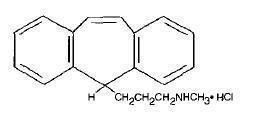
Protriptyline HCl, dibenzocycloheptene derivative, has a molecular weight of 299.84. It is a white to yellowish powder that is freely soluble in water and soluble in dilute HCl. Protriptyline HCl is supplied as 5 mg or 10 mg film-coated tablets. Inactive ingredients are anhydrous lactose, crospovidone, dibasic calcium phosphate, magnesium stearate, microcrystalline cellulose, polyethylene glycol, polyvinyl alcohol, talc, titanium dioxide, FD&C Yellow#6, and the 10 mg tablets contain D & C Yellow#10.
CLINICAL PHARMACOLOGY
Protriptyline hydrochloride is an antidepressant agent. The mechanism of its antidepressant action in man is not known. It is not a monoamine oxidase inhibitor, and it does not act primarily by stimulation of the central nervous system.
Protriptyline has been found in some studies to have a more rapid onset of action than imipramine or amitriptyline. The initial clinical effect may occur within one week. Sedative and tranquilizing properties are lacking. The rate of excretion is slow.
HOW SUPPLIED
Protriptyline Hydrochloride Tablets:
5 mg - Orange, round, film-coated tablets in bottles of 100 (NDC 42794-004-02). Debossed “Σ” on one side and “4” on the other.
10 mg - Yellow, round, film-coated tablets in bottles of 100 (NDC 42794-007-02). Debossed “Σ” on one side and “7” on the other.
Dispense in a tight container as defined in the USP.
Store at 20°-25°C (68°-77°F) [See USP Controlled Room Temperature].
METABOLISM
Metabolic studies indicate that protriptyline is well absorbed from the gastrointestinal tract and is rapidly sequestered in tissues. Relatively low plasma levels are found after administration, and only a small amount of unchanged drug is excreted in the urine of dogs and rabbits. Preliminary studies indicate that demethylation of the secondary amine moiety occurs to a significant extent, and that metabolic transformation probably takes place in the liver. It penetrates the brain rapidly in mice and rats, and moreover that which is present in the brain is almost all unchanged drug.
Studies on the disposition of radioactive protriptyline in human test subjects showed significant plasma levels within 2 hours, peaking at 8 to 12 hours, then declining gradually.
Urinary excretion studies in the same subjects showed significant amounts of radioactivity in 2 hours. The rate of excretion was slow. Cumulative urinary excretion during 16 days accounted for approximately 50% of the drug. The fecal route of excretion did not seem to be important.
Sigmapharm Laboratories, LLC Bensalem, PA 19020 OS007A-00 REV.0219
