Get your patient on Prudoxin - Doxepin Hydrochloride cream (Doxepin Hydrochloride)
Prudoxin - Doxepin Hydrochloride cream prescribing information

INDICATIONS AND USAGE
PRUDOXIN ® Cream is indicated for the short-term (up to 8 days) management of moderate pruritus in adult patients with atopic dermatitis or lichen simplex chronicus. (See DOSAGE AND ADMINISTRATION .)
DOSAGE AND ADMINISTRATION
A thin film of PRUDOXIN ® Cream should be applied four times each day with at least a 3 to 4 hour interval between applications. There are no data to establish the safety and effectiveness of PRUDOXIN ® Cream when used for greater than 8 days. Chronic use beyond eight days may result in higher systemic levels and should be avoided. Use of PRUDOXIN ® Cream for longer than 8 days may result in an increased likelihood of contact sensitization.
The risk for sedation may increase with greater body surface area application of PRUDOXIN ® Cream (See WARNINGS section). Clinical experience has shown that drowsiness is significantly more common in patients applying PRUDOXIN ® Cream to over 10% of body surface area; therefore, patients with greater than 10% of body surface area (see WARNINGS section) affected should be particularly cautioned concerning possible drowsiness and other systemic adverse effects of doxepin. If excessive drowsiness occurs, it may be necessary to do one or more of the following: reduce the body surface area treated, reduce the number of applications per day, reduce the amount of cream applied, or discontinue the drug.
Occlusive dressings may increase the absorption of most topical drugs; therefore, occlusive dressings should not be utilized with PRUDOXIN ® Cream.
CONTRAINDICATIONS
Because doxepin HCl has an anticholinergic effect and because significant plasma levels of doxepin are detectable after topical PRUDOXIN ® Cream application, the use of PRUDOXIN ® Cream is contraindicated in patients with untreated narrow angle glaucoma or a tendency to urinary retention.
PRUDOXIN ® Cream is contraindicated in individuals who have shown previous sensitivity to any of its components.
ADVERSE REACTIONS
Controlled Clinical Trials
Systemic Adverse Effects: In controlled clinical trials of patients treated with PRUDOXIN ® Cream, the most common systemic adverse event reported was drowsiness. Drowsiness occurred in 71 of 330 (22%) of patients treated with PRUDOXIN ® Cream compared to 7 of 334 (2%) of patients treated with vehicle cream. Drowsiness resulted in the premature discontinuation of the drug in approximately 5% of patients treated with PRUDOXIN ® Cream in controlled clinical trials.
Local Site Adverse Effects: In controlled clinical trials of patients treated with PRUDOXIN ® Cream, the most common local site adverse event reported was burning and/or stinging at the site of application.
These occurred in 76 of 330 (23%) of patients treated with PRUDOXIN ® Cream compared to 54 of 334 (16%) of patients treated with vehicle cream. Most of these reactions were categorized as "mild"; however, approximately 25% of patients who reported burning and/or stinging reported the reaction as "severe". Four patients treated with PRUDOXIN ® Cream withdrew from the study because of the burning and/or stinging.
The table below presents the adverse events reported at an incidence of ≥ 1 % in either PRUDOXIN ® or vehicle cream treatment groups during the trials:
Adverse Event | PRUDOXIN ® N=330 | Vehicle N=334 |
Burning /Stinging | 76 (23.0%) | 54 (16.2%) |
Drowsiness | 71 (21.5%) | 7 (2.1%) |
Dry Mouth 1 | 32 (9.7%) | 4 (1.2%) |
Pruritus 2 | 13 (3.9%) | 20 (6.0%) |
Fatigue/Tiredness | 10 (3.0%) | 5 (1.5%) |
Exacerbated Eczema | 10 (3.0%) | 8 (2.4%) |
Other Application Site Reaction 3 | 10 (3.0%) | 16 (4.8%) |
Dizziness 4 | 7 (2.1%) | 3 (0.9%) |
Mental/Emotional Changes | 6 (1.8%) | 1 (0.3%) |
Taste Perversion 5 | 5 (1.5%) | 1 (0.3%) |
Edema | 4 (1.2%) | 1 (0.3%) |
Headache | 3 (0.9%) | 14 (4.2%) |
1 Includes reports of “dry lips”, “dry throat”, and “thirst” | ||
2 Includes reports of “pruritus exacerbated” | ||
3 Includes report of “increased irritation at application site” | ||
4 Includes reports of “lightheadedness” and “dizziness/vertigo” | ||
5 Includes reports of “bitter taste” and “metallic taste in mouth” | ||
Adverse events occurring in 0.5% to < 1.0% of PRUDOXIN ® Cream treated patients in the controlled clinical trials included: nervousness/anxiety, tongue numbness, fever, and nausea.
Drug Interactions
Studies have not been performed examining drug interactions with PRUDOXIN ® Cream. However, since plasma levels of doxepin following topical application of PRUDOXIN ® Cream can reach levels obtained with oral doxepin HCl therapy, the following drug interactions are possible following topical PRUDOXIN ® Cream application:
Drugs Metabolized by P450 2D6: The biochemical activity of the drug metabolizing isozyme cytochrome P450 2D6 (debrisoquin hydroxylase) is reduced in a subset of the Caucasian population (about 7-10% of Caucasians are so-called "poor metabolizers"); reliable estimates of the prevalence of reduced P450 2D6 isozyme activity among Asian, African and other populations are not yet available.
Poor metabolizers have higher than expected plasma concentrations of tricyclic antidepressants (TCAs) when given usual doses. Depending on the fraction of drug metabolized by P450 2D6, the increase in plasma concentration may be small, or quite large (8-fold increase in plasma AUC of the TCA).
In addition, certain drugs inhibit the activity of this isozyme and make normal metabolizers resemble poor metabolizers. An individual who is stable on a given dosage regimen of a TCA may become abruptly toxic when given one of these inhibiting drugs as concomitant therapy. The drugs that inhibit cytochrome P450 2D6 include some that are not metabolized by the enzyme (quinidine; cimetidine) and many that are substrates for P450 2D6 (many other antidepressants, phenothiazines, and the Type 1C antiarrhythmics propafenone and flecainide). While all the selective serotonin reuptake inhibitors (SSRIs), e.g., fluoxetine, sertraline, and paroxetine, inhibit P450 2D6, they may vary in the extent of inhibition. The extent to which SSRI-TCA interactions may pose clinical problems will depend on the degree of inhibition and the pharmacokinetics of the SSRI involved. Nevertheless, caution is indicated in the co-administration of TCAs with any of the SSRIs. Of particular importance, sufficient time must elapse before initiating TCA treatment in a patient being withdrawn from fluoxetine, given the long half- life of the parent and active metabolite (at least 5 weeks may be necessary).
Concomitant use of tricyclic antidepressants with drugs that can inhibit cytochrome P450 2D6 may require lower doses than usually prescribed for either the tricyclic antidepressant or the other drug. It is desirable to monitor TCA plasma levels whenever a TCA is going to be co-administered with another drug known to be an inhibitor of P450 2D6.
MAO Inhibitors: Serious side effects and even death have been reported following the concomitant use of certain drugs with MAO inhibitors. Therefore, MAO inhibitors should be discontinued at least two weeks prior to the cautious initiation of therapy with PRUDOXIN ® Cream. The exact length of time may vary and is dependent upon the particular MAO inhibitor being used, the length of time it has been administered, and the dosage involved.
Cimetidine: Serious anticholinergic symptoms (i.e., severe dry mouth, urinary retention and blurred vision) have been associated with elevations in the serum levels of tricyclic antidepressant when cimetidine therapy is initiated. Additionally, higher than expected tricyclic antidepressant levels have been observed when they are begun in patients already taking cimetidine.
Alcohol: Alcohol ingestion may exacerbate the potential sedative effects of PRUDOXIN ® Cream. This is especially important in patients who may use alcohol excessively.
Tolazamide: A case of severe hypoglycemia has been reported in a type II diabetic patient maintained on tolazamide (1 gm/day) 11 days after the addition of oral doxepin (75 mg/day).
DESCRIPTION
PRUDOXIN ® (doxepin hydrochloride) Cream, 5% is a topical cream. Each gram contains: 50 mg of doxepin hydrochloride (equivalent to 44.3 mg of doxepin).
Doxepin hydrochloride, USP is one of a class of agents known as dibenzoxepin tricyclic antidepressant compounds. It is an isomeric mixture of N,N-dimethyldibenz[ b,e ]oxepin-Δ 11(6H),γ -propylamine hydrochloride. Doxepin hydrochloride has a molecular formula of C 19 H 21 NO•HCl and a molecular weight of 316.
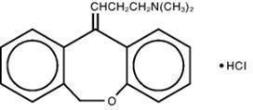
PRUDOXIN ® Cream also contains sorbitol, cetyl alcohol, isopropyl myristate, glyceryl stearate, PEG- 100 stearate, petrolatum, benzyl alcohol, titanium dioxide and purified water.
CLINICAL PHARMACOLOGY
Although doxepin HCl does have H1 and H2 histamine receptor blocking actions, the exact mechanism by which doxepin exerts its antipruritic effect is unknown. PRUDOXIN ® Cream can produce drowsiness which may reduce awareness, including awareness of pruritic symptoms. In 19 pruritic eczema patients treated with PRUDOXIN ® Cream, plasma doxepin concentrations ranged from nondetectable to 47 ng/mL from percutaneous absorption. Plasma levels from topical application of PRUDOXIN ® Cream can result in CNS and other systemic side effects.
Once absorbed into the systemic circulation, doxepin undergoes hepatic metabolism that results in conversion to pharmacologically-active desmethyldoxepin. Further glucuronidation results in urinary excretion of the parent drug and its metabolites. Desmethyldoxepin has a half-life that ranges from 28 to 52 hours and is not affected by multiple dosing. Plasma levels of both doxepin and desmethyldoxepin are highly variable and are poorly correlated with dosage. Wide distribution occurs in body tissues including lungs, heart, brain, and liver. Renal disease, genetic factors, age, and other medications affect the metabolism and subsequent elimination of doxepin. (See PRECAUTIONS - Drug Interactions .)
HOW SUPPLIED
PRUDOXIN ® Cream is available containing 50 mg of doxepin hydrochloride, USP equivalent to 44.3 mg of doxepin. PRUDOXIN ® Cream, 5% is a soft white cream available as follows:
NDC 0378-8130-45 carton containing one 45 g tube
Store below 27° C (80° F).
Manufactured for: Mylan Pharmaceuticals Inc. Morgantown, WV 26505 U.S.A.
Manufactured by: DPT Laboratories, Ltd. San Antonio, TX 78215 U.S.A.
PRUDOXIN is a registered trademark of Delcor Asset Corporation, a Mylan Company
© 2017 Mylan Pharmaceuticals Inc.
DPT:PRUD:R1 Revised: 6/2017
140901-0617
