Get your patient on Terbutaline Sulfate - Terbutaline Sulfate injection (Terbutaline Sulfate)
Terbutaline Sulfate - Terbutaline Sulfate injection prescribing information

BOXED WARNING
WARNING: PROLONGED TOCOLYSIS Terbutaline Sulfate has not been approved for and should not be used for prolonged tocolysis (beyond 48-72 hours). In particular, terbutaline sulfate should not be used for maintenance tocolysis in the outpatient or home setting. Serious adverse reactions, including death, have been reported after administration of terbutaline sulfate to pregnant women. In the mother, these adverse reactions include increased heart rate, transient hyperglycemia, hypokalemia, cardiac arrhythmias, pulmonary edema and myocardial ischemia. Increased fetal heart rate and neonatal hypoglycemia may occur as a result of maternal administration. [See CONTRAINDICATIONS, Prolonged Tocolysis.]
INDICATIONS & USAGE
Terbutaline sulfate injection is indicated for the prevention and reversal of bronchospasm in patients 12 years of age and older with asthma and reversible bronchospasm associated with bronchitis and emphysema.
DOSAGE AND ADMINISTRATION
Vials should be used only for subcutaneous administration and not intravenous infusion. Sterility and accurate dosing cannot be assured if the vials are not used in accordance with DOSAGE AND ADMINISTRATION.
Discard unused portion after single patient use.
The usual subcutaneous dose of terbutaline sulfate injection is 0.25 mg injected into the lateral deltoid area. If significant clinical improvement does not occur within 15 to 30 minutes, a second dose of 0.25 mg may be administered. If the patient then fails to respond within another 15 to 30 minutes, other therapeutic measures should be considered. The total dose within 4 hours should not exceed 0.5 mg.
Note: Parenteral drug products should be inspected visually for particulate matter and discoloration prior to administration, whenever solution and container permit.
CONTRAINDICATIONS
Prolonged Tocolysis
Terbutaline sulfate has not been approved for and should not be used for prolonged tocolysis (beyond 48-72 hours). In particular, terbutaline sulfate should not be used for maintenance tocolysis in the outpatient or home setting. [See Boxed Warning: Prolonged Tocolysis.]
Hypersensitivity
Terbutaline sulfate injection is contraindicated in patients known to be hypersensitive to sympathomimetic amines or any component of this drug product.
ADVERSE REACTIONS
Adverse reactions observed with terbutaline sulfate injection are similar to those commonly seen with other sympathomimetic agents. All these reactions are transient in nature and usually do not require treatment. The following table compares adverse reactions seen in patients treated with terbutaline sulfate injection (0.25 mg and 0.5 mg), with those seen in patients treated with epinephrine injection (0.25 mg and 0.5 mg), during eight double-blind crossover studies involving a total of 214 patients.
Incidence (%) of Adverse Reactions | ||||
Terbutaline (%) | Epinephrine (%) | |||
0.25mg N=77 | 0.5 mg N=205 | 0.25mg N=153 | 0.5 mg N=61 | |
Reaction Central Nervous System | ||||
Tremor | 7.8 | 38.0 | 16.3 | 18.0 |
Nervousness | 16.9 | 30.7 | 8.5 | 31.1 |
Dizziness | 1.3 | 10.2 | 7.8 | 3.3 |
Headache | 7.8 | 8.8 | 3.3 | 9.8 |
Drowsiness | 11.7 | 9.8 | 14.4 | 8.2 |
Cardiovascular | ||||
Palpitations | 7.8 | 22.9 | 7.8 | 29.5 |
Tachycardia | 1.3 | 1.5 | 2.6 | 0.0 |
Respiratory | ||||
Dyspnea | 0.0 | 2.0 | 2.0 | 0.0 |
Chest discomfort | 1.3 | 1.5 | 2.6 | 0.0 |
Gastrointestinal | ||||
Nausea/vomiting | 1.3 | 3.9 | 1.3 | 11.5 |
Systemic | ||||
Weakness | 1.3 | 0.5 | 2.6 | 1.6 |
Flushed feeling | 0.0 | 2.4 | 1.3 | 0.0 |
Sweating | 0.0 | 2.4 | 0.0 | 0.0 |
Pain at injection site | 2.6 | 0.5 | 2.6 | 1.6 |
Note: Some patients received more than one dosage strength of terbutaline sulfate and epinephrine. In addition, there were reports of anxiety, muscle cramps, and dry mouth (<0.5%). There have been rare reports of elevations in liver enzymes and of hypersensitivity vasculitis with terbutaline administration.
To report SUSPECTED ADVERSE REACTIONS, contact Areva Pharamceuticals Inc. at 1-855-853-4760 or FDA at 1-800-FDA-1088 or www.fda.gov/medwatch.
DRUG INTERACTIONS
Drug Interactions
The concomitant use of terbutaline sulfate injection with other sympathomimetic agents is not recommended, since the combined effect on the cardiovascular system may be deleterious to the patient.
DESCRIPTION SECTION
Terbutaline sulfate USP, the active ingredient of terbutaline sulfate injection, is a beta-adrenergic agonist bronchodilator available as a sterile, nonpyrogenic, aqueous solution in vials, for subcutaneous administration. Each milliliter of solution contains 1 mg of terbutaline sulfate USP (0.82 mg of the free base), sodium chloride for isotonicity, and hydrochloric acid for adjustment to a target pH of 4. Terbutaline sulfate is (±)-α-[(tert-butylamino)methyl]-3,5-dihydroxybenzyl alcohol sulfate (2:1) (salt). The molecular formula is (C12H19NO3)2•H2SO4 and the structural formula is:
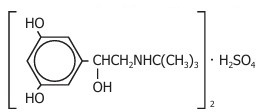
Terbutaline sulfate USP is a white to gray-white crystalline powder. It is odorless or has a faint odor of acetic acid. It is soluble in water and in 0.1N hydrochloric acid, slightly soluble in methanol, and insoluble in chloroform. Its molecular weight is 548.65.
CLINICAL PHARMACOLOGY
Terbutaline sulfate injection is a beta-adrenergic receptor agonist. In vitro and in vivo pharmacologic studies have demonstrated that terbutaline exerts a preferential effect on beta2-adrenergic receptors. While it is recognized that beta2-adrenergic receptors are the predominant receptors in bronchial smooth muscle, data indicate that there is a population of beta2-receptors in the human heart, existing in a concentration between 10% to 50%. The precise function of these receptors has not been established (see WARNINGS). Controlled clinical studies in patients given terbutaline subcutaneously have not revealed a preferential beta2-adrenergic effect.
The pharmacologic effects of beta-adrenergic agonists, including terbutaline, are at least in part attributable to stimulation through beta-adrenergic receptors of intracellular adenyl cyclase, the enzyme which catalyzes the conversion of adenosine triphosphate (ATP) to cyclic 3’,5’-adenosine monophosphate (cAMP). Increased cAMP levels are associated with relaxation of bronchial smooth muscle and inhibition of release of mediators of immediate hypersensitivity from cells, especially from mast cells.
Controlled clinical studies have shown that terbutaline sulfate injection relieves bronchospasm in acute and chronic obstructive pulmonary disease by significantly increasing pulmonary flow rates (e.g., an increase of 15% or more in FEV1). After subcutaneous administration of 0.25 mg of terbutaline sulfate injection, a measurable change in expiratory flow rate usually occurs within 5 minutes, and a clinically significant increase in FEV1 occurs within 15 minutes. The maximum effect usually occurs within 30 to 60 minutes, and clinically significant bronchodilator activity may continue for 1.5 to 4 hours. The duration of clinically significant improvement is comparable to that observed with equimilligram doses of epinephrine
Preclinical
Studies in laboratory animals (minipigs, rodents, and dogs) have demonstrated the occurrence of cardiac arrhythmias and sudden death (with histological evidence of myocardial necrosis) when beta-agonists and methylxanthines are administered concurrently. The clinical significance of these findings is unknown.
PHARMACOKINETICS
Subcutaneous administration of 0.5 mg of terbutaline sulfate to 17 healthy, adult, male subjects resulted in mean (SD) peak plasma terbutaline concentration of 9.6 (3.6) ng/mL, which was observed at a median (range) time of 0.5 (0.08 to 1.0) hours after dosing. The mean (SD) AUC (0 to 48) and total body clearance values were 29.4 (14.2) hr•ng/mL, and 311 (112) mL/min respectively. The terminal half-life was determined in 9 of the 17 subjects and had a mean (SD) of 5.7 (2.0) hours.
After subcutaneous administration of 0.25 mg of terbutaline sulfate to two male subjects, peak terbutaline serum concentrations of 5.2 and 5.3 ng/mL were observed at about 20 minutes after dosing.
Elimination half-life of the drug in 10 of 14 patients was approximately 2.9 hours after subcutaneous administration, but longer elimination half-lives (between 6 to 14 hours) were found in the other 4 patients. About 90% of the drug was excreted in the urine at 96 hours after subcutaneous administration, with about 60% of this being unchanged drug. It appears that the sulfate conjugate is a major metabolite of terbutaline and urinary excretion is the primary route of elimination.
HOW SUPPLIED
Terbutaline Sulfate Injection USP; 1 mg/mL, is supplied at a volume of 1 mL contained in a 2 mL clear glass vial. Each vial contains 1 mg of terbutaline sulfate per 1 mL of solution; 0.25 mL of solution will provide the usual clinical dose of 0.25 mg.
Vials are expiration-dated.
NDC 59923-615-05; Carton of 5 vials.
Store at 20° to 25°C (68° to 77°F). See USP controlled room temperature. Protect from light by storing vials in original carton until dispensed.
Do not use if solution is discolored.
Discard unused portion after single patient use.
