Triamcinolone Acetonide
Triamcinolone Acetonide Prescribing Information
Triamcinolone acetonide lotion, 0.1% is indicated for relief of the inflammatory and pruritic manifestations of corticosteroid-responsive dermatoses.
Apply the 0.1% triamcinolone acetonide lotion to the affected area two to three times daily. Rub in gently.
Topical corticosteroids are contraindicated in those patients with a history of hypersensitivity to any of the components of the preparations.
The following local adverse reactions are reported infrequently with topical corticosteroids, but may occur more frequently with the use of occlusive dressings (reactions are listed in an approximate decreasing order of occurrence): burning, itching, irritation, dryness, folliculitis, hypertrichosis, acneiform eruptions, hypopigmentation, perioral dermatitis, allergic contact dermatitis, maceration of the skin, secondary infection, skin atrophy, striae, and miliaria.
The topical corticosteroids constitute a class of primarily synthetic steroids used as anti‑inflammatory and antipruritic agents. The steroids in this class include triamcinolone acetonide. Triamcinolone acetonide is designated chemically as 9-Fluoro-11β,16α,17,21-tetrahydroxypregna-1,4‑diene-3,20-dione cyclic 16, 17-acetal with acetone.
Structural formula:
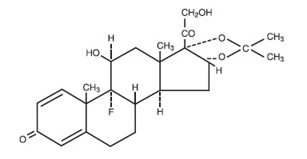
C
24H
31FO
6 MW 434.51 g/mol
Each mL of 0.1% triamcinolone acetonide lotion, USP provides 1 mg triamcinolone acetonide, USP in a lotion base containing cetyl alcohol, citric acid, polysorbate 20, propylene glycol, purified water, simethicone 30% emulsion, sorbitan monopalmitate and stearyl alcohol.
Topical corticosteroids share anti-inflammatory, antipruritic and vasoconstrictive actions.
The mechanism of anti-inflammatory activity of the topical corticosteroids is unclear. Various laboratory methods, including vasoconstrictor assays, are used to compare and predict potencies and/or clinical efficacies of the topical corticosteroids. There is some evidence to suggest that a recognizable correlation exists between vasoconstrictor potency and therapeutic efficacy in man.