Get your patient on Verapamil Hydrochloride - Verapamil Hydrochloride injection, Solution (Verapamil Hydrochloride)
Verapamil Hydrochloride - Verapamil Hydrochloride injection, Solution prescribing information

INDICATIONS AND USAGE
Verapamil Hydrochloride Injection, USP is indicated for the following:
- Rapid conversion to sinus rhythm of paroxysmal supraventricular tachycardias, including those associated with accessory bypass tracts (Wolff-Parkinson-White [W-P-W] and Lown-Ganong- Levine [L-G-L] syndromes). When clinically advisable, appropriate vagal maneuvers (e.g., Valsalva maneuver) should be attempted prior to verapamil hydrochloride administration.
- Temporary control of rapid ventricular rate in atrial flutter or atrial fibrillation except when the atrial flutter and/or atrial fibrillation are associated with accessory bypass tracts (Wolff-Parkinson-White (W-P-W) and Lown-Ganong-Levine (L-G-L) syndromes).
In controlled studies in the United States, about 60% of patients with supraventricular tachycardia converted to normal sinus rhythm within 10 minutes after intravenous verapamil hydrochloride. Uncontrolled studies reported in the world literature describe a conversion rate of about 80%. About 70% of patients with atrial flutter and/or fibrillation with a faster ventricular rate respond with a decrease in ventricular rate of at least 20%. Conversion of atrial flutter or fibrillation to sinus rhythm is uncommon (about 10%) after verapamil hydrochloride and may reflect the spontaneous conversion rate, since the conversion rate after placebo was similar. Slowing of the ventricular rate in patients with atrial fibrillation/flutter lasts 30 to 60 minutes after a single injection.
Because a small fraction (<1%) of patients treated with verapamil hydrochloride respond with life-threatening adverse responses (rapid ventricular rate in atrial flutter/fibrillation, and an accessory bypass tract, marked hypotension, or extreme bradycardia/asystole – see CONTRAINDICATIONS and WARNINGS ), the initial use of verapamil hydrochloride injection should, if possible, be in a treatment setting with monitoring and resuscitation facilities, including D.C.-cardioversion capability (see ADVERSE REACTIONS , Suggested Treatment of Acute Cardiovascular Adverse Reactions). As familiarity with the patient's response is gained, use in an office setting may be acceptable.
Cardioversion has been used safely and effectively after verapamil hydrochloride injection.
DOSAGE AND ADMINISTRATION
FOR INTRAVENOUS USE ONLY. VERAPAMIL HYDROCHLORIDE INJECTION SHOULD BE GIVEN AS A SLOW INTRAVENOUS INJECTION OVER AT LEAST A TWO-MINUTE PERIOD OF TIME UNDER CONTINUOUS ELECTROCARDIOGRAPHIC (ECG) AND BLOOD PRESSURE MONITORING. The recommended intravenous doses of verapamil hydrochloride injection are as follows:
Adult:
Initial dose − 5 to 10 mg (0.075 to 0.15 mg/kg body weight) given as an intravenous bolus over at least 2 minutes.
Repeat dose − 10 mg (0.15 mg/kg body weight) 30 minutes after the first dose if the initial response is not adequate. An optimal interval for subsequent intravenous doses has not been determined, and should be individualized for each patient.
Older patients − The dose should be administered over at least 3 minutes to minimize the risk of untoward drug effects.
Pediatric:
Initial dose:
0 to 1 year: 0.1 to 0.2 mg/kg body weight (usual single dose range: 0.75 to 2 mg) should be administered as an intravenous bolus over at least 2 minutes under continuous ECG monitoring .
1 to 15 years: 0.1 to 0.3 mg/kg body weight (usual single dose range: 2 to 5 mg) should be administered as an intravenous bolus over at least 2 minutes. Do not exceed 5 mg .
Repeat dose:
0 to 1 year: 0.1 to 0.2 mg/kg body weight (usual single dose range: 0.75 to 2 mg) 30 minutes after the first dose if the initial response is not adequate ( under continuous ECG monitoring ). An optimal interval for subsequent intravenous doses has not been determined, and should be individualized for each patient.
1 to 15 years: 0.1 to 0.3 mg/kg body weight (usual single dose range: 2 to 5 mg) 30 minutes after the first dose if the initial response is not adequate. Do not exceed 10 mg as a single dose. An optimal interval for subsequent intravenous doses has not been determined, and should be individualized for each patient.
Note: Parenteral drug products should be inspected visually for particulate matter and discoloration prior to administration, whenever solution and container permit. Use only if solution is clear and vial seal is intact. Unused amount of solution should be discarded immediately following withdrawal of any portion of contents.
For stability reasons this product is not recommended for dilution with Sodium Lactate Injection, USP in polyvinyl chloride bags. Verapamil is physically compatible and chemically stable for at least 24 hours at 25°C protected from light in most common large volume parenteral solutions. Admixing verapamil hydrochloride injection with albumin, amphotericin B, hydralazine hydrochloride and trimethoprim with sulfamethoxazole should be avoided. Verapamil hydrochloride injection will precipitate in any solution with a pH above 6.0.
CONTRAINDICATIONS
Verapamil hydrochloride injection is contraindicated in:
1. Severe hypotension or cardiogenic shock.
2. Second- or third-degree AV block (except in patients with a functioning artificial ventricular pacemaker).
3. Sick sinus syndrome (except in patients with a functioning artificial ventricular pacemaker).
4. Severe congestive heart failure (unless secondary to a supraventricular tachycardia amenable to verapamil therapy).
5. Patients receiving intravenous beta-adrenergic blocking drugs (e.g., propranolol). Intravenous verapamil and intravenous beta-adrenergic blocking drugs should not be administered in close proximity to each other (within a few hours), since both may have a depressant effect on myocardial contractility and AV conduction.
6. Patients with atrial flutter or atrial fibrillation and an accessory bypass tract (e.g., Wolff- Parkinson-White, Lown-Ganong-Levine syndromes) are at risk to develop ventricular tachyarrhythmia including ventricular fibrillation if verapamil is administered. Therefore, the use of verapamil in these patients is contraindicated.
7. Ventricular tachycardia: Administration of intravenous verapamil to patients with wide-complex ventricular tachycardia (QRS ≥ 0.12 sec) can result in marked hemodynamic deterioration and ventricular fibrillation. Proper pretherapy diagnosis and differentiation from wide-complex supraventricular tachycardia is imperative in the emergency room setting.
8. Known hypersensitivity to verapamil hydrochloride.
ADVERSE REACTIONS
The following reactions were reported with verapamil hydrochloride injection used in controlled U.S. clinical trials involving 324 patients:
Cardiovascular: Symptomatic hypotension (1.5%); bradycardia (1.2%); severe tachycardia (1.0%). The worldwide experience in open clinical trials in more than 7,900 patients was similar.
Central Nervous System Effects: Dizziness (1.2%); headache (1.2%). Occasional cases of seizures during verapamil injection have been reported.
Gastrointestinal: Nausea (0.9%); abdominal discomfort (0.6%).
In rare cases of hypersensitive patients, broncho/laryngeal spasm accompanied by itch and urticaria has been reported.
The following reactions have been reported at low frequency: emotional depression, rotary nystagmus, sleepiness, vertigo, muscle fatigue, diaphoresis, and respiratory failure.
| Suggested Treatment of Acute Cardiovascular Adverse Reactions• | ||
| The frequency of these adverse reactions was quite low, and experience with their treatment has been limited. | ||
| Adverse Reaction | Proven Effective Treatment | Supportive Treatment |
| 1.Symptomatic hypotension requiring treatment | Dopamine intravenous Calcium chloride intravenous Norepinephrine bitartrate Intravenous Metaraminol bitartrate intravenous Isoproterenol HCl intravenous | Intravenous fluids Trendelenburg position |
| 2. Bradycardia, AV block, Asystole | Isoproterenol HCl intravenous Calcium chloride intravenous Norepinephrine bitartrate intravenous Atropine intravenous Cardiac pacing | Intravenous fluids (slow drip) |
| 3. Rapid ventricular rate (due to antegrade conduction in flutter/fibrillation with W-P-W or L-G-L syndromes) | DC-cardioversion (high energy may be required) Procainamide intravenous Lidocaine intravenous | Intravenous fluids (slow drip) |
• Actual treatment and dosage should depend on the severity of the clinical situation and the judgment and experience of the treating physician.
To report SUSPECTED ADVERSE REACTIONS, contact Lifestar Pharma LLC at 1-888-995-4337 or FDA at 1-800-FDA-1088 or www.fda.gov/medwatch.
Drug Interactions:
(See WARNINGS : Concomitant Antiarrhythmic Therapy .) Verapamil hydrochloride injection has been used concomitantly with other cardioactive drugs (especially digitalis) without evidence of serious negative drug interactions. In rare instances, including when patients with severe cardiomyopathy, congestive heart failure, or recent myocardial infarction were given intravenous beta-adrenergic blocking agents or disopyramide concomitantly with intravenous verapamil, serious adverse effects have occurred. Concomitant use of verapamil hydrochloride with β-adrenergic blockers may result in an exaggerated hypotensive response. Such an effect was observed in one study, following the concomitant administration of verapamil and prazosin. It may be necessary to decrease the dose of verapamil and/or dose of the neuromuscular blocking agent when the drugs are used concomitantly. As verapamil is highly bound to plasma proteins, it should be administered with caution to patients receiving other highly protein-bound drugs.
Other
Cimetidine: The interaction between cimetidine and chronically administered verapamil has not been studied. In acute studies of healthy volunteers, clearance of verapamil was either reduced or unchanged.
Lithium: Increased sensitivity to the effects of lithium (neurotoxicity) has been reported during concomitant verapamil-lithium therapy with either no change or an increase in serum lithium levels. The addition of verapamil, however, has also resulted in the lowering of serum lithium levels in patients receiving chronic stable oral lithium. Patients receiving both drugs must be monitored carefully.
Carbamazepine: Verapamil therapy may increase carbamazepine concentrations during combined therapy. This may produce carbamazepine side effects such as diplopia, headache, ataxia, or dizziness.
Rifampin: Therapy with rifampin may markedly reduce oral verapamil bioavailability.
Phenobarbital: Phenobarbital therapy may increase verapamil clearance.
Cyclosporin: Verapamil therapy may increase serum levels of cyclosporin.
Inhalation Anesthetics: Animal experiments have shown that inhalation anesthetics depress cardiovascular activity by decreasing the inward movement of calcium ions. When used concomitantly, inhalation anesthetics and calcium antagonists (such as verapamil) should be titrated carefully to avoid excessive cardiovascular depression.
Neuromuscular Blocking Agents: Clinical data and animal studies suggest that verapamil may potentiate the activity of depolarizing and nondepolarizing neuromuscular blocking agents. It may be necessary to decrease the dose of verapamil and/or the dose of the neuromuscular blocking agent when the drugs are used concomitantly.
Dantrolene: Two animal studies suggest concomitant intravenous use of verapamil and dantrolene sodium may result in cardiovascular collapse. There has been one report of hyperkalemia and myocardial depression following the coadministration of oral verapamil and intravenous dantrolene.
DESCRIPTION
Verapamil hydrochloride is a calcium antagonist or slow-channel inhibitor. Verapamil Hydrochloride Injection, USP is a sterile, nonpyrogenic solution containing verapamil hydrochloride 2.5 mg/mL and sodium chloride 8.5 mg/mL in water for injection. The solution contains no bacteriostat or antimicrobial agent and is intended for single-dose intravenous administration. May contain hydrochloric acid and/or sodium hydroxide for pH adjustment; pH is 4.0 to 6.5.
The chemical name of Verapamil Hydrochloride, USP is benzeneacetonitrile, α-[3-[{2-(3,4-dimethoxyphenyl)ethyl} methylamino] propyl]-3,4-dimethoxy-α-(1-methylethyl) hydrochloride. Verapamil hydrochloride is a white or practically white crystalline powder. It is practically odorless and has a bitter taste. It is soluble in water; freely soluble in chloroform; sparingly soluble in alcohol; practically insoluble in ether. It has the following structural formula:
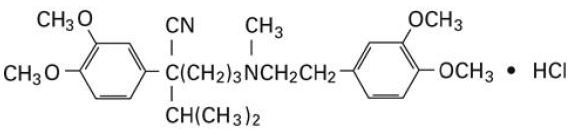
Molecular weight: 491.07
Molecular formula: C 27 H 38 N 2 O 4 • HCl
Verapamil hydrochloride is not chemically related to other antiarrhythmic drugs.
CLINICAL PHARMACOLOGY
Mechanism of Action: Verapamil inhibits the calcium ion (and possibly sodium ion) influx through slow channels into conductile and contractile myocardial cells and vascular smooth muscle cells. The antiarrhythmic effect of verapamil appears to be due to its effect on the slow channel in cells of the cardiac conduction system. The vasodilatory effect of verapamil appears to be due to its effect on blockade of calcium channels as well as α receptors.
In the isolated rabbit heart, concentrations of verapamil that markedly affect SA nodal fibers or fibers in the upper and middle regions of the AV node have very little effect on fibers in the lower AV node (NH region) and no effect on atrial action potentials or His bundle fibers.
Electrical activity in the SA and AV nodes depends, to a large degree, upon calcium influx through the slow channel. By inhibiting this influx, verapamil slows AV conduction and prolongs the effective refractory period within the AV node in a rate-related manner. This effect results in a reduction of the ventricular rate in patients with atrial flutter and/or atrial fibrillation and a rapid ventricular response.
By interrupting reentry at the AV node, verapamil can restore normal sinus rhythm in patients with paroxysmal supraventricular tachycardias (PSVT), including PSVT associated with Wolff-Parkinson-White syndrome.
Verapamil does not induce peripheral arterial spasm.
Verapamil has a local anesthetic action that is 1.6 times that of procaine on an equimolar basis. It is not known whether this action is important at the doses used in man.
Verapamil does not alter total serum calcium levels.
Hemodynamics: Verapamil reduces afterload and myocardial contractility. The commonly used intravenous doses of 5 to 10 mg verapamil hydrochloride produce transient, usually asymptomatic, reduction in normal systemic arterial pressure, systemic vascular resistance and contractility; left ventricular filling pressure is slightly increased. In most patients, including those with organic cardiac disease, the negative inotropic action of verapamil is countered by reduction of afterload, and cardiac index is usually not reduced. However, in patients with moderately severe to severe cardiac dysfunction (pulmonary wedge pressure above 20 mm Hg, ejection fraction less than 30%), acute worsening of heart failure may be seen. Peak therapeutic effects occur within 3 to 5 minutes after a bolus injection.
Pharmacokinetics: Intravenously administered verapamil hydrochloride has been shown to be rapidly metabolized. Following intravenous infusion in man, verapamil is eliminated bi-exponentially, with a rapid early distribution phase (half-life about 4 minutes) and a slower terminal elimination phase (half-life 2 to 5 hours). In healthy men, orally administered verapamil hydrochloride undergoes extensive metabolism in the liver, with 12 metabolites having been identified, most in only trace amounts. The major metabolites have been identified as various N- and O-dealkylated products of verapamil.
Approximately 70% of an administered dose is excreted in the urine and 16% more in the feces within 5 days. About 3% to 4% is excreted as unchanged drug.
Aging may affect the pharmacokinetics of verapamil given to hypertensive patients. Elimination half-life may be prolonged in the elderly.
HOW SUPPLIED
Verapamil Hydrochloride Injection, USP 2.5 mg/mL is a clear, colourless solution and supplied in single-dose containers as follows:
| NDC No. | Container | Volume | Content |
| 70756-606-05 | Single-dose vial | 4 mL (5 pack carton) | 10 mg |
| 70756-605-05 | Single-dose vial | 2 mL (5 pack carton) | 5 mg |
| 70756-605-25 | Single-dose vial | 2 mL (25 pack carton) | 5 mg |
Store at 20º to 25°C (68º to 77°F). [See USP Controlled Room Temperature.]
Protect from light by retaining in package until ready to use.
Manufactured for:
Lifestar Pharma LLC
1200 MacArthur Blvd.
Mahwah, NJ 07430 USA
Made in India
Revised: February 2020, V-01
