Get your patient on Amondys 45 (Casimersen)
Amondys 45 patient education
Patient toolkit
Dosage & administration

Amondys 45 prescribing information

INDICATIONS AND USAGE
AMONDYS 45 is indicated for the treatment of Duchenne muscular dystrophy (DMD) in patients who have a confirmed mutation of the DMD gene that is amenable to exon 45 skipping. This indication is approved under accelerated approval based on an increase in dystrophin production in skeletal muscle observed in patients treated with AMONDYS 45 [see Clinical Studies (14 )] . Continued approval for this indication may be contingent upon verification of a clinical benefit in confirmatory trials.
DOSAGE AND ADMINISTRATION
- Serum cystatin C, urine dipstick, and urine protein-to-creatinine ratio should be measured before starting AMONDYS 45 (2.1 )
- 30 milligrams per kilogram of body weight once weekly (2.2 )
- Administer as an intravenous (IV) infusion over 35 to 60 minutes via an in-line 0.2 micron filter (2.2 , 2.4 )
- Dilution required prior to administration (2.3 )
Monitoring to Assess Safety
Serum cystatin C, urine dipstick, and urine protein-to-creatinine ratio (UPCR) should be measured before starting AMONDYS 45. Consider measurement of glomerular filtration rate prior to initiation of AMONDYS 45. Monitoring for kidney toxicity during treatment is recommended. Obtain the urine sample prior to infusion of AMONDYS 45 or at least 48 hours after infusion [see Warnings and Precautions (5.2 )] .
Dosing Information
The recommended dosage of AMONDYS 45 is 30 milligrams per kilogram administered once weekly as a 35 to 60-minute intravenous infusion via an in-line 0.2 micron filter.
If a dose of AMONDYS 45 is missed, it may be administered as soon as possible after the scheduled dose.
Preparation Instructions
AMONDYS 45 is supplied in single-dose vials as a preservative-free concentrated solution that requires dilution prior to administration. Parenteral drug products should be inspected visually for particulate matter and discoloration prior to administration, whenever solution and container permit. Use aseptic technique.
- Calculate the total dose of AMONDYS 45 to be administered based on the patient's weight and the recommended dose of 30 milligrams per kilogram. Determine the volume of AMONDYS 45 needed and the correct number of vials to supply the full calculated dose.
- Allow the vials to warm to room temperature. Mix the contents of each vial by gently inverting 2 or 3 times. Do not shake.
- Visually inspect each vial of AMONDYS 45. The solution is a clear to slightly opalescent, colorless liquid, and may contain trace amounts of small, white to off-white amorphous particles. Do not use if the solution in the vials is cloudy, discolored or contains extraneous particulate matter other than trace amounts of small, white to off-white amorphous particles.
- With a syringe fitted with a 21-gauge or smaller bore non-coring needle, withdraw the calculated volume of AMONDYS 45 from the appropriate number of vials. To avoid dulling the needle and fragmenting the stoppers, replace the needle periodically during preparation.
- Dilute the withdrawn AMONDYS 45 in 0.9% Sodium Chloride Injection, USP, to make a total volume of 100 to 150 mL. Gently invert 2 to 3 times to mix. Do not shake. Visually inspect the diluted solution. Do not use if the solution is cloudy, discolored or contains extraneous particulate matter other than trace amounts of small, white to off-white amorphous particles.
- Administer the diluted solution via an in-line 0.2 micron filter.
- AMONDYS 45 contains no preservatives and should be administered immediately after dilution. Complete infusion of diluted AMONDYS 45 within 4 hours of dilution. If immediate use is not possible the diluted product may be stored for up to 24 hours at 2 °C to 8 °C (36 °F to 46 °F). Do not freeze. Discard unused AMONDYS 45.
Administration Instructions
Application of a topical anesthetic cream to the infusion site prior to administration of AMONDYS 45 may be considered.
AMONDYS 45 is administered via intravenous infusion. Flush the intravenous access line with 0.9% Sodium Chloride Injection, USP, prior to and after infusion.
Infuse the diluted AMONDYS 45 over 35 to 60 minutes via an in-line 0.2 micron filter. Do not mix other medication with AMONDYS 45 or infuse other medications concomitantly via the same intravenous access with AMONDYS 45.
If a hypersensitivity reaction occurs, consider slowing the infusion, interrupting or discontinuing the AMONDYS 45 therapy [see Contraindications (4 ), Warning and Precautions (5.1 ) and Adverse Reactions (6.2 )] .
DOSAGE FORMS AND STRENGTHS
AMONDYS 45 is a clear to slightly opalescent, colorless liquid and may contain trace amounts of small, white to off-white amorphous particles and is available as:
- Injection: 100 mg/2 mL (50 mg/ mL) solution in a single-dose vial
USE IN SPECIFIC POPULATIONS
Pregnancy
Risk Summary
There are no human or animal data available to assess the use of AMONDYS 45 during pregnancy. In the U.S. general population, major birth defects occur in 2% to 4% and miscarriage occurs in 15% to 20% of clinically recognized pregnancies.
Lactation
Risk Summary
There are no human or animal data to assess the effect of AMONDYS 45 on milk production, the presence of casimersen in milk, or the effects of AMONDYS 45 on the breastfed infant.
The developmental and health benefits of breastfeeding should be considered along with the mother's clinical need for AMONDYS 45 and any potential adverse effects on the breastfed infant from AMONDYS 45 or from the underlying maternal condition.
Pediatric Use
AMONDYS 45 is indicated for the treatment of DMD in patients who have a confirmed mutation of the DMD gene that is amenable to exon 45 skipping, including pediatric patients [see Clinical Studies (14 )].
Juvenile Animal Toxicity Data
Intravenous administration of casimersen (0, 100, 300, and 900 mg/kg) to juvenile male rats once weekly for 10 weeks (postnatal days 14 to 77) resulted in renal tubular degeneration/necrosis at the highest dose tested. No effects were observed on the male reproductive system, neurobehavioral development, or immune function. At the overall no-effect dose (300 mg/kg), plasma exposure (AUC) was 4 times that in humans at the recommended human dose of 30 mg/kg/week.
Geriatric Use
DMD is largely a disease of children and young adults; therefore, there is no experience with AMONDYS 45 in geriatric DMD patients.
Patients with Renal Impairment
Renal clearance of casimersen is decreased in non-DMD adults with renal impairment based on estimated glomerular filtration rate (calculated using the Modification of Diet and Renal Disease (MDRD) equation) [see Clinical Pharmacology (12.3 )] . However, because of the effect of reduced skeletal muscle mass on creatinine measurements in DMD patients, no specific dosage adjustment can be recommended for DMD patients with renal impairment based on estimated glomerular filtration rate. Patients with known renal function impairment should be closely monitored during treatment with AMONDYS 45.
CONTRAINDICATIONS
AMONDYS 45 is contraindicated in patients with known serious hypersensitivity to casimersen or to any of the inactive ingredients in AMONDYS 45. Instances of hypersensitivity, including angioedema and anaphylaxis, have occurred in patients receiving AMONDYS 45 [see Warnings and Precautions (5.1 )] .
WARNINGS AND PRECAUTIONS
- Hypersensitivity Reactions: Hypersensitivity reactions, including angioedema and anaphylaxis, have occurred in patients who were treated with AMONDYS 45. If a hypersensitivity reaction occurs, institute appropriate medical treatment and consider slowing the infusion, interrupting or discontinuing the AMONDYS 45 infusion (2.4 , 5.1 )
- Kidney Toxicity: Based on animal data, may cause kidney toxicity. Kidney function should be monitored; creatinine may not be a reliable measure of renal function in DMD patients. (5.2 , 13.2 )
Hypersensitivity Reactions
Hypersensitivity reactions, including angioedema and anaphylaxis, have occurred in patients who were treated with AMONDYS 45. If a hypersensitivity reaction occurs, institute appropriate medical treatment, and consider slowing the infusion [see Dosage and Administration (2.4 )] , interrupting, or discontinuing the AMONDYS 45 infusion and monitor until the condition resolves. AMONDYS 45 is contraindicated in patients with known serious hypersensitivity to casimersen or to any of the inactive ingredients in AMONDYS 45 [see Contraindications (4 )] .
Kidney Toxicity
Kidney toxicity was observed in animals who received casimersen [see Use in Specific Populations (8.4 ) and Nonclinical Toxicology (13.2 )] . Although kidney toxicity was not observed in the clinical studies with AMONDYS 45, kidney toxicity, including potentially fatal glomerulonephritis, has been observed after administration of some antisense oligonucleotides. Kidney function should be monitored in patients taking AMONDYS 45. Because of the effect of reduced skeletal muscle mass on creatinine measurements, creatinine may not be a reliable measure of kidney function in DMD patients. Serum cystatin C, urine dipstick, and urine protein-to-creatinine ratio should be measured before starting AMONDYS 45. Consider also measuring glomerular filtration rate using an exogenous filtration marker before starting AMONDYS 45. During treatment, monitor urine dipstick every month, and serum cystatin C and urine protein-to-creatinine ratio (UPCR) every three months. Only urine expected to be free of excreted AMONDYS 45 should be used for monitoring of urine protein. Urine obtained on the day of AMONDYS 45 infusion prior to the infusion, or urine obtained at least 48 hours after the most recent infusion, may be used. Alternatively, use a laboratory test that does not use the reagent pyrogallol red, as this reagent has the potential to cross react with any AMONDYS 45 that is excreted in the urine and thus lead to a false positive result for urine protein.
If a persistent increase in serum cystatin C or proteinuria is detected, refer to a pediatric nephrologist for further evaluation.
ADVERSE REACTIONS
The following clinically significant adverse reactions are described elsewhere in the labeling:
- Hypersensitivity reactions [see Warnings and Precautions (5.1 )]
Clinical Trials Experience
Because clinical trials are conducted under widely varying conditions, adverse reaction rates observed in clinical trials of a drug cannot be directly compared to rates in the clinical trials of another drug and may not reflect the rates observed in practice.
In the AMONDYS 45 clinical development program, 76 patients received at least one intravenous dose of AMONDYS 45 (30 mg/kg). All patients were male and had genetically confirmed Duchenne muscular dystrophy. Age at study entry was 7 to 20 years (mean 9.9 years). Most (88%) patients were White, and 9% were Asian.
AMONDYS 45 was studied in a double-blind, placebo-controlled study (Study 1).
Patients in ongoing Study 1 received AMONDYS 45 (n=57) 30 mg/kg or placebo (n=31) intravenously once weekly for up to 96 weeks, after which all patients received or will receive AMONDYS 45 30 mg/kg for up to 48 weeks.
Adverse reactions observed in ≥20% of patients treated with AMONDYS 45 and 5% more frequently than in the placebo group in Study 1 are shown in Table 1 .
•Includes upper respiratory infection, pharyngitis, nasopharyngitis, and rhinitis. | ||
| Adverse Reaction | AMONDYS 45 30 mg/kg Once Weekly (n = 57) % | Placebo (n = 31) % |
| Upper Respiratory Tract Infections• | 65 | 55 |
| Cough | 33 | 26 |
| Pyrexia | 33 | 23 |
| Headache | 32 | 19 |
| Arthralgia | 21 | 10 |
| Oropharyngeal Pain | 21 | 7 |
Other adverse reactions that occurred in at least 10% of patients treated with AMONDYS 45, and that were reported at a rate at least 5% more frequently in the AMONDYS 45 group than in the placebo group, were: ear pain, nausea, ear infection, post-traumatic pain, and dizziness and light-headedness.
Postmarketing Experience
The following adverse reactions have been identified during postapproval use of AMONDYS 45. Because these reactions are reported voluntarily from a population of uncertain size, it is not always possible to reliably estimate their frequency or establish a causal relationship to drug exposure. Infusion-related reactions including rash, headache, cough, abdominal pain (including upper abdominal pain), and vomiting occurred within 24 hours from the start of an infusion of AMONDYS 45.
Hypersensitivity reactions, including angioedema and anaphylaxis, have occurred in patients treated with AMONDYS 45.
DESCRIPTION
AMONDYS 45 (casimersen) injection is a sterile, aqueous, preservative-free, concentrated solution for dilution prior to intravenous administration. AMONDYS 45 is a clear to slightly opalescent, colorless liquid and may contain trace amounts of small, white to off-white amorphous particles. AMONDYS 45 is supplied in single-dose vials containing 100 mg casimersen (50 mg/mL). AMONDYS 45 is formulated as an isotonic phosphate buffered saline solution with an osmolality of 260 to 320 mOsm and a pH of 7.5. Each milliliter of AMONDYS 45 contains: 50 mg casimersen; 0.2 mg potassium chloride; 0.2 mg potassium phosphate monobasic; 8 mg sodium chloride; and 1.14 mg sodium phosphate dibasic, anhydrous, in water for injection. The product may contain hydrochloric acid or sodium hydroxide to adjust pH.
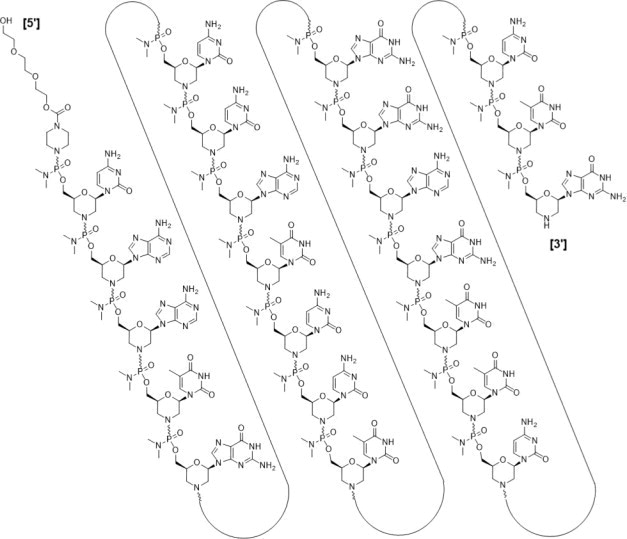
Casimersen is an antisense oligonucleotide of the phosphorodiamidate morpholino oligomer (PMO) subclass. PMOs are synthetic molecules in which the five-membered ribofuranosyl rings found in natural DNA and RNA are replaced by a six-membered morpholino ring. Each morpholino ring is linked through an uncharged phosphorodiamidate moiety rather than the negatively charged phosphate linkage that is present in natural DNA and RNA. Each phosphorodiamidate morpholino subunit contains one of the heterocyclic bases found in DNA (adenine, cytosine, guanine, or thymine). Casimersen contains 22 linked subunits. The sequence of bases from the 5' end to 3' end is CAATGCCATCCTGGAGTTCCTG. The molecular formula of casimersen is C 268 H 424 N 124 O 95 P 22 and the molecular weight is 7584.5 daltons.
The structure of casimersen is:
CLINICAL PHARMACOLOGY
Mechanism of Action
Casimersen is designed to bind to exon 45 of dystrophin pre-mRNA resulting in exclusion of this exon during mRNA processing in patients with genetic mutations that are amenable to exon 45 skipping. Exon 45 skipping is intended to allow for production of an internally truncated dystrophin protein in patients with genetic mutations that are amenable to exon 45 skipping [see Clinical Studies (14 )] .
Pharmacodynamics
In the interim analysis of muscle biopsy tissue obtained at baseline and at Week 48 from patients in Study 1, patients who received AMONDYS 45 (n=27) demonstrated a significant increase in skipping of exon 45 (p<0.001) compared to baseline, demonstrated by reverse transcription digital droplet polymerase chain reaction (RT-ddPCR). Patients who received placebo (n=16) did not demonstrate a significant increase in exon 45 skipping (p=0.808). The level of exon skipping is positively correlated with dystrophin protein expression [see Clinical Studies (14 )] .
In Study 1 [see Clinical Studies (14 )] , dystrophin levels as assessed by the Sarepta Western blot assay increased from 0.93% (SD 1.67) of normal at baseline to 1.74% (SD 1.97) of normal after 48 weeks of treatment with AMONDYS 45. The mean change from baseline in dystrophin after 48 weeks of treatment with AMONDYS 45 was 0.81% (SD 0.70) of normal levels (p<0.001). This increase in dystrophin protein expression after treatment with AMONDYS 45 positively correlated with the level of exon skipping. The mean change from baseline in dystrophin after 48 weeks of treatment with placebo was 0.22% (SD 0.49). Patients who received AMONDYS 45 showed a significantly greater increase in dystrophin protein levels from baseline to Week 48 compared to those who received placebo (mean difference of 0.59%; p = 0.004). Dystrophin levels assessed by Western blot can be meaningfully influenced by differences in sample processing, analytical technique, reference materials, and quantitation methodologies. Therefore, comparing dystrophin results from different assay protocols will require a standardized reference material and additional bridging studies.
Correct localization of dystrophin to the sarcolemma in patients treated with AMONDYS 45 was demonstrated by immunofluorescence staining.
Pharmacokinetics
The pharmacokinetics of casimersen was evaluated in DMD patients following administration of intravenous (IV) doses ranging from 4 mg/kg/week to 30 mg/kg/week (i.e., recommended dosage). Following a single IV dose of casimersen, C max was reached at the end of infusion. Casimersen exposure increased in a proportional manner with dose increment. No accumulation of casimersen was observed in plasma following once weekly dosing. Inter-subject variability (as %CV) for casimersen C max and AUC ranged from 12% to 34% and 16% to 34%, respectively.
Distribution
Binding of casimersen to human plasma protein was not concentration-dependent and ranged from 8.4% to 31.6%. The mean apparent volume of distribution at steady state (V ss ) was 367 mL/kg (%CV = 28.9) following a 30 mg/kg dose of casimersen administered intravenously.
Elimination
The plasma clearance (CL) of casimersen was 180 mL/hr/kg at the 30 mg/kg dose. The elimination half-life (t 1/2 ) was 3.5 hours (SD 0.4 hours).
Metabolism
Casimersen is metabolically stable in human hepatic microsomal incubations. No metabolites were detected in plasma or urine.
Excretion
Casimersen is mostly excreted unchanged in the urine. In a clinical study with radiolabeled casimersen, more than 90% of the drug was excreted in urine, with negligible fecal excretion.
Specific Populations
Age, Sex & Race
The pharmacokinetics of AMONDYS 45 have been evaluated in male DMD patients 9 to 20 years of age. There is no experience with the use of AMONDYS 45 in DMD patients 65 years of age or older. AMONDYS 45 has not been studied in female patients. The potential impact of race on the pharmacokinetics of casimersen is unknown.
Patients with Renal Impairment
The effect of renal impairment on the pharmacokinetics of casimersen was evaluated in non-DMD subjects aged 35 to 65 years with Stage 2 chronic kidney disease (CKD) (n=8, estimated glomerular filtration rate [eGFR] ≥60 and <90 mL/min/1.73 m 2 ) or Stage 3 CKD (n=8, eGFR ≥30 and <60 mL/min/1.73 m 2 ) and matched healthy subjects (n=9, eGFR ≥90 mL/min/1.73 m 2 ). Subjects received a single 30 mg/kg intravenous dose of casimersen.
In subjects with Stage 2 or Stage 3 CKD, exposure (AUC) increased approximately 1.2-fold and 1.8-fold, respectively, compared with subjects with normal renal function. The C max in subjects with Stage 2 CKD was similar to C max in subjects with normal renal function; in subjects with Stage 3 CKD, there was a 1.2-fold increase in C max compared with subjects with normal renal function. The effect of Stage 4 or Stage 5 CKD on casimersen pharmacokinetics and safety has not been studied.
Estimated GFR values derived from MDRD equations and the threshold definitions for various CKD stages in otherwise healthy adults would not be generalizable to pediatric patients with DMD. Therefore, no specific dosage adjustment can be recommended for patients with renal impairment [see Use in Specific Populations (8.6 )] .
Patients with Hepatic Impairment
AMONDYS 45 has not been studied in patients with hepatic impairment. However, casimersen does not undergo hepatic metabolism, and the systemic clearance of casimersen is not expected to be affected by hepatic impairment.
Drug Interaction Studies
Based on in vitro data, casimersen has a low potential for clinically relevant drug-drug interactions with major CYP enzymes and transporters.
Casimersen did not inhibit CYP1A2, CYP2B6, CYP2C8, or CYP2D6 in vitro . Casimersen was a potential inhibitor of CYP3A4/5, CYP2C9, and CYP2C19 in vitro ; however, considering its short plasma half-life and lack of plasma accumulation with the weekly dosing regimen, clinical drug interaction with substrates for these enzymes is unlikely. Casimersen did not induce CYP1A2, CYP2B6, or CYP3A4 either at the mRNA or protein (activity) level. Casimersen was not metabolized by human hepatic microsomes and was not a substrate or strong inhibitor of the key human drug transporters tested (OAT1, OAT3, OCT2, OATP1B1, OATP1B3, MATE1, MATE2-K, P-gp, BCRP, and MRP2).
NONCLINICAL TOXICOLOGY
Carcinogenesis, Mutagenesis, Impairment of Fertility
Carcinogenesis
Administration of casimersen to male transgenic (Tg.rasH2) mice (0, 100, 300, or 1000 mg/kg) weekly for 26 weeks by subcutaneous injection and to male rats (0, 125, 250, or 500 mg/kg) for up to 104 weeks by intravenous injection resulted in no increase in neoplasms.
Mutagenesis
Casimersen was negative in in vitro (bacterial reverse mutation assay and chromosomal aberration assay in CHO cells) and in vivo (mouse bone marrow micronucleus) assays.
Impairment of Fertility
Fertility studies in animals were not conducted with casimersen. No effects of casimersen were observed on the male reproductive system following weekly administration to male mice at subcutaneous doses up to 960 mg/kg for 26 weeks or to male monkeys at intravenous doses up to 640 mg/kg for 39 weeks. Plasma exposures at the highest doses tested in mouse and monkey were approximately 9 and 35 times, respectively, that in humans at the recommended human dose of 30 mg/kg/week.
Animal Toxicology and/or Pharmacology
Kidney toxicity was observed in studies in male mice and rats [see Warnings and Precautions (5.1 )] .
In male mice, casimersen was administered weekly for 12 weeks (0, 12, 120, or 960 mg/kg) or 22 weeks (0, 300, 960, or 2000 mg/kg) by intravenous injection or for 26 weeks by subcutaneous injection (0, 300, 600, or 960 mg/kg). In the 12-week study, microscopic findings in kidney (cytoplasmic basophilia and microvacuolation) were observed at the highest dose tested. In the 22- and 26-week studies, renal tubular degeneration was observed at all doses. A no-effect dose for adverse effects on kidney was not identified. Plasma exposure (AUC) at the lowest dose tested in the 26-week study (300 mg/kg) was approximately 2 times that in humans at the recommended human dose (RHD) of 30 mg/kg/week.
In male rats, intravenous administration of casimersen (0, 250, 500, 1000, or 2000 mg/kg) weekly for 13 weeks resulted in renal tubular degeneration at all doses tested; at the highest dose, the microscopic changes were accompanied by increases in blood urea nitrogen. A no-effect dose for adverse effects on kidney was not identified. Plasma exposure (AUC) at the lowest dose tested were approximately 4 times that in humans at the RHD.
CLINICAL STUDIES
The effect of AMONDYS 45 on dystrophin production was evaluated in one study in male DMD patients who have a confirmed mutation of the DMD gene that is amenable to exon 45 skipping (Study 1; NCT02500381).
Study 1 is an ongoing, double-blind, placebo-controlled, multicenter study designed to evaluate the safety and efficacy of AMONDYS 45 in ambulatory patients. The study is planned to enroll a total of 111 patients, age 7 to 13 years, randomized to AMONDYS 45 or placebo in a 2 to 1 ratio. Patients were required to have been on a stable dose of oral corticosteroids for at least 24 weeks prior to dosing with AMONDYS 45 or placebo. Following the 96-week double-blind period, all patients began or are to begin an additional 48 week open-label treatment period. Interim efficacy was assessed based on change from baseline in the dystrophin protein level (measured as % of the dystrophin level in healthy subjects, i.e., % of normal) at Week 48 of Study 1. Interim results from 43 evaluable patients (n = 27, AMONDYS 45; n = 16, placebo) who had a muscle biopsy at Week 48 of the double-blind period are presented in Table 2 . Patients who provided muscle biopsy data had a median age of 9 years and were 86% White.
| Placebo | AMONDYS 45 30 mg/kg/week IV | |
| Dystrophin by Sarepta Western blot | n=16 | n=27 |
| Baseline Mean (SD) | 0.54 (0.79) | 0.93 (1.67) |
| Week 48 Mean (SD) | 0.76 (1.15) | 1.74 (1.97) |
| Change from Baseline Mean (SD) | 0.22 (0.49) | 0.81 (0.70) |
| p-value Change from Baseline to Week 48 | 0.09 | <0.001 |
| Between group mean difference | 0.59 | |
| p-value between groups | p=0.004 | |
HOW SUPPLIED/STORAGE AND HANDLING
How Supplied
AMONDYS 45 injection is supplied in single dose vials. The solution is a clear to slightly opalescent, colorless liquid, and may contain trace amounts of small, white to off-white amorphous particles.
• Single-dose vials containing 100 mg/2 mL (50 mg/mL) NDC 60923-227-02
Storage and Handling
Store AMONDYS 45 at 2°C to 8°C (36°F to 46°F). Do not freeze. Store in original carton until ready for use to protect from light.
Mechanism of Action
Casimersen is designed to bind to exon 45 of dystrophin pre-mRNA resulting in exclusion of this exon during mRNA processing in patients with genetic mutations that are amenable to exon 45 skipping. Exon 45 skipping is intended to allow for production of an internally truncated dystrophin protein in patients with genetic mutations that are amenable to exon 45 skipping [see Clinical Studies (14 )] .
