Get your patient on Cyanocobalamin - Cyanocobalamin injection, Solution (Cyanocobalamin)
Cyanocobalamin - Cyanocobalamin injection, Solution prescribing information

INDICATIONS AND USAGE
Cyanocobalamin is indicated for vitamin B 12 deficiencies due to malabsorption which may be associated with the following conditions:
- Addisonian (pernicious) anemia
- Gastrointestinal pathology, dysfunction, or surgery, including gluten enteropathy or sprue, small bowel bacteria overgrowth, total or partial gastrectomy
- Fish tapeworm infestation
- Malignancy of pancreas or bowel
- Folic acid deficiency
It may be possible to treat the underlying disease by surgical correction of anatomic lesions leading to small bowel bacterial overgrowth, expulsion of fish tapeworm, discontinuation of drugs leading to vitamin malabsorption (see Drug Interactions ), use of a gluten-free diet in nontropical sprue, or administration of antibiotics in tropical sprue. Such measures remove the need for long-term administration of cyanocobalamin.
Requirements of vitamin B 12 in excess of normal (due to pregnancy, thyrotoxicosis, hemolytic anemia, hemorrhage, malignancy, hepatic and renal disease) can usually be met with oral supplementation.
Cyanocobalamin Injection, USP is also suitable for the vitamin B 12 absorption test (Schilling test).
DOSAGE AND ADMINISTRATION
Avoid using the intravenous route. Use of this product intravenously will result in almost all of the vitamin being lost in the urine.
Pernicious Anemia: Parenteral vitamin B 12 is the recommended treatment and will be required for the remainder of the patient's life. The oral form is not dependable. A dose of 100 mcg daily for 6 or 7 days should be administered by intramuscular or deep subcutaneous injection. If there is clinical improvement and if a reticulocyte response is observed, the same amount may be given on alternate days for seven doses, then every 3 to 4 days for another 2 to 3 weeks. By this time hematologic values should have become normal. This regimen should be followed by 100 mcg monthly for life. Folic acid should be administered concomitantly if needed.
Patients with Normal Intestinal Absorption: Where the oral route is not deemed adequate, initial treatment similar to that for patients with pernicious anemia may be indicated depending on the severity of the deficiency. Chronic treatment should be with an oral B 12 preparation. If other vitamin deficiencies are present, they should be treated.
Schilling Test: The flushing dose is 1,000 mcg.
Parenteral drug products should be inspected visually for particulate matter and discoloration prior to administration, whenever solution and container permit.
CONTRAINDICATIONS
Sensitivity to cobalt and/or vitamin B 12 is a contraindication.
ADVERSE REACTIONS
Generalized: Anaphylactic shock and death have been reported with administration of parenteral vitamin B 12 (see WARNINGS ).
Cardiovascular: Pulmonary edema and congestive heart failure early in treatment; peripheral vascular thrombosis.
Hematological: Polycythemia vera
Gastrointestinal: Mild transient diarrhea
Dermatological: Itching; transitory exanthema
Miscellaneous : Feeling of swelling of entire body
DESCRIPTION
Cyanocobalamin Injection, USP is a sterile solution of cyanocobalamin for intramuscular or subcutaneous injection. Each mL contains 1,000 mcg cyanocobalamin.
Each vial also contains Sodium Chloride USP, 0.9%. Benzyl Alcohol NF, 1.5%, is present as a preservative. Dibasic Sodium Phosphate (Heptahydrate) USP 0.05% is present as a buffering agent. Hydrochloric acid NF and/or sodium hydroxide NF may have been added during manufacture to adjust the pH (range 4.5-7.0).
Cyanocobalamin appears as crystals or deep red colored, odorless crystalline powder. It is very hygroscopic in the anhydrous form, and sparingly soluble in water (1:80). It is stable to autoclaving for short periods at 121°C. The vitamin B 12 coenzymes are very unstable in light.
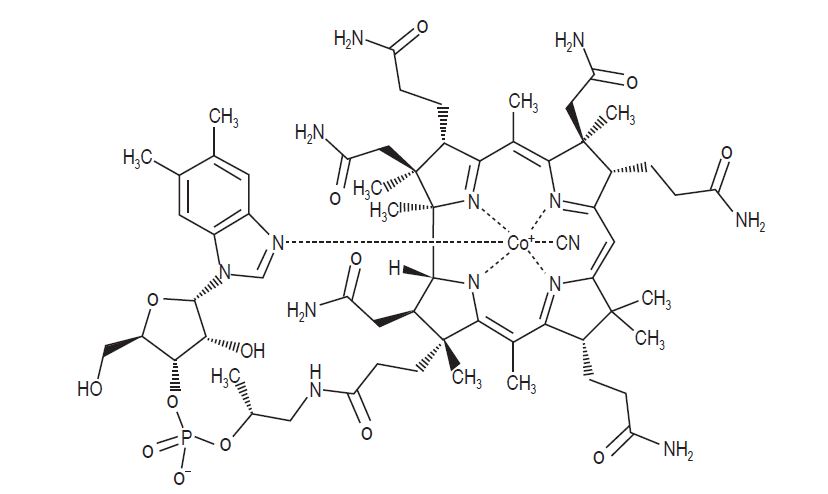
The chemical name is 5,6-dimethyl-benzimidazolyl cyanocobamide; the molecular formula is C 63 H 88 CoN 14 O 14 P. The cobalt content is 4.35%. The molecular weight is 1355.4.
The structural formula is represented below.
CLINICAL PHARMACOLOGY
Vitamin B 12 is essential to growth, cell reproduction, hematopoiesis, and nucleoprotein and myelin synthesis.
Cyanocobalamin is quantitatively and rapidly absorbed from intramuscular and subcutaneous sites of injection; the plasma level of the compound reaches its peak within 1 hour after intramuscular injection. Absorbed vitamin B 12 is transported via specific B 12 binding proteins, transcobalamin I and II to the various tissues. The liver is the main organ for vitamin B 12 storage.
Within 48 hours after injection of 100 or 1,000 mcg of vitamin B 12 , 50 to 98% of the injected dose may appear in the urine. The major portion is excreted within the first eight hours. Intravenous administration results in even more rapid excretion with little opportunity for liver storage.
Gastrointestinal absorption of vitamin B 12 depends on the presence of sufficient intrinsic factor and calcium ions. Intrinsic factor deficiency causes pernicious anemia, which may be associated with subacute combined degeneration of the spinal cord. Prompt parenteral administration of vitamin B 12 prevents progression of neurologic damage.
The average diet supplies about 5 to 15 mcg/day of vitamin B 12 in a protein-bound form that is available for absorption after normal digestion. Vitamin B 12 is not present in foods of plant origin, but is abundant in foods of animal origin. In people with normal absorption, deficiencies have been reported only in strict vegetarians who consume no products of animal origin (including no milk products or eggs).
Vitamin B 12 is bound to intrinsic factor during transit through the stomach; separation occurs in the terminal ileum in the presence of calcium, and vitamin B 12 enters the mucosal cell for absorption. It is then transported by the transcobalamin binding proteins. A small amount (approximately 1% of the total amount ingested) is absorbed by simple diffusion, but this mechanism is adequate only with very large doses. Oral absorption is considered too undependable to rely on in patients with pernicious anemia or other conditions resulting in malabsorption of vitamin B 12 .
Cyanocobalamin is the most widely used form of vitamin B 12 , and has hematopoietic activity apparently identical to that of the antianemia factor in purified liver extract. Hydroxycobalamin is equally as effective as cyanocobalamin, and they share the cobalamin molecular structure.
HOW SUPPLIED
Cyanocobalamin Injection, USP 1,000 mcg/mL
| Strength(s) | Pack | NDC |
| 1,000 mcg/mL | Carton of 25 Multiple-dose vials | 70710-1663-7 |
| 1 mL Multiple-dose vial | 70710-1663-1 | |
| 10,000 mcg/10 mL (1,000 mcg/mL) | Carton of 10 Multiple-dose vials | 70710-1664-6 |
| Carton of 25 Multiple-dose vials | 70710-1664-7 | |
| 10 mL Multiple-dose vial | 70710-1664-1 | |
| 30,000 mcg/30 mL (1,000 mcg/mL) | Carton of 1 Multiple-dose vial | 70710-1665-1 |
| Carton of 5 Multiple-dose vials | 70710-1665-5 | |
| 30 mL Multiple-dose vial | 70710-1665-1 |
Store at 20° to 25°C (68° to 77°F); excursions permitted to 15° to 30°C (59° to 86°F) (See USP Controlled Room Temperature).
PROTECT THE PRODUCT FROM LIGHT.
Call your doctor for medical advice about side effects. You may report side effects to FDA at 1-800-FDA-1088. Please address medical inquiries to Zydus Pharmaceuticals (USA) Inc. at MedicalAffairs@zydususa.com or Tel.: 1-877-993-8779.
Manufactured by:
Zydus Lifesciences Ltd.
(formerly known as Cadila Healthcare Ltd.)
Vadodara, India.
Distributed by:
Zydus Pharmaceuticals (USA) Inc.
Pennington, NJ 08534
Revised: 04/2022
