Get your patient on Erythromycin - Erythromycin solution (Erythromycin)
Erythromycin - Erythromycin solution prescribing information

INDICATIONS AND USAGE
Erythromycin Topical Solution USP, 2% is indicated for the topical treatment of acne vulgaris.
DOSAGE AND ADMINISTRATION
Erythromycin Topical Solution USP, 2% should be applied over the affected areas twice a day (morning and evening) after the skin is thoroughly washed with warm water and soap and patted dry. Acne lesions on the face, neck, shoulders, chest, and back may be treated in this manner.
This medication should be applied with applicator top. If fingertips are used, wash hands after application. Drying and peeling may be controlled by reducing the frequency of applications.
CONTRAINDICATIONS
Erythromycin Topical Solution USP, 2% is contraindicated in those individuals who have shown hypersensitivity to any of its components.
ADVERSE REACTIONS
The following local adverse reactions have been reported occasionally: peeling, dryness, itching, erythema, and oiliness. Irritation of the eyes and tenderness of the skin have also been reported with topical use of erythromycin. Generalized urticarial reactions possibly related to the use of erythromycin, which required systemic steroid therapy have been reported.
DESCRIPTION
Erythromycin Topical Solution USP, 2% contains erythromycin for topical dermatologic use. Erythromycin is a macrolide antibiotic produced from a strain of Saccaropolyspora erythraea (formerly Streptomyces erythreus ). It is a base and readily forms salts with acids. Chemically, erythromycin is: (3 R •,4 S •,5 S •,6 R •,7 R •,9 R •,11 R •,12 R •,13 S •,14 R •)-4-[(2,6-Dideoxy-3- C -methyl-3- 0 -methyl-α-L- ribo -hexopyranosyl)oxy]-14-ethyl-7,12,13-trihydroxy -3,5,7,9,11,13-hexamethyl-6-[[3,4,6-trideoxy-3-(dimethylamino)-ß-D- xylo -hexopyranosyl]oxy]oxacyclotetradecane-2,10-dione. It has the following structural formula:
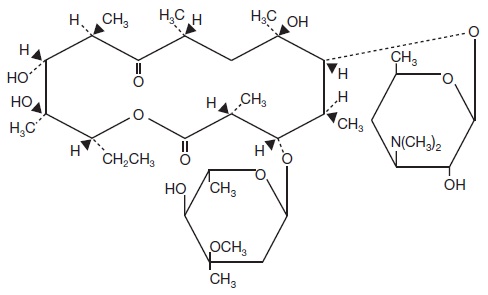
Molecular Formula: C 37 H 67 NO 13
Molecular Weight: 733.94
Erythromycin is a white or slightly yellow crystalline powder that is slightly soluble in water, freely soluble in alcohols, acetone, chloroform, acetonitrile, ethyl acetate, and moderately soluble in ether, ethylene dichloride and amyl acetate.
Each mL of Erythromycin Topical Solution USP, 2% contains 20 mg of erythromycin base in a vehicle consisting of alcohol (66%), citric acid, and propylene glycol.
CLINICAL PHARMACOLOGY
The exact mechanism by which erythromycin reduces lesions of acne vulgaris is not fully known; however, the effect appears to be due in part to the antibacterial activity of the drug.
Microbiology –
Erythromycin acts by inhibition of protein synthesis in susceptible organisms by reversibly binding to 50S ribosomal subunits, thereby inhibiting translocation of aminoacyl transfer-RNA and inhibiting polypeptide synthesis. Antagonism has been demonstrated in vitro between erythromycin, lincomycin, chloramphenicol, and clindamycin.
HOW SUPPLIED
