Get your patient on Kedrab (Human Rabies Virus Immune Globulin)
Dosage & administration

Kedrab prescribing information

INDICATIONS AND USAGE
KEDRAB is a human rabies immune globulin (HRIG) indicated for passive, transient post-exposure prophylaxis (PEP) of rabies infection to persons of all ages when given immediately after contact with a rabid or possibly rabid animal. KEDRAB should be administered concurrently with a full course of rabies vaccine.
DOSAGE AND ADMINISTRATION
For wound infiltration and intramuscular use.
Dosage
Post-exposure prophylaxis consists of a single 20 IU/kg body weight dose of KEDRAB and a full course of rabies vaccine (See Table 1 ).
• Adapted from reference 1. | ||
† These regimens are applicable for all age groups, including children. | ||
ǂ Day 0 is the day the first dose of vaccine is administered. Refer to vaccine manufacturer's instructions or to the recommendations of the Advisory Committee on Immunization Practices (ACIP) 1,2 for appropriate rabies vaccine formulations, schedules, and dosages. | ||
§ Any person with a history of rabies vaccination and a documented history of antibody response to the prior vaccination. | ||
| Vaccination Status | Intervention | Regimen† |
| Not previously vaccinated | Wound Cleansing |
|
| KEDRAB ® 20 IU/kg body weight |
| |
| Rabies Vaccine |
| |
| Previously vaccinated§ | Wound cleansing |
|
| KEDRAB ® |
| |
| Rabies Vaccine |
| |
| Other Considerations | Tetanus prophylaxis and/or antibiotics |
|
Administration
Infiltrate as much of the KEDRAB dose as possible into and around any detectable bite wounds if infiltration at the bite site is feasible. Administer any remaining KEDRAB intramuscularly into anatomical site(s) distant from the site of the rabies vaccine.
- When the bite site is unknown or indeterminate (undetectable) or if infiltration is difficult at the bite site (e.g., lips, fingers, knee), administer the full KEDRAB dose by the intramuscular route at a site distant from the site of rabies vaccination.
- If a large intramuscular volume is required (>2 mL for children or >5 mL for adults), administer the total volume in divided doses at different sites.
- Do not mix KEDRAB with the rabies vaccine or administer in the same syringe with the rabies vaccine.
- Discard unused portion of the product in the vial.
Parenteral drug products should be inspected visually for particulate matter and discoloration prior to administration. Do not use if either of these conditions exists, and contact Kedrion Biopharma Inc. at 1-855-353-7466. Do not discard the vial.
DOSAGE FORMS AND STRENGTHS
KEDRAB is supplied in single-dose vials containing 2 mL or 10 mL of ready-to-use solution with a nominal potency of 150 IU/mL (Note that more than one vial may be required for a single patient treatment).
- The 2 mL vial contains a total of 300 IU, which is sufficient for a child weighing 15 kg (33 lb)
- The 10 mL vial contains a total of 1500 IU, which is sufficient for an adult weighing 75 kg (165 lb)
The final product is assayed with human rabies immunoglobulin reference standard that is calibrated against the WHO International Standard.
USE IN SPECIFIC POPULATIONS
Pregnancy
Risk Summary
KEDRAB has not been studied in pregnant women. Therefore, the risk of major birth defects and miscarriage in pregnant women who are exposed to KEDRAB is unknown. Animal developmental or reproduction toxicity studies have not been conducted with KEDRAB. It is not known whether KEDRAB can cause harm to the fetus when administered to a pregnant woman or whether KEDRAB can affect reproductive capacity. In the U.S. general population, the estimated background of major birth defects occurs in 2-4% of the general population and miscarriage occurs in 15-20% of clinically recognized pregnancies.
Lactation
Risk Summary
There is no information regarding the presence of KEDRAB in human milk, the effects on the breastfed infant, or the effects on milk production. The developmental and health benefits of breastfeeding should be considered along with the mother's clinical need for KEDRAB and any potential adverse effects on the breastfed infant from KEDRAB or from the underlying maternal condition.
Pediatric Use
Safety and effectiveness have been established in children. In a pediatric study of 30 patients ranging in age from 0.5 to 14.9 years, KEDRAB presented no serious adverse reactions through day 84. Of the 30 patients, 28 (93.3%) achieved a Day-14 RVNA titer ≥0.5 IU/mL, the WHO recommended level. None of the patients who were followed until the end of the study (28/30 patients) developed rabies infection through day 84. [see Clinical Trials (14 )]
Adverse reactions that occurred in ≥3.3% of patients within the first 14 days of KEDRAB and the first rabies vaccination administration are listed in Section 6.1 .
The clinical trial conducted in the pediatric population is described in Section 14 .
Additional evidence to support the use of KEDRAB in children comes from Real World Evidence. Based on claims data, 172 U.S. children (≤17 years) were treated with KEDRAB between 2018-2020. Based on Center for Disease Control data, no children in the U.S. treated with post-exposure prophylaxis have been reported to have had rabies between 2018-April 2021.
Geriatric Use
Clinical studies of KEDRAB did not include sufficient numbers of subjects aged 65 years and over to determine whether they respond differently from younger subjects. Clinical experience with HRIG products has not identified differences in effectiveness between elderly and younger patients (ACIP) 1 .
CONTRAINDICATIONS
None.
WARNINGS AND PRECAUTIONS
- Do not give KEDRAB to persons who have completed rabies pre- or post-exposure prophylaxis because it can interfere with the anamnestic response to the rabies vaccine. (5.1 )
- Hypersensitivity reactions, including anaphylaxis, may occur with KEDRAB. IgA deficient patients with antibodies against IgA are at greater risk. Have epinephrine available immediately to treat any acute severe hypersensitivity reactions. (5.2 )
- Interference with live attenuated virus vaccines. (5.5 , 7 )
- KEDRAB is made from human plasma, and may carry a risk of transmitting infectious agents, e.g., viruses, the variant Creutzfeldt-Jakob disease (vCJD) agent, and theoretically, the Creutzfeldt-Jakob disease (CJD) agent. (5.7 )
Previous Rabies Vaccination
Patients who can document previous complete rabies pre-exposure prophylaxis or complete post-exposure prophylaxis should only receive a booster rabies vaccine without KEDRAB because KEDRAB may interfere with the anamnestic response to the vaccine (ACIP) 1 .
Hypersensitivity Reactions
Hypersensitivity reactions, including anaphylaxis, may occur with KEDRAB. History of prior systemic allergic reactions to human immunoglobulin preparations places patients at greater risk. Have epinephrine available for treatment of acute allergic symptoms. Patients with isolated immunoglobulin A (IgA) deficiency may develop severe hypersensitivity reactions to KEDRAB or, subsequently, to the administration of blood products that contain IgA.
Live Attenuated Virus Vaccines
KEDRAB administration may interfere with the development of an immune response to live attenuated virus vaccines. If feasible, delay immunization with measles vaccine for 4 months, and other live attenuated virus vaccines for 3 months, after KEDRAB administration.
Interference with Serologic Testing
- A transient rise of the various passively transferred antibodies in the patient's blood may result in misleading positive results of serologic tests after KEDRAB administration.
- Passive transmission of antibodies to erythrocyte antigens, e.g., A, B, and D, may interfere with serologic tests for red cell antibodies such as the antiglobulin test (Coombs' test).
Transmissible Infectious Agents
Because KEDRAB is made from human plasma donors hyper-immunized with rabies vaccine, it may carry a risk of transmitting infectious agents, e.g., viruses, the variant Creutzfeldt-Jakob disease (vCJD) agent and, theoretically, the Creutzfeldt-Jakob disease (CJD) agent. All infections suspected by a physician possibly to have been transmitted by this product should be reported by the physician or other healthcare provider to Kedrion Biopharma Inc. at 1-855-353-7466.
ADVERSE REACTIONS
The most common adverse reactions (>5%) observed in adult subjects were injection site pain, headache, muscle pain, joint pain, dizziness, and fatigue.
The most common adverse reactions (>5%) observed in pediatric patients were injection site pain, headache, pyrexia, plain in extremity, bruising, fatigue and vomiting.
Clinical Trials Experience
Because clinical trials are conducted under widely varying conditions, adverse reaction rates observed in clinical trials of a drug cannot be directly compared to rates of adverse reactions in clinical trials of another drug and may not reflect the rates observed in clinical practice.
KEDRAB was evaluated in three single-center, controlled clinical trials in adults. Subjects in these clinical studies of KEDRAB were healthy adults, primarily white, and ranged in age from 18 to 72 years. A total of 160 adult subjects were treated in these three studies, including 91 subjects who received single intramuscular doses of KEDRAB (20 IU/kg) with or without rabies vaccine.
Table 2 summarizes adverse reactions occurring in >3% of adult subjects in the clinical trials of KEDRAB. (Table 2 ).
Data are presented as number of subjects (% of subjects). | |||
| All KEDRAB (N=91) | All Comparator HRIG (N=84) | Saline Placebo+Vaccine (N=8) | |
| Injection site pain | 30 (33%) | 26 (31%) | 2 (25%) |
| Headache | 14 (15%) | 11 (13%) | 3 (38%) |
| Muscle pain | 8 (9%) | 6 (7%) | 0 (0%) |
| Joint Pain | 5 (6%) | 0 (0%) | 1 (13%) |
| Dizziness | 5 (6%) | 3 (4%) | 0 (0%) |
| Fatigue | 5 (6%) | 2 (2%) | 0 (0%) |
| Abdominal pain | 4 (4%) | 1 (1%) | 0 (0%) |
| Blood in urine (Hematuria) | 4 (4%) | 2 (2%) | 0 (0%) |
| Nausea | 4 (4%) | 3 (4%) | 0 (0%) |
| Feeling faint | 4 (4%) | 1 (1%) | 0 (0%) |
Less frequent adverse reactions (≤3%) in adult subjects were diarrhea, vomiting, decreased appetite, musculoskeletal stiffness, malaise, weakness (asthenia), fainting (syncope), itching (pruritis), tingling sensation (paresthesia), rash, sunburn and elevation in liver function.
KEDRAB was also evaluated in a two-center, open-label clinical trial in 30 pediatric patients exposed or possibly exposed to rabies virus. They ranged in age from 0.5 to 14.9 years. Study treatment included a single dose of KEDRAB (20 IU/kg) and active rabies vaccine on Days 0, 3, 7 and 14 administered as per ACIP 1 recommendations for rabies post-exposure prophylaxis.
Twelve pediatric patients (40%) experienced adverse reactions within 14 days of receipt of KEDRAB and first dose of rabies vaccine. There were no serious adverse reactions. Table 3 summarizes the adverse reactions that occurred in >5% of patients in the pediatric clinical trial within 14 days of receipt of KEDRAB and the first dose of the rabies vaccine.
Data are presented as number of patients (% of patients). | |
| KEDRAB + Rabies Vaccine N = 30 | |
| Injection site pain | 8 (27%) |
| Headache | 4 (13%) |
| Fever (Pyrexia) | 4 (13%) |
| Pain in extremity | 3 (10%) |
| Bruising (hematoma) | 2 (7%) |
| Fatigue | 2 (7%) |
| Vomiting | 2 (7%) |
Less common adverse reactions (≤5%) in pediatric patients were injection site redness (erythema), injection site swelling (edema), muscle pain, oral pain, and wound complication.
Insomnia was reported as a less common adverse reactions (<5%) in pediatric patients occurring after 14 days of administration.
DRUG INTERACTIONS
- Patients who can document previous complete rabies pre-exposure prophylaxis or complete post-exposure prophylaxis and have a confirmed adequate rabies antibody titer should receive only a booster rabies vaccine (without KEDRAB) because KEDRAB may interfere with the anamnestic response to the vaccine (ACIP) 1 .
- KEDRAB can interfere with the immune response to the rabies vaccine. For this reason, do not exceed the recommended KEDRAB dose or give additional (repeat) doses of KEDRAB once rabies vaccination has been initiated.
- KEDRAB can inactivate the rabies vaccine. For this reason, do not administer KEDRAB in the same syringe as the rabies vaccine or near the anatomical site of administration of the rabies vaccine.
- KEDRAB contains other antibodies that may interfere with the response to live vaccines such as measles, mumps, polio or rubella. Avoid immunization with live virus vaccines within 3 months after KEDRAB administration, or in the case of measles vaccine, within 4 months after KEDRAB administration.
DESCRIPTION
KEDRAB is a sterile, non-pyrogenic aqueous solution of anti-rabies immunoglobulin (≥95% protein as IgG). The product is stabilized with 0.3 M glycine and has a pH of 5.5 ± 0.5. It does not contain preservatives and the vial stopper is not made with natural rubber latex. KEDRAB is a clear to opalescent liquid.
KEDRAB is prepared from human plasma from donors hyper-immunized with rabies vaccine. Individual plasma units are tested using FDA-licensed serologic assays for hepatitis B surface antigen (HBsAg) and for antibodies to hepatitis C virus (HCV) and human immunodeficiency virus types 1 and 2 (HIV-1/2), as well as by FDA-licensed Nucleic Acid Testing (NAT) for hepatitis B virus (HBV), HCV and HIV-1. Each plasma unit must be non-reactive (negative) in all tests. Plasma is also tested by in-process NAT procedures for HAV and parvovirus B19. Each plasma unit must be non-reactive to HAV, while the limit in the manufacturing pool is set not to exceed 10 4 IU per mL for parvovirus B19. The KEDRAB manufacturing process includes three validated and effective viral elimination steps:
- Solvent/detergent (S/D) treatment - inactivates enveloped viral agents
- Heat inactivation (pasteurization) - inactivates both enveloped and non-enveloped viruses
- Nanofiltration (NF) - physically removes viruses
The effectiveness of the S/D treatment, pasteurization and nanofiltration procedures for reducing viral content has been assessed using a series of viruses with a range of physico-chemical characteristics. The results of the viral challenge studies are summarized in Table 4 .
Abbreviations: BVDV: bovine viral diarrhea virus; EMCV: encephalomyocarditis virus; HIV-1: human immunodeficiency virus 1; HRIG: human rabies immune globulin; PPV: Porcine parvovirus; PRV: Pseudorabies virus; S/D: solvent/detergent; WNV: West Nile Virus. | ||||||
| Process Step | Enveloped Viruses | Non-enveloped Viruses | ||||
| HIV-1 | BVDV | PRV | WNV | EMCV | PPV | |
| S/D treatment | >4.99 | >5.70 | >4.38 | >5.46 | Not tested | Not tested |
| Heat treatment | >6.21 | >5.67 | Not tested | >6.33 | 3.30 | Not tested |
| Nanofiltration | Not tested | Not tested | >6.58 | Not tested | >7.66 | 3.41 |
| Global Log 10 Reduction Factor | >11.20 | >11.37 | >10.96 | >11.79 | >10.96 | 3.41 |
CLINICAL PHARMACOLOGY
Mechanism of Action
Rabies is a zoonotic disease caused by RNA viruses in the family Rhabdoviridae, genus Lyssavirus . Virus is typically present in the saliva of rabid mammals and is transmitted primarily through a bite. KEDRAB is infiltrated into the inoculation site(s) in previously unvaccinated persons, to provide immediate passive rabies virus neutralizing antibody protection until the patient's immune system responds to vaccination by actively producing antibodies.
Pharmacodynamics
A protective threshold for rabies virus neutralizing activity (RVNA) has never been established. However, the WHO has generally accepted a RVNA of at least 0.5 IU/mL measured 14 days after initiation of post-exposure prophylaxis as protective.
Pharmacokinetics
A randomized, single-dose, two-period, two-treatment, two-sequence, double-blind, crossover study assessed the pharmacokinetics of KEDRAB. Twenty-six healthy volunteer subjects were randomized to receive a single IM injection of 20 IU/kg HRIG on two separate occasions (KEDRAB or Comparator HRIG). Subjects received the second treatment (A or B) following the 42-day test period and a 21-day washout period. Single dose IM injection of KEDRAB resulted in maximum plasma RVNA levels of 0.25 IU/mL. The median T max was 7 days (range: 3-14 days). The elimination half-life was approximately 17.9 days. A statistical analysis of the pharmacokinetic parameters showed that KEDRAB was not bioequivalent to the Comparator HRIG (Table 5 ).
Abbreviations: AUC: area under the concentration-time curve; C max : maximum concentration; inf: infinity; IU: international units; mL: milliliter; PK: Pharmacokinetic; RVNA: rabies virus neutralizing antibody | |||||
| Parameter | Units | Geometric LS Mean Values | Test/Reference (%) | 90% Confidence Interval (%) | |
| KEDRAB | Comparator HRIG | ||||
| C max | IU/mL | 0.24 | 0.30 | 81.71 | 75.34-88.62 |
| AUC 0-last | Day•IU/mL | 5.08 | 6.17 | 82.35 | 77.39-87.63 |
| AUC 0-inf | Day•IU/mL | 6.64 | 7.86 | 84.44 | 78.63-90.68 |
A plot of plasma rabies virus neutralizing antibody titer concentration versus time (Figure 1 ) demonstrated that, in both treatment groups, plasma rabies virus neutralizing antibody concentrations declined in a biphasic manner after the absorption phase was complete.
Figure 1: Plasma HRIG Concentrations [Mean (±SD)] at Scheduled PK Sampling Days (Semi-log Scale), Phase 2/3 Study, Pharmacokinetic Analysis
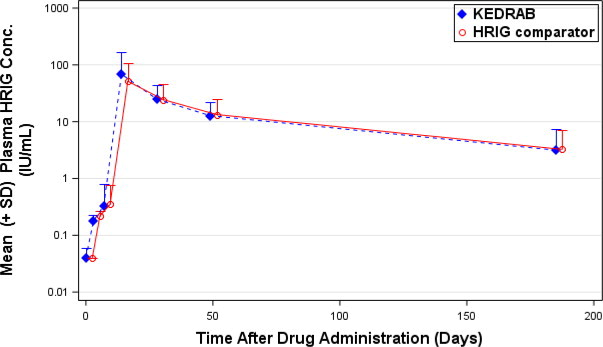
Additionally, a prospective, randomized, double-blind, non-inferiority, study evaluated the pharmacokinetics, safety, and effectiveness of simulated post-exposure prophylaxis with KEDRAB with co-administration of active rabies vaccine in 118 healthy subjects. Subjects were randomized into two treatment groups (59 per treatment group) to receive intramuscular KEDRAB or comparator HRIG at a dose of 20 IU/kg on Day 0, and rabies vaccine on Days 0, 3, 7, 14 and 28. The peak plasma RVNA was 71.9 IU/mL and 53.9 IU/mL for KEDRAB and comparator HRIG respectively. For both treatment groups, the median T max was 14 days (range: 14-49 days). The half-lives were 48.6 hours and 52.7 hours for KEDRAB and comparator HRIG respectively.
Bioequivalent assessment showed that KEDRAB was not bioequivalent to the comparator HRIG when co-administered with a five-dose rabies vaccine regimen (Table 6 ). Furthermore, the RVNA on Day 3 was lower in the KEDRAB with rabies vaccine group relative to the comparator HRIG with vaccine group (0.188+0.051 vs 0.229+0.054, P=0.0005). However, these pharmacokinetic differences are not expected to affect clinical outcomes.
Abbreviations: AUC: area under the concentration-time curve; C max : maximum concentration; inf: infinity; IU: international units; mL: milliliter; RVNA: rabies virus neutralizing antibody | |||||
| Parameter | Units | Geometric LS Mean Values | Test/Reference (%) | 90% Confidence Interval (%) | |
| KEDRAB (Test) | Comparator HRIG (Reference) | ||||
| C max | IU/mL | 44.87 | 36.02 | 124.59 | 90.62-171.28 |
| AUC 0-last | Day•IU/mL | 1741.40 | 1686.03 | 103.28 | 79.03-134.98 |
| AUC 0-inf | Day•IU/mL | 2045.87 | 1916.90 | 106.73 | 80.48-141.54 |
Please see Clinical Studies (14 ) section for clinical efficacy.
NONCLINICAL TOXICOLOGY
Animal Toxicology and/or Pharmacology
Intramuscular administration of a single dose of KEDRAB to rats at 60 and 120 IU/kg (3-fold and 6-fold higher than the recommended human dose of 20 IU/kg) did not result in any signs of toxicity.
CLINICAL STUDIES
The efficacy of KEDRAB administered concurrently with rabies vaccine was studied in a single-center, randomized, comparator HRIG-controlled clinical study in adults. Study subjects were healthy adults 18 to 72 years of age who were without significant acute or chronic illness. A total of 118 subjects (59 per treatment group) received intramuscular KEDRAB or comparator HRIG at a dose of 20 IU/kg on Day 0, and rabies vaccine on Days 0, 3, 7, 14 and 28. The mean age of study subjects was 45 years; subjects were, predominantly white (93%), and 64% were women. The efficacy variable was RVNA, as assessed by Rapid Fluorescent Focus Inhibition Test (RFFIT), on Day 14. Efficacy analyses were performed on the As-Treated Population, which comprised the 116 study subjects who received KEDRAB or comparator HRIG and at least 3 of the 5 doses of rabies vaccine before Day 14.
Efficacy, considered when RVNA titer is 0.5 IU/mL or higher on Day 14 (as established by the WHO), was met by 56/57 subjects (98.2%) in the KEDRAB group and 59/59 subjects in the comparator HRIG group (Table 7 ). The lower limit of the 90% CI was greater than the pre-specified non-inferiority margin of -10%; thus, KEDRAB was non-inferior to comparator HRIG.
a 'Pa' and 'Pb' are the proportion of participants with IgG antibody titer ≥0.5 IU/mL on Day 14 in Groups A and B, respectively. Group A = KEDRAB +Rabies Vaccine, Group B = Control HyperRAB ® +Rabies Vaccine. | ||
b based on Farrington-Manning score statistic. | ||
Abbreviations: CI: confidence interval; HRIG: human rabies immune globulin; IU: international units; mL: milliliter | ||
| KEDRAB with Rabies Vaccine (N=57) | Comparator HRIG with Rabies Vaccine (N=59) | |
| Rabies virus neutralizing antibody titer ≥0.5 IU/mL, n (%) | 56 (98.2) | 59 (100) |
| Exact 95% CI for proportion (%) | (90.6, 100) | (93.9, 100) |
| Difference (Pa-Pb) a (%) | -1.8 | |
| Exact 90% CI for difference b (%) | (-8.1, 3.0) | |
Additional efficacy analyses in adult subjects included pharmacokinetics [see Clinical Pharmacology (12 ) ].
KEDRAB was also evaluated in a two-center, open-label clinical trial in 30 pediatric patients exposed or possibly exposed to rabies virus for whom post-exposure prophylaxis was indicated. The patients were treated with KEDRAB at a dose of 20 IU/kg on Day 0 and active rabies vaccine on Days 0, 3, 7, and 14 as per ACIP 1 recommendations for rabies post-exposure prophylaxis. The patients ranged in age from 0.5 to 14.9 years, 46.7% were females, 6.7% were Asian, 23.3% were Black and 70% were White, 10% were Latino. The efficacy variables were RVNA as assessed by RFFIT on Day 14 and occurrence of rabies disease through Day 84 after administration of KEDRAB. Efficacy analyses were performed on the As-Treated Population, which comprised all 30 study patients.
In the As-Treated Population, the geometric mean (SD) Day-14 RVNA titer was 18.89 (31.61) IU/mL and the median Day-14 RVNA titer was 8.81 (range 0.21 – 153.62) IU/mL. Of the 30 treated pediatric patients, 28 patients (93.3%) had a Day-14 RVNA titer ≥ 0.5 IU/mL, the WHO recommended level. None of the 28/30 patients who were followed for the duration of the study developed rabies infection through day 84.
HOW SUPPLIED/STORAGE AND HANDLING
- Each package of KEDRAB contains a single-dose vial containing 2 mL or 10 mL of ready-to-use solution with a potency of 150 IU/mL (Note that more than one vial may be required for a single patient treatment).
- The 2-mL vial contains a total of 300 IU which is sufficient for a child weighing 15 kg (33 lb). (NDC 76125-150-02). The 10-mL vial contains a total of 1500 IU which is sufficient for an adult weighing 75 kg (165 lb). (NDC 76125-150-10)
- Keep vial in package until use.
- Store KEDRAB at 2-8 °C (36-46 °F). DO NOT FREEZE.
- KEDRAB may be stored at room temperatures not exceeding 25 °C (77 °F) for up to one month.
- Use within one month after removal from refrigeration. Do not return to refrigeration.
- Do not use after the expiration date printed on the label.
Mechanism of Action
Rabies is a zoonotic disease caused by RNA viruses in the family Rhabdoviridae, genus Lyssavirus . Virus is typically present in the saliva of rabid mammals and is transmitted primarily through a bite. KEDRAB is infiltrated into the inoculation site(s) in previously unvaccinated persons, to provide immediate passive rabies virus neutralizing antibody protection until the patient's immune system responds to vaccination by actively producing antibodies.
