Get your patient on Levofloxacin - Levofloxacin solution (Levofloxacin)
Levofloxacin - Levofloxacin solution prescribing information

INDICATIONS AND USAGE
Levofloxacin ophthalmic solution is indicated for the treatment of bacterial conjunctivitis caused by susceptible strains of the following organisms:
Gram-positive bacteria
Corynebacterium species •
Staphylococcus aureus
Staphylococcus epidermidis
Streptococcus pneumonia
Streptococcus (Groups C/F)
Streptococcus (Group G)
Viridans group streptococci•
Gram-negative bacteria
Acinetobacter lwoffii •
Haemophilus influenzae
Serratia marcescens•
•Efficacy for this organism was studied in fewer than 10 infections
DOSAGE AND ADMINISTRATION
Days 1 and 2
Instill one to two drops in the affected eye(s) every 2 hours while awake, up to 8 times per day.
Days 3 through 7
Instill one to two drops in the affected eye(s) every 4 hours while awake, up to 4 times per day.
DOSAGE FORMS AND STRENGTHS
5 mL white LDPE bottle filled with 5 mL sterile ophthalmic solution of levofloxacin, 0.5%.
USE IN SPECIFIC POPULATIONS
Pregnancy
Teratogenic Effects
Levofloxacin at oral doses of 810 mg/kg/day in rats caused decreased fetal body weight and increased fetal mortality. No teratogenic effect was observed when rabbits were dosed orally as high as 50 mg/kg/day, at which systemic exposure was approximately 2,250 times that observed at the maximum recommended human ophthalmic dose, or when dosed intravenously as high as 25 mg/kg/day, at which systemic exposure was approximately 1000 times that observed at the maximum recommended human ophthalmic dose.
There are, however, no adequate and well-controlled studies in pregnant women. Levofloxacin should be used during pregnancy only if the potential benefit justifies the potential risk to the fetus.
Nursing Mothers
Levofloxacin has not been measured in human milk. Based upon data from ofloxacin, it can be presumed that levofloxacin is excreted in human milk. Caution should be exercised when levofloxacin ophthalmic solution is administered to a nursing mother.
Pediatric Use
Safety and effectiveness in children below the age of six years have not been established. Oral administration of systemic quinolones has been shown to cause arthropathy in immature animals. There is no evidence that the ophthalmic administration of levofloxacin has any effect on weight bearing joints.
Geriatric Use
No overall differences in safety or effectiveness have been observed between elderly and other adult patients.
CONTRAINDICATIONS
Levofloxacin ophthalmic solution is contraindicated in patients with a history of hypersensitivity to levofloxacin, to other quinolones, or to any of the components in this medication.
WARNINGS AND PRECAUTIONS
Hypersensitivity Reactions
In patients receiving systemically administered quinolones, including levofloxacin, serious and occasionally fatal hypersensitivity (anaphylactic) reactions have been reported, some following the first dose. Some reactions were accompanied by cardiovascular collapse, loss of consciousness, angioedema, (including laryngeal, pharyngeal or facial edema), airway obstruction, dyspnea, urticaria and itching. If allergic reaction to levofloxacin occurs, discontinue the drug. Serious acute hypersensitivity reactions may require immediate emergency treatment. Oxygen and airway management should be administered as clinically indicated.
Growth of Resistant Organisms with Prolonged Use
As with other anti-infectives, prolonged use may result in overgrowth of non-susceptible organisms, including fungi. If superinfection occurs, discontinue use and institute alternative therapy. Whenever clinical judgment dictates, the patient should be examined with the aid of magnification, such as slit-lamp biomicroscopy, and where appropriate, fluorescein staining.
Avoidance of Contact Lens Wear
Patients should be advised not to wear contact lenses if they have signs and symptoms of bacterial conjunctivitis.
ADVERSE REACTIONS
The most frequently reported adverse reactions in the overall study population were transient decreased vision, fever, foreign body sensation, headache, transient ocular burning, ocular pain or discomfort, pharyngitis and photophobia. These reactions occurred in approximately 1-3% of patients. Other reported reactions occurring in less than 1% of patients included allergic reactions, lid edema, ocular dryness, and ocular itching.
DESCRIPTION
Levofloxacin Ophthalmic Solution, 0.5% is a sterile topical ophthalmic solution. Levofloxacin is a fluoroquinolone antibacterial active against a broad spectrum of Gram-positive and Gram-negative ocular pathogens. Levofloxacin is a fluorinated 4-quinolone containing a six-member (pyridobenzoxazine) ring from positions 1 to 8 of the basic ring structure. Levofloxacin is the pure (-)-(S)-enantiomer of the racemic drug substance, ofloxacin. It is more soluble in water at neutral pH than ofloxacin.
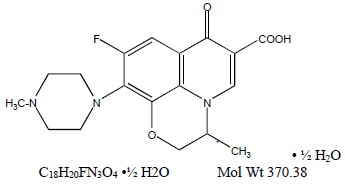
Chemical Name: (-)-(S)-9-fluoro-2,3-dihydro-3-methyl-10-(4-methyl-1-piperazinyl)-7-oxo-7H-pyrido [1,2,3-de]-1,4 benzoxazine-6-carboxylic acid hemihydrate.
Levofloxacin (hemihydrate) is a light yellow powder.
Each mL of levofloxacin ophthalmic solution, 0.5% contains 5.12 mg of levofloxacin hemihydrate equivalent to 5 mg levofloxacin.
Contains Levofloxacin 5 mg equivalent to 5.12 mg levofloxacin hemihydrate with benzalkonium chloride 0.005%, sodium chloride, water for injection, hydrochloric acid and/or sodium hydroxide (to adjust pH).
Levofloxacin ophthalmic solution, 0.5% is isotonic and formulated at pH 6.0-6.8 with an osmolality between 285-315 mOsm/kg.
CLINICAL PHARMACOLOGY
Mechanism of Action
Levofloxacin is a member of the fluoroquinolone class of anti-infective drugs. (See 12.4 Microbiology )
Pharmacokinetics
Levofloxacin concentration in plasma was measured in 15 healthy adult volunteers at various time points during a 15-day course of treatment with levofloxacin ophthalmic solution. The mean levofloxacin concentration in plasma 1 hour postdose, ranged from 0.86 ng/mL on Day 1 to 2.05 ng/mL on Day 15. The highest maximum mean levofloxacin concentration of 2.25 ng/mL was measured on Day 4 following 2 days of dosing every 2 hours for a total of 8 doses per day. Maximum mean levofloxacin concentrations increased from 0.94 ng/mL on Day 1 to 2.15 ng/mL on Day 15, which is more than 1,000 times lower than those reported after standard oral doses of levofloxacin.
Levofloxacin concentration in tears was measured in 30 healthy adult volunteers at various time points following instillation of a single drop of levofloxacin ophthalmic solution. Mean levofloxacin concentrations in tears ranged from 34.9 to 221.1 mcg/mL during the 60-minute period following the single dose. The mean tear concentrations measured 4 and 6 hours postdose were 17.0 and 6.6 mcg/mL. The clinical significance of these concentrations is unknown.
Microbiology
Levofloxacin is the L-isomer of the racemate, ofloxacin, a quinolone antimicrobial agent. The antibacterial activity of ofloxacin resides primarily in the L-isomer. The mechanism of action of levofloxacin and other fluoroquinolone antimicrobials involves the inhibition of bacterial topoisomerase IV and DNA gyrase (both of which are type II topoisomerases), enzymes required for DNA replication, transcription, repair, and recombination.
Levofloxacin has in vitro activity against a wide range of Gram-negative and Gram-positive microorganisms and is often bactericidal at concentrations equal to or slightly greater than inhibitory concentrations.
Fluoroquinolones, including levofloxacin, differ in chemical structure and mode of action from β- lactam antibiotics and aminoglycosides, and therefore may be active against bacteria resistant to β- lactam antibiotics and aminoglycosides. Additionally, β-lactam antibiotics and aminoglycosides may be active against bacteria resistant to levofloxacin.
Resistance to levofloxacin due to spontaneous mutation i n vitro is a rare occurrence (range: 10 -9 to 10 -10 )
Levofloxacin has been shown to be active against most strains of the following microorganisms, both in vitro and in clinical infections as described in the INDICATIONS AND USAGE section:
Aerobic gram-positive microorganisms
Corynebacterium species•
Staphylococcus aureus
Staphylococcus epidermidis
Streptococcus pneumonia
Streptococcus (Groups C/F)
Streptococcus (Group G)
Viridans group streptococci•
Aerobic gram-negative microorganisms
Acinetobacter lwoffii•
Haemophilus influenzae
Serratia marcescens•
•Efficacy for this organism was studied in fewer than 10 infections.
The following i n vitro data are also available, but their clinical significance in ophthalmic infections is unknown. The safety and effectiveness of levofloxacin in treating ophthalmological infections due to these microorganisms have not been established in adequate and well- controlled trials.
These organisms are considered susceptible when evaluated using systemic breakpoints. However, a correlation between the in vitro systemic breakpoint and ophthalmological efficacy has not been established. The list of organisms is provided as guidance only in assessing the potential treatment of conjunctival infections. Levofloxacin exhibits in vitro minimal inhibitory concentrations (MICs) of 2 mcg/mL or less (systemic susceptible breakpoint) against most (≥90%) strains of the following ocular pathogens:
Aerobicgram-positive microorganisms
Enterococcus faecalis
Staphylococcus saprophyticus
Streptococcus agalactiae
Streptococcus pyogenes
Aerobic gram-negative microorganisms
Acinetobacter anitratus
Acinetobacter baumannii
Citrobacter koseri
Citrobacter freundii
Enterobacter aerogenes
Enterobacter agglomerans
Enterobacter cloacae
Escherichia coli
Haemophilus parainfluenzae
Klebsiella oxytoca
Klebsiella pneumonia
Legionella pneumophila
Moraxella catarrhalis
Morganella morganii
Neisseria gonorrhoeae
Proteus mirabilis
Proteus vulgaris
Providencia rettgeri
Providencia stuartii
Pseudomonas aeruginosa
Pseudomonas fluorescens
NONCLINICAL TOXICOLOGY
Carcinogenesis, Mutagenesis, Impairment of Fertility
In a long term carcinogenicity study in rats, levofloxacin exhibited no carcinogenic or tumorigenic potential following daily dietary administration for 2 years at doses up to 100 mg/kg/day, corresponding to plasma levels that were 1235 times the maximum clinical exposure, based on C max .
Levofloxacin was not mutagenic in the following assays: Ames bacterial mutation assay ( S. typhimurium and E . coli ), CHO/HGPRT forward mutation assay, mouse micronucleus test, mouse dominant lethal test, rat unscheduled DNA synthesis assay, and the in vivo mouse sister chromatid exchange assay. It was positive in the in vitro chromosomal aberration (CHL cell line) and in vitro sister chromatid exchange (CHL/IU cell line) assays. Levofloxacin caused no impairment of fertility or reproduction in rats at oral doses as high as 360 mg/kg/day, at which systemic exposure was estimated to be 23,000 times that at the maximum recommended human ophthalmic dose.
CLINICAL STUDIES
In randomized, double-masked, multicenter controlled clinical trials where patients were dosed for 5 days, Levofloxacin ophthalmic® demonstrated clinical cures in 79% of patients treated for bacterial conjunctivitis on the final study visit day (day 6 to10). Microbial outcomes for the same clinical trials demonstrated an eradication rate for presumed pathogens of 90%.
HOW SUPPLIED/STORAGE HANDLING
Levofloxacin Ophthalmic Solution, 0.5% is a clear light yellow solution supplied in a white LDPE bottle with translucent LDPE nozzle and tan coloured HDPE cap in the following size:
5 mL filled in 5 mL bottle – NDC 72888-142-22
Storage:
Store at 20º to 25°C (68º to 77°F) [See USP Controlled Room Temperature].
