Get your patient on Nexiclon XR (Clonidine)
Nexiclon XR patient education
Patient toolkit
Dosage & administration

Nexiclon XR prescribing information

1 INDICATIONS AND USAGE
NEXICLON XR is indicated in the treatment of hypertension. NEXICLON XR may be employed alone or concomitantly with other antihypertensive agents.
2 DOSAGE AND ADMINISTRATION
The dose of NEXICLON XR must be adjusted according to the patient's individual blood pressure response. The following is a general guide to its administration in adults.
2.1 Initial Dose
Dosing with NEXICLON XR should be initiated at 0.17 mg once daily. Elderly patients may benefit from a lower initial dose [ see Use in Specific Populations (8.4) ]. Initial dose is recommended to be administered at bedtime.
2.2 Maintenance Dose
Further increments of 0.09 mg once daily may be made at weekly intervals if necessary until the desired response is achieved. The therapeutic doses most commonly employed have ranged from 0.17 mg to 0.52 mg once daily.
NEXICLON XR was studied at doses of 0.17 to 0.52 mg once daily. Doses higher than 0.52 mg per day were not evaluated and are not recommended.
2.3 Patients Currently Using Clonidine Hydrochloride Immediate-Release Tablets
The recommended dose of NEXICLON XR for patients who are currently taking clonidine hydrochloride immediate-release tablets is provided in the table below.
| NEXICLON XR (clonidine) Extended-Release Tablets | Equivalent dose of Clonidine HCl Immediate-Release Tablets | |
| Initial Dose | 0.17 mg once daily | 0.1 mg twice daily |
| Maintenance Dose Titration Increments | 0.09 mg once daily | 0.05 mg twice daily |
| Common Doses Used for Blood Pressure Effect | 0.17 mg once daily | 0.1 mg twice daily |
| 0.34 mg once daily | 0.2 mg twice daily | |
| 0.52 mg once daily | 0.3 mg twice daily |
2.4 Renal Impairment
Adjust dosage according to the degree of impairment. In patients with end stage kidney disease on maintenance dialysis, start at 0.09 mg per day and up-titrate slowly to minimize dose related adverse events.
Monitor patients carefully, especially for bradycardia, sedation and hypotension. Only a minimal amount of clonidine is removed during routine hemodialysis.
In patients with moderate to severe kidney impairment not undergoing dialysis, initiate clonidine at the same dose as for patients without renal impairment. Up-titrate slowly and monitor for dose-related adverse events.
3 DOSAGE FORMS AND STRENGTHS
0.17 mg Extended-Release Tablets (clonidine base)
0.26 mg Extended-Release Tablets (clonidine base)
8 USE IN SPECIFIC POPULATIONS
8.1 Pregnancy
Pregnancy Category C. Reproduction studies performed in rabbits at doses up to approximately 3 times the oral maximum recommended daily human dose (MRDHD) of clonidine hydrochloride produced no evidence of a teratogenic or embryotoxic potential in rabbits. In rats, however, doses as low as 1/3 the oral MRDHD (1/15 the MRDHD on a mg/m 2 basis) of clonidine were associated with increased resorptions in a study in which dams were treated continuously from 2 months prior to mating. Increased resorptions were not associated with treatment at the same time or at higher dose levels (up to 3 times the oral MRDHD) when the dams were treated on gestation days 6 to 15. Increases in resorption were observed at much higher dose levels (40 times the oral MRDHD on a mg/kg basis; 4 to 8 times the MRDHD on a mg/m 2 basis) in mice and rats treated on gestation days 1 to 14 (lowest dose employed in the study was 500 mcg/kg).
No adequate, well-controlled studies have been conducted in pregnant women. Because animal reproduction studies are not always predictive of human response, this drug should be used during pregnancy only if clearly needed.
8.2 Nursing Mothers
Clonidine is secreted in human milk.
8.3 Pediatric Use
Safety and effectiveness in pediatric patients have not been established.
8.4 Geriatric Use
Elderly patients may benefit from a lower initial dose [ see Dosage and Administration (2) ].
8.5 Patients with Renal Impairment
The initial dosage should be based on the degree of impairment. Monitor patients carefully for hypotension and bradycardia, and titrate to higher doses cautiously. Only a minimal amount of clonidine is removed during routine hemodialysis.
4 CONTRAINDICATIONS
NEXICLON XR should not be used in patients with known hypersensitivity to clonidine [ see Warnings and Precautions (5.2) ].
5 WARNINGS AND PRECAUTIONS
- Patients should not discontinue therapy without consulting a physician. Dose reduction should be performed gradually over a 2- to 4-day period to avoid withdrawal symptomatology. Rare instances of hypertensive encephalopathy, cerebrovascular accidents and death have been reported after clonidine withdrawal. (5.1 )
- Monitor closely and up-titrate slowly in patients with severe coronary insufficiency, conduction disturbances, recent myocardial infarction, cerebrovascular disease, or chronic renal failure. (5.2 )
- Patients who engage in potentially hazardous activities, such as operating machinery or driving, should be advised of a possible sedative effect of clonidine. (5.2 )
- In perioperative use, NEXICLON XR may be administered up to 28 hours prior to surgery and resumed the following day. (5.3 )
5.1 Withdrawal
Instruct patients not to discontinue therapy without consulting their physician. Sudden cessation of clonidine treatment has resulted in symptoms such as nervousness, agitation, headache, and tremor accompanied or followed by a rapid rise in blood pressure and elevated catecholamine concentrations in the plasma. The likelihood of such reactions to discontinuation of clonidine therapy appears to be greater after administration of higher doses or continuation of concomitant beta-blocker treatment and special caution is therefore advised in these situations. Rare instances of hypertensive encephalopathy, cerebrovascular accidents and death have been reported after clonidine withdrawal. When discontinuing therapy with NEXICLON XR, reduce the dose gradually over 2 to 4 days to avoid withdrawal symptoms.
An excessive rise in blood pressure following discontinuation of NEXICLON XR can be reversed by administration of oral clonidine hydrochloride or by intravenous phentolamine. If therapy is to be discontinued in patients receiving a beta-blocker and clonidine concurrently, the beta-blocker should be withdrawn several days before the gradual discontinuation of NEXICLON XR.
Because children commonly have gastrointestinal illnesses that lead to vomiting, they may be particularly susceptible to hypertensive episodes resulting from abrupt inability to take medication.
5.2 General Precautions
In patients who have developed localized contact sensitization to a clonidine transdermal system, substitution of oral clonidine therapy may be associated with the development of a generalized skin rash.
In patients who develop an allergic reaction to a clonidine transdermal system, substitution of oral clonidine may also elicit an allergic reaction (including generalized rash, urticaria, or angioedema).
Monitor carefully and up-titrate slowly in patients with severe coronary insufficiency, conduction disturbances, recent myocardial infarction, cerebrovascular disease, or chronic renal failure.
Patients who engage in potentially hazardous activities, such as operating machinery or driving, should be advised of a possible sedative effect of clonidine. The sedative effect may be increased by concomitant use of alcohol, barbiturates, or other sedating drugs.
5.3 Perioperative Use
NEXICLON XR may be administered up to 28 hours prior to surgery and resumed the following day. Blood pressure should be carefully monitored during surgery and additional measures to control blood pressure should be available if required.
6 ADVERSE REACTIONS
The following serious adverse reactions are discussed in detail elsewhere in the labeling:
- Withdrawal [ see Warnings and Precautions (5.1) ]
- Allergic reactions [ see Warnings and Precautions (5.2) ]
6.1 NEXICLON XR Clinical Trial Experience
There is very limited experience with NEXICLON XR in controlled trials. Based on this limited experience, the adverse event profile appears similar with to the immediate-release clonidine formulation.
6.2 Experience with Immediate-Release Clonidine
Most adverse reactions are mild and tend to diminish with continued therapy. The most frequent (which also appear to be dose-related) are dry mouth (approximately 40%); drowsiness (approximately 33%); dizziness (approximately 16%); constipation and sedation (approximately 10% each).
The following less frequent adverse reactions have also been reported in patients receiving immediate-release clonidine, but in many cases patients were receiving concomitant medication and a causal relationship has not been established.
Body as a Whole: Fatigue, fever, headache, pallor, weakness, and withdrawal syndrome. Also reported were a weakly positive Coombs’ test and increased sensitivity to alcohol.
Cardiovascular: Bradycardia, congestive heart failure, electrocardiographic abnormalities (i.e., sinus node arrest, junctional bradycardia, high degree AV block and arrhythmias), orthostatic symptoms, palpitations, Raynaud’s phenomenon, syncope, and tachycardia. Cases of sinus bradycardia and atrioventricular block have been reported, both with and without the use of concomitant digitalis.
Central Nervous System (CNS): Agitation, anxiety, delirium, delusional perception, hallucinations (including visual and auditory), insomnia, mental depression, nervousness, other behavioral changes, paresthesia, restlessness, sleep disorder, and vivid dreams or nightmares.
Dermatological: Alopecia, angioneurotic edema, hives, pruritus, rash, and urticaria.
Gastrointestinal: Abdominal pain, anorexia, constipation, hepatitis, malaise, mild transient abnormalities in liver function tests, nausea, parotitis, pseudo-obstruction (including colonic pseudo-obstruction), salivary gland pain, and vomiting.
Genitourinary: Decreased sexual activity, difficulty in micturition, erectile dysfunction, loss of libido, nocturia, and urinary retention.
Hematologic: Thrombocytopenia.
Metabolic: Gynecomastia, transient elevation of blood glucose or serum creatine phosphokinase, and weight gain.
Musculoskeletal: Leg cramps and muscle or joint pain.
Oro-otolaryngeal: Dryness of the nasal mucosa.
Ophthalmological: Accommodation disorder, blurred vision, burning of the eyes, decreased lacrimation, and dryness of eyes.
7 DRUG INTERACTIONS
No drug interaction studies have been conducted with NEXICLON XR. The following have been reported with other oral formulations of clonidine.
Clonidine may potentiate the CNS-depressive effects of alcohol, barbiturates or other sedating drugs. If a patient receiving clonidine hydrochloride is also taking tricyclic antidepressants, the hypotensive effect of clonidine may be reduced, necessitating an increase in the clonidine dose.
Monitor heart rate in patients receiving clonidine concomitantly with agents known to affect sinus node function or AV nodal conduction, e.g., digitalis, calcium channel blockers, and beta-blockers. Sinus bradycardia resulting in hospitalization and pacemaker insertion has been reported in association with the use of clonidine concomitantly with diltiazem or verapamil.
Amitriptyline in combination with clonidine enhances the manifestation of corneal lesions in rats [ see Nonclinical Toxicology (13.2) ].
Alcohol: Based on in vitro studies, high concentration of alcohol may increase the rate of release of NEXICLON XR.
11 DESCRIPTION
NEXICLON XR (clonidine) Extended-Release Tablets are available for oral administration in two dose strengths: 0.17 mg and 0.26 mg. The 0.17 mg and 0.26 mg tablets are equivalent to 0.2 mg and 0.3 mg of immediate-release clonidine hydrochloride, respectively.
Clonidine hydrochloride, a centrally active alpha-adrenergic agonist, is an imidazoline derivative and exists as a mesomeric compound. The chemical name is 2-(2.6-dichlorophenylamino)-2-imidazoline hydrochloride. The following is the structural formula:
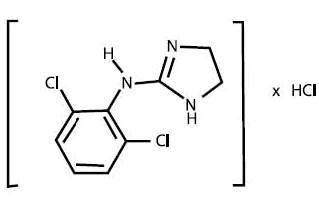
C 9 H 9 C l2 N 3 ·HCl Mol. Wt. 266.56
Clonidine hydrochloride is an odorless, bitter, white crystalline substance soluble in water and alcohol.
The inactive ingredients are: crospovidone, dental-type silica, lactose monohydrate, magnesium stearate, microcrystalline cellulose, polyvinyl acetate, povidone, sodium polystyrene sulfonate, triacetin. The 0.17 mg tablet also contains hypromellose, polyethylene glycol, and titanium dioxide. The 0.26 mg tablet also contains D&C yellow #10 aluminum lake, FD&C yellow #6 aluminum lake, fractionated coconut oil, maltodextrin, polydextrose, talc, and titanium dioxide.
12 CLINICAL PHARMACOLOGY
12.1 Mechanism of Action
Clonidine stimulates alpha-adrenoreceptors in the brain stem. This action results in reduced sympathetic outflow from the central nervous system and in decreases in peripheral resistance, renal vascular resistance, heart rate, and blood pressure. The patient’s maximum blood pressure decrease occurred within 6 to 8 hours. Renal blood flow and glomerular filtration rate remain essentially unchanged. Normal postural reflexes are intact; therefore, orthostatic symptoms are mild and infrequent.
12.2 Pharmacodynamics
NEXICLON XR was studied in an open-label crossover, force titration, partially randomized trial in patients with mild and moderate essential hypertension who were on two or fewer antihypertensive medications. The trial was designed to compare steady-state exposures between the NEXICLON XR and clonidine immediate-release tablets. There were up- and down-titration phases. There was no washout period between phases or treatments.
Studies with immediate-release clonidine hydrochloride have demonstrated a moderate reduction (15% to 20%) in cardiac output in the supine position with no change in the peripheral resistance. At a 45° tilt, there is a smaller reduction in cardiac output and a decrease of peripheral resistance. During long-term therapy, cardiac output tends to return to control values, while peripheral resistance remains decreased. Slowing of the pulse rate has been observed in most patients given clonidine, but the drug does not alter normal hemodynamic response to exercise.
Tolerance to the antihypertensive effect may develop in some patients, necessitating a re-evaluation of therapy.
Other studies in patients have provided evidence of a reduction in plasma renin activity and in the excretion of aldosterone and catecholamines. The exact relationship of these pharmacologic actions to the antihypertensive effect of clonidine has not been fully elucidated.
Clonidine acutely stimulates growth hormone release in both children and adults, but does not produce a chronic elevation of growth hormone with long-term use.
12.3 Pharmacokinetics
Following single doses of NEXICLON XR 0.17 mg, clonidine mean (S.D.) peak plasma concentrations of 0.49 (±0.09) ng/mL occurred at 7.8 (±1.7) hours. The plasma half-life of clonidine was 13.7 (±3.0) hours. There was no effect of food on the pharmacokinetic parameters.
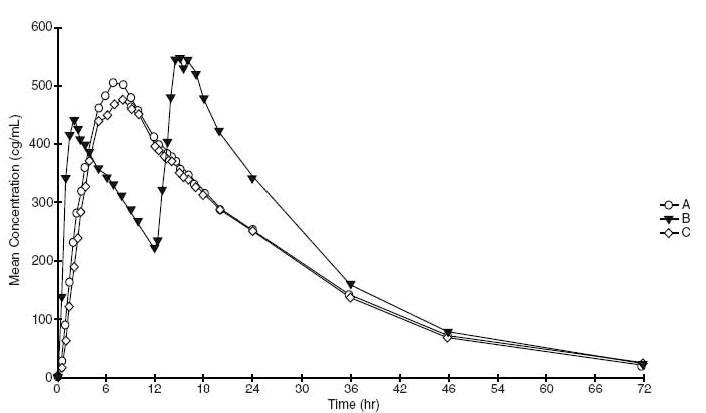
A = NEXICLON XR Tablets (0.17 mg QD) Fasted
B = Clonidine IR Tablet (0.1 mg clonidine hydrochloride Q12h) Fasted
C = NEXICLON XR Tablets (0.17 mg QD) Fed
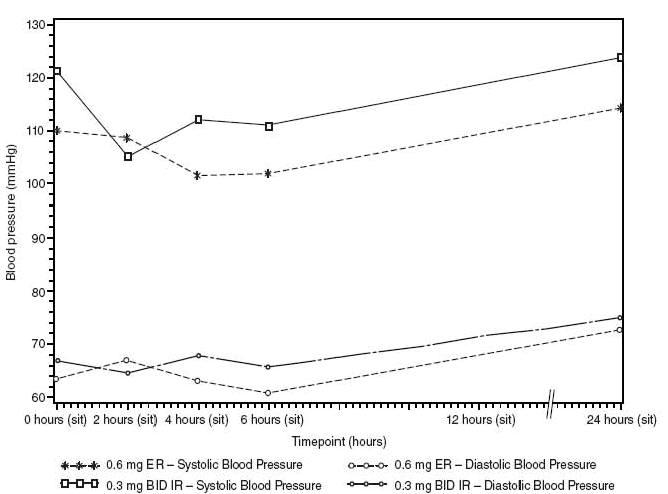
In the multi-dose study, mild to moderate hypertensive patients were randomized to ER and BID IR clonidine formulations. The following plot shows the sitting blood pressure values for each treatment group at Day 22.
The half-life may increase up to 41 hours in patients with severe impairment of renal function. Following oral administration of clonidine about 40 to 60% of the absorbed dose is recovered in the urine as unchanged drug in 24 hours. About 50% of the absorbed dose is metabolized in the liver.
13 NONCLINICAL TOXICOLOGY
13.1 Carcinogenesis, Mutagenesis, Impairment of Fertility
Chronic dietary administration of clonidine was not carcinogenic to rats (132 weeks) or mice (78 weeks) dosed, respectively, at up to 46 or 70 times the maximum recommended daily human dose as mg/kg (9 or 6 times the MRDHD on a mg/m 2 basis). There was no evidence of genotoxicity in the Ames test for mutagenicity or mouse micronucleus test for clastogenicity.
Fertility of male or female rats was unaffected by clonidine doses as high as 150 mcg/kg (approximately 3 times MRDHD). In a separate experiment, fertility of female rats appeared to be affected at dose levels of 500 to 2000 mcg/kg (10 to 40 times the oral MRDHD on a mg/kg basis; 2 to 8 times the MRDHD on a mg/m 2 basis).
13.2 Animal Toxicology and/or Pharmacology
In several studies with oral clonidine hydrochloride, a dose-dependent increase in the incidence and severity of spontaneous retinal degeneration was seen in albino rats treated for six months or longer. Tissue distribution studies in dogs and monkeys showed a concentration of clonidine in the choroid.
In view of the retinal degeneration seen in rats, eye examinations were performed during clinical trials in 908 patients before, and periodically after, the start of clonidine therapy. In 353 of these 908 patients, the eye examinations were carried out over periods of 24 months or longer. Except for some dryness of the eyes, no drug-related abnormal ophthalmological findings were recorded and, according to specialized tests such as electroretinography and macular dazzle, retinal function was unchanged.
In combination with amitriptyline, clonidine hydrochloride administration led to the development of corneal lesions in rats within 5 days.
14 CLINICAL STUDIES
[ see Clinical Pharmacology (12.3) ].
16 HOW SUPPLIED/STORAGE AND HANDLING
NEXICLON XR (clonidine) Extended-Release Tablets are scored, splitable, capsule-shaped coated tablets that are supplied in bottles of 30.
| Strength | Color | Markings | NDC |
| 0.17 mg | White | NP 2 | 71511-503-30 |
Store at 20º to 25ºC (68º to 77ºF); excursions permitted to 15º to 30ºC (59º to 86ºF). [See USP Controlled Room Temperature.]
Dispense in a tight, light-resistant container with a child-resistant closure.
