Get your patient on Oxiconazole Nitrate - Oxiconazole Nitrate cream (Oxiconazole Nitrate)
Oxiconazole Nitrate - Oxiconazole Nitrate cream prescribing information

INDICATIONS AND USAGE
Oxiconazole nitrate cream is indicated for the topical treatment of the following dermal infections: tinea pedis, tinea cruris, and tinea corporis due to Trichophyton rubrum , Trichophyton mentagrophytes , or Epidermophyton floccosum . Oxiconazole nitrate cream is indicated for the topical treatment of tinea (pityriasis) versicolor due to Malassezia furfur (see DOSAGE AND ADMINISTRATION and CLINICAL STUDIES ).
Oxiconazole nitrate cream may be used in pediatric patients for tinea corporis, tinea cruris, tinea pedis, and tinea (pityriasis) versicolor; however, these indications for which oxiconazole nitrate cream has been shown to be effective rarely occur in children below the age of 12.
DOSAGE AND ADMINISTRATION
Oxiconazole nitrate cream should be applied to affected and immediately surrounding areas once to twice daily in patients with tinea pedis, tinea corporis, or tinea cruris. Oxiconazole nitrate cream should be applied once daily in the treatment of tinea (pityriasis) versicolor. Tinea corporis, tinea cruris, and tinea (pityriasis) versicolor should be treated for 2 weeks and tinea pedis for 1 month to reduce the possibility of recurrence. If a patient shows no clinical improvement after the treatment period, the diagnosis should be reviewed.
Note: Tinea (pityriasis) versicolor may give rise to hyperpigmented or hypopigmented patches on the trunk that may extend to the neck, arms, and upper thighs. Treatment of the infection may not immediately result in restoration of pigment to the affected sites. Normalization of pigment following successful therapy is variable and may take months, depending on individual skin type and incidental sun exposure. Although tinea (pityriasis) versicolor is not contagious, it may recur because the organism that causes the disease is part of the normal skin flora.
CONTRAINDICATIONS
Oxiconazole nitrate cream is contraindicated in individuals who have shown hypersensitivity to any of their components.
ADVERSE REACTIONS
During clinical trials, of 955 patients treated with oxiconazole nitrate cream , 1%, 41 (4.3%) reported adverse reactions thought to be related to drug therapy. These reactions included pruritus (1.6%); burning (1.4%); irritation and allergic contact dermatitis (0.4% each); folliculitis (0.3%); erythema (0.2%); and papules, fissure, maceration, rash, stinging, and nodules (0.1% each).
In a controlled, multicenter clinical trial of 269 patients treated with oxiconazole nitrate lotion , 1%, 7 (2.6%) reported adverse reactions thought to be related to drug therapy. These reactions included burning and stinging (0.7% each) and pruritus, scaling, tingling, pain, and dyshidrotic eczema (0.4% each).
Drug Interactions
Potential drug interactions between oxiconazole nitrate cream and other drugs have not been systematically evaluated.
DESCRIPTION
Oxiconazole nitrate cream, 1% contains the antifungal active compound oxiconazole nitrate. This formulation is for topical dermatologic use only.
Chemically, oxiconazole nitrate is 2',4'-dichloro-2-imidazol-1-ylacetophenone (Z) -[ 0 -(2,4-dichlorobenzyl)oxime], mononitrate. The compound has the molecular formula C 18 H 13 ON 3 CI 4 •HNO 3 , a molecular weight of 492.15, and the following structural formula:
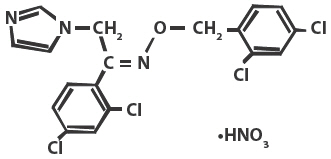
Oxiconazole nitrate is a nearly white crystalline powder, soluble in methanol; sparingly soluble in ethanol, chloroform, and acetone; and very slightly soluble in water.
Oxiconazole nitrate cream, 1% contains 10 mg of oxiconazole per gram of cream in a white to off-white cream base of cetyl alcohol, polysorbate 60, propylene glycol, purified water, stearyl alcohol, white petrolatum, and benzoic acid 0.2% as a preservative.
CLINICAL PHARMACOLOGY
Pharmacokinetics
The penetration of oxiconazole nitrate into different layers of the skin was assessed using an in vitro permeation technique with human skin. Five hours after application of 2.5 mg/cm 2 of oxiconazole nitrate cream onto human skin, the concentration of oxiconazole nitrate was demonstrated to be 16.2 μmol in the epidermis, 3.64 μmol in the upper corium, and 1.29 μmol in the deeper corium. Systemic absorption of oxiconazole nitrate is low. Using radiolabeled drug, less than 0.3% of the applied dose of oxiconazole nitrate was recovered in the urine of volunteer subjects up to 5 days after application of the cream formulation. Neither in vitro nor in vivo studies have been conducted to establish relative activity between the lotion and cream formulations.
Microbiology
Oxiconazole nitrate is an imidazole derivative whose antifungal activity is derived primarily from the inhibition of ergosterol biosynthesis, which is critical for cellular membrane integrity. It has in vitro activity against a wide range of pathogenic fungi.
Oxiconazole has been shown to be active against most strains of the following organisms both in vitro and in clinical infections at indicated body sites (see INDICATIONS AND USAGE ):
- Epidermophyton floccosum
- Trichophyton mentagrophytes
- Trichophyton rubrum
- Malassezia furfur
The following in vitro data are available; however, their clinical significance is unknown. Oxiconazole exhibits satisfactory in vitro minimum inhibitory concentrations (MICs) against most strains of the following organisms; however, the safety and efficacy of oxiconazole in treating clinical infections due to these organisms have not been established in adequate and well-controlled clinical trials:
- Candida albicans
- Microsporum audouini
- Microsporum canis
- Microsporum gypseum
- Trichophyton tonsurans
- Trichophyton violaceum
CLINICAL STUDIES
The following definitions were applied to the clinical and microbiological outcomes in patients enrolled in the clinical trials that form the basis for the approvals of Oxiconazole nitrate lotion and Oxiconazole nitrate cream.
Definitions
- Mycological Cure: No evidence (culture and KOH preparation) of the baseline (original) pathogen in a specimen from the affected area taken at the 2-week post-treatment visit (for tinea [pityriasis] versicolor, mycological cure was limited to KOH only).
- Treatment Success: Both a global evaluation of ≥90% clinical improvement and a microbiologic eradication (see above) at the 2-week post-treatment visit.
Tinea Pedis
THERE ARE NO HEAD-TO-HEAD COMPARISON TRIALS OF THE OXICONAZOLE NITRATE CREAM AND LOTION FORMULATIONS IN THE TREATMENT OF TINEA PEDIS.
Lotion Formulation
The clinical trial for the lotion formulation line extension involved 332 evaluable patients with clinically and microbiologically established tinea pedis. Of these evaluable patients, 64% were diagnosed with hyperkeratotic plantar tinea pedis and 28% with interdigital tinea pedis. Seventy-seven percent (77%) had disease secondary to infection with Trichophyton rubrum , 18% had disease secondary to infection with Trichophyton mentagrophytes , and 4% had disease secondary to infection with Epidermophyton floccosum .
The results of this clinical trial at the 2-week post-treatment follow-up visit are shown in the following table:
| Patient Outcome | Oxiconazole nitrate lotion | Vehicle | |
|---|---|---|---|
| b.i.d | q.d. | ||
| Myocological cure | 67% | 64% | 28% |
| Treatment success | 41% | 34% | 10% |
In this study, the improvement and cure rates of the b.i.d.- and q.d.-treated groups did not differ significantly (95% confidence interval) from each other but were statistically (95% confidence interval) superior to the vehicle-treated group.
Cream Formulation
The two pivotal trials for the cream formulation involved 281 evaluable patients (total from both trials) with clinically and microbiologically established tinea pedis.
The combined results of these two clinical trials at the 2-week post-treatment follow-up visit are shown in the following table:
| Patient Outcome | Oxiconazole nitrate cream | Vehicle | |
|---|---|---|---|
| b.i.d | q.d. | ||
| Myocological cure | 77% | 79% | 33% |
| Treatment success | 52% | 43% | 14% |
All the improvement and cure rates of the b.i.d.- and q.d.- treated groups did not differ significantly (95% confidence interval) from each other but were statistically (95% confidence interval) superior to the vehicle-treated group.
In addition, pediatric data (95 children ages 10 and under) available with the cream formulation indicate that it is safe and effective for use in children when used as directed. Adverse events were reported in 2 children; 1 child was reported to have reddening of the skin and 1 child was reported to have eczema-like skin alterations.
Tinea (pityriasis) Versicolor
Two pivotal clinical trials of oxiconazole nitrate cream in tinea (pityriasis) versicolor involved 219 evaluable patients in the q day oxiconazole nitrate and vehicle arms of the trial with clinical and mycological evidence of tinea (pityriasis) versicolor. Patients were treated for 2 weeks with oxiconazole nitrate cream once daily, or with cream vehicle. The combined results of these clinical trials at the 2-week post-treatment follow-up visit are shown in the following table. These results are based on 207 patients (110 in the oxiconazole nitrate group and 97 in the vehicle group) with efficacy evaluations at this visit.
| Patient Outcome | Oxiconazole nitrate cream | Vehicle |
|---|---|---|
| q.d. | ||
| Myocological cure | 88% | 67% |
| Treatment success | 83% | 62% |
Only once a day was shown in both studies to be statistically superior to vehicle for all efficacy parameters at 2 weeks and follow-up.
HOW SUPPLIED
Oxiconazole Nitrate Cream, 1% is supplied in:
15 g tubes - (NDC 51672-1359-1) 30 g tubes - (NDC 51672-1359-2) 60 g tubes - (NDC 51672-1359-3) 90 g tubes - (NDC 51672-1359-8)
Store at 20° – 25°C (68° – 77°F) [See USP Controlled Room Temperature].
