Get your patient on Prednisone - Prednisone tablet (Prednisone)
Prednisone - Prednisone tablet prescribing information

INDICATIONS
Endocrine disorders: primary or secondary adrenocortical insufficiency (hydrocortisone or cortisone is the first choice; synthetic analogs may be used in conjunction with mineralocorticoids where applicable; in infancy mineralocorticoid supplementation is of particular importance), congenital adrenal hyperplasia, nonsuppurative thyroiditis, hypercalcemia associated with cancer.
Rheumatic disorders: as adjunctive therapy for short-term administration (to tide the patient over an acute episode or exacerbation) in: psoriatic arthritis; rheumatoid arthritis, including juvenile rheumatoid arthritis (selected cases may require low-dose maintenance therapy); ankylosing spondylitis; acute and subacute bursitis; acute nonspecific tenosynovitis; acute gouty arthritis; post-traumatic osteoarthritis; synovitis of osteoarthritis; epicondylitis.
Collagen diseases: during an exacerbation or as maintenance therapy in selected cases of: systemic lupus erythematosus, acute rheumatic carditis.
Dermatologic diseases: pemphigus, bullous dermatitis herpetiformis, severe erythema multiforme (Stevens-Johnson syndrome), exfoliative dermatitis, mycosis fungoides, severe psoriasis, severe seborrheic dermatitis.
Allergic states: control of severe or incapacitating allergic conditions intractable to adequate trials of conventional treatment: seasonal or perennial allergic rhinitis, serum sickness, bronchial asthma, contact dermatitis, atopic dermatitis, drug hypersensitivity reactions.
Ophthalmic diseases: severe acute and chronic allergic and inflammatory processes involving the eye and its adnexa, such as: allergic conjunctivitis, keratitis, allergic corneal marginal ulcers, herpes zoster ophthalmicus, iritis and iridocyclitis, chorioretinitis, anterior segment inflammation, diffuse posterior uveitis and choroiditis, optic neuritis, sympathetic ophthalmia.
Respiratory diseases: symptomatic sarcoidosis, Loeffler's syndrome not manageable by other means, berylliosis, fulminating or disseminated pulmonary tuberculosis when used concurrently with appropriate antituberculous chemotherapy, aspiration pneumonitis.
Hematologic disorders: idiopathic thrombocytopenic purpura in adults, secondary thrombocytopenia in adults, acquired (autoimmune) hemolytic anemia, erythroblastopenia (RBC anemia), congenital (erythroid) hypoplastic anemia.
Neoplastic diseases: for palliative management of: leukemias and lymphomas in adults, acute leukemia of childhood.
Edematous states: to induce a diuresis or remission of proteinuria in the nephrotic syndrome, without uremia, of the idiopathic type or that due to lupus erythematosus.
Gastrointestinal diseases: to tide the patient over a critical period of the disease in: ulcerative colitis, regional enteritis.
Miscellaneous: tuberculous meningitis with subarachnoid block or impending block when used concurrently with appropriate antituberculous chemotherapy, trichinosis with neurologic or myocardial involvement.
In addition to the above indications, Prednisone Tablets, USP are indicated for systemic dermatomyositis (polymyositis).
DOSAGE AND ADMINISTRATION
Dosage of Prednisone Tablets, USP should be individualized according to the severity of the disease and the response of the patient. For infants and children, the recommended dosage should be governed by the same considerations rather than strict adherence to the ratio indicated by age or body weight.
Hormone therapy is an adjunct to, and not a replacement for, conventional therapy.
Dosage should be decreased or discontinued gradually when the drug has been administered for more than a few days.
The severity, prognosis, expected duration of the disease, and the reaction of the patient to medication are primary factors in determining dosage.
If a period of spontaneous remission occurs in a chronic condition, treatment should be discontinued.
Blood pressure, body weight, routine laboratory studies, including two-hour postprandial blood glucose and serum potassium, and a chest X-ray should be obtained at regular intervals during prolonged therapy. Upper GI X-rays are desirable in patients with known or suspected peptic ulcer disease.
The initial dosage of prednisone may vary from 5 mg to 60 mg per day, depending on the specific disease entity being treated. In situations of less severity lower doses will generally suffice, while in selected patients higher initial doses may be required. The initial dosage should be maintained or adjusted until a satisfactory response is noted. If after a reasonable period of time there is a lack of satisfactory clinical response, prednisone should be discontinued and the patient transferred to other appropriate therapy. IT SHOULD BE EMPHASIZED THAT DOSAGE REQUIREMENTS ARE VARIABLE AND MUST BE INDIVIDUALIZED ON THE BASIS OF THE DISEASE UNDER TREATMENT AND THE RESPONSE OF THE PATIENT. After a favorable response is noted, the proper maintenance dosage should be determined by decreasing the initial drug dosage in small decrements at appropriate time intervals until the lowest dosage which will maintain an adequate clinical response is reached. It should be kept in mind that constant monitoring is needed in regard to drug dosage. Included in the situations which may make dosage adjustments necessary are changes in clinical status secondary to remissions or exacerbations in the disease process, the patient's individual drug responsiveness, and the effect of patient exposure to stressful situations not directly related to the disease entity under treatment; in this latter situation it may be necessary to increase the dosage of prednisone for a period of time consistent with the patient's condition. If after long-term therapy the drug is to be stopped, it is recommended that it be withdrawn gradually rather than abruptly.
CONTRAINDICATIONS
Prednisone Tablets, USP are contraindicated in systemic fungal infections.
ADVERSE REACTIONS
Fluid and electrolyte disturbances: sodium retention, fluid retention, congestive heart failure in susceptible patients, potassium loss, hypokalemic alkalosis, hypertension.
Musculoskeletal: muscle weakness, steroid myopathy, loss of muscle mass, osteoporosis, vertebral compression fractures, aseptic necrosis of femoral and humeral heads, pathologic fracture of long bones.
Gastrointestinal: peptic ulcer with possible perforation and hemorrhage, pancreatitis, abdominal distention, ulcerative esophagitis.
Dermatologic: impaired wound healing, thin fragile skin, petechiae and ecchymoses, facial erythema, increased sweating, may suppress reactions to skin tests. Neurological: convulsions, increased intracranial pressure with papilledema (pseudotumor cerebri) usually after treatment, vertigo, headache.
Endocrine: menstrual irregularities; development of cushingoid state; suppression of growth in children; secondary adrenocortical and pituitary unresponsiveness, particularly in times of stress, as in trauma, surgery or illness; decreased carbohydrate tolerance; manifestations of latent diabetes mellitus; increased requirements of insulin or oral hypoglycemic agents in diabetics.
Ophthalmic: posterior subcapsular cataracts, increased intraocular pressure, glaucoma, exophthalmos.
Metabolic: negative nitrogen balance due to protein catabolism.
DESCRIPTION
Glucocorticoids are adrenocortical steroids, both naturally occurring and synthetic, that are readily absorbed from the gastrointestinal tract. The formula for prednisone is C 21 H 26 O 5 . Chemically, it is 17,21-dihydroxypregna-1,4-diene-3,11,20-trione and has the following structure:
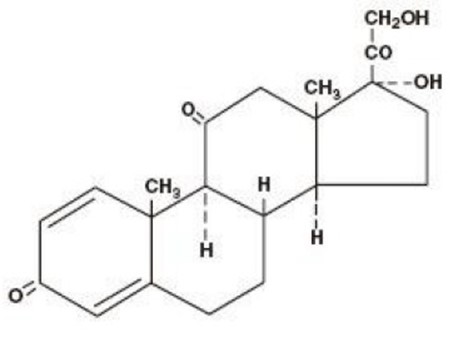
Prednisone is a white to practically white, odorless, crystalline powder and has a molecular weight of 358.43. It melts at about 230°C with some decomposition. Prednisone is very slightly soluble in water, slightly soluble in alcohol, chloroform, dioxane, and methanol. Prednisone Tablets, USP contain 1 mg Prednisone, USP.
The inactive ingredients for Prednisone Tablets, USP include: Microcrystalline Cellulose, Lactose Monohydrate, Pregelatinized Starch, Stearic Acid, Sodium Starch Glycolate and Magnesium Stearate.
HOW SUPPLIED
1 mg (white, round, scored, imprinted PD4)
Bottles of 90 NDC 62135-470-90 Bottles of 180 NDC 62135-470-18
Store at 20°C to 25°C (68°F to 77°F) [See USP Controlled Room Temperature]. PROTECT FROM MOISTURE.
Dispense in a tight, child-resistant container as defined in the USP/NF.
Rx only
Manufactured by: Tianjin Tianyao Pharmaceuticals Co., Ltd Tianjin China 300457
Manufactured for: Chartwell RX, LLC.
Congers, NY 10920
L71269
Revised 01/2023
ACTIONS
Naturally occurring glucocorticoids (hydrocortisone and cortisone), which also have salt-retaining properties, are used as replacement therapy in adrenocortical deficiency states. Their synthetic analogs, such as prednisone, are primarily used for their potent anti-inflammatory effects in disorders of many organ systems.
Glucocorticoids, such as prednisone, cause profound and varied metabolic effects. In addition, they modify the body's immune response to diverse stimuli.
