Get your patient on Triamcinolone Acetonide - Triamcinolone Acetonide cream (Triamcinolone Acetonide)
Triamcinolone Acetonide - Triamcinolone Acetonide cream prescribing information

INDICATIONS & USAGE:
Triamcinolone Acetonide Cream is indicated for the relief of the inflammatory and pruritic manifestations of corticosteroid-responsive dermatoses.
DOSAGE & ADMINISTRATION:
Apply Triamcinolone Acetonide Cream 0.025% to the affected area two to four times daily. Rub in gently.
Apply the 0.1% or the 0.5% Triamcinolone Acetonide Cream, as appropriate, to the affected area two to three times daily. Rub in gently.
Occlusive Dressing Technique
Occlusive dressings may be used for the management of psoriasis or other recalcitrant conditions. Gently rub a small amount of cream into the lesion until it disappears.
Reapply the preparation leaving a thin coating on the lesion, cover with pliable nonporous film, and seal the edges. If needed, additional moisture may be provided by covering the lesion with a dampened clean cotton cloth before the nonporous film is applied or by briefly wetting the affected area with water immediately prior to applying the medication. The frequency of changing dressings is best determined on an individual basis. It may be convenient to apply triamcinolone acetonide cream under an occlusive dressing in the evening and to remove the dressing in the morning (i.e., 12-hour occlusion). When utilizing the 12-hour occlusion regimen, additional cream should be applied, without occlusion, during the day. Reapplication is essential at each dressing change. If an infection develops, the use of occlusive dressings should be discontinued and appropriate antimicrobial therapy instituted.
CONTRAINDICATIONS:
Topical corticosteroids are contraindicated in those patients with a history of hypersensitivity to any of the components of the preparation.
ADVERSE REACTIONS:
The following local adverse reactions are reported infrequently with topical corticosteroids, but may occur more frequently with the use of occlusive dressings. These reactions are listed in an approximate decreasing order of occurrence: burning, itching, irritation, dryness, folliculitis, hypertrichosis, acneiform eruptions, hypopigmentation, perioral dermatitis, allergic contact dermatitis, maceration of the skin, secondary infection, skin atrophy, striae and miliaria.
DESCRIPTION:
The topical corticosteroids constitute a class of primarily synthetic steroids used as anti-inflammatory and anti-pruritic agents. The steroids in this class include triamcinolone acetonide.
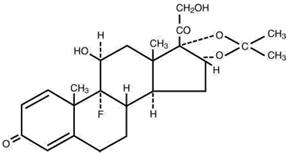
Triamcinolone Acetonide Cream USP contains Triamcinolone Acetonide [Pregna-1,4-diene-3,20-dione,9-fluoro-11,21-dihydroxy-16,17-[(1-methylethylidene) bis- (oxy)]-, (11β,16α)-], with the empirical formula C 24 H 31 FO 6 and molecular weight 434.50. CAS 76-25-5.
The structural formula is:
Triamcinolone Acetonide Cream USP, 0.025% contains: 0.25 mg of Triamcinolone Acetonide, USP per gram in a base containing Emulsifying Wax, Cetyl Alcohol, Isopropyl Palmitate, Sorbitol Solution, Glycerin, Lactic Acid, Benzyl Alcohol and Purified Water. Triamcinolone Acetonide Cream USP, 0.1% contains: 1 mg of Triamcinolone Acetonide, USP per gram in a base containing Emulsifying Wax, Cetyl Alcohol, Isopropyl Palmitate, Sorbitol Solution, Glycerin, Lactic Acid, Benzyl Alcohol and Purified Water. Triamcinolone Acetonide Cream USP, 0.5% contains: 5 mg of Triamcinolone Acetonide, USP per gram in a base containing Emulsifying Wax, Cetyl Alcohol, Isopropyl Palmitate, Sorbitol Solution, Glycerin, Lactic Acid, Benzyl Alcohol and Purified Water.
CLINICAL PHARMACOLOGY:
Topical corticosteroids share anti-inflammatory, anti-pruritic and vasoconstrictive actions. The mechanism of anti-inflammatory activity of the topical corticosteroids is unclear. Various laboratory methods, including vasoconstrictor assays, are used to compare and predict potencies and/or clinical efficacies of the topical corticosteroids. There is some evidence to suggest that a recognizable correlation exists between vasoconstrictor potency and therapeutic efficacy in man.
Pharmacokinetics: The extent of percutaneous absorption of topical corticosteroids is determined by many factors including the vehicle, the integrity of the epidermal barrier, and the use of occlusive dressings. Topical corticosteroids can be absorbed from normal intact skin. Inflammation and/or other disease processes in the skin increase percutaneous absorption. Occlusive dressings substantially increase the percutaneous absorption of topical corticosteroids. Thus, occlusive dressings may be a valuable therapeutic adjunct for treatment of resistant dermatoses (See DOSAGE AND ADMINISTRATION ). Once absorbed through the skin, topical corticosteroids are handled through pharmacokinetic pathways similar to systemically administered corticosteroids. Corticosteroids are bound to plasma proteins in varying degrees. Corticosteroids are metabolized primarily in the liver and are then excreted by the kidneys. Some of the topical corticosteroids and their metabolites are also excreted into the bile.
HOW SUPPLIED:
Triamcinolone Acetonide Cream USP, 0.025% 15 gram tubes NDC 16714-985-01 80 gram tubes NDC 16714-985-02
Triamcinolone Acetonide Cream USP, 0.1% 15 gram tubes NDC 16714-986-01 30 gram tubes NDC 16714-986-02 80 gram tubes NDC 16714-986-03 1 Lb jars NDC 16714-986-04
Triamcinolone Acetonide Cream USP, 0.5% 15 gram tubes NDC 16714-987-01
Store at 20° to 25°C (68° to 77°F); excursions permitted to 15° to 30°C (59° to 86°F) [See USP Controlled Room Temperature]. Avoid excessive heat.
PROTECT FROM FREEZING.
Manufactured for: Northstar Rx LLC. Memphis, TN 38141.
Manufactured by:
Macleods Pharmaceuticals Limited
At Oxalis Labs
Baddi, Himachal Pradesh, INDIA
To report SUSPECT ADVERSE REACTIONS, contact NorthStar Rx LLC 1-800-206-7821 or FDA at 1-800-FDA-1088 or www.fda.gov/medwatch
Revised: December 2023
