Get your patient on Accupril - Quinapril Hydrochloride tablet, Film Coated (Quinapril Hydrochloride)
Accupril - Quinapril Hydrochloride tablet, Film Coated prescribing information

WARNING: FETAL TOXICITY
- When pregnancy is detected, discontinue ACCUPRIL as soon as possible.
- Drugs that act directly on the renin-angiotensin system can cause injury and death to the developing fetus. See Warnings: Fetal Toxicity
INDICATIONS AND USAGE
Hypertension
ACCUPRIL is indicated for the treatment of hypertension, to lower blood pressure. Lowering blood pressure reduces the risk of fatal and nonfatal cardiovascular events, primarily strokes and myocardial infarctions. These benefits have been seen in controlled trials of antihypertensive drugs from a wide variety of pharmacologic classes including the class to which this drug principally belongs. There are no controlled trials demonstrating risk reduction with ACCUPRIL.
Control of high blood pressure should be part of comprehensive cardiovascular risk management, including, as appropriate, lipid control, diabetes management, antithrombotic therapy, smoking cessation, exercise, and limited sodium intake. Many patients will require more than one drug to achieve blood pressure goals. For specific advice on goals and management, see published guidelines, such as those of the National High Blood Pressure Education Program's Joint National Committee on Prevention, Detection, Evaluation, and Treatment of High Blood Pressure (JNC).
Numerous antihypertensive drugs, from a variety of pharmacologic classes and with different mechanisms of action, have been shown in randomized controlled trials to reduce cardiovascular morbidity and mortality, and it can be concluded that it is blood pressure reduction, and not some other pharmacologic property of the drugs, that is largely responsible for those benefits. The largest and most consistent cardiovascular outcome benefit has been a reduction in the risk of stroke, but reductions in myocardial infarction and cardiovascular mortality also have been seen regularly.
Elevated systolic or diastolic pressure causes increased cardiovascular risk, and the absolute risk increase per mmHg is greater at higher blood pressures, so that even modest reductions of severe hypertension can provide substantial benefit. Relative risk reduction from blood pressure reduction is similar across populations with varying absolute risk, so the absolute benefit is greater in patients who are at higher risk independent of their hypertension (for example, patients with diabetes or hyperlipidemia), and such patients would be expected to benefit from more aggressive treatment to a lower blood pressure goal.
Some antihypertensive drugs have smaller blood pressure effects (as monotherapy) in black patients, and many antihypertensive drugs have additional approved indications and effects (e.g., on angina, heart failure, or diabetic kidney disease). These considerations may guide selection of therapy.
ACCUPRIL may be used alone or in combination with thiazide diuretics .
Heart Failure
ACCUPRIL is indicated in the management of heart failure as adjunctive therapy when added to conventional therapy including diuretics and/or digitalis.
In using ACCUPRIL, consideration should be given to the fact that another ACE inhibitor, captopril, has caused agranulocytosis, particularly in patients with renal impairment or collagen vascular disease. Available data are insufficient to show that ACCUPRIL does not have a similar risk (see WARNINGS ).
Angioedema in black patients: Black patients receiving ACE inhibitor monotherapy have been reported to have a higher incidence of angioedema compared to non-blacks. It should also be noted that in controlled clinical trials ACE inhibitors have an effect on blood pressure that is less in black patients than in non-blacks.
DOSAGE AND ADMINISTRATION
Hypertension
Monotherapy:
The recommended initial dosage of ACCUPRIL in patients not on diuretics is 10 or 20 mg once daily. Dosage should be adjusted according to blood pressure response measured at peak (2–6 hours after dosing) and trough (predosing). Generally, dosage adjustments should be made at intervals of at least 2 weeks. Most patients have required dosages of 20, 40, or 80 mg/day, given as a single dose or in two equally divided doses. In some patients treated once daily, the antihypertensive effect may diminish toward the end of the dosing interval. In such patients an increase in dosage or twice daily administration may be warranted. In general, doses of 40–80 mg and divided doses give a somewhat greater effect at the end of the dosing interval.
Concomitant Diuretics:
If blood pressure is not adequately controlled with ACCUPRIL monotherapy, a diuretic may be added. In patients who are currently being treated with a diuretic, symptomatic hypotension occasionally can occur following the initial dose of ACCUPRIL. To reduce the likelihood of hypotension, the diuretic should, if possible, be discontinued 2 to 3 days prior to beginning therapy with ACCUPRIL (see WARNINGS ). Then, if blood pressure is not controlled with ACCUPRIL alone, diuretic therapy should be resumed.
If the diuretic cannot be discontinued, an initial dose of 5 mg ACCUPRIL should be used with careful medical supervision for several hours and until blood pressure has stabilized.
The dosage should subsequently be titrated (as described above) to the optimal response (see WARNINGS , PRECAUTIONS , and Drug Interactions ).
Renal Impairment:
Kinetic data indicate that the apparent elimination half-life of quinaprilat increases as creatinine clearance decreases. Recommended starting doses, based on clinical and pharmacokinetic data from patients with renal impairment, are as follows:
| Creatinine Clearance | Maximum Recommended Initial Dose |
|---|---|
>60 mL/min | 10 mg |
30–60 mL/min | 5 mg |
10–30 mL/min | 2.5 mg |
<10 mL/min | Insufficient data for dosage recommendation |
Patients should subsequently have their dosage titrated (as described above) to the optimal response.
Elderly (≥65 years):
The recommended initial dosage of ACCUPRIL in elderly patients is 10 mg given once daily followed by titration (as described above) to the optimal response.
Heart Failure
ACCUPRIL is indicated as adjunctive therapy when added to conventional therapy including diuretics and/or digitalis. The recommended starting dose is 5 mg twice daily. This dose may improve symptoms of heart failure, but increases in exercise duration have generally required higher doses. Therefore, if the initial dosage of ACCUPRIL is well tolerated, patients should then be titrated at weekly intervals until an effective dose, usually 20 to 40 mg daily given in two equally divided doses, is reached or undesirable hypotension, orthostatis, or azotemia (see WARNINGS ) prohibit reaching this dose.
Following the initial dose of ACCUPRIL, the patient should be observed under medical supervision for at least two hours for the presence of hypotension or orthostatis and, if present, until blood pressure stabilizes. The appearance of hypotension, orthostatis, or azotemia early in dose titration should not preclude further careful dose titration. Consideration should be given to reducing the dose of concomitant diuretics.
DOSE ADJUSTMENTS IN PATIENTS WITH HEART FAILURE AND RENAL IMPAIRMENT OR HYPONATREMIA
Pharmacokinetic data indicate that quinapril elimination is dependent on level of renal function. In patients with heart failure and renal impairment, the recommended initial dose of ACCUPRIL is 5 mg in patients with a creatinine clearance above 30 mL/min and 2.5 mg in patients with a creatinine clearance of 10 to 30 mL/min. There is insufficient data for dosage recommendation in patients with a creatinine clearance less than 10 mL/min (see DOSAGE AND ADMINISTRATION, Heart Failure , WARNINGS , and PRECAUTIONS, Drug Interactions ).
If the initial dose is well tolerated, ACCUPRIL may be administered the following day as a twice daily regimen. In the absence of excessive hypotension or significant deterioration of renal function, the dose may be increased at weekly intervals based on clinical and hemodynamic response.
CONTRAINDICATIONS
ACCUPRIL is contraindicated in patients who are hypersensitive to this product and in patients with a history of angioedema related to previous treatment with an ACE inhibitor.
ACCUPRIL is contraindicated in combination with a neprilysin inhibitor (e.g., sacubitril). Do not administer ACCUPRIL within 36 hours of switching to or from sacubitril/valsartan, a neprilysin inhibitor (see WARNINGS and PRECAUTIONS ).
Do not co-administer ACCUPRIL with aliskiren in patients with diabetes.
ADVERSE REACTIONS
Hypertension
ACCUPRIL has been evaluated for safety in 4960 subjects and patients. Of these, 3203 patients, including 655 elderly patients, participated in controlled clinical trials. ACCUPRIL has been evaluated for long-term safety in over 1400 patients treated for 1 year or more.
Adverse experiences were usually mild and transient.
In placebo-controlled trials, discontinuation of therapy because of adverse events was required in 4.7% of patients with hypertension.
Adverse experiences probably or possibly related to therapy or of unknown relationship to therapy occurring in 1% or more of the 1563 patients in placebo-controlled hypertension trials who were treated with ACCUPRIL are shown below.
| Accupril (N=1563) Incidence (Discontinuance) | Placebo (N=579) Incidence (Discontinuance) | |
|---|---|---|
Headache | 5.6 (0.7) | 10.9 (0.7) |
Dizziness | 3.9 (0.8) | 2.6 (0.2) |
Fatigue | 2.6 (0.3) | 1.0 |
Coughing | 2.0 (0.5) | 0.0 |
Nausea and/or Vomiting | 1.4 (0.3) | 1.9 (0.2) |
Abdominal Pain | 1.0 (0.2) | 0.7 |
Heart Failure
ACCUPRIL has been evaluated for safety in 1222 ACCUPRIL treated patients. Of these, 632 patients participated in controlled clinical trials. In placebo-controlled trials, discontinuation of therapy because of adverse events was required in 6.8% of patients with congestive heart failure.
Adverse experiences probably or possibly related or of unknown relationship to therapy occurring in 1% or more of the 585 patients in placebo-controlled congestive heart failure trials who were treated with ACCUPRIL are shown below.
| Accupril (N=585) Incidence (Discontinuance) | Placebo (N=295) Incidence (Discontinuance) | |
|---|---|---|
Dizziness | 7.7 (0.7) | 5.1 (1.0) |
Coughing | 4.3 (0.3) | 1.4 |
Fatigue | 2.6 (0.2) | 1.4 |
Nausea and/or Vomiting | 2.4 (0.2) | 0.7 |
Chest Pain | 2.4 | 1.0 |
Hypotension | 2.9 (0.5) | 1.0 |
Dyspnea | 1.9 (0.2) | 2.0 |
Diarrhea | 1.7 | 1.0 |
Headache | 1.7 | 1.0 (0.3) |
Myalgia | 1.5 | 2.0 |
Rash | 1.4 (0.2) | 1.0 |
Back Pain | 1.2 | 0.3 |
See PRECAUTIONS, Cough .
Hypertension and/or Heart Failure
Clinical adverse experiences probably, possibly, or definitely related, or of uncertain relationship to therapy occurring in 0.5% to 1.0% (except as noted) of the patients with CHF or hypertension treated with ACCUPRIL (with or without concomitant diuretic) in controlled or uncontrolled trials (N=4847) and less frequent, clinically significant events seen in clinical trials or post-marketing experience (the rarer events are in italics) include (listed by body system):
General: back pain, malaise, viral infections, anaphylactoid reaction
Cardiovascular: palpitation, vasodilation, tachycardia, heart failure, hyperkalemia, myocardial infarction, cerebrovascular accident, hypertensive crisis, angina pectoris, orthostatic hypotension, cardiac rhythm disturbances, cardiogenic shock
Hematology: hemolytic anemia
Gastrointestinal: flatulence, dry mouth or throat, constipation, gastrointestinal hemorrhage, pancreatitis, abnormal liver function tests, dyspepsia
Metabolism and Nutrition Disorders: hyponatremia
Nervous/Psychiatric: somnolence, vertigo, syncope, nervousness, depression, insomnia, paresthesia
Integumentary: alopecia, increased sweating, pemphigus, pruritus, exfoliative dermatitis, photosensitivity reaction, dermatopolymyositis
Urogenital: urinary tract infection, impotence, acute renal failure, worsening renal failure
Respiratory: eosinophilic pneumonitis
Other: amblyopia, edema, arthralgia, pharyngitis, agranulocytosis, hepatitis, thrombocytopenia
Angioedema
Angioedema has been reported in patients receiving ACCUPRIL (0.1%). Angioedema associated with laryngeal edema may be fatal. If angioedema of the face, extremities, lips, tongue, glottis, and/or larynx occurs, treatment with ACCUPRIL should be discontinued and appropriate therapy instituted immediately. (See WARNINGS. )
Clinical Laboratory Test Findings
Hematology:
(See WARNINGS )
Hyperkalemia:
(See PRECAUTIONS )
Creatinine and Blood Urea Nitrogen:
Increases (>1.25 times the upper limit of normal) in serum creatinine and blood urea nitrogen were observed in 2% and 2%, respectively, of all patients treated with ACCUPRIL alone. Increases are more likely to occur in patients receiving concomitant diuretic therapy than in those on ACCUPRIL alone. These increases often remit on continued therapy. In controlled studies of heart failure, increases in blood urea nitrogen and serum creatinine were observed in 11% and 8%, respectively, of patients treated with ACCUPRIL; most often these patients were receiving diuretics with or without digitalis.
Drug Interactions
Concomitant diuretic therapy:
As with other ACE inhibitors, patients on diuretics, especially those on recently instituted diuretic therapy, may occasionally experience an excessive reduction of blood pressure after initiation of therapy with ACCUPRIL. The possibility of hypotensive effects with ACCUPRIL may be minimized by either discontinuing the diuretic or cautiously increasing salt intake prior to initiation of treatment with ACCUPRIL. If it is not possible to discontinue the diuretic, the starting dose of quinapril should be reduced (see DOSAGE AND ADMINISTRATION ).
Agents increasing serum potassium:
Coadministration of ACCUPRIL with other drugs that raise serum potassium levels may result in hyperkalemia. Monitor serum potassium in such patients.
Tetracycline and other drugs that interact with magnesium:
Simultaneous administration of tetracycline with ACCUPRIL reduced the absorption of tetracycline by approximately 28% to 37%, possibly due to the high magnesium content in ACCUPRIL tablets. This interaction should be considered if coprescribing ACCUPRIL and tetracycline or other drugs that interact with magnesium.
Lithium:
Increased serum lithium levels and symptoms of lithium toxicity have been reported in patients receiving concomitant lithium and ACE inhibitor therapy. These drugs should be coadministered with caution and frequent monitoring of serum lithium levels is recommended. If a diuretic is also used, it may increase the risk of lithium toxicity.
Gold:
Nitritoid reactions (symptoms include facial flushing, nausea, vomiting, and hypotension) have been reported rarely in patients on therapy with injectable gold (sodium aurothiomalate) and concomitant ACE inhibitor therapy.
Non-steroidal anti-inflammatory agents including selective cyclooxygenase-2 inhibitors (COX-2 inhibitors):
In patients who are elderly, volume-depleted (including those on diuretic therapy), or with compromised renal function, co-administration of NSAIDs, including selective COX-2 inhibitors, with ACE inhibitors, including quinapril, may result in deterioration of renal function, including possible acute renal failure. These effects are usually reversible. Monitor renal function periodically in patients receiving quinapril and NSAID therapy.
The antihypertensive effect of ACE inhibitors, including quinapril may be attenuated by NSAIDs.
Agents that inhibit mTOR or other drugs known to cause angioedema:
Patients taking concomitant mTOR inhibitor (e.g., temsirolimus) therapy or a neprilysin inhibitor may be at increased risk for angioedema.
Other agents:
Drug interaction studies of ACCUPRIL with other agents showed:
- Multiple dose therapy with propranolol or cimetidine has no effect on the pharmacokinetics of single doses of ACCUPRIL.
- The anticoagulant effect of a single dose of warfarin (measured by prothrombin time) was not significantly changed by quinapril coadministration twice-daily.
- ACCUPRIL treatment did not affect the pharmacokinetics of digoxin.
- No pharmacokinetic interaction was observed when single doses of ACCUPRIL and hydrochlorothiazide were administered concomitantly.
- Co-administration of multiple 10 mg doses of atorvastatin with 80 mg of ACCUPRIL resulted in no significant change in the steady-state pharmacokinetic parameters of atorvastatin.
DESCRIPTION
ACCUPRIL ® is the hydrochloride salt of quinapril, the ethyl ester of a non-sulfhydryl, angiotensin-converting enzyme (ACE) inhibitor, quinaprilat.
Quinapril hydrochloride is chemically described as [3S-[2[R•(R•)], 3R•]]-2-[2-[[1-(ethoxycarbonyl)-3-phenylpropyl]amino]-1-oxopropyl]-1,2,3,4-tetrahydro-3-isoquinolinecarboxylic acid, monohydrochloride. Its empirical formula is C 25 H 30 N 2 O 5 ∙HCl and its structural formula is:
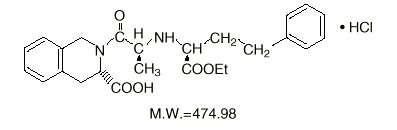
Quinapril hydrochloride is a white to off-white amorphous powder that is freely soluble in aqueous solvents.
ACCUPRIL tablets contain 5 mg (equivalent to 5.416 mg Quinapril Hydrochloride), 10 mg (equivalent to 10.832 mg Quinapril Hydrochloride), 20 mg (equivalent to 21.664 mg Quinapril Hydrochloride), or 40 mg (equivalent to 43.328 mg Quinapril Hydrochloride) of quinapril for oral administration. Each tablet also contains candelilla wax, crospovidone, gelatin, lactose, magnesium carbonate, magnesium stearate, synthetic red iron oxide, and titanium dioxide.
CLINICAL PHARMACOLOGY
Mechanism of Action:
Quinapril is deesterified to the principal metabolite, quinaprilat, which is an inhibitor of ACE activity in human subjects and animals. ACE is a peptidyl dipeptidase that catalyzes the conversion of angiotensin I to the vasoconstrictor, angiotensin II. The effect of quinapril in hypertension and in congestive heart failure (CHF) appears to result primarily from the inhibition of circulating and tissue ACE activity, thereby reducing angiotensin II formation. Quinapril inhibits the elevation in blood pressure caused by intravenously administered angiotensin I, but has no effect on the pressor response to angiotensin II, norepinephrine or epinephrine. Angiotensin II also stimulates the secretion of aldosterone from the adrenal cortex, thereby facilitating renal sodium and fluid reabsorption. Reduced aldosterone secretion by quinapril may result in a small increase in serum potassium. In controlled hypertension trials, treatment with ACCUPRIL alone resulted in mean increases in potassium of 0.07 mmol/L (see PRECAUTIONS ). Removal of angiotensin II negative feedback on renin secretion leads to increased plasma renin activity (PRA).
While the principal mechanism of antihypertensive effect is thought to be through the renin-angiotensin-aldosterone system, quinapril exerts antihypertensive actions even in patients with low renin hypertension. ACCUPRIL was an effective antihypertensive in all races studied, although it was somewhat less effective in blacks (usually a predominantly low renin group) than in nonblacks. ACE is identical to kininase II, an enzyme that degrades bradykinin, a potent peptide vasodilator; whether increased levels of bradykinin play a role in the therapeutic effect of quinapril remains to be elucidated.
Pharmacokinetics and Metabolism:
Following oral administration, peak plasma quinapril concentrations are observed within one hour. Based on recovery of quinapril and its metabolites in urine, the extent of absorption is at least 60%. The rate and extent of quinapril absorption are diminished moderately (approximately 25–30%) when ACCUPRIL tablets are administered during a high-fat meal. Following absorption, quinapril is deesterified to its major active metabolite, quinaprilat (about 38% of oral dose), and to other minor inactive metabolites. Following multiple oral dosing of ACCUPRIL, there is an effective accumulation half-life of quinaprilat of approximately 3 hours, and peak plasma quinaprilat concentrations are observed approximately 2 hours post-dose. Quinaprilat is eliminated primarily by renal excretion, up to 96% of an IV dose, and has an elimination half-life in plasma of approximately 2 hours and a prolonged terminal phase with a half-life of 25 hours. The pharmacokinetics of quinapril and quinaprilat are linear over a single-dose range of 5–80 mg doses and 40–160 mg in multiple daily doses. Approximately 97% of either quinapril or quinaprilat circulating in plasma is bound to proteins.
In patients with renal insufficiency, the elimination half-life of quinaprilat increases as creatinine clearance decreases. There is a linear correlation between plasma quinaprilat clearance and creatinine clearance. In patients with end-stage renal disease, chronic hemodialysis or continuous ambulatory peritoneal dialysis has little effect on the elimination of quinapril and quinaprilat. Elimination of quinaprilat may be reduced in elderly patients (≥65 years) and in those with heart failure; this reduction is attributable to decrease in renal function (see DOSAGE AND ADMINISTRATION ). Quinaprilat concentrations are reduced in patients with alcoholic cirrhosis due to impaired deesterification of quinapril. Studies in rats indicate that quinapril and its metabolites do not cross the blood-brain barrier.
Pharmacodynamics and Clinical Effects
Hypertension:
Single doses of 20 mg of ACCUPRIL provide over 80% inhibition of plasma ACE for 24 hours. Inhibition of the pressor response to angiotensin I is shorter-lived, with a 20 mg dose giving 75% inhibition for about 4 hours, 50% inhibition for about 8 hours, and 20% inhibition at 24 hours. With chronic dosing, however, there is substantial inhibition of angiotensin II levels at 24 hours by doses of 20–80 mg.
Administration of 10 to 80 mg of ACCUPRIL to patients with mild to severe hypertension results in a reduction of sitting and standing blood pressure to about the same extent with minimal effect on heart rate. Symptomatic postural hypotension is infrequent although it can occur in patients who are salt-and/or volume-depleted (see WARNINGS ). Antihypertensive activity commences within 1 hour with peak effects usually achieved by 2 to 4 hours after dosing. During chronic therapy, most of the blood pressure lowering effect of a given dose is obtained in 1–2 weeks. In multiple-dose studies, 10–80 mg per day in single or divided doses lowered systolic and diastolic blood pressure throughout the dosing interval, with a trough effect of about 5–11/3–7 mm Hg. The trough effect represents about 50% of the peak effect. While the dose-response relationship is relatively flat, doses of 40–80 mg were somewhat more effective at trough than 10–20 mg, and twice daily dosing tended to give a somewhat lower trough blood pressure than once daily dosing with the same total dose. The antihypertensive effect of ACCUPRIL continues during long-term therapy, with no evidence of loss of effectiveness.
Hemodynamic assessments in patients with hypertension indicate that blood pressure reduction produced by quinapril is accompanied by a reduction in total peripheral resistance and renal vascular resistance with little or no change in heart rate, cardiac index, renal blood flow, glomerular filtration rate, or filtration fraction.
Use of ACCUPRIL with a thiazide diuretic gives a blood-pressure lowering effect greater than that seen with either agent alone.
In patients with hypertension, ACCUPRIL 10–40 mg was similar in effectiveness to captopril, enalapril, propranolol, and thiazide diuretics.
Therapeutic effects appear to be the same for elderly (≥65 years of age) and younger adult patients given the same daily dosages, with no increase in adverse events in elderly patients.
Heart Failure:
In a placebo-controlled trial involving patients with congestive heart failure treated with digitalis and diuretics, parenteral quinaprilat, the active metabolite of quinapril, reduced pulmonary capillary wedge pressure and systemic vascular resistance and increased cardiac output/index. Similar favorable hemodynamic effects were seen with oral quinapril in baseline-controlled trials, and such effects appeared to be maintained during chronic oral quinapril therapy. Quinapril reduced renal hepatic vascular resistance and increased renal and hepatic blood flow with glomerular filtration rate remaining unchanged.
A significant dose response relationship for improvement in maximal exercise tolerance has been observed with ACCUPRIL therapy. Beneficial effects on the severity of heart failure as measured by New York Heart Association (NYHA) classification and Quality of Life and on symptoms of dyspnea, fatigue, and edema were evident after 6 months in a double-blind, placebo-controlled study. Favorable effects were maintained for up to two years of open label therapy. The effects of quinapril on long-term mortality in heart failure have not been evaluated.
HOW SUPPLIED
ACCUPRIL tablets are supplied as follows:
5-mg tablets: brown, film-coated, elliptical scored tablets, coded "PD 527"on one side and "5"on the other. NDC 0071-0527-23 bottles of 90 tablets
10-mg tablets: brown, film-coated, triangular tablets, coded "PD 530"on one side and "10"on the other. NDC 0071-0530-23 bottles of 90 tablets
20-mg tablets: brown, film-coated, round tablets, coded "PD 532"on one side and "20"on the other. NDC 0071-0532-23 bottles of 90 tablets
40-mg tablets: brown, film-coated, elliptical tablets, coded "PD 535"on one side and "40"on the other. NDC 0071-0535-23 bottles of 90 tablets
Dispense in well-closed containers as defined in the USP.
Storage:
Store at controlled room temperature 15º–30ºC (59º–86ºF).
Protect from light.
Mechanism of Action:
Quinapril is deesterified to the principal metabolite, quinaprilat, which is an inhibitor of ACE activity in human subjects and animals. ACE is a peptidyl dipeptidase that catalyzes the conversion of angiotensin I to the vasoconstrictor, angiotensin II. The effect of quinapril in hypertension and in congestive heart failure (CHF) appears to result primarily from the inhibition of circulating and tissue ACE activity, thereby reducing angiotensin II formation. Quinapril inhibits the elevation in blood pressure caused by intravenously administered angiotensin I, but has no effect on the pressor response to angiotensin II, norepinephrine or epinephrine. Angiotensin II also stimulates the secretion of aldosterone from the adrenal cortex, thereby facilitating renal sodium and fluid reabsorption. Reduced aldosterone secretion by quinapril may result in a small increase in serum potassium. In controlled hypertension trials, treatment with ACCUPRIL alone resulted in mean increases in potassium of 0.07 mmol/L (see PRECAUTIONS ). Removal of angiotensin II negative feedback on renin secretion leads to increased plasma renin activity (PRA).
While the principal mechanism of antihypertensive effect is thought to be through the renin-angiotensin-aldosterone system, quinapril exerts antihypertensive actions even in patients with low renin hypertension. ACCUPRIL was an effective antihypertensive in all races studied, although it was somewhat less effective in blacks (usually a predominantly low renin group) than in nonblacks. ACE is identical to kininase II, an enzyme that degrades bradykinin, a potent peptide vasodilator; whether increased levels of bradykinin play a role in the therapeutic effect of quinapril remains to be elucidated.
