Get your patient on Acyclovir - Acyclovir ointment (Acyclovir)
Acyclovir - Acyclovir ointment prescribing information

INDICATIONS AND USAGE
Acyclovir Ointment 5% is indicated in the management of initial genital herpes and in limited non-life-threatening mucocutaneous Herpes simplex virus infections in immunocompromised patients.
DOSAGE AND ADMINISTRATION
Apply sufficient quantity to adequately cover all lesions every 3 hours, 6 times per day for 7 days. The dose size per application will vary depending upon the total lesion area but should approximate a one-half inch ribbon of ointment per 4 square inches of surface area. A finger cot or rubber glove should be used when applying Acyclovir Ointment to prevent autoinoculation of other body sites and transmission of infection to other persons. Therapy should be initiated as early as possible following onset of signs and symptoms.
CONTRAINDICATIONS
Acyclovir Ointment 5% is contraindicated in patients who develop hypersensitivity to the components of the formulation.
ADVERSE REACTIONS
In the controlled clinical trials, mild pain (including transient burning and stinging) was reported by about 30% of patients in both the active and placebo arms; treatment was discontinued in 2 of these patients. Local pruritus occurred in 4% of these patients. In all studies, there was no significant difference between the drug and placebo group in the rate or type of reported adverse reactions nor were there any differences in abnormal clinical laboratory findings.
Observed During Clinical Practice
Based on clinical practice experience in patients treated with Acyclovir Ointment in the US, spontaneously reported adverse events are uncommon. Data are insufficient to support an estimate of their incidence or to establish causation. These events may also occur as part of the underlying disease process. Voluntary reports of adverse events that have been received since market introduction include:
General
Edema and/or pain at the application site.
Skin
Pruritus, rash.
Drug Interactions
Clinical experience has identified no interactions resulting from topical or systemic administration of other drugs concomitantly with Acyclovir Ointment 5%.
DESCRIPTION
Acyclovir Ointment USP, 5% is a synthetic nucleoside analogue active against herpes viruses. Acyclovir Ointment USP, 5% is a formulation for topical administration. Each gram of Acyclovir Ointment USP, 5% contains 50 mg of acyclovir in a polyethylene glycol (PEG) base.
Acyclovir is a white to off-white, crystalline powder with the molecular formula C 8 H 11 N 5 O 3 and a molecular weight of 225. The maximum solubility in water at 37°C is 2.5 mg/mL. The pka's of acyclovir are 2.27 and 9.25.
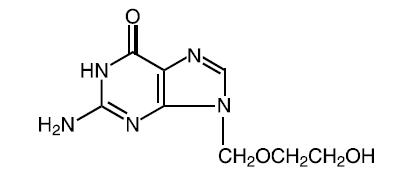
The chemical name of acyclovir is 2-amino-1,9-dihydro-9-[(2-hydroxyethoxy)methyl]-6 H -purin-6-one; it has the following structural formula:
CLINICAL PHARMACOLOGY
Two clinical pharmacology studies were performed with Acyclovir Ointment 5% in immunocompromised adults at risk of developing mucocutaneous Herpes simplex virus infections or with localized varicella-zoster infections. These studies were designed to evaluate the dermal tolerance, systemic toxicity, and percutaneous absorption of acyclovir.
In 1 of these studies, which included 16 inpatients, the complete ointment or its vehicle were randomly administered in a dose of 1-cm strips (25 mg acyclovir) 4 times a day for 7 days to an intact skin surface area of 4.5 square inches. No local intolerance, systemic toxicity, or contact dermatitis were observed. In addition, no drug was detected in blood and urine by radioimmunoassay (sensitivity, 0.01 mcg/mL).
The other study included 11 patients with localized varicella-zoster infections. In this uncontrolled study, acyclovir was detected in the blood of 9 patients and in the urine of all patients tested. Acyclovir levels in plasma ranged from < 0.01 to 0.28 mcg/mL in 8 patients with normal renal function, and from < 0.01 to 0.78 mcg/mL in 1 patient with impaired renal function. Acyclovir excreted in the urine ranged from < 0.02% to 9.4% of the daily dose. Therefore, systemic absorption of acyclovir after topical application is minimal.
HOW SUPPLIED
Each gram of Acyclovir Ointment USP, 5% contains 50 mg acyclovir in a polyethylene glycol base.
Acyclovir Ointment USP, 5% is supplied in 15 gram and 30 gram tubes.
NDC 72578-082-01 in tube of 15 gm
NDC 72578-082-06 in tube of 30 gm
Storage
Store at 15° to 25°C (59° to 77°F) in a dry place.
Keep this and all medications out of the reach of children.
Call your doctor for medical advice about side effects. You may report side effects to Viona Pharmaceuticals Inc. at 1-888-304-5011 or FDA at 1-800-FDA-1088.
