Get your patient on Alacort - Hydrocortisone cream (Hydrocortisone)
Alacort - Hydrocortisone cream prescribing information

INDICATIONS AND USAGE
Topical corticosteroids are indicated for the relief of the inflammatory and pruritic manifestations of corticosteroid-responsive dermatoses.
DOSAGE AND ADMINISTRATION
Topical corticosteroids are generally applied to the affected area as a thin film from two to four times daily depending on the severity of the condition.
Occlusive dressings may be used for the management of psoriasis or recalcitrant conditions. If an infection develops, the use of occlusive dressings should be discontinued and appropriate antimicrobial therapy instituted.
CONTRAINDICATIONS
Topical corticosteroids are contraindicated in those patients with a history of hypersensitivity to any of the components of the preparation.
ADVERSE REACTIONS
The following local adverse reactions are reported infrequently with topical corticosteroids, but may occur more frequently with the use of occlusive dressings. These reactions are listed in an approximate decreasing order of occurrence: burning, itching, irritation, dryness, foliculitiis, hypertrichosis, acneiform eruptions, hypopigmentation, perioral dermatitis, allergic contact dermatitis, maceration of the skin, secondary infection, skin atrophy, striae, and miliaria.
DESCRIPTION
The topical corticosteroids constitute a class of primarily synthetic steroids used as anti-inflammatory and antipruritic agents. Hydrocortisone is a member of this class. Chemically hydrocortisone is pregn-4-ene-3, 20-dione, 11, 17, 21-trihydroxy-, (11β)-. Its molecular formula is C 21 H 30 O 5 and molecular weight is 362.47. Its structural formula is:
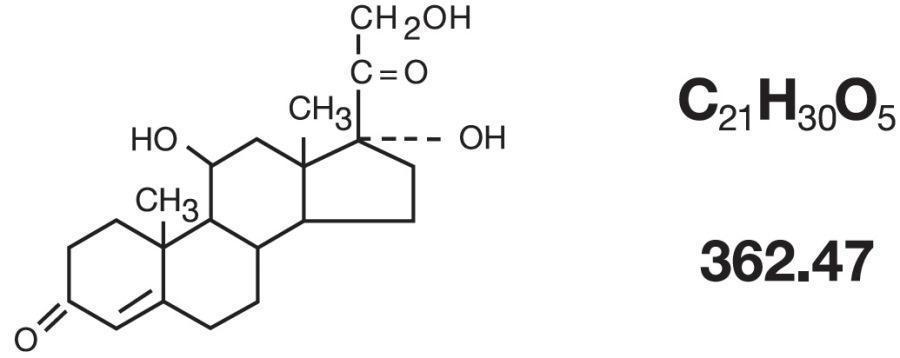
Each gram of ALA-CORT ® (Hydrocortisone Cream USP) 1% contains 10 mg hydrocortisone USP in a cream base consisting of purified water, cetyl alcohol, glycerin, stearyl alcohol, propylene glycol, sodium lauryl sulfate, cetyl palmitate and sorbic acid.
Each gram of ALA-CORT® (Hydrocortisone Cream USP) 2.5% contains 25 mg hydrocortisone USP in a cream base consisting of purified water, cetyl alcohol, glycerin, stearyl alcohol, propylene glycol, sodium lauryl sulfate, cetyl palmitate and sorbic acid.
CLINICAL PHARMACOLOGY
Topical corticosteroids share anti-inflammatory, antipruritic and vasoconstrictive actions.
The mechanism of anti-inflammatory activity of the topical corticosteroids is unclear. Various laboratory methods, including vasoconstrictor assays, are used to compare and predict potencies and/or clinical efficacies of the topical corticosteroids. There is some evidence to suggest that a recognizable correlation exists between vasoconstrictor potency and therapeutic efficacy in man.
HOW SUPPLIED
ALA-CORT ® (Hydrocortisone Cream USP), 1% is supplied in:
1 ounce (28.4 grams) tube NDC 0316-0126-01
3 ounce (85.2 grams) tube NDC 0316-0126-03
ALA-CORT® (Hydrocortisone Cream USP), 2.5% is supplied in:
20 grams tube NDC 0316-0128-20
30 grams tube NDC 0316-0128-30
454 grams jar NDC 0316-0128-16
Manufactured and Distributed by: Crown Laboratories, Inc., Johnson City, Tennessee 37604
PRINTED IN USA
Revised: OCT 2015
P8000.03
