Get your patient on Alprostadil - Alprostadil injection, Solution, Concentrate (Alprostadil)
Alprostadil - Alprostadil injection, Solution, Concentrate prescribing information

WARNING
Apnea is experienced by about 10 to 12% of neonates with congenital heart defects treated with alprostadil injection. Apnea is most often seen in neonates weighing less than 2 kg at birth and usually appears during the first hour of drug infusion. Therefore, respiratory status should be monitored throughout treatment, and alprostadil injection should be used where ventilatory assistance is immediately available.
INDICATIONS AND USAGE
Alprostadil injection, USP is indicated for palliative, not definitive, therapy to temporarily maintain the patency of the ductus arteriosus until corrective or palliative surgery can be performed in neonates who have congenital heart defects and who depend upon the patent ductus for survival. Such congenital heart defects include pulmonary atresia, pulmonary stenosis, tricuspid atresia, tetralogy of Fallot, interruption of the aortic arch, coarctation of the aorta, or transposition of the great vessels with or without other defects.
In infants with restricted pulmonary blood flow, the increase in blood oxygenation is inversely proportional to pretreatment pO 2 values; that is, patients with low pO 2 values respond best, and patients with pO 2 values of 40 torr or more usually have little response.
Alprostadil injection, USP should be administered only by trained personnel in facilities that provide pediatric intensive care.
DOSAGE AND ADMINISTRATION
The preferred route of administration for alprostadil injection is continuous intravenous infusion into a large vein. Alternatively, alprostadil injection may be administered through an umbilical artery catheter placed at the ductal opening. Increases in blood pO 2 (torr) have been the same in neonates who received the drug by either route of administration.
Begin infusion with 0.05 to 0.1 micrograms alprostadil per kilogram of body weight per minute. A starting dose of 0.1 micrograms per kilogram of body weight per minute is the recommended starting dose based on clinical studies; however, adequate clinical response has been reported using a starting dose of 0.05 micrograms per kilogram of body weight per minute. After a therapeutic response is achieved (increased pO 2 in infants with restricted pulmonary blood flow or increased systemic blood pressure and blood pH in infants with restricted systemic blood flow), reduce the infusion rate to provide the lowest possible dosage that maintains the response. This may be accomplished by reducing the dosage from 0.1 to 0.05 to 0.025 to 0.01 micrograms per kilogram of body weight per minute. If response to 0.05 micrograms per kilogram of body weight per minute is inadequate, dosage can be increased up to 0.4 micrograms per kilogram of body weight per minute although, in general, higher infusion rates do not produce greater effects.
Dilution Instructions
To prepare infusion solutions, dilute 1 mL of alprostadil injection with sodium chloride injection, USP or dextrose injection, USP. Undiluted alprostadil injection may interact with the plastic sidewalls of volumetric infusion chambers causing a change in the appearance of the chamber and creating a hazy solution. Should this occur, the solution and the volumetric infusion chamber should be replaced.
When using a volumetric infusion chamber, the appropriate amount of intravenous infusion solution should be added to the chamber first. The undiluted alprostadil injection should then be added to the intravenous infusion solution, avoiding direct contact of the undiluted solution with the walls of the volumetric infusion chamber.
Dilute to volumes appropriate for the pump delivery system available. Prepare fresh infusion solutions every 24 hours. Discard any solution more than 24 hours old .
| Add 1 vial (500 micrograms) alprostadil to: | Approximate Concentration of resulting solution (micrograms/mL) | lnfusion rate (mL/min per kg) (of body weight) |
| 250 mL | 2 | 0.05 |
| 100 mL | 5 | 0.02 |
| 50 mL | 10 | 0.01 |
| 25 mL | 20 | 0.005 |
Example: | To provide 0.1 micrograms/kilogram of body weight per minute to an infant weighing 2.8 kilograms using a solution of 1 vial alprostadil injection in 100 mL of saline or dextrose: INFUSION RATE = 0.02 mL/min per kg × 2.8 kg = 0.056 mL/min or 3.36 mL/hr. |
Parenteral drug products should be inspected visually for particulate matter and discoloration prior to administration, whenever solution and container permit.
CONTRAINDICATIONS
None.
ADVERSE REACTIONS
Central Nervous System
Apnea has been reported in about 12% of the neonates treated (see WARNING box). Other common adverse reactions reported have been fever in about 14% of the patients treated and seizures in about 4%. The following reactions have been reported in less than 1% of the patients: cerebral bleeding, hyperextension of the neck, hyperirritability, hypothermia, jitteriness, lethargy, and stiffness.
Cardiovascular System
The most common adverse reactions reported have been flushing in about 10% of patients (more common after intraarterial dosing), bradycardia in about 7%, hypotension in about 4%, tachycardia in about 3%, cardiac arrest in about 1%, and edema in about 1%. The following reactions have been reported in less than 1% of the patients: congestive heart failure, hyperemia, second degree heart block, shock, spasm of the right ventricle infundibulum, supraventricular tachycardia, and ventricular fibrillation.
Respiratory System
The following reactions have been reported in less than 1% of the patients: bradypnea, bronchial wheezing, hypercapnia, respiratory depression, respiratory distress, and tachypnea.
Gastrointestinal System
See WARNINGS .
The most common adverse reaction reported has been diarrhea in about 2% of the patients. The following reactions have been reported in less than 1% of the patients: gastric regurgitation, and hyperbilirubinemia.
Hematologic System
The most common hematologic event reported has been disseminated intravascular coagulation in about 1% of the patients. The following events have been reported in less than 1% of the patients: anemia, bleeding, and thrombocytopenia.
Excretory System
Anuria and hematuria have been reported in less than 1% of the patients.
Skeletal System
Cortical proliferation of the long bones has been reported (see PRECAUTIONS ).
Miscellaneous
Sepsis has been reported in about 2% of the patients. Peritonitis has been reported in less than 1% of the patients. Hypokalemia has been reported in about 1%, and hypoglycemia and hyperkalemia have been reported in less than 1% of the patients.
To report SUSPECTED ADVERSE REACTIONS, contact Meitheal Pharmaceuticals, Inc. at 1-844-824-8426 or FDA at 1-800-FDA-1088 or www.fda.gov/medwatch .
Drug Interactions
No drug interactions have been reported between alprostadil injection and the therapy standard in neonates with restricted pulmonary or systemic blood flow. Standard therapy includes antibiotics, such as penicillin and gentamicin; vasopressors, such as dopamine and isoproterenol; cardiac glycosides; and diuretics, such as furosemide.
DESCRIPTION
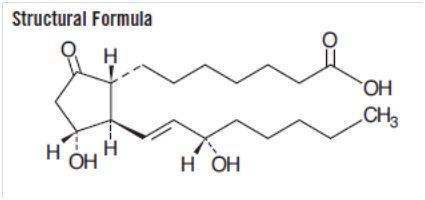
Alprostadil injection, USP for intravascular infusion contains 500 micrograms alprostadil, more commonly known as prostaglandin E 1 , in 1 mL dehydrated alcohol.
The chemical name for alprostadil is (1R,2R,3R)-3-Hydroxy-2-[(E)-(3S)-3-hydroxy-1-octenyl]-5-oxocyclopentane heptanoic acid, and the molecular weight is 354.49.
Alprostadil is a white to off-white crystalline powder with a melting point between 110° and 116°C. Its solubility at 35°C is 8000 micrograms per 100 mL double distilled water. Alprostadil has a molecular formula of C 20 H 34 O 5 .
CLINICAL PHARMACOLOGY
Alprostadil (prostaglandin E 1 ) is one of a family of naturally occurring acidic lipids with various pharmacologic effects. Vasodilation, inhibition of platelet aggregation, and stimulation of intestinal and uterine smooth muscle are among the most notable of these effects. Intravenous doses of 1 to 10 micrograms of alprostadil per kilogram of body weight lower the blood pressure in mammals by decreasing peripheral resistance. Reflex increases in cardiac output and rate accompany the reduction in blood pressure.
Smooth muscle of the ductus arteriosus is especially sensitive to alprostadil, and strips of lamb ductus markedly relax in the presence of the drug. In addition, administration of alprostadil reopened the closing ductus of new-born rats, rabbits, and lambs. These observations led to the investigation of alprostadil in infants who had congenital defects which restricted the pulmonary or systemic blood flow and who depended on a patent ductus arteriosus for adequate blood oxygenation and lower body perfusion.
In infants with restricted pulmonary blood flow, about 50% responded to alprostadil infusion with at least a 10 torr increase in blood pO 2 (mean increase about 14 torr and mean increase in oxygen saturation about 23%). In general, patients who responded best had low pretreatment blood pO 2 and were 4 days old or less.
In infants with restricted systemic blood flow, alprostadil often increased pH in those having acidosis, increased systemic blood pressure, and decreased the ratio of pulmonary artery pressure to aortic pressure.
Alprostadil must be infused continuously because it is very rapidly metabolized. As much as 80% of the circulating alprostadil may be metabolized in one pass through the lungs, primarily by β- and ω-oxidation. The metabolites are excreted primarily by the kidney, and excretion is essentially complete within 24 hours after administration. No unchanged alprostadil has been found in the urine, and there is no evidence of tissue retention of alprostadil or its metabolites.
HOW SUPPLIED
Each mL contains 500 micrograms alprostadil in dehydrated alcohol.
| NDC | Alprostadil Injection, USP (500 mcg per mL) | Package Factor |
| NDC 71288- 206 -02 | 500 mcg per mL Single-Dose Vial | 10 vials per carton |
Store alprostadil injection, USP in a refrigerator at 2° to 8°C (36° to 46°F).
Sterile, Nonpyrogenic, Preservative-free.
The container closure is not made with natural rubber latex.
meitheal ®
Mfd. for Meitheal Pharmaceuticals Chicago, IL 60631 (USA) ©2024 Meitheal Pharmaceuticals Inc.
Mfd. by Nanjing King-Friend Biochemical Pharmaceutical Co., Ltd. Nanjing, China 210061
April 2024
8T2AAM9-00
