Get your patient on Benztropine Mesylate - Benztropine Mesylate injection, Solution (Benztropine Mesylate)
Benztropine Mesylate - Benztropine Mesylate injection, Solution prescribing information

INDICATIONS AND USAGE:
For use as an adjunct in the therapy of all forms of parkinsonism (see DOSAGE AND ADMINISTRATION ).
Useful also in the control of extrapyramidal disorders (except tardive dyskinesia — see PRECAUTIONS ) due to neuroleptic drugs (e.g., phenothiazines).
DOSAGE AND ADMINISTRATION:
Since there is no significant difference in onset of effect after intravenous or intramuscular injection, usually there is no need to use the intravenous route. The drug is quickly effective after either route, with improvement sometimes noticeable a few minutes after injection. In emergency situations, when the condition of the patient is alarming, 1 to 2 mL of the injection normally will provide quick relief. If the parkinsonian effect begins to return, the dose can be repeated.
Because of cumulative action, therapy should be initiated with a low dose which is increased gradually at five or six-day intervals to the smallest amount necessary for optimal relief. Increases should be made in increments of 0.5 mg, to a maximum of 6 mg, or until optimal results are obtained without excessive adverse reactions.
Postencephalitic and Idiopathic Parkinsonism
The usual daily dose is 1 to 2 mg, with a range of 0.5 to 6 mg parenterally.
As with any agent used in parkinsonism, dosage must be individualized according to age and weight, and the type of parkinsonism being treated. Generally, older patients, and thin patients cannot tolerate large doses. Most patients with postencephalitic parkinsonism need fairly large doses and tolerate them well. Patients with a poor mental outlook are usually poor candidates for therapy.
In idiopathic parkinsonism, therapy may be initiated with a single daily dose of 0.5 to 1 mg at bedtime. In some patients, this will be adequate; in others 4 to 6 mg a day may be required.
In postencephalitic parkinsonism, therapy may be initiated in most patients with 2 mg a day in one or more doses. In highly sensitive patients, therapy may be initiated with 0.5 mg at bedtime, and increased as necessary.
Some patients experience greatest relief when given the entire dose at bedtime; others react more favorably to divided doses, two to four times a day. Frequently, one dose a day is sufficient, and divided doses may be unnecessary or undesirable.
The long duration of action of this drug makes it particularly suitable for bedtime medication when its effects may last throughout the night, enabling patients to turn in bed during the night more easily, and to rise in the morning.
When benztropine mesylate is started, do not terminate therapy with other antiparkinsonian agents abruptly. If the other agents are to be reduced or discontinued, it must be done gradually. Many patients obtain greatest relief with combination therapy.
Benztropine mesylate may be used concomitantly with SINEMET ® (Carbidopa-Levodopa), or with levodopa, in which case dosage adjustment may be required in order to maintain optimum response.
Drug-Induced Extrapyramidal Disorders
In treating extrapyramidal disorders due to neuroleptic drugs (e.g., phenothiazines), the recommended dosage is 1 to 4 mg once or twice a day parenterally. Dosage must be individualized according to the need of the patient. Some patients require more than recommended; others do not need as much.
In acute dystonic reactions, 1 to 2 mL of the injection usually relieves the condition quickly.
When extrapyramidal disorders develop soon after initiation of treatment with neuroleptic drugs (e.g., phenothiazines), they are likely to be transient. One to 2 mg of benztropine mesylate two or three times a day usually provides relief within one or two days. If such disorders recur, benztropine mesylate can be reinstituted.
Certain drug-induced extrapyramidal disorders that develop slowly may not respond to benztropine mesylate.
Parenteral drug products should be inspected visually for particulate matter and discoloration prior to administration.
CONTRAINDICATIONS:
Hypersensitivity to any component of benztropine mesylate injection.
Because of its atropine-like side effects, this drug is contraindicated in pediatric patients under three years of age, and should be used with caution in older pediatric patients.
ADVERSE REACTIONS:
The adverse reactions below, most of which are anticholinergic in nature, have been reported and within each category are listed in order of decreasing severity.
Cardiovascular
Tachycardia.
Digestive
Paralytic ileus, constipation, vomiting, nausea, dry mouth.
If dry mouth is so severe that there is difficulty in swallowing or speaking, or loss of appetite and weight, reduce dosage, or discontinue the drug temporarily. Slight reduction in dosage may control nausea and still give sufficient relief of symptoms. Vomiting may be controlled by temporary discontinuation, followed by resumption at a lower dosage.
Nervous System
Toxic psychosis, including confusion, disorientation, memory impairment, visual hallucinations; exacerbation of pre-existing psychotic symptoms; nervousness; depression; listlessness; numbness of fingers.
Special Senses
Blurred vision, dilated pupils.
Urogenital
Urinary retention, dysuria.
Metabolic/Immune or Skin
Occasionally, an allergic reaction, e.g., skin rash, develops. If this cannot be controlled by dosage reduction, the medication should be discontinued.
Other
Heat stroke, hyperthermia, fever. To report SUSPECTED ADVERSE REACTIONS, contact Fresenius Kabi, Vigilance & Medical Affairs at 1-800-551-7176 or FDA at 1-800-FDA-1088 or www.fda.gov/medwatch .
Drug Interactions
Antipsychotic drugs such as phenothiazines or haloperidol; tricyclic antidepressants (see WARNINGS ).
DESCRIPTION:
Benztropine mesylate is a synthetic compound containing structural features found in atropine and diphenhydramine. It is designated chemically as 8-azabicyclo[3.2.1]octane, 3-(diphenylmethoxy)-, endo , methanesulfonate. Its structural formula is:
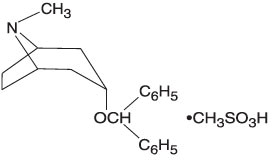
C 21 H 25 NO•CH 4 O 3 S M.W. 403.54
Benztropine mesylate is a crystalline white powder, and is very soluble in water.
Benztropine mesylate injection is supplied as a sterile injection for intravenous and intramuscular use.
Each milliliter of the injection contains: Benztropine mesylate 1 mg; sodium chloride 9 mg; water for injection q.s. 1 mL.
CLINICAL PHARMACOLOGY:
Benztropine mesylate possesses both anticholinergic and antihistaminic effects, although only the former have been established as therapeutically significant in the management of parkinsonism. In the isolated guinea pig ileum, the anticholinergic activity of this drug is about equal to that of atropine; however, when administered orally to unanesthetized cats, it is only about half as active as atropine.
In laboratory animals, its antihistaminic activity and duration of action approach those of pyrilamine maleate.
HOW SUPPLIED:
Benztropine Mesylate Injection, 1 mg per mL, is a clear, colorless solution and is supplied as follows:
| Product No. | NDC No. | Strength | Size |
| 970102 | 63323-970-02 | 2 mg per mL (1 mg per mL) | 2 mL fill, in a 5 mL vial, in a carton of five. |
Store at 20° to 25°C (68° to 77°F) [see USP Controlled Room Temperature]. Protect from light. Retain in carton until time of use.
The container closure is not made with natural rubber latex.
The brand names mentioned in this document are the trademarks of their respective owners.
