Get your patient on Betimol - Timolol solution/ Drops (Timolol)
Betimol - Timolol solution/ Drops prescribing information

INDICATIONS AND USAGE
Betimol ® is indicated in the treatment of elevated intraocular pressure in patients with ocular hypertension or open-angle glaucoma.
DOSAGE AND ADMINISTRATION
Betimol® Ophthalmic Solution is available in concentrations of 0.25% and 0.5%. The usual starting dose is one drop of 0.25% Betimol® in the affected eye(s) twice a day. If the clinical response is not adequate, the dosage may be changed to one drop of 0.5% solution in the affected eye(s) twice a day.
If the intraocular pressure is maintained at satisfactory levels, the dosage schedule may be changed to one drop once a day in the affected eye(s). Because of diurnal variations in intraocular pressure, satisfactory response to the once-a-day dose is best determined by measuring the intraocular pressure at different times during the day.
Since in some patients the pressure-lowering response to Betimol® may require a few weeks to stabilize, evaluation should include a determination of intraocular pressure after approximately 4 weeks of treatment with Betimol®.
Dosages above one drop of 0.5% Betimol® twice a day generally have not been shown to produce further reduction in intraocular pressure. If the patient's intraocular pressure is still not at a satisfactory level on this regimen, concomitant therapy with pilocarpine and other miotics, and/or epinephrine, and/or systemically administered carbonic anhydrase inhibitors, such as acetazolamide, can be instituted.
CONTRAINDICATIONS
Betimol ® is contraindicated in patients with overt heart failure, cardiogenic shock, sinus bradycardia, second- or third-degree atrioventricular block, bronchial asthma or history of bronchial asthma, or severe chronic obstructive pulmonary disease, or hypersensitivity to any component of this product.
ADVERSE REACTIONS
The most frequently reported ocular event in clinical trials was burning/stinging on instillation and was comparable between Betimol ® and timolol maleate (approximately one in eight patients).
The following adverse events were associated with use of Betimol ® in frequencies of more than 5% in two controlled, double-masked clinical studies in which 184 patients received 0.25% or 0.5% Betimol ® :
OCULAR:
Dry eyes, itching, foreign body sensation, discomfort in the eye, eyelid erythema, conjunctival injection, and headache.
BODY AS A WHOLE:
Headache.
The following side effects were reported in frequencies of 1 to 5%:
OCULAR:
Eye pain, epiphora, photophobia, blurred or abnormal vision, corneal fluorescein staining, keratitis, blepharitis and cataract.
BODY AS A WHOLE:
Allergic reaction, asthenia, common cold and pain in extremities.
CARDIOVASCULAR:
Hypertension.
DIGESTIVE:
Nausea.
METABOLIC/NUTRITIONAL:
Peripheral edema.
NERVOUS SYSTEM/PSYCHIATRY:
Dizziness and dry mouth.
RESPIRATORY:
Respiratory infection and sinusitis.
In addition, the following adverse reactions have been reported with ophthalmic use of beta blockers:
OCULAR:
Conjunctivitis, blepharoptosis, decreased corneal sensitivity, visual disturbances including refractive changes, diplopia and retinal vascular disorder.
BODY AS A WHOLE:
Chest pain.
CARDIOVASCULAR:
Arrhythmia, palpitation, bradycardia, hypotension, syncope, heart block, cerebral vascular accident, cerebral ischemia, cardiac failure and cardiac arrest.
DIGESTIVE:
Diarrhea.
ENDOCRINE:
Masked symptoms of hypoglycemia in insulin dependent diabetics (See WARNINGS ).
NERVOUS SYSTEM/PSYCHIATRY:
Depression, impotence, increase in signs and symptoms of myasthenia gravis and paresthesia.
RESPIRATORY:
Dyspnea, bronchospasm, respiratory failure and nasal congestion.
SKIN:
Alopecia, hypersensitivity including localized and generalized rash, urticaria.
Drug Interactions
Beta-adrenergic blocking agents
Patients who are receiving a beta-adrenergic blocking agent orally and Betimol ® should be observed for a potential additive effect either on the intraocular pressure or on the known systemic effects of beta-blockade.
Patients should not usually receive two topical ophthalmic beta-adrenergic blocking agents concurrently.
Catecholamine-depleting drugs
Close observation of the patient is recommended when a beta-blocker is administered to patients receiving catecholamine-depleting drugs such as reserpine, because of possible additive effects and the production of hypotension and/or marked bradycardia, which may produce vertigo, syncope, or postural hypotension.
Calcium antagonists
Caution should be used in the co-administration of beta-adrenergic blocking agents and oral or intravenous calcium antagonists, because of possible atrioventricular conduction disturbances, left ventricular failure, and hypotension. In patients with impaired cardiac function, co-administration should be avoided.
Digitalis and calcium antagonists
The concomitant use of beta-adrenergic blocking agents with digitalis and calcium antagonists may have additive effects in prolonging atrioventricular conduction time.
Injectable Epinephrine
DESCRIPTION
Betimol ® (timolol ophthalmic solution), 0.25% and 0.5%, is a non-selective beta-adrenergic antagonist for ophthalmic use. The chemical name of the active ingredient is (S)-1-[(1, 1-dimethylethyl)amino]-3-[[4-(4-morpholinyl)-1,2,5-thiadiazol-3-yl]oxy]-2-propanol. Timolol hemihydrate is the levo isomer. Specific rotation is [α] 25 405nm =-16° (C=10% as the hemihydrate form in 1N HCl).
| The molecular formula of timolol is Formula C 13 H 24 N 4 O 3 S and its structural formula is: | 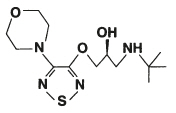 |
Timolol (as the hemihydrate) is a white, odorless, crystalline powder which is slightly soluble in water and freely soluble in ethanol. Timolol hemihydrate is stable at room temperature.
Betimol ® is a clear, colorless, isotonic, sterile, microbiologically preserved phosphate buffered aqueous solution.
It is supplied in two dosage strengths, 0.25% and 0.5%.
Each mL of Betimol ® 0.25% contains 2.56 mg of timolol hemihydrate equivalent to 2.5 mg timolol.
Each mL of Betimol ® 0.5% contains 5.12 mg of timolol hemihydrate equivalent to 5.0 mg timolol.
Inactive ingredients: monosodium and disodium phosphate dihydrate to adjust pH (6.5 - 7.5) and water for injection, benzalkonium chloride 0.01 % added as preservative.
The osmolality of Betimol ® is 260 to 320 mOsmol/kg.
CLINICAL PHARMACOLOGY
Timolol is a non-selective beta-adrenergic antagonist.
It blocks both beta 1 -and beta 2 -adrenergic receptors. Timolol does not have significant intrinsic sympathomimetic activity, local anesthetic (membrane-stabilizing) or direct myocardial depressant activity.
Timolol, when applied topically in the eye, reduces normal and elevated intraocular pressure (IOP) whether or not accompanied by glaucoma. Elevated intraocular pressure is a major risk factor in the pathogenesis of glaucomatous visual field loss. The higher the level of IOP, the greater the likelihood of glaucomatous visual field loss and optic nerve damage. The predominant mechanism of ocular hypotensive action of topical beta-adrenergic blocking agents is likely due to a reduction in aqueous humor production.
In general, beta-adrenergic blocking agents reduce cardiac output both in healthy subjects and patients with heart diseases. In patients with severe impairment of myocardial function, beta-adrenergic receptor blocking agents may inhibit sympathetic stimulatory effect necessary to maintain adequate cardiac function. In the bronchi and bronchioles, beta-adrenergic receptor blockade may also increase airway resistance because of unopposed parasympathetic activity.
Pharmacokinetics
When given orally, timolol is well absorbed and undergoes considerable first pass metabolism. Timolol and its metabolites are primarily excreted in the urine. The half-life of timolol in plasma is approximately 4 hours.
Clinical Studies
In two controlled multicenter studies in the U.S., Betimol ® 0.25% and 0.5% were compared with respective timolol maleate eyedrops. In these studies, the efficacy and safety profile of Betimol ® was similar to that of timolol maleate.
Clinical Studies
In two controlled multicenter studies in the U.S., Betimol ® 0.25% and 0.5% were compared with respective timolol maleate eyedrops. In these studies, the efficacy and safety profile of Betimol ® was similar to that of timolol maleate.
HOW SUPPLIED
Betimol ® (timolol ophthalmic solution) is a clear, colorless solution.
Betimol ® 0.25% is supplied in a white, opaque, plastic, ophthalmic dispenser bottle with a controlled drop tip as follows:
| NDC 82584-001-05 | 5 mL | fill in 5 cc container |
Betimol ® 0.5% is supplied in a white, opaque, plastic, ophthalmic dispenser bottle with a controlled drop tip as follows:
| NDC 82584-002-05 | 5 mL | fill in 5 cc container |
| NDC 82584-002-15 | 15 mL | fill in 15 cc container |
Rx Only
STORAGE
Store between 15° to 25°C (59° to 77°F). Do not freeze. Protect from light.
