Get your patient on Bleomycin - Bleomycin Sulfate injection, Powder, Lyophilized, For Solution (Bleomycin Sulfate)
Bleomycin - Bleomycin Sulfate injection, Powder, Lyophilized, For Solution prescribing information

BOXED WARNING
It is recommended that Bleomycin for Injection, USP be administered under the supervision of a qualified physician experienced in the use of cancer chemotherapeutic agents. Appropriate management of therapy and complications is possible only when adequate diagnostic and treatment facilities are readily available.
Pulmonary fibrosis is the most severe toxicity associated with bleomycin. The most frequent presentation is pneumonitis occasionally progressing to pulmonary fibrosis. Its occurrence is higher in elderly patients and in those receiving greater than 400 units total dose, but pulmonary toxicity has been observed in young patients and those treated with low doses.
A severe idiosyncratic reaction consisting of hypotension, mental confusion, fever, chills, and wheezing has been reported in approximately 1% of lymphoma patients treated with bleomycin.
INDICATIONS AND USAGE:
Bleomycin for Injection, USP should be considered a palliative treatment. It has been shown to be useful in the management of the following neoplasms either as a single agent or in proven combinations with other approved chemotherapeutic agents:
Squamous Cell Carcinoma: Head and neck (including mouth, tongue, tonsil, nasopharynx, oropharynx, sinus, palate, lip, buccal mucosa, gingivae, epiglottis, skin, larynx), penis, cervix, and vulva. The response to Bleomycin for Injection is poorer in patients with previously irradiated head and neck cancer.
Lymphomas: Hodgkin’s disease, non-Hodgkin’s lymphoma.
Testicular Carcinoma: Embryonal cell, choriocarcinoma, and teratocarcinoma.
Bleomycin for Injection, USP has also been shown to be useful in the management of:
Malignant Pleural Effusion: Bleomycin for Injection is effective as a sclerosing agent for the treatment of malignant pleural effusion and prevention of recurrent pleural effusions.
DOSAGE AND ADMINISTRATION:
Because of the possibility of an anaphylactoid reaction, lymphoma patients should be treated with 2 units or less for the first 2 doses. If no acute reaction occurs, then the regular dosage schedule may be followed.
The following dose schedule is recommended:
Squamous cell carcinoma, non-Hodgkin’s lymphoma, testicular carcinoma – 0.25 to 0.5 units/kg (10 to 20 units/m 2 ) given intravenously, intramuscularly, or subcutaneously weekly or twice weekly.
Hodgkin’s Disease – 0.25 to 0.5 units/kg (10 to 20 units/m 2 ) given intravenously, intramuscularly, or subcutaneously weekly or twice weekly. After a 50% response, a maintenance dose of 1 unit daily or 5 units weekly intravenously or intramuscularly should be given.
Pulmonary toxicity of Bleomycin for Injection, USP appears to be dose-related with a striking increase when the total dose is over 400 units. Total doses over 400 units should be given with great caution.
Note: When Bleomycin for Injection, USP is used in combination with other antineoplastic agents, pulmonary toxicities may occur at lower doses.
Improvement of Hodgkin’s disease and testicular tumors is prompt and noted within 2 weeks. If no improvement is seen by this time, improvement is unlikely. Squamous cell cancers respond more slowly, sometimes requiring as long as 3 weeks before any improvement is noted.
Malignant Pleural Effusion – 60 units administered as a single dose bolus intrapleural injection (see ADMINISTRATION, Intrapleural ).
Use in Patients with Renal Insufficiency
The following dosing reductions are proposed for patients with creatinine clearance (CrCL) values of less than 50 mL/min:
| Patient CrCL (mL/min) | Bleomycin for Injection, USP Dose (%) |
| 50 and above | 100 |
| 40 to 50 | 70 |
| 30 to 40 | 60 |
| 20 to 30 | 55 |
| 10 to 20 | 45 |
| 5 to 10 | 40 |
CrCL can be estimated from the individual patient’s measured serum creatinine (Scr) values using the Cockcroft and Gault formula:
Males CrCL = [weight x (140 – Age)]/(72 x Scr)
Females CrCL = 0.85 x [weight x (140 – Age)]/(72 x Scr)
Where CrCL in mL/min/1.73 m 2 , weight in kg, age in years, and Scr in mg/dL.
CONTRAINDICATIONS:
Bleomycin for Injection is contraindicated in patients who have demonstrated a hypersensitive or an idiosyncratic reaction to it.
ADVERSE REACTIONS:
Pulmonary
The most serious side effects are pulmonary adverse reactions, occurring in approximately 10% of treated patients. The most frequent presentation is pneumonitis occasionally progressing to pulmonary fibrosis. Approximately 1% of patients treated have died of pulmonary fibrosis. Pulmonary toxicity is both dose and age related, being more common in patients over 70 years of age and in those receiving over 400 units total dose. This toxicity, however, is unpredictable and has been seen in young patients receiving low doses. Some published reports have suggested that the risk of pulmonary toxicity may be increased when bleomycin is used in combination with G-CSF (filgrastim) or other cytokines. However, randomized clinical studies completed to date have not demonstrated an increased risk of pulmonary complications in patients treated with bleomycin and G-CSF.
Because of lack of specificity of the clinical syndrome, the identification of patients with pulmonary toxicity due to bleomycin has been extremely difficult. The earliest symptom associated with bleomycin pulmonary toxicity is dyspnea. The earliest sign is fine rales.
Radiographically, bleomycin-induced pneumonitis produces nonspecific patchy opacities, usually of the lower lung fields. The most common changes in pulmonary function tests are a decrease in total lung volume and a decrease in vital capacity. However, these changes are not predictive of the development of pulmonary fibrosis.
The microscopic tissue changes due to bleomycin toxicity include bronchiolar squamous metaplasia, reactive macrophages, atypical alveolar epithelial cells, fibrinous edema, and interstitial fibrosis. The acute stage may involve capillary changes and subsequent fibrinous exudation into alveoli producing a change similar to hyaline membrane formation and progressing to a diffuse interstitial fibrosis resembling the Hamman-Rich syndrome. These microscopic findings are nonspecific; e.g., similar changes are seen in radiation pneumonitis and pneumocystic pneumonitis.
To monitor the onset of pulmonary toxicity, roentgenograms of the chest should be taken every 1 to 2 weeks (see WARNINGS ). If pulmonary changes are noted, treatment should be discontinued until it can be determined if they are drug related. Recent studies have suggested that sequential measurement of the pulmonary diffusion capacity for carbon monoxide (DL co ) during treatment with bleomycin may be an indicator of subclinical pulmonary toxicity. It is recommended that the DL co be monitored monthly if it is to be employed to detect pulmonary toxicities, and thus the drug should be discontinued when the DL co falls below 30% to 35% of the pretreatment value.
Because of bleomycin’s sensitization of lung tissue, patients who have received bleomycin are at greater risk of developing pulmonary toxicity when oxygen is administered in surgery. While long exposure to very high oxygen concentrations is a known cause of lung damage, after bleomycin administration, lung damage can occur at lower concentrations that are usually considered safe. Suggested preventive measures are:
1. Maintain FlO 2 at concentrations approximating that of room air (25%) during surgery and the postoperative period.
2. Monitor carefully fluid replacement, focusing more on colloid administration rather than crystalloid.
Sudden onset of an acute chest pain syndrome suggestive of pleuropericarditis has been reported during bleomycin infusions. Although each patient must be individually evaluated, further courses of bleomycin do not appear to be contraindicated.
Pulmonary adverse events which may be related to the intrapleural administration of bleomycin have been reported.
Idiosyncratic Reactions
In approximately 1% of the lymphoma patients treated with bleomycin, an idiosyncratic reaction, similar to anaphylaxis clinically, has been reported. The reaction may be immediate or delayed for several hours, and usually occurs after the first or second dose (see WARNINGS ). It consists of hypotension, mental confusion, fever, chills, and wheezing. Treatment is symptomatic including volume expansion, pressor agents, antihistamines, and corticosteroids.
Integument and Mucous Membranes
These adverse reactions have been reported in approximately 50% of treated patients. They consist of erythema, rash, striae, vesiculation, hyperpigmentation, and tenderness of the skin. Hyperkeratosis, nail changes, alopecia, pruritus, and stomatitis have also been reported. It was necessary to discontinue bleomycin therapy in 2% of treated patients because of these toxicities.
Scleroderma-like skin changes have been reported.
Skin toxicity is a relatively late manifestation usually developing in the second and third week of treatment after 150 to 200 units of bleomycin have been administered and appears to be related to the cumulative dose.
Intrapleural administration of bleomycin has been associated with local pain. Hypotension possibly requiring symptomatic treatment has been reported. Death has been reported in association with bleomycin pleurodesis in seriously ill patients.
Other
Vascular toxicities coincident with the use of bleomycin in combination with other antineoplastic agents have been reported. The events are clinically heterogeneous and may include myocardial infarction, cerebrovascular accident, thrombotic microangiopathy (HUS), or cerebral arteritis. Various mechanisms have been proposed for these vascular complications. There are also reports of Raynaud’s phenomenon occurring in patients treated with bleomycin in combination with vinblastine with or without cisplatin or, in a few cases, with bleomycin as a single agent. It is currently unknown if the cause of Raynaud’s phenomenon in these cases is the disease, underlying vascular compromise, bleomycin, vinblastine, hypomagnesemia, or a combination of any of these factors.
Fever, chills, and vomiting have been reported. Anorexia and weight loss have been reported and may persist long after termination of this medication. Pain at tumor site, phlebitis, and other local reactions have been reported.
Malaise has been reported.
DESCRIPTION:
Bleomycin for Injection, USP is a mixture of cytotoxic glycopeptide antibiotics isolated from a strain of Streptomyces verticillus . It is freely soluble in water.
Bleomycin for Injection, USP is provided as a sterile lyophilized powder for reconstitution containing 15 units per vial and 30 units per vial, which are intended for intramuscular, intravenous, subcutaneous or intrapleural administration.
Its chemical name is N’-[3-(dimethylsulphonio)propyl]bleomycin-amide (bleomycin A 2 ) and N’-[4-(guaniodobutyl)]bleomycin-amide (bleomycin B 2 ).
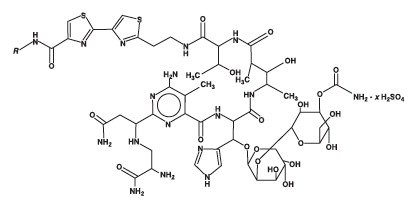
(Main component: Bleomycin A 2 , in which R is [CH 3 ] 2 S + CH 2 CH 2 CH 2 -)
Note: A unit of bleomycin is equal to the formerly used milligram activity. The term milligram activity is a misnomer and was changed to units to be more precise.
CLINICAL PHARMACOLOGY:
Mechanism of Action
Although the exact mechanism of action of bleomycin is unknown, available evidence indicates that the main mode of action is the inhibition of DNA synthesis with some evidence of lesser inhibition of RNA and protein synthesis.
Bleomycin is known to cause single, and to a lesser extent, double-stranded breaks in DNA. In in vitro and in vivo experiments, bleomycin has been shown to cause cell cycle arrest in G2 and in mitosis.
When administered into the pleural cavity in the treatment of malignant pleural effusion, bleomycin acts as a sclerosing agent.
Pharmacokinetics
Absorption
Bleomycin is rapidly absorbed following either intramuscular, subcutaneous, intraperitoneal, or intrapleural administration reaching peak plasma concentrations in 30 to 60 minutes. Systemic bioavailability of bleomycin is 100% and 70% following intramuscular and subcutaneous administrations, respectively, and 45% following both intraperitoneal and intrapleural administrations, compared to intravenous and bolus administration.
Following intramuscular doses of 1 to 10 units/m 2 , both peak plasma concentration and AUC increased in proportion with the increase of dose.
Following intravenous bolus administration of 30 units of bleomycin to one patient with a primary germ cell tumor of the brain, a peak CSF level was 40% of the simultaneously-obtained plasma level and was attained in 2 hours after drug administration. The area under the bleomycin CSF concentration x time curve was 25% of the area of the bleomycin plasma concentration x time curve.
Distribution
Bleomycin is widely distributed throughout the body with a mean volume of distribution of 17.5 L/m 2 in patients following a 15 units/m 2 intravenous bolus dose. Protein binding of bleomycin has not been studied.
Metabolism
Bleomycin is inactivated by a cytosolic cysteine proteinase enzyme, bleomycin hydrolase. The enzyme is widely distributed in normal tissues with the exception of the skin and lungs, both targets of bleomycin toxicity. Systemic elimination of the drug by enzymatic degradation is probably only important in patients with severely compromised renal function.
Excretion
The primary route of elimination is via the kidneys. About 65% of the administered intravenous dose is excreted in urine within 24 hours. In patients with normal renal function, plasma concentrations of bleomycin decline biexponentially with a mean terminal half-life of 2 hours following intravenous bolus administration. Total body clearance and renal clearance averaged 51 mL/min/m 2 and 23 mL/min/m 2 , respectively.
Following intrapleural administration to patients with normal renal function, a lower percentage of drug (40%) is recovered in the urine, as compared to that found in the urine after intravenous administration.
Special Populations
Age, Gender, and Race
The effects of age, gender, and race on the pharmacokinetics of bleomycin have not been evaluated.
Pediatric
Children of less than 3 years of age have higher total body clearance than in adults, 71 mL/min/m 2 versus 51 mL/min/m 2 , respectively, following intravenous bolus administration. Children of more than 8 years of age have comparable clearance as in adults.
In children with normal renal function, plasma concentrations of bleomycin decline biexponentially as in adults. The volume of distribution and terminal half-life of bleomycin in children appears comparable to that in adults.
Renal Insufficiency
Renal insufficiency markedly alters bleomycin elimination. The terminal elimination half-life increases exponentially as the creatinine clearance decreases. Dosing reductions were proposed for patients with creatinine clearance values of <50 mL/min (see PRECAUTIONS and DOSAGE AND ADMINISTRATION ).
Hepatic Insufficiency
The effect of hepatic insufficiency on the pharmacokinetics of bleomycin has not been evaluated.
Drug Interactions
Drugs that Can Affect Renal Clearance
Because bleomycin is eliminated predominantly through renal excretion, the administration of nephrotoxic drugs with bleomycin may affect its renal clearance. Specifically, in one report of 2 children receiving concomitant cisplatin with bleomycin, total body clearance of bleomycin decreased from 39 to 18 mL/min/m 2 as the cumulative dose of cisplatin exceeded 300 mg/m 2 . Terminal half-life of bleomycin also increased from 4.4 to 6 hours. Fatal bleomycin pulmonary toxicity has been reported in a patient with unrecognized cisplatin-induced oliguric renal failure.
Clinical Studies
Malignant Pleural Effusion
The safety and efficacy of bleomycin 60 units and tetracycline (1 g) as treatment for malignant pleural effusion were evaluated in a multicenter, randomized trial. Patients were required to have cytologically positive pleural effusion, good performance status (0,1,2), lung re-expansion following tube thoracostomy with drainage rates of 100 mL/24 hours or less, no prior intrapleural therapy, no prior systemic bleomycin therapy, no chest irradiation, and no recent change in systemic therapy. Overall survival did not differ between the bleomycin (n=44) and tetracycline treatment (n=41) groups. Of patients evaluated within 30 days of instillation, the recurrence rate was 36% (10/28) with bleomycin and 67% (18/27) with tetracycline (p=0.023). Toxicity was similar between groups.
HOW SUPPLIED:
Bleomycin for Injection, USP is available as follows:
| Product No. | NDC No. | |
| 103610 | 63323-136-10 | 15 units per vial, individually packaged. |
| 103720 | 63323-137-20 | 30 units per vial, individually packaged. |
Stability
The sterile powder is stable under refrigeration 2°C to 8°C (36°F to 46°F) and should not be used after the expiration date is reached.
Bleomycin for Injection should not be reconstituted or diluted with D 5 W or other dextrose containing diluents. When reconstituted in D 5 W and analyzed by HPLC, Bleomycin for Injection demonstrates a loss of A 2 and B 2 potency that does not occur when Bleomycin for Injection is reconstituted in Sodium Chloride for Injection, 0.9%, USP.
Bleomycin for Injection is stable for 24 hours at room temperature in Sodium Chloride.
The container closure is not made with natural rubber latex.
