Get your patient on Chlorothiazide Sodium - Chlorothiazide Sodium injection, Powder, Lyophilized, For Solution (Chlorothiazide Sodium)
Chlorothiazide Sodium - Chlorothiazide Sodium injection, Powder, Lyophilized, For Solution prescribing information

INDICATIONS AND USAGE
Chlorothiazide sodium for injection, USP is indicated as adjunctive therapy in edema associated with congestive heart failure, hepatic cirrhosis, and corticosteroid and estrogen therapy.
Chlorothiazide sodium for injection, USP has also been found useful in edema due to various forms of renal dysfunction such as nephrotic syndrome, acute glomerulonephritis, and chronic renal failure.
Use in Pregnancy
Routine use of diuretics during normal pregnancy is inappropriate and exposes mother and fetus to unnecessary hazard. Diuretics do not prevent development of toxemia of pregnancy and there is no satisfactory evidence that they are useful in the treatment of toxemia.
Edema during pregnancy may arise from pathologic causes or from the physiologic and mechanical consequences of pregnancy. Thiazides are indicated in pregnancy when edema is due to pathologic causes, just as they are in the absence of pregnancy (see PRECAUTIONS, Pregnancy ). Dependent edema in pregnancy, resulting from restriction of venous return by the gravid uterus, is properly treated through elevation of the lower extremities and use of support stockings. Use of diuretics to lower intravascular volume in this instance is illogical and unnecessary. During normal pregnancy there is hypervolemia which is not harmful to the fetus or the mother in the absence of cardiovascular disease. However, it may be associated with edema, rarely generalized edema. If such edema causes discomfort, increased recumbency will often provide relief. Rarely this edema may cause extreme discomfort which is not relieved by rest. In these instances, a short course of diuretic therapy may provide relief and be appropriate.
DOSAGE AND ADMINISTRATION
Chlorothiazide sodium for injection, USP should be reserved for patients unable to take oral medication or for emergency situations.
Therapy should be individualized according to patient response. Use the smallest dosage necessary to achieve the required response.
Intravenous use in infants and children has been limited and is not generally recommended.
When medication can be taken orally, therapy with chlorothiazide tablets or oral suspension may be substituted for intravenous therapy, using the same dosage schedule as for the parenteral route.
Chlorothiazide sodium for injection, USP may be given slowly by direct intravenous injection or by intravenous infusion.
Extravasation must be rigidly avoided. Do not give subcutaneously or intramuscularly.
The usual adult dosage is 500 mg to 1 g once or twice a day. Many patients with edema respond to intermittent therapy, i.e., administration on alternate days or on three to five days each week. With an intermittent schedule, excessive response and the resulting undesirable electrolyte imbalance are less likely to occur.
Directions for Reconstitution
Use aseptic technique. Because chlorothiazide sodium for injection, USP contains no preservative, a fresh solution should be prepared immediately prior to each administration, and the unused portion should be discarded.
Add 18 mL of Sterile Water for Injection to the vial to form an isotonic solution for intravenous injection. Never add less than 18 mL. When reconstituted with 18 mL of Sterile Water, the final concentration of chlorothiazide sodium for injection, USP is 28 mg/mL. The reconstituted solution is clear and essentially free from visible particles. Parenteral drug products should be inspected visually for particulate matter and discoloration prior to use whenever solution and container permit. The solution is compatible with dextrose or sodium chloride solutions for intravenous infusion. Avoid simultaneous administration of solutions of chlorothiazide with whole blood or its derivatives.
CONTRAINDICATIONS
Anuria.
Hypersensitivity to any component of this product or to other sulfonamide-derived drugs.
ADVERSE REACTIONS
The following adverse reactions have been reported and, within each category, are listed in order of decreasing severity.
Body as a Whole : Weakness.
Cardiovascular : Hypotension including orthostatic hypotension (may be aggravated by alcohol, barbiturates, narcotics or antihypertensive drugs).
Digestive : Pancreatitis, jaundice (intrahepatic cholestatic jaundice), diarrhea, vomiting, sialadenitis, cramping, constipation, gastric irritation, nausea, anorexia.
Hematologic : Aplastic anemia, agranulocytosis, leukopenia, hemolytic anemia, thrombocytopenia.
Hypersensitivity : Anaphylactic reactions, necrotizing angiitis (vasculitis and cutaneous vasculitis), respiratory distress including pneumonitis and pulmonary edema, photosensitivity, fever, urticaria, rash, purpura.
Metabolic : Electrolyte imbalance (see PRECAUTIONS ), hyperglycemia, glycosuria, hyperuricemia.
Musculoskeletal : Muscle spasm.
Nervous System/Psychiatric : Vertigo, paresthesias, dizziness, headache, restlessness.
Skin : Erythema multiforme including Stevens-Johnson syndrome, exfoliative dermatitis including toxic epidermal necrolysis, alopecia.
Special Senses : Transient blurred vision, xanthopsia.
Renal : Renal failure, renal dysfunction, interstitial nephritis, (see WARNINGS ); hematuria (following intravenous use).
Urogenital : Impotence.
Whenever adverse reactions are moderate or severe, thiazide dosage should be reduced or therapy withdrawn.
To report SUSPECTED ADVERSE REACTIONS, contact American Regent at 1-800-734-9236 or FDA at 1-800-FDA-1088 or www.fda.gov/medwatch .
Drug Interactions
When given concurrently the following drugs may interact with thiazide diuretics.
Alcohol, barbiturates, or narcotics - potentiation of orthostatic hypotension may occur.
Antidiabetic drugs - (oral agents and insulin) - dosage adjustment of the antidiabetic drug may be required.
Other antihypertensive drugs - additive effect or potentiation.
Corticosteroids, ACTH - intensified electrolyte depletion, particularly hypokalemia.
Pressor amines (e.g., norepinephrine) - possible decreased response to pressor amines but not sufficient to preclude their use.
Skeletal muscle relaxants, nondepolarizing (e.g., tubocurarine) - possible increased responsiveness to the muscle relaxant.
Lithium - generally should not be given with diuretics. Diuretic agents reduce the renal clearance of lithium and add a high risk of lithium toxicity. Refer to the package insert for lithium preparations before use of such preparations with chlorothiazide sodium for injection.
Non-steroidal Anti-inflammatory Drugs - In some patients, the administration of a non-steroidal anti-inflammatory agent can reduce the diuretic, natriuretic, and antihypertensive effects of loop, potassium-sparing and thiazide diuretics. Therefore, when chlorothiazide sodium for injection and non-steroidal anti-inflammatory agents are used concomitantly, the patient should be observed closely to determine if the desired effect of the diuretic is obtained.
DESCRIPTION
Chlorothiazide Sodium for Injection, USP is a diuretic and antihypertensive. It is 6-chloro-2 H -1,2,4-benzothiadiazine-7-sulfonamide 1,1-dioxide monosodium salt and its molecular weight is 317.71. Its empirical formula is C 7 H 5 ClN 3 NaO 4 S 2 and its structural formula is:
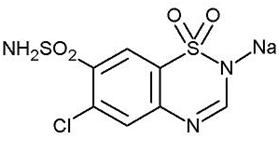
Chlorothiazide Sodium for Injection, USP is a sterile lyophilized white powder and is supplied in a vial containing:
Chlorothiazide Sodium equivalent to Chlorothiazide……………500 mg
Inactive ingredients: Mannitol………………………………………...…………………..250 mg Sodium Hydroxide to adjust pH.
Chlorothiazide is a diuretic and antihypertensive. It is 6-chloro-2 H -1,2,4-benzothiadiazine-7-sulfonamide 1,1-dioxide. Its empirical formula is C 7 H 6 ClN 3 O 4 S 2 and its structural formula is:
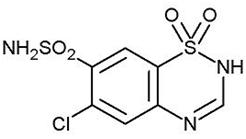
It is a white, or practically white, crystalline powder with a molecular weight of 295.72, which is very slightly soluble in water, but readily soluble in dilute aqueous sodium hydroxide. It is soluble in urine to the extent of about 150 mg per 100 mL at pH 7.
CLINICAL PHARMACOLOGY
The mechanism of the antihypertensive effect of thiazides is unknown. Chlorothiazide sodium for injection does not usually affect normal blood pressure.
Chlorothiazide sodium for injection affects the distal renal tubular mechanism of electrolyte reabsorption. At maximal therapeutic dosage all thiazides are approximately equal in their diuretic efficacy.
Chlorothiazide sodium for injection increases excretion of sodium and chloride in approximately equivalent amounts. Natriuresis may be accompanied by some loss of potassium and bicarbonate.
After oral use diuresis begins within 2 hours, peaks in about 4 hours and lasts about 6 to 12 hours. Following intravenous use of chlorothiazide sodium for injection, onset of the diuretic action occurs in 15 minutes and the maximal action in 30 minutes.
Pharmacokinetics and Metabolism
Chlorothiazide sodium for injection is not metabolized but is eliminated rapidly by the kidney; 96 percent of an intravenous dose is excreted unchanged in the urine within 23 hours. The plasma half-life of chlorothiazide is 45 to 120 minutes. Chlorothiazide crosses the placental but not the blood-brain barrier and is excreted in breast milk.
HOW SUPPLIED
Chlorothiazide Sodium for Injection, USP is a dry, sterile lyophilized white powder usually in plug form, supplied in vials containing Chlorothiazide Sodium equivalent to 500 mg of Chlorothiazide.
Individually boxed NDC 0517-1820-01
Storage
Store lyophilized powder at 20° to 25°C (68° to 77°F) (See USP Controlled Room Temperature).
For single dose only. Use solution immediately after reconstitution (see DOSAGE AND ADMINISTRATION, Directions for Reconstitution ). Discard unused portion of the reconstituted solution.
•• Calculations based on a human body weight of 50 kg.
Revised March 2018 AMERICAN REGENT, INC. SHIRLEY, NY 11967
