Get your patient on Ciprofloxacin Otic - Ciprofloxacin solution/ Drops (Ciprofloxacin)
Ciprofloxacin Otic - Ciprofloxacin solution/ Drops prescribing information

INDICATIONS AND USAGE
Ciprofloxacin otic solution, 0.2% is a quinolone antimicrobial indicated for the treatment of acute otitis externa due to susceptible isolates of Pseudomonas aeruginosa or Staphylococcus aureus .
DOSAGE AND ADMINISTRATION
The contents of one single-dose container (deliverable volume: 0.25 mL) should be instilled into the affected ear twice daily (approximately 12 hours apart) for 7 days.
Wash hands before use. The solution should be warmed, by holding the container in the hands for at least 1 minute, to minimize the dizziness that may result from the instillation of a cold solution into the ear canal. The patient should lie with the affected ear upward and then the solution should be instilled. This position should be maintained for at least 1 minute to facilitate penetration of the drops into the ear. Repeat, if necessary, for the opposite ear. Discard unused portion.
DOSAGE FORMS AND STRENGTHS
Ciprofloxacin otic solution, 0.2% is a sterile, preservative-free, otic solution of ciprofloxacin hydrochloride equivalent to 0.2 % ciprofloxacin (0.5 mg in 0.25 mL) in each single-dose container.
USE IN SPECIFIC POPULATIONS
Pregnancy
Pregnancy Category C.
Reproduction studies have been performed in rats and mice using oral doses of up to 100 mg/kg and intravenous (IV) doses up to 30 mg/kg and have revealed no evidence of harm to the fetus as a result of ciprofloxacin. In rabbits, ciprofloxacin (30 and 100 mg/kg orally) produced gastrointestinal disturbances resulting in maternal weight loss and an increased incidence of abortion, but no teratogenicity was observed at either dose. After intravenous administration of doses up to 20 mg/kg, no maternal toxicity was produced in the rabbit, and no embryotoxicity or teratogenicity was observed.
Animal reproduction studies have not been conducted with ciprofloxacin otic solution, 0.2%. No adequate and well controlled studies have been performed in pregnant women. Caution should be exercised when ciprofloxacin otic solution, 0.2% is used by a pregnant woman.
Nursing Mothers
Ciprofloxacin is excreted in human milk with systemic use. It is not known whether ciprofloxacin is excreted in human milk following otic use. Because of the potential for serious adverse reactions in nursing infants, a decision should be made whether to discontinue nursing or to discontinue the drug, taking into account the importance of the drug to the mother.
Pediatric Use
The safety and effectiveness of ciprofloxacin otic solution, 0.2% in infants below one year of age have not been established. The efficacy of ciprofloxacin otic solution, 0.2% in treating otitis externa in pediatric patients one year or older has been demonstrated in controlled clinical trials (see Section 14 Clinical Studies ).
There is no evidence that the otic administration of quinolones has any effect on weight bearing joints, even though systemic administration of some quinolones has been shown to cause arthropathy in immature animals.
Geriatric Use
No overall differences in safety and effectiveness have been observed between elderly and younger patients.
CONTRAINDICATIONS
Ciprofloxacin otic solution, 0.2% is contraindicated in persons with a history of hypersensitivity to ciprofloxacin.
WARNINGS AND PRECAUTIONS
Ciprofloxacin otic solution, 0.2% is for otic use only. (5.1 )
Hypersensitivity: discontinue at the first appearance of a skin rash or any other sign of hypersensitivity. (5.2 )
Use of ciprofloxacin otic solution, 0.2% may result in overgrowth of nonsusceptible organisms. (5.3 )
Otic Use Only
Ciprofloxacin otic solution, 0.2% is for otic use only. It should not be used for injection, for inhalation or for topical ophthalmic use.
Hypersensitivity
Ciprofloxacin otic solution, 0.2% should be discontinued at the first appearance of a skin rash or any other sign of hypersensitivity.
Growth of Rsistant Organisms with Prolonged Use
As with other anti-infectives, use of ciprofloxacin otic solution, 0.2% may result in overgrowth of nonsusceptible organisms, including yeast and fungi. If super-infection occurs, discontinue use and institute alternative therapy.
Lack of Clinical Response
If the infection is not improved after one week of therapy, cultures may help guide further treatment.
ADVERSE REACTIONS
Because clinical studies are conducted under widely varying conditions, adverse drug reaction rates observed in the clinical studies of a drug cannot be directly compared to rates in the clinical studies of another drug and may not reflect the rates observed in clinical practice.
In a randomized, active-controlled clinical trial, approximately 300 patients with clinical signs and symptoms of otitis externa were treated with ciprofloxacin otic solution, 0.2%. The most frequently reported adverse reactions were application site pain, ear pruritus, fungal ear superinfection, and headache, each reported in approximately 2-3% of patients.
DESCRIPTION
Ciprofloxacin otic solution, 0.2% contains the synthetic antimicrobial agent ciprofloxacin hydrochloride. Ciprofloxacin otic solution, 0.2% is a sterile, preservative-free solution for otic use. Each single-dose container of ciprofloxacin otic solution, 0.2% delivers 0.25 mL of solution equivalent to 0.5 mg of ciprofloxacin. The inactive ingredients are povidone, glycerin, and water for injection. Sodium hydroxide and/or lactic acid may be added to adjust pH.
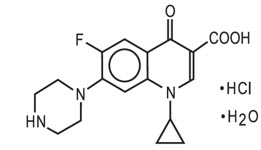
Ciprofloxacin, a fluroquinolone is available as the monohydrochloride, monohydrate salt of 1cyclopropyl-6-fluoro-1,4-dihydro-4-oxo-7-(1-piperazinyl)-3-quinolinecarboxylic acid. Its molecular formula is C 17 H 18 FN 3 O 3 ∙HCl∙H 2 O, and molecular weight is 385.82.
The chemical structure of ciprofloxacin hydrochloride is:
CLINICAL PHARMACOLOGY
Mechanism of Action
Ciprofloxacin is a fluoroquinolone antimicrobial (see 12.4 Clinical Pharmacology, Microbiology ).
Pharmacokinetics
The plasma concentrations of ciprofloxacin were not measured following administration of 0.25 mL ciprofloxacin otic solution, 0.2% (total dose: 0.5 mg ciprofloxacin). However, the maximum plasma concentration of ciprofloxacin is anticipated to be less than 5 ng/mL.
Microbiology
The bactericidal action of ciprofloxacin results from interference with the enzyme DNA gyrase, which is needed for the synthesis of bacterial DNA.
Bacterial resistance to quinolones can develop through chromosomally- or plasmid-mediated mechanisms.
The mechanism of action of fluoroquinolones, including ciprofloxacin, is different from that of macrolides. Therefore, ciprofloxacin may be active against pathogens that are resistant to these antibiotics, and these antibiotics may be active against pathogens that are resistant to ciprofloxacin. In vitro studies demonstrated cross-resistance between ciprofloxacin and some fluoroquinolones.
Ciprofloxacin has been shown to be active against most isolates of the following bacteria, both in vitro and in clinical infections of acute otitis externa as described in Section 1 Indications and Usage.
| Staphylococcus aureus | Pseudomonas aeruginosa . |
NONCLINICAL TOXICOLOGY
Carcinogenesis, Mutagenesis, and Impairment of Fertility
Long-term carcinogenicity studies in mice and rats have been completed for ciprofloxacin. After daily oral doses of 750 mg/kg (mice) and 250 mg/kg (rats) were administered for up to 2 years, there was no evidence that ciprofloxacin had any carcinogenic or tumorigenic effects in these species. No long-term studies of ciprofloxacin otic solution, 0.2% have been performed to evaluate carcinogenic potential.
Eight in vitro mutagenicity tests have been conducted with ciprofloxacin, and the test results are listed below:
- Salmonella/ Microsome Test (Negative)
- Escherichia coli DNA Repair Assay (Negative)
- Mouse Lymphoma Cell Forward Mutation Assay (Positive)
- Chinese Hamster V79 Cell HGPRT Test (Negative)
- Syrian Hamster Embryo Cell Transformation Assay (Negative)
- Saccharomyces cerevisiae Point Mutation Assay (Negative)
- Saccharomyces cerevisiae Mitotic Crossover and Gene Conversion Assay (Negative)
- Rat Hepatocyte DNA Repair Assay (Positive).
Two of the 8 in vitro tests were positive, but results of the following 3 in vivo test systems gave negative results:
- Rat Hepatocyte DNA Repair Assay
- Micronucleus Test (Mice)
- Dominant Lethal Test (Mice).
Fertility studies performed in rats at oral doses of ciprofloxacin up to 100 mg/kg/day revealed no evidence of impairment. This would be over 100 times the maximum recommended clinical dose of ototopical ciprofloxacin based upon body surface area, assuming total absorption of ciprofloxacin from the ear of a patient treated with ciprofloxacin otic solution, 0.2% twice per day.
CLINICAL STUDIES
In a randomized, multi-center, evaluator-blinded study of patients with acute otitis externa, patients were treated with either ciprofloxacin otic solution, 0.2% twice daily or neomycin and polymyxin B sulfates and hydrocortisone otic solution (PNH) three times daily for 7 days.
In the per protocol population, clinical cure was achieved at the end of a 7-day treatment in 70% (173/247) for the ciprofloxacin otic solution, 0.2% treated group versus 60% (147/243) for the control treated group.
HOW SUPPLIED/STORAGE AND HANDLING
Ciprofloxacin otic solution, 0.2% is a clear, colorless, sterile, preservative-free solution. Ciprofloxacin otic solution, 0.2% is supplied as a 0.2% otic solution in a low-density polyethylene (LDPE) single-dose container. Each single-dose container delivers 0.25 mL of solution equivalent to 0.5 mg of ciprofloxacin; 14 single-dose containers are packaged in a foil overwrap pouch in a carton (NDC 64950-381-14).
Store at 15°C to 25°C (59°F to 77°F). Discard used containers. Store unused containers in pouch to protect from light.
Mechanism of Action
Ciprofloxacin is a fluoroquinolone antimicrobial (see 12.4 Clinical Pharmacology, Microbiology ).
