Get your patient on Clobetasol Propionate - Clobetasol Propionate cream (Clobetasol Propionate)
Clobetasol Propionate - Clobetasol Propionate cream prescribing information

INDICATIONS AND USAGE:
Clobetasol propionate cream is a super-high potency corticosteroid formulations indicated for the relief of the inflammatory and pruritic manifestations of corticosteroid-responsive dermatoses. Treatment beyond 2 consecutive weeks is not recommended, and the total dosage should not exceed 50 g/week because of the potential for the drug to suppress the hypothalamic-pituitary-adrenal (HPA) axis. Use in pediatric patients under 12 years of age is not recommended.
As with other highly active corticosteroids, therapy should be discontinued when control has been achieved. If no improvement is seen within 2 weeks, reassessment of the diagnosis may be necessary.
DOSAGE AND ADMINISTRATION:
Apply a thin layer of clobetasol propionate cream to the affected skin areas twice daily and rub in gently and completely (see INDICATIONS AND USAGE ).
Clobetasol propionate cream are super-high potency topical corticosteroids; therefore, treatment should be limited to 2 consecutive weeks and amounts greater than 50 g/week should not be used.
As with other highly active corticosteroids, therapy should be discontinued when control has been achieved. If no improvement is seen within 2 weeks, reassessment of diagnosis may be necessary.
Clobetasol propionate cream should not be used with occlusive dressings.
Geriatric Use:
In studies where geriatric patients (65 years of age or older, see PRECAUTIONS ) have been treated with clobetasol propionate cream, safety did not differ from that in younger patients; therefore, no dosage adjustment is recommended.
CONTRAINDICATIONS:
Clobetasol propionate cream is contraindicated in those patients with a history of hypersensitivity to any of the components of the preparations.
ADVERSE REACTIONS:
In controlled clinical trials, the most frequent adverse reactions reported for clobetasol propionate cream were burning and stinging sensation in 1% of treated patients. Less frequent adverse reactions were itching, skin atrophy, and cracking and fissuring of the skin.
Cushing’s syndrome has been reported in infants and adults as a result of prolonged use of topical clobetasol propionate formulations.
The following additional local adverse reactions have been reported with topical corticosteroids, and they may occur more frequently with the use of occlusive dressings and higher potency corticosteroids. These reactions are listed in an approximately decreasing order of occurrence: dryness, acneiform eruptions, hypopigmentation, perioral dermatitis, allergic contact dermatitis, secondary infection, irritation, striae, and miliaria.
DESCRIPTION:
Clobetasol Propionate Cream USP, 0.05% contains the active compound clobetasol propionate, USP, a synthetic corticosteroid, for topical dermatologic use. Clobetasol, an analog of prednisolone, has a high degree of glucocorticoid activity and a slight degree of mineralocorticoid activity.
Chemically, clobetasol propionate, USP is 21-chloro-9-fluoro- 11β,17-dihydroxy-16β-methylpregna-1,4-diene-3,20-dione 17-propionate, and it has the following structural formula:
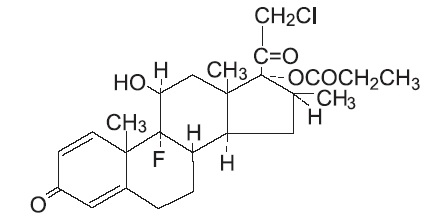
Clobetasol propionate, USP has the molecular formula C 25 H 32 CIFO 5 and a molecular weight of 466.97 g/mol. It is a white to almost white, crystalline powder, practically insoluble in water, slightly soluble in benzene and diethyl ether; sparingly soluble in ethanol; freely soluble in acetone, in dimethylsulfoxide, in chloroform, in methanol and in dioxane.
Clobetasol Propionate Cream USP, 0.05% contains clobetasol propionate, USP 0.5 mg/g in a cream base composed of cetostearyl alcohol, chlorocresol, citric acid monohydrate, glyceryl monostearate, glyceryl stearate and PEG 100 stearate, propylene glycol, purified water, sodium citrate anhydrous and white wax.
CLINICAL PHARMACOLOGY:
Like other topical corticosteroids, clobetasol propionate has anti-inflammatory, antipruritic, and vasoconstrictive properties. The mechanism of the anti-inflammatory activity of the topical steroids, in general, is unclear. However, corticosteroids are thought to act by the induction of phospholipase A 2 inhibitory proteins, collectively called lipocortins. It is postulated that these proteins control the biosynthesis of potent mediators of inflammation such as prostaglandins and leukotrienes by inhibiting the release of their common precursor, arachidonic acid. Arachidonic acid is released from membrane phospholipids by phospholipase A 2 .
Pharmacokinetics:
The extent of percutaneous absorption of topical corticosteroids is determined by many factors, including the vehicle and the integrity of the epidermal barrier. Occlusive dressing with hydrocortisone for up to 24 hours has not been demonstrated to increase penetration; however, occlusion of hydrocortisone for 96 hours markedly enhances penetration. Topical corticosteroids can be absorbed from normal intact skin. Inflammation and/or other disease processes in the skin may increase percutaneous absorption.
Studies performed with clobetasol propionate cream indicate that they are in the super-high range of potency as compared with other topical corticosteroids.
HOW SUPPLIED:
Clobetasol Propionate Cream USP, 0.05% is supplied in 15 g tubes (NDC 68462-529-17), 30 g tubes (NDC 68462-529-35), 45 g tubes (NDC 68462-529-47) and 60 g tubes (NDC 68462-529-65).
Store at 20°C to 25°C (68°F to 77°F); excursions permitted to 15°C to 30°C (59°F to 86°F) [see USP Controlled Room Temperature].
Do not refrigerate and avoid freezing .
Rx only
Distributed by:

Glenmark Pharmaceuticals Inc., USA Elmwood Park, NJ 07407
Questions? 1 (888) 721-7115 www.glenmarkpharma-us.com
April 2025
