Get your patient on Desipramine Hydrochloride - Desipramine Hydrochloride tablet (Desipramine Hydrochloride)
Desipramine Hydrochloride - Desipramine Hydrochloride tablet prescribing information

Suicidality and Antidepressant Drugs
Antidepressants increased the risk compared to placebo of suicidal thinking and behavior (suicidality) in children, adolescents, and young adults in short-term studies of major depressive disorder (MDD) and other psychiatric disorders. Anyone considering the use of desipramine hydrochloride tablets or any other antidepressant in a child, adolescent, or young adult must balance this risk with the clinical need. Short-term studies did not show an increase in the risk of suicidality with antidepressants compared to placebo in adults beyond age 24; there was a reduction in risk with antidepressants compared to placebo in adults aged 65 and older. Depression and certain other psychiatric disorders are themselves associated with increases in the risk of suicide. Patients of all ages who are started on antidepressant therapy should be monitored appropriately and observed closely for clinical worsening, suicidality, or unusual changes in behavior. Families and caregivers should be advised of the need for close observation and communication with the prescriber. Desipramine hydrochloride is not approved for use in pediatric patients ( See WARNINGS: Clinical Worsening and Suicide Risk , PRECAUTIONS: Information for Patients , and PRECAUTIONS: Pediatric Use .)
INDICATIONS AND USAGE
Desipramine hydrochloride tablets is indicated for the treatment of depression.
DOSAGE AND ADMINISTRATION
Not recommended for use in children ( see WARNINGS ).
Lower dosages are recommended for elderly patients and adolescents. Lower dosages are also recommended for outpatients compared to hospitalized patients, who are closely supervised. Dosage should be initiated at a low level and increased according to clinical response and any evidence of intolerance. Following remission, maintenance medication may be required for a period of time and should be at the lowest dose that will maintain remission.
Usual Adult Dose
The usual adult dose is 100 to 200 mg per day. In more severely ill patients, dosage may be further increased gradually to 300 mg/day if necessary. Dosages above 300 mg/day are not recommended.
Dosage should be initiated at a lower level and increased according to tolerance and clinical response.
Treatment of patients requiring as much as 300 mg should generally be initiated in hospitals, where regular visits by the physician, skilled nursing care, and frequent electrocardiograms (ECGs) are available.
The best available evidence of impending toxicity from very high doses of desipramine hydrochloride is prolongation of the QRS or QT intervals on the ECG. Prolongation of the PR interval is also significant, but less closely correlated with plasma levels. Clinical symptoms of intolerance, especially drowsiness, dizziness, and postural hypotension, should also alert the physician to the need for reduction in dosage.
Initial therapy may be administered in divided doses or a single daily dose.
Maintenance therapy may be given on a once-daily schedule for patient convenience and compliance .
Adolescent and Geriatric Dose
The usual adolescent and geriatric dose is 25 to 100 mg daily.
Dosage should be initiated at a lower level and increased according to tolerance and clinical response to a usual maximum of 100 mg daily. In more severely ill patients, dosage may be further increased to 150 mg/day. Doses above 150 mg/day are not recommended in these age groups.
Initial therapy may be administered in divided doses or a single daily dose.
Maintenance therapy may be given on a once-daily schedule for patient convenience and compliance.
Switching a Patient To or From a Monoamine Oxidase Inhibitor (MAOI) Intended to Treat Psychiatric Disorders: At least 14 days should elapse between discontinuation of an MAOI intended to treat psychiatric disorders and initiation of therapy with desipramine hydrochloride. Conversely, at least 14 days should be allowed after stopping desipramine hydrochloride before starting an MAOI intended to treat psychiatric disorders (see CONTRAINDICATIONS ).
Use of desipramine hydrochloride With Other MAOI's, Such as Linezolid or Methylene Blue:
Do not start desipramine hydrochloride in a patient who is being treated with linezolid or intravenous methylene blue because there is increased risk of serotonin syndrome. In a patient who requires more urgent treatment of a psychiatric condition, other interventions, including hospitalization, should be considered (see CONTRAINDICATIONS ).
In some cases, a patient already receiving desipramine hydrochloride therapy may require urgent treatment with linezolid or intravenous methylene blue. If acceptable alternatives to linezolid or intravenous methylene blue treatment are not available and the potential benefits of linezolid or intravenous methylene blue treatment are judged to outweigh the risks of serotonin syndrome in a particular patient, Desipramine hydrochloride should be stopped promptly, and linezolid or intravenous methylene blue can be administered. The patient should be monitored for symptoms of serotonin syndrome for 2 weeks or until 24 hours after the last dose of linezolid or intravenous methylene blue, whichever comes first. Therapy with desipramine hydrochloride may be resumed 24 hours after the last dose of linezolid or intravenous methylene blue (see WARNINGS ).
The risk of administering methylene blue by non-intravenous routes (such as oral tablets or by local injection) or in intravenous doses much lower than 1 mg/kg with desipramine hydrochloride is unclear. The clinician should, nevertheless, be aware of the possibility of emergent symptoms of serotonin syndrome with such use (see WARNINGS ).
CONTRAINDICATIONS
The use of MAOIs intended to treat psychiatric disorders with desipramine hydrochloride or within 14 days of stopping treatment with desipramine hydrochloride is contraindicated because of an increased risk of serotonin syndrome. The use of desipramine hydrochloride within 14 days of stopping an MAOI intended to treat psychiatric disorders is also contraindicated ( see WARNINGS and DOSAGE AND ADMINISTRATION ).
Starting desipramine hydrochloride in a patient who is being treated with MAOIs such as linezolid or intravenous methylene blue is also contraindicated because of an increased risk of serotonin syndrome (see WARNINGS and DOSAGE AND ADMINISTRATION ).
Desipramine hydrochloride is contraindicated in the acute recovery period following myocardial infarction. It should not be used in those who have shown prior hypersensitivity to the drug. Cross-sensitivity between this and other dibenzazepines is a possibility.
ADVERSE REACTIONS
Included in the following listing are a few adverse reactions that have not been reported with this specific drug. However, the pharmacologic similarities among the tricyclic antidepressant drugs require that each of the reactions be considered when desipramine hydrochloride is given.
Cardiovascular: Hypotension, hypertension, palpitations, heart block, myocardial infarction, stroke, arrhythmias, premature ventricular contractions, tachycardia, ventricular tachycardia, ventricular fibrillation, sudden death
There has been a report of an "acute collapse" and "sudden death" in an 8-year-old (18 kg) male, treated for 2 years for hyperactivity.
There have been additional reports of sudden death in children ( See PRECAUTIONS- Pediatric Use )
Psychiatric: Confusional states (especially in the elderly) with hallucinations, disorientation, delusions; anxiety, restlessness, agitation; insomnia and nightmares; hypomania; exacerbation of psychosis
Neurologic: Numbness, tingling, paresthesias of extremities; incoordination, ataxia, tremors; peripheral neuropathy; extrapyramidal symptoms; seizures; alterations in EEG patterns; tinnitus .
Symptoms attributed to Neuroleptic Malignant Syndrome have been reported during desipramine use with and without concomitant neuroleptic therapy.
Anticholinergic: Dry mouth, and rarely associated sublingual adenitis; blurred vision, disturbance of accommodation, mydriasis, increased intraocular pressure; constipation, paralytic ileus; urinary retention, delayed micturition, dilation of urinary tract
Allergic: Skin rash, petechiae, urticaria, itching, photosensitization (avoid excessive exposure to sunlight), edema (of face and tongue or general), drug fever, cross- sensitivity with other tricyclic drugs
Hematologic: Bone marrow depressions including agranulocytosis, eosinophilia, purpura, thrombocytopenia
Gastrointestinal: Anorexia, nausea and vomiting, epigastric distress, peculiar taste, abdominal cramps, diarrhea, stomatitis, black tongue, hepatitis, jaundice (simulating obstructive), altered liver function, elevated liver function tests, increased pancreatic enzymes
Endocrine: Gynecomastia in the male, breast enlargement and galactorrhea in the female; increased or decreased libido, impotence, painful ejaculation, testicular swelling; elevation or depression of blood sugar levels; syndrome of inappropriate antidiuretic hormone secretion (SIADH)
Other: Weight gain or loss; perspiration, flushing; urinary frequency, nocturia; parotid swelling; drowsiness, dizziness, proneness to falling, weakness and fatigue, headache; fever; alopecia; elevated alkaline phosphatase
Withdrawal Symptoms: Though not indicative of addiction, abrupt cessation of treatment after prolonged therapy may produce nausea, headache, and malaise.
To report SUSPECTED ADVERSE REACTIONS, contact Chartwell RX, LLC. at 1-845-232-1683 or FDA at 1-800-FDA-1088 or www.fda.gov/medwatch.
DESCRIPTION
Desipramine hydrochloride, USP is an antidepressant drug of the tricyclic type, and is chemically: 5H-Dibenz [bƒ] azepine-5-propanamine,10,11-dihydro-N-methyl-, monohydrochloride.
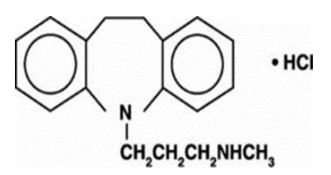
Each desipramine hydrochloride, USP tablet contains 10 mg, 25 mg, 50 mg, 75 mg, 100 mg, or 150 mg of desipramine hydrochloride for oral administration.
Inactive Ingredients The following inactive ingredients are contained in all dosage strengths: Hypromellose, lactose monohydrate, microcrystalline cellulose, polyethylene glycol, sodium starch glycolate type A (potato), stearic acid, talc and titanium dioxide.
CLINICAL PHARMACOLOGY
Mechanism of Action
Available evidence suggests that many depressions have a biochemical basis in the form of a relative deficiency of neurotransmitters such as norepinephrine and serotonin.
Norepinephrine deficiency may be associated with relatively low urinary 3-methoxy-4- hydroxyphenyl glycol (MHPG) levels, while serotonin deficiencies may be associated with low spinal fluid levels of 5-hydroxyindoleacetic acid.
While the precise mechanism of action of the tricyclic antidepressants is unknown, a leading theory suggests that they restore normal levels of neurotransmitters by blocking the re-uptake of these substances from the synapse in the central nervous system.
Evidence indicates that the secondary amine tricyclic antidepressants, including desipramine hydrochloride, may have greater activity in blocking the re-uptake of norepinephrine. Tertiary amine tricyclic antidepressants, such as amitriptyline, may have greater effect on serotonin re-uptake.
Desipramine hydrochloride is not a monoamine oxidase inhibitor (MAOI) and does not act primarily as a central nervous system stimulant. It has been found in some studies to have a more rapid onset of action than imipramine. Earliest therapeutic effects may occasionally be seen in 2 to 5 days, but full treatment benefit usually requires 2 to 3 weeks to obtain.
Metabolism
Tricyclic antidepressants, such as desipramine hydrochloride, are rapidly absorbed from the gastrointestinal tract. Tricyclic antidepressants or their metabolites are to some extent excreted through the gastric mucosa and reabsorbed from the gastrointestinal tract. Desipramine is metabolized in the liver, and approximately 70% is excreted in the urine.
The rate of metabolism of tricyclic antidepressants varies widely from individual to individual, chiefly on a genetically determined basis. Up to a 36-fold difference in plasma level may be noted among individuals taking the same oral dose of desipramine. The ratio of 2-hydroxydesipramine to desipramine may be increased in the elderly, most likely due to decreased renal elimination with aging.
Certain drugs, particularly the psychostimulants and the phenothiazines, increase plasma levels of concomitantly administered tricyclic antidepressants through competition for the same metabolic enzyme systems. Concurrent administration of cimetidine and tricyclic antidepressants can produce clinically significant increases in the plasma concentrations of the tricyclic antidepressants. Conversely, decreases in plasma levels of the tricyclic antidepressants have been reported upon discontinuation of cimetidine, which may result in the loss of the therapeutic efficacy of the tricyclic antidepressant. Other substances, particularly barbiturates and alcohol, induce liver enzyme activity and thereby reduce tricyclic antidepressant plasma levels. Similar effects have been reported with tobacco smoke.
Research on the relationship of plasma level to therapeutic response with the tricyclic antidepressants has produced conflicting results. While some studies report no correlation, many studies cite therapeutic levels for most tricyclics in the range of 50 to 300 nanograms per milliliter. The therapeutic range is different for each tricyclic antidepressant. For desipramine, an optimal range of therapeutic plasma levels has not been established.
HOW SUPPLIED
Desipramine hydrochloride tablets, USP for oral administration are available as:
10 mg: white to off white, rounded square shape, biconvex, coated tablets with 'N6' debossed on one side and plain on other side.
NDC 62135-593-12: bottles of 120
25 mg: white to off white, round biconvex, coated tablets with 'I86' debossed on one side and plain on other side.
NDC 62135-594-12: bottles of 120
50 mg: white to off white, round biconvex, coated tablets with 'I82' debossed on one side and plain on other side.
NDC 62135-595-12: bottles of 120
75 mg: white to off white, round biconvex, coated tablets with 'I83' debossed on one side and plain on other side.
NDC 62135-597-12: bottles of 120
100 mg: white to off white, round biconvex, coated tablets with 'I84' debossed on one side and plain on other side.
NDC 62135-598-30: bottles of 30
150 mg: white to off white, round biconvex, coated tablets with 'I85' debossed on one side and plain on other side.
NDC 62135-599-30: bottles of 30
Store at 20°-25°C (68°-77°F); [see USP Controlled Room Temperature]. Protect from excessive heat. Dispense in tight container with child-resistant closure.
Manufactured B y:
USV Private Limited
Daman - 396210, India
Manufactured For:
Chartwell RX, LLC.
Congers, NY 10920
Revised: 04/2023
L71458
