Get your patient on Diphenhydramine Hydrochloride - Diphenhydramine Hydrochloride solution (Diphenhydramine Hydrochloride)
Diphenhydramine Hydrochloride - Diphenhydramine Hydrochloride solution prescribing information

INDICATIONS AND USAGE
Diphenhydramine hydrochloride in the oral form is effective for the following indications:
Antihistaminic
For allergic conjunctivitis due to foods; mild, uncomplicated allergic skin manifestations of urticaria and angioedema; amelioration of allergic reactions to blood or plasma; dermatographism; as therapy for anaphylactic reactions adjunctive to epinephrine and other standard measures after the acute manifestations have been controlled.
Motion Sickness
For active and prophylactic treatment of motion sickness.
Antiparkinsonism
For parkinsonism (including drug-induced) in the elderly unable to tolerate more potent agents; mild cases of parkinsonism (including drug-induced) in other age groups; in other cases of parkinsonism (including drug-induced) in combination with centrally acting anticholinergic agents.
Nighttime Sleep-aid.
DOSAGE AND ADMINISTRATION
DOSAGE SHOULD BE INDIVIDUALIZED ACCORDING TO THE NEEDS AND THE RESPONSE OF THE PATIENT.
A single oral dose of diphenhydramine hydrochloride is quickly absorbed with maximum activity occurring in approximately one hour. The duration of activity following an average dose of diphenhydramine hydrochloride is from four to six hours.
Adults
25 to 50 mg three to four times daily. The nightime sleep aid dosage is 50 mg at bedtime.
Pediatric Patients, other than premature infants and neonates
12.5 to 25 mg three or four times daily. Maximum daily dosage not to exceed 300 mg. For physicians who wish to calculate the dose on the basis of body weight or surface area, the recommended dosage is 5 mg/kg/24 hours or 150 mg/m2/24 hours.
Data are not available on the use of diphenhydramine hydrochloride as a nighttime sleep-aid in children under 12 years.
The basis for determining the most effective dosage regimen will be the response of the patient to medication and the condition under treatment.
In motion sickness, full dosage is recommended for prophylactic use, the first dose to be given 30 minutes before exposure to motion and similar doses before meals and upon retiring for the duration of exposure
CONTRAINDICATIONS
Use in Neonates or Premature Infants
This drug should not be used in neonates or premature infants.
Use in Nursing Mothers
Because of the higher risk of antihistamines for infants generally, and for neonates and prematures in particular, antihistamine therapy is contraindicated in nursing mothers.
Antihistamines are also contraindicated in the following conditions
Hypersensitivity to diphenhydramine hydrochloride and other antihistamines of similar chemical structure.
ADVERSE REACTIONS
The most frequent adverse reactions are underscored.
- General: Urticaria, drug rash, anaphylactic shock, photosensitivity, excessive perspiration, chills, dryness of the mouth, nose and throat.
- Cardiovascular System: Hypotension, headache, palpitations, tachycardia, extrasystoles.
- Hematologic System: Hemolytic anemia, thrombocytopenia, agranulocytosis.
- Nervous System: Sedation, sleepiness, dizziness, disturbed coordination , fatigue, confusion, restlessness, excitation, nervousness, tremor, irritability, insomnia, euphoria, paresthesia, blurred vision, diplopia, vertigo, tinnitus, acute labyrinthitis, neuritis, convulsions.
- GI System: Epigastric distress , anorexia, nausea, vomiting, diarrhea, constipation.
- GU System: Urinary frequency, difficult urination, urinary retention, early menses.
- Respiratory System: Thickening of bronchial secretions , tightness of chest or throat and wheezing, nasal stuffiness.
To report SUSPECTED ADVERSE REACTIONS, contact Pharmaceutical Associates, Inc. at 1-800-845-8210 of FDA at 1-800-FDA-1088 or www.fda.gov/medwatch .
Drug Interactions
Diphenhydramine hydrochloride has additive effects with alcohol and other CNS depressants (hypnotics, sedatives, tranquilizers, etc.). MAO inhibitors prolong and intensify the anticholinergic (drying) effects of antihistamines.
DESCRIPTION
Diphenhydramine hydrochloride is an antihistamine drug having the chemical name 2-(diphenylmethoxy)-N,N -dimethylethylamine hydrochloride and has the molecular formula C 17 H 21 NO•HCI (molecular weight 291.82). It occurs as a white odorless, crystalline powder and is freely soluble in water and alcohol. The structural formula is as follows:
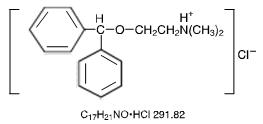
Each 5 mL contains 12.5 mg of diphenhydramine hydrochloride and alcohol 14% for oral administration. Inactive Ingredients: Citric acid, D&C Red No. 33, FD&C Red No. 40, flavoring, purified water, sodium citrate, and sucrose.
CLINICAL PHARMACOLOGY
Diphenhydramine hydrochloride is an antihistamine with anticholinergic (drying) and sedative effects. Antihistamines appear to compete with histamine for cell receptor sites on effector cells.
A single oral dose of diphenhydramine hydrochloride is quickly absorbed with maximum activity occurring in approximately one hour. The duration of activity following an average dose of diphenhydramine hydrochloride is from four to six hours. Diphenhydramine is widely distributed throughout the body, including the CNS. Little, if any, is excreted unchanged in the urine; most appears as the degradation products of metabolic transformation in the liver, which are almost completely excreted within 24 hours.
HOW SUPPLIED
Each 5 mL of Diphenhydramine Hydrochloride Oral Solution USP (clear purple/red liquid, cinnamon/anise flavor) contains 12.5 mg diphenhydramine hydrochloride with 14% alcohol and is supplied in the following oral dosage forms:
NDC 0121-0489-05: 5 mL unit dose cup
NDC 0121-0489-00: Case contains 100 unit dose cups of 5 mL (0121-0489-05) packaged in 10 trays of 10 unit dose cups each.
NDC 0121-0978-10: 10 mL unit dose cup
NDC 0121-0978-00: Case contains 100 unit dose cups of 10 mL (0121-0978-10) packaged in 10 trays of 10 unit dose cups each.
