Get your patient on Enroflox (Enrofloxacin)
Enroflox prescribing information

INDICATIONS:
Enroflox ® Chewable Tablets (enrofloxacin) are indicated for the management of diseases associated with bacteria susceptible to enrofloxacin. Enroflox Chewable Tablets are indicated for use in dogs and cats.
DOSAGE AND ADMINISTRATION:
Dogs : Administer orally at a rate to provide 5-20 mg/kg (2.27 to 9.07 mg/lb) of body weight. Selection of a dose within the range should be based on clinical experience, the severity of disease, and susceptibility of the pathogen. Animals which receive doses in the upper-end of the dose range should be carefully monitored for clinical signs that may include inappetence, depression, and vomition.
| Weight of Dog | Once Daily Dosing Chart | |||
| 5.0 mg/kg | 10.0 mg/kg | 15.0 mg/kg | 20.0 mg/kg | |
| 9.1 kg (20 lb) | 2 x 22.7 mg tablets | 1 x 22.7 mg plus 1 x 68 mg tablets | 1 x 136 mg tablet | 1 x 136 mg plus 2 x 22.7 mg tablets |
| 27.2 kg (60 lb) | 1 x 136 mg tablet | 2 x 136 mg tablets | 3 x 136 mg tablets | 4 x 136 mg tablets |
All tablet sizes are double scored for accurate dosing.
Cats : Administer orally at 5 mg/kg (2.27 mg/lb) of body weight. The dose for dogs and cats may be administered either as a single daily dose or divided into two (2) equal daily doses administered at twelve (12) hour intervals. The dose should be continued for at least 2-3 days beyond cessation of clinical signs, to a maximum of 30 days.
| Weight of Cat | Once Daily Dosing Chart (5 mg/kg/day) |
| 5 lb (2.27 kg) | 1/2 x 22.7 mg tablet |
| 10 lb (4.5 kg) | 1 x 22.7 mg tablet |
| 15 lb (6.8 kg) | 1 and 1/2 x 22.7 mg tablets or 1/2 x 68 mg tablet |
All tablet sizes are double scored for accurate dosing.
Dogs & Cats: The duration of treatment should be selected based on clinical evidence. Generally, administration of Enroflox Chewable Tablets (enrofloxacin) should continue for at least 2-3 days beyond cessation of clinical signs. For severe and/or complicated infections, more prolonged therapy, up to 30 days, may be required. If no improvement is seen within five days, the diagnosis should be reevaluated and a different course of therapy considered.
The lower limit of the dose range in dogs and the daily dose for cats was based on efficacy studies in dogs and cats where enrofloxacin was administered at 2.5 mg/kg twice daily. Target animal safety and toxicology were used to establish the upper limit of the dose range for dogs and treatment duration for dogs and cats.
CONTRAINDICATIONS:
Enrofloxacin is contraindicated in dogs and cats known to be hypersensitive to quinolones.
Dogs : Based on the studies discussed under the section on Animal Safety Summary, the use of enrofloxacin is contraindicated in small and medium breeds of dogs during the rapid growth phase (between 2 and 8 months of age). The safe use of enrofloxacin has not been established in large and giant breeds during the rapid growth phase.
Large breeds may be in this phase for up to one year of age and the giant breeds for up to 18 months. In clinical field trials utilizing a daily oral dose of 5.0 mg/kg, there were no reports of lameness or joint problems in any breed. However, controlled studies with histological examination of the articular cartilage have not been conducted in the large or giant breeds.
ADVERSE REACTIONS:
Dogs : Two of the 270 (0.7%) dogs treated with enrofloxacin tablets at 5.0 mg/kg per day in the clinical field studies exhibited side effects, which were apparently drug-related. These two cases of vomition were self-limiting.
Post-Approval Experience: The following adverse experiences, although rare, are based on voluntary post-approval adverse drug experience reporting. The categories of reactions are listed in decreasing order of frequency by body system.
Gastrointestinal: anorexia, diarrhea, vomiting, elevated liver enzymes
Neurologic: ataxia, seizures
Behavioral: depression, lethargy, nervousness
Cats : No drug-related side effects were reported in 124 cats treated with enrofloxacin tablets at 5.0 mg/kg per day for 10 days in clinical field studies.
Post-Approval Experience: The following adverse experiences, although rare, are based on voluntary post-approval adverse drug experience reporting. The categories of reactions are listed in decreasing order of frequency by body system.
Ocular: Mydriasis, retinal degeneration (retinal atrophy, attenuated retinal vessels, and hyperreflective tapeta have been reported), loss of vision. Mydriasis may be an indication of impending or existing retinal changes.
Gastrointestinal: vomiting, anorexia, elevated liver enzymes, diarrhea
Neurologic: ataxia, seizures
Behavioral: depression, lethargy, vocalization, aggression
To report suspected adverse drug events, for technical assistance or to obtain a copy of the Safety Data Sheet (SDS), contact Norbrook at 1-866-591-5777. For additional information about adverse drug experience reporting for animal drugs, contact FDA at 1-888-FDA-VETS or online at www.fda.gov/reportanimalae.
DRUG INTERACTIONS:
Compounds that contain metal cations (e.g., aluminum, calcium, iron, magnesium) may reduce the absorption of some quinolone-class drugs from the intestinal tract. Concomitant therapy with other drugs that are metabolized in the liver may reduce the clearance rates of the quinolone and the other drug.
Dogs : Enrofloxacin has been administered to dogs at a daily dosage rate of 10 mg/kg concurrently with a wide variety of other health products including anthelmintics (praziquantel, febantel, sodium disophenol), insecticides (fenthion, pyrethrins), heartworm preventatives (diethylcarbamazine) and other antibiotics (ampicillin, gentamicin sulfate, penicillin, dihydrostreptomycin). No incompatibilities with other drugs are known at this time.
Cats : Enrofloxacin was administered at a daily dosage rate of 5 mg/kg concurrently with anthelmintics (praziquantel, febantel), an insecticide (propoxur) and another antibacterial (ampicillin). No incompatibilities with other drugs are known at this time.
DESCRIPTION
Enrofloxacin is a synthetic chemotherapeutic agent from the class of the quinolone carboxylic acid derivatives. It has antibacterial activity against a broad spectrum of Gram negative and Gram positive bacteria (See Tables I and II ). It is rapidly absorbed from the digestive tract, penetrating into all measured body tissues and fluids (See Table III ).
Tablets are available in three sizes (22.7, 68.0 and 136.0 mg enrofloxacin).
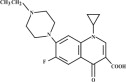
CHEMICAL NOMENCLATURE AND STRUCTURAL FORMULA:
1-cyclopropyl-7-(4-ethyl-1-piperazinyl)-6-fluoro-1,4-dihydro-4-oxo-3-quinolinecarboxylic acid.
HOW SUPPLIED:
| Tablet Size | Tablets/Bottle | Tablet Size | Tablets /Bottle |
| 22.7 mg | 50 Double Scored | 68.0 mg | 200 Double Scored |
| 22.7 mg | 200 Double Scored | 136.0 mg | 50 Double Scored |
| 68.0 mg | 50 Double Scored | 136.0 mg | 200 Double Scored |
Norbrook, the Norbrook bull and Enroflox ® are registered trademarks of Norbrook Laboratories Limited.