Get your patient on Epioxa Cross-Linking (Riboflavin 5-Phosphate Ophthalmic)
Epioxa Cross-Linking prescribing information

INDICATIONS AND USAGE
EPIOXA HD and EPIOXA are indicated in epithelium-on corneal collagen cross-linking for the treatment of keratoconus in adults and pediatric patients aged 13 years and older, in conjunction with the O 2 n System and the Boost Goggles.
DOSAGE AND ADMINISTRATION
- Apply topical anesthetic and insert a lid speculum (2 ).
- Using a cellulose spear sponge soaked with EPIOXA HD, remove the mucin layer from the corneal surface without debriding the corneal epithelium (epithelium-on) by swiping the sponge 4 to 10 times horizontally and vertically (2 ).
- Apply two drops of EPIOXA HD topically on the eye every 60 seconds for 4 minutes (STEP 1), followed by two drops of EPIOXA topically on the eye every 30 seconds for 6 minutes (STEP 2) (2 ).
- Gently rinse the corneal surface with approximately 5 mL of balanced salt solution (BSS) (2 ).
- Perform ultrasound pachymetry. If corneal thickness is less than 325 microns, irradiation should not be performed (2 ).
- Apply the Boost Goggles and turn on the oxygen flow. Refer to the Boost Goggles User Guide (2 ).
- Center the optical head of the O 2 n System over the cornea and irradiate the eye as per the instructions in the O 2 n System Operator's Manual . The O 2 n System automatically delivers irradiation to the eye for 11 minutes 6 seconds at 30 mW/cm 2 with an on/off cycle of 1 second UV-A on/ 1 second UV-A off at a wavelength of 365 nm (2 ).
- Instill BSS on the cornea every 2 minutes, or more frequently as needed, to maintain corneal hydration during UV-A irradiation (2 ).
- When the UV-A irradiation has stopped, shut off the oxygen flow and remove the Boost Goggles and lid speculum (2 ).
- Apply a bandage contact lens (2 ).
Important Administration Instructions
EPIOXA HD and EPIOXA are for topical ophthalmic use. NOT for injection or intraocular use.
EPIOXA HD and EPIOXA are supplied in single-dose syringes. Discard opened syringes after use.
EPIOXA HD and EPIOXA are for use with the O 2 n System and Boost Goggles only.
Refer to the O 2 n System Operator's Manual and Boost Goggles User Guide for device instructions.
Recommended Dosage and Administration Instructions
Apply topical anesthetic and insert a lid speculum.
Using a cellulose spear sponge soaked with EPIOXA HD, remove the mucin layer from the corneal surface without debriding the corneal epithelium (epithelium-on) by swiping the sponge 4 to 10 times horizontally and vertically.
Apply two drops of EPIOXA HD topically on the eye every 60 seconds for 4 minutes (STEP 1), followed by two drops of EPIOXA topically on the eye every 30 seconds for 6 minutes (STEP 2).
Gently rinse the corneal surface with approximately 5 mL of balanced salt solution (BSS).
Perform ultrasound pachymetry. If corneal thickness is less than 325 microns, irradiation should not be performed.
Apply the Boost Goggles and turn on the oxygen flow as per the instructions in the Boost Goggles User Guide .
Center the optical head of the O 2 n System over the cornea and irradiate the eye as per the instructions in the O 2 n System Operator's Manual . The O 2 n System automatically delivers irradiation to the eye for 11 minutes 6 seconds at 30 mW/cm 2 with an on/off cycle of 1 second UV-A on/1 second UV-A off at a wavelength of 365 nm.
Instill BSS on the cornea every 2 minutes, or more frequently as needed, to maintain corneal hydration during UV-A irradiation.
When the UV-A irradiation has stopped, shut off the oxygen flow, and remove the Boost Goggles and lid speculum.
Apply a bandage contact lens.
DOSAGE FORMS AND STRENGTHS
EPIOXA HD
Ophthalmic solution: 0.239% (2.39 mg/mL) of riboflavin 5'-phosphate in a clear, yellow, solution in a single-dose glass syringe.
EPIOXA
Ophthalmic solution: 0.177% (1.77 mg/mL) of riboflavin 5'-phosphate in a clear, yellow, solution in a single-dose glass syringe.
USE IN SPECIFIC POPULATIONS
Pregnancy
Risk Summary
Animal development and reproduction studies have not been conducted with EPIOXA HD and EPIOXA with the O 2 n System and Boost Goggles. Since it is not known whether the epithelium-on corneal collagen cross-linking procedure can cause fetal harm or affect reproduction capacity, it should not be performed on pregnant women.
Lactation
Risk Summary
There are no data on the presence of EPIOXA HD or EPIOXA in human milk, the effects on the breastfed infant, or the effects on milk production. The developmental and health benefits of breastfeeding should be considered, along with the mother's clinical need for the EPIOXA HD and EPIOXA epithelium-on corneal collagen cross-linking procedure and any potential adverse effects on the breastfed child from the EPIOXA HD and EPIOXA epithelium-on corneal collagen cross-linking procedure or from the underlying maternal condition.
Pediatric Use
The safety and effectiveness of EPIOXA HD and EPIOXA for the treatment of keratoconus have been established in pediatric patients aged 13 years and older.
Geriatric Use
No patients enrolled in the clinical trials were 65 years of age or older.
CONTRAINDICATIONS
Hypersensitivity
EPIOXA HD and EPIOXA are contraindicated in patients with known hypersensitivity to benzalkonium chloride or any ingredients in EPIOXA HD and EPIOXA.
Aphakic and Pseudophakic Patients
Epithelium-on corneal collagen cross-linking is contraindicated in aphakic patients and pseudophakic patients without a UV-blocking intraocular lens.
WARNINGS AND PRECAUTIONS
Herpetic keratitis : Use with caution in patients with a history of herpetic keratitis due to the potential for reactivation (5 ).
Herpetic Keratitis
Corneal collagen cross-linking should be used with caution in patients with a history of herpetic keratitis due to the potential for reactivation of herpes keratitis.
ADVERSE REACTIONS
The following clinically significant adverse reactions are described elsewhere in the labeling:
Herpetic keratitis [see Warnings and Precautions (5.1) ]
Clinical Trials Experience
Because clinical trials are conducted under widely varying conditions, adverse reaction rates observed in the clinical trials of a drug cannot be directly compared to rates in the clinical trials of another drug and may not reflect the rates observed in practice.
The safety of EPIOXA HD and EPIOXA in the epithelium-on corneal collagen cross-linking procedure with UV-A irradiation and supplemental oxygen was evaluated in two randomized, parallel-group, sham procedure/vehicle-controlled trials. Study eyes were randomized in a 2:1 treatment allocation to receive corneal collagen cross-linking (CXL) or sham procedure/vehicle control at the baseline visit. In both trials, CXL-treated eyes were followed for 12 months.
Safety data were obtained from a total of 389 CXL-treated eyes.
The most commonly reported adverse reaction in CXL-treated eyes was conjunctival hyperaemia (31%). Other adverse reactions occurring in 5% to 25% of CXL-treated eyes included: corneal opacity (haze), photophobia, punctate keratitis, eye pain, eye irritation, lacrimation increased, corneal epithelium defect, eyelid oedema, corneal striae, visual acuity reduced, dry eye, and anterior chamber flare.
DESCRIPTION
EPIOXA HD (riboflavin 5'-phosphate ophthalmic solution) 0.239% and EPIOXA (riboflavin 5'-phosphate ophthalmic solution) 0.177% contain riboflavin 5'-phosphate, a photoenhancer, for topical ophthalmic use.
EPIOXA HD 0.239% is a clear, yellow, sterile buffered solution containing 2.39 mg/mL riboflavin 5'-phosphate. The pH of the solution is 6.7 to 7.7 and the osmolality is 200 mOsm/kg to 260 mOsm/kg. Each mL of solution contains 2.50 mg of riboflavin 5'-phosphate sodium (equivalent to 1.97 mg/mL riboflavin). Riboflavin 5'-phosphate sodium is a mixture of the sodium salts of riboflavin, riboflavin monophosphates, and riboflavin diphosphates. The inactive ingredients are hydroxypropyl methylcellulose, sodium chloride, dibasic sodium phosphate dihydrate, edetate disodium dihydrate, tromethamine, monobasic sodium phosphate dihydrate, benzalkonium chloride, and water for injection. Sodium hydroxide and/or hydrochloric acid may be added to adjust pH.
EPIOXA 0.177% is a clear, yellow, sterile buffered solution containing 1.77 mg/mL riboflavin 5'-phosphate. The pH of the solution is 6.5 to 7.5 and the osmolality is 330 mOsm/kg to 400 mOsm/kg. Each mL of solution contains 1.85 mg of riboflavin 5'-phosphate sodium (equivalent to 1.46 mg/mL riboflavin). Riboflavin 5'-phosphate sodium is a mixture of the sodium salts of riboflavin, riboflavin monophosphates, and riboflavin diphosphates. The inactive ingredients are sodium chloride, dibasic sodium phosphate dihydrate, tromethamine, monobasic sodium phosphate dihydrate, and water for injection. Sodium hydroxide and/or hydrochloric acid may be added to adjust pH.
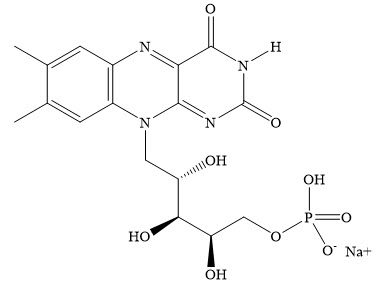
The molecular formula for riboflavin 5'-phosphate sodium (Vitamin B2) is C 17 H 20 N 4 NaO 9 P with a molecular weight of 478.33 g/mol.
CLINICAL PHARMACOLOGY
Mechanism of Action
Riboflavin 5'-phosphate sodium (Vitamin B2) is the precursor of two coenzymes, flavin adenine dinucleotide and flavin mononucleotide, which catalyze oxidation/reduction reactions involved in a number of metabolic pathways.
Under the conditions used for corneal collagen cross-linking, riboflavin 5'-phosphate functions as a photoenhancer and generates singlet oxygen which is responsible for the cross-linking.
Pharmacodynamics
The pharmacodynamics of EPIOXA HD and EPIOXA have not been characterized.
Pharmacokinetics
The pharmacokinetics of EPIOXA HD and EPIOXA have not been characterized.
NONCLINICAL TOXICOLOGY
Carcinogenesis, Mutagenesis, Impairment of Fertility
Carcinogenicity
Animal studies have not been conducted to determine the carcinogenic potential of photoexcited riboflavin.
Mutagenesis
Photoexcited riboflavin has been shown to be genotoxic in the Ames Salmonella reverse mutation assay and in the SOS/umu test system.
The genotoxicity of riboflavin, in the absence of photoexcitation has been examined in vitro in bacterial reverse mutation assays, sister chromatid exchange assay, chromosomal aberration assays and in vivo in a mouse micronucleus study. The overall weight of evidence indicates that riboflavin, in the absence of photoexcitation, is not genotoxic.
Impairment of Fertility
Animal studies to determine the effects of the EPIOXA HD and EPIOXA epithelium-on corneal collagen cross-linking procedure on fertility were not conducted.
CLINICAL STUDIES
Two prospective, randomized, parallel-group, sham procedure/vehicle-controlled trials (Study 1 [NCT03442751] and Study 2 [NCT05759559]) were conducted to evaluate the safety and efficacy of epithelium-on corneal collagen cross-linking (CXL) using riboflavin 5'-phosphate ophthalmic solutions with UV-A irradiation and supplemental oxygen in patients with keratoconus.
In both trials, eligible eyes were randomized to receive CXL treatment or sham procedure/vehicle control in a 2:1 treatment allocation at the baseline visit. Aphakic patients and pseudophakic patients without a UV-blocking intraocular lens were excluded. Both eyes of a patient could be enrolled in the trial; however, one eye was treated first, and the second eye was treated between 1 week and 3 months after the first eye. Eyes were evaluated at 1 day, 3 days, 1 week, and 1, 3, 6, and 12 months post-treatment.
In Study 1, eyes randomized to sham procedure/vehicle control were permitted to receive CXL treatment after month 6 and were followed an additional 6 months. The primary efficacy endpoint was at month 6 post-treatment and the secondary efficacy endpoint was at month 12 post-treatment. In Study 2, the primary efficacy endpoint was at month 12 post-treatment and the secondary efficacy endpoint was at month 6 post-treatment.
In Study 1, a total of 280 eyes of 201 patients were randomized into the trial, of which 279 eyes were treated: 189 eyes received CXL treatment and 90 eyes initially received sham procedure/vehicle control. A statistically significant treatment effect was demonstrated at month 6, based on the difference in change from baseline in maximum corneal curvature (K max ) between the CXL treatment group and sham procedure/vehicle control group ( Table 1 ).
| Visit | CXL Treatment (N=189) | Sham Procedure/ Vehicle Control (N=90) | Treatment Difference (95% CI) P-value |
|---|---|---|---|
| Randomized eyes that received study treatment | |||
| Baseline Mean (standard deviation) K max | 59.4 (9.1) | 59.3 (9.1) | |
| Month 6 LS Mean change from baseline and corresponding 95% CIs obtained from a RMMM ANCOVA model with treatment as a factor and the baseline K max value and baseline keratoconus severity as covariates. Missing post-baseline K max data were handled by multiple imputation procedure for month 6. | -0.3 (-0.6, -0.0) | 0.6 (0.2, 1.1) | -1.0 (-1.5, -0.4) P <0.01 |
| Month 12 Missing post-baseline K max data were handled by last observation carried forward method for month 12 in Sham Procedure/Vehicle Control eyes that received CXL treatment after month 6. | -0.4 (-0.7, -0.2) | 0.7 (0.3, 1.1) | -1.1 (-1.6, -0.6) P <0.01 |
In a subgroup analysis of patients in this trial at month 6, younger patients (< 29 years) experienced a treatment effect of -2.0 D, as a combination of improvement in the CXL treatment arm (-0.7 D) and deterioration in the sham procedure/vehicle control arm (1.3 D). Older patients (≥ 29 years) did not experience improvement at month 6 in either arm.
In Study 2, a total of 312 eyes of 208 patients were randomized into the trial, of which 312 eyes were treated: 200 eyes received CXL treatment and 112 eyes received sham procedure/vehicle control. A statistically significant treatment effect was demonstrated at month 12, based on the difference in change from baseline in K max between the CXL treatment group and sham procedure/vehicle control group ( Table 2 ).
| Visit | CXL Treatment (N=200) | Sham Procedure/ Vehicle Control (N=112) | Treatment Difference (95% CI) P-Value |
|---|---|---|---|
| Randomized eyes that received study treatment | |||
| Baseline Mean (standard deviation) K max | 58.0 (8.0) | 58.1 (8.6) | |
| Month 6 LS Mean change from baseline and corresponding 95% CIs obtained from a RMMM ANCOVA model with treatment as a factor and the baseline K max value and baseline keratoconus severity and age stratum as covariates. Missing post-baseline K max data were handled by multiple imputation procedure. | -0.4 (-0.6, -0.2) | 0.1 (-0.1, 0.4) | -0.6 (-0.9, -0.2) P <0.01 |
| Month 12 | -0.5 (-0.7, -0.3) | 0.4 (0.1, 0.8) | -1.0 (-1.3, -0.6) P <0.01 |
In a subgroup analysis of patients in this trial at month 12, younger patients (< 30 years) experienced a treatment effect of -1.1 D, as a combination of improvement in the CXL treatment arm (-0.5 D) and deterioration in the sham procedure/vehicle control arm (0.5 D). Older patients (≥ 30 years) in the CXL treatment arm experienced comparable improvement (-0.6 D) as younger patients (-0.5 D); however, in the sham procedure/vehicle control arm, older patients (-0.0 D) did not deteriorate as much as younger patients (0.5 D).
HOW SUPPLIED/STORAGE AND HANDLING
EPIOXA HD (riboflavin 5'-phosphate ophthalmic solution) 0.239%, and EPIOXA (riboflavin 5'-phosphate ophthalmic solution) 0.177%, are clear, yellow, ophthalmic solutions. EPIOXA HD and EPIOXA are co-packaged in an Epithelium-on Cross-linking Kit (NDC 25357-024-01) containing:
- One single-dose glass syringe containing 2 mL of EPIOXA HD 0.239% packaged in a foil pouch.
- One single-dose glass syringe containing 2 mL of EPIOXA 0.177% packaged in a foil pouch.
Store kit refrigerated at 2°C to 8°C (36°F to 46°F). Do not freeze. Minimize exposure of the syringes to light once removed from their protective packaging.
For topical ophthalmic use. Single-dose only. Discard syringes after use.
EPIOXA HD and EPIOXA are for use only with the O 2 n System, the single-use O 2 n System Treatment Activation Card, and Boost Goggles.
Mechanism of Action
Riboflavin 5'-phosphate sodium (Vitamin B2) is the precursor of two coenzymes, flavin adenine dinucleotide and flavin mononucleotide, which catalyze oxidation/reduction reactions involved in a number of metabolic pathways.
Under the conditions used for corneal collagen cross-linking, riboflavin 5'-phosphate functions as a photoenhancer and generates singlet oxygen which is responsible for the cross-linking.
