Get your patient on Felanorm (Methimazole)
Felanorm prescribing information

INDICATION:
Felanorm (methimazole) is indicated for the treatment of hyperthyroidism in cats.
DOSAGE AND ADMINISTRATION:
Always include the Instructions for Preparing a Dose of Felanorm (methimazole) Oral Solution and the Information for Cat Owners with the prescription. The starting dose of Felanorm is 2.5 mg administered every 12 hours. Following 3 weeks of treatment, the dose should be titrated to effect based on individual serum total T4 (TT4) levels and clinical response. Dose adjustments should be made in 2.5 mg increments. The maximum total dosage is 20 mg per day divided, not to exceed 10 mg as a single administration.
Hematology, biochemistry, and TT4 should be evaluated prior to initiating treatment and monitored after 3 weeks and 6 weeks of treatment. Thereafter, bloodwork should be monitored every 3 months and the dose adjusted as necessary. Cats receiving doses greater than 10 mg per day should be monitored more frequently.
The product should be administered orally using the enclosed graduated dosing syringe. The syringe has measurements representing the mg dose of the product. Rinse/clean the oral dosing syringe between uses. (See the Instructions for Preparing a Dose of Felanorm (methimazole) Oral Solution ).
CONTRAINDICATIONS:
Do not use in cats with hypersensitivity to methimazole or carbimazole. Do not use in cats with primary liver disease or renal failure.
Do not use in cats with autoimmune disease. See ADVERSE REACTIONS .
Do not use in cats with hematological disorders (such as anemia, neutropenia, lymphopenia, or thrombocytopenia) or coagulopathies. See ADVERSE REACTIONS .
Do not use in pregnant or lactating queens. Laboratory studies in rats and mice have shown evidence of teratogenic and embryotoxic effects of methimazole.
ADVERSE REACTIONS:
In a US field study with 113 cats, the most common adverse reactions included change in food consumption (increase or decrease), lethargy, vomiting, diarrhea/loose stool, skin lesions, and abnormal vocalization. Three cats were withdrawn early from the study, one due to unmasking of latent renal disease and two due to the development of skin lesions. Over the course of the study, there was a decreasing trend in the mean counts of red blood cells, lymphocytes, neutrophils and monocytes; however, means remained within or near normal ranges for the testing laboratory. In the extended use phase of the US field study with 101 cats, the most common adverse reactions reported in the study above (lethargy, anorexia) were also observed. Additional signs occurring more frequently in the long-term study were:
depression/withdrawn behavior, weight loss, hair coat abnormalities, increased blood urea nitrogen (BUN), weakness, agitation and diarrhea. Most of the adverse reactions reported were mild and transient.
Serum chemistry and hematology results in the extended use study were consistent with the trends noted during the field study. The mean alanine transaminase (ALT) was above the reference range at the first two quarterly visits, but within the normal reference range (10-100 U/L) through the next two quarterly visits.
Mean lymphocyte counts decreased consistently during the study period, to slightly below the reference range (1200-8000 cells/mcL) at the fourth quarterly visit.
Sixteen cats experienced elevated antinuclear antibody (ANA) titers at one or more points during long-term therapy with methimazole , but the significance was not determined. Eighteen cats died or were euthanized during the extended use study, four of which may have been related to methimazole due to the unmasking/acceleration of chronic renal failure. See PRECAUTIONS .
In a foreign field study with 26 cats using a starting dose of 5 mg twice daily (twice the recommended starting dose), one cat was withdrawn due to lethargy, vomiting and facial excoriations. Marked thrombocytopenia was reported in two cats; the platelet count returned to normal in one cat when methimazole tablets were discontinued. Two cats collapsed and died within 12 days of starting methimazole at a dose of 5 mg twice daily. Both cats were reported with lethargy, vomiting, anorexia, and bloody diarrhea; one cat also had pallor.
In a second foreign field study with 78 cats using a starting dose of 2.5 mg twice daily, 4 cats were withdrawn due to suspected adverse reactions to methimazole including anemia, cholangiohepatitis, excoriations, vomiting, lethargy, jaundice, and anorexia. One cat receiving 2.5 mg three times daily collapsed and died after 8 weeks of treatment. Adverse reactions included pallor, anorexia, dehydration, jaundice, bleeding diathesis, and anemia. The most frequently reported adverse reactions included mild, transient, self-limiting vomiting, lethargy, and anorexia.
Foreign Market Experience: The following events were reported voluntarily during post-approval use of methimazole in foreign markets: facial pruritus, self-induced excoriations of the head and neck, generalized lymphadenopathy, thrombocytopenia, hematemesis, epistaxis, and elevation of serum liver enzymes and bilirubin.
If overdosage occurs, stop treatment and give symptomatic and supportive care.
POST APPROVAL EXPERIENCE (revised 2015): The following adverse events are based on voluntary, post approval reporting. Not all adverse events are reported to FDA/CVM. It is not always possible to reliably estimate the adverse event frequency or establish a causal relationship to product exposure using these data. The following adverse events are listed in decreasing order of reporting frequency: Anorexia, vomiting, head/facial pruritus or edema, depression/lethargy, weight loss, anemia, elevated liver enzymes, skin lesions, elevated BUN, diarrhea, and thrombocytopenia. In some reported cases, the patients recovered after adverse signs were recognized, the drug was withdrawn, and veterinary care was applied. In some cases, death (or euthanasia) has been reported as an outcome of the adverse reactions listed above.
DESCRIPTION:
Methimazole is a thioureylene antithyroid drug, which inhibits the synthesis of thyroid hormones. Methimazole (1-methylimidazole-2-thiol) is a white, crystalline substance that is freely soluble in water. The chemical formula is C 4 H 6 N 2 S. Molecular weight is 114.16.
Methimazole Chemical Structure:

CLINICAL PHARMACOLOGY:
Methimazole is an antithyroid drug that acts by blocking the biosynthesis of thyroid hormone in vivo. The primary action is to inhibit binding of iodide to the enzyme thyroid peroxidase, thereby preventing the catalyzed iodination of thyroglobulin and T3 and T4 synthesis.
Methimazole is well absorbed following oral administration. Maximum plasma concentrations are achieved within 1-1 1/2 hours after dosing and methimazole is rapidly eliminated from the blood (T1/2 is approximately 3 hours). Administration of methimazole in a fasted state enhances absorption.
HOW SUPPLIED:
Felanorm is available at 5mg/mL in bottles containing 30 or 100mL with 1mL dosing syringe.
Approved by FDA under ANADA # 200-771
TAKE TIME

OBSERVE LABEL DIRECTIONS
Manufactured by:
Norbrook Laboratories Limited Newry, Co. Down, BT35 6QQ, Northern Ireland Felanorm ® is a trademark of Norbrook Laboratories Limited US Patent Numbers: 10,045,967, US 11,123,327 and US 11,738,005 Rev. 08/2024 317670I04 Norbrook ®
Instructions for Preparing a Dose of Felanorm (methimazole) Oral Solution
To draw up a dose, carefully follow these instructions. Prior to preparing a dose, carefully read the Special precautions to be taken when administering Felanorm in the Information for Cat Owners.
- Always wear protective single use, impermeable (e.g., latex or nitrile) gloves when preparing and administering the cat's dose of this medicine.
- Push and turn the screw cap to open the bottle. Attach the dosing syringe to the bottle by gently pushing the end onto the top of the bottle. Note: Always cap the bottle after use.
- Check that the plunger of the oral dosing syringe (included with the product bottle) is pushed all the way down.
- Turn the bottle/syringe upside down. Pull the plunger back/down until the oral dosing syringe fills with medicine.
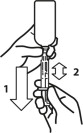
- Carefully expel any large bubbles by pushing and pulling the plunger a few times with the bottle upside down. The presence of a few tiny bubbles is not important for dosing accuracy.
- Fill the syringe with the dose of medicine prescribed by your veterinarian by pulling the plunger back/down slowly. The scale on the oral dosing syringe corresponds to the milligram (mg) dose. The end of plunger nearest the tip of the syringe should be level with the measurement (line) corresponding to the correct mg dose.
- Turn the bottle right way up and with a twisting movement, separate the dosing syringe from the bottle.
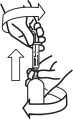
Note: If the prescribed dose is more than one syringe-full (5 mg or 1 milliliter (mL) of solution), you will need to reload the syringe with additional medication to provide the full dose. In this case, the total dose will need to be given via multiple fillings of the dosing syringe. For instance, if the dose is 7.5 mg, then you will need to give one syringe-full (5 mg) plus an additional 2.5 mg to provide the full dose.
- Push the plunger to empty the content of the syringe directly in the cat's mouth.

The product should be administered slowly and gently, allowing the cat to swallow the product. The product is administered by pushing it out of the syringe with the syringe plunger.
Following administration, any residual product remaining on the tip of the dosing syringe should be wiped clean with a disposable item (napkin, paper towel, or tissue). The contaminated item (napkin, paper towel, or tissue) should be disposed of immediately in a trash receptacle. To avoid contamination of the product bottle, the dosing syringe should be rinsed externally, cleaned, and dried between doses and between individual fillings (when multiple fillings of the dosing syringe are needed to provide a single dose). The bottle cap should be screwed back on the product bottle tightly, and the dosing syringe should be stored with the product bottle in the original carton.
Wash your hands with soap and water after administration to avoid exposure to the drug.
Keep out of reach of children.
