Get your patient on Firovet (Firocoxib)
Firovet prescribing information

Indications:Firovet (firocoxib) chewable tablets are indicated for the control of pain and inflammation associated with osteoarthritits and for the control of postoperative pain and inflammation associated with soft-tissue and orthopedic surgery in dogs.
Dosage and Administration:Always provide the Client Information Sheet with prescription. Carefully consider the potential benefits and risks of Firovet and other treatment options before deciding to use Firovet. Use the lowest effective dose for the shortest duration consistent with individual response. The recommended dosage of Firovet (firocoxib) for oral administration in dogs is 2.27 mg/lb (5.0 mg/kg) body weight once daily as needed for osteoarthritis and for 3 days as needed for postoperative pain and inflammation associated with soft-tissue and orthopedic surgery. The dogs can be treated with Firovet approximately two hours prior to surgery. The tablets are scored and dosage should be calculated in half tablet increments. Firovet chewable tablets can be administered with or without food.
Contraindications:Dogs with known hypersensitivity to firocoxib should not receive Firovet.
Adverse Reactions:
Osteoarthritis: In controlled field studies, 128 dogs (ages 11 months to 15 years) were evaluated for safety when given firocoxib chewable tablets at a dose of 2.27 mg/lb (5.0 mg/kg) orally once daily for 30 days. The following adverse reactions were observed. Dogs may have experienced more than one of the observed adverse reactions during the study.
| Adverse Reactions | Firocoxib n=128 | Active Control n=121 |
| Vomiting | 5 | 8 |
| Diarrhea | 1 | 10 |
| Decreased Appetite or Anorexia | 3 | 3 |
| Lethargy | 1 | 3 |
| Pain | 2 | 1 |
| Somnolence | 1 | 1 |
| Hyperactivity | 1 | 0 |
Firocoxib chewable tablets were safely used during field studies concomitantly with other therapies, including vaccines, anthelmintics, and antibiotics.
Soft-tissue Surgery: In controlled field studies eveluating soft-tissue postoperative pain and inflammation, 258 dogs (ages 10.5 weeks to 16 years) were eveluated for safety when given firocoxib chewable tablets at a dose of 2.27 mg/lb (5.0 mg/kg) orally approximately 2 hours prior to surgery and once daily thereafter for up to two days. The following adverse reactions were observed. Dogs may have experienced more than one of the observed reactions during the study.
| Adverse Reactions | Firocoxib Group n=127 | Control Group • n=131 |
| Vomiting | 5 | 6 |
| Diarrhea | 1 | 1 |
| Bruising at Surgery Site | 1 | 1 |
| Respiratory Arrest | 1 | 0 |
| SQ Crepitus in Rear Leg and Flank | 1 | 0 |
| Swollen Paw | 1 | 0 |
• Sham-dosed (pilled)
Orthopedic Surgery: In a controlled field study evaluating orthopedic postoperative pain and inflammation, 226 dogs of various breeds, ranging in age from 1 to 11.9 years in the firocoxib-treated groups and 0.7 to 17 years in the control group were evaluated for safety. Of the 226 dogs, 118 were given firocoxib chewable tablets at a dose of 2.27 mg/lb (5.0 mg/kg) orally approximately 2 hours prior to surgery and once daily thereafter for a total of three days. The following adverse reactions were observed. Dogs may have experienced more than one of the observed reactions during the study.
| Adverse Reactions | Firocoxib Group n=118 | Control Group • n=108 |
| Vomiting | 1 | 0 |
| Diarrhea | 2 •• | 1 |
| Bruising at Surgery Site | 2 | 3 |
| Inappetence/Decreased Appetite | 1 | 2 |
| Pyrexia | 0 | 1 |
| Incision Swelling, Redness | 9 | 5 |
| Oozing Incision | 2 | 0 |
A case may be represented in more than one category. • Sham-dosed (pilled). •• One dog had hemorrhagic gastroenteritis.
Post-Approval Experience (Rev. 2009): The following adverse reactions are based on post-approval adverse drug event reporting. The categories are listed in decreasing order of frequency by body system:
Gastrointestinal: vomiting, anorexia, diarrhea, melena, gastrointestinal perforation, hematemesis, hematochezia, weightloss, gastrointestinal ulceration, peritonitis, abdominal pain, hypersalivation, nausea
Urinary: elevated BUN, elevated creatinine, polydypsia, polyuria, hematuria, urinary incontinence, proteinuria, kidnay failure, azotemia, urinary tract infection
Neurological/Behavioral/Special Sense: depression/lethargy, ataxia, seizures, nervousness, confusion, weakness, hyperactivity, tremor, paresis, head tilt, nystagmus, mydriasis, aggression, uveitis.
Hepatic: elevated ALP, elevated ALT, elevated bilirubin, decreased albumin, elevated AST, icterus, decreased or increased total protein and globulin, pancreatitis, ascites, liver failure, decreased BUN
Hematological: anemia, neutrophilia, thrombocytopenia, neutropenia
Cardiovascular/Respiratory: tachypnea, dyspnea, tachycardia
Dermatologic/Immunologic: pruritis, fever, alopecia, moist dermatitis, autoimmune hemolytic anemia, facial/muzzle edema, urticaria
In some cases, death has been reported as an outcome of the adverse events listed above.
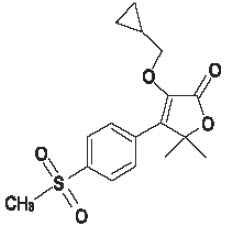
Description:Firovet (lirocoxib) belongs to the coxib class of non-narcotic, non-steroidal anti-inflammatory drugs. Firocoxib is a white crystalline compound described chemically as 3-(cyclopropylmethoxy)-4-(4-(methylsulfonyl)phenyl)-5,5-dimethylfuranone. The empirical formula is C 17 H 20 O 5 S, and the molecular weight is 336.4. The structural formula is shown below:
Clinical Pharmacology:Mode of action: Firovet (firocoxib) is a cyclooxygenase-inhibiting (coxib) class, non-narcotic, non-steroidal anti-inflammatory drug (NSAID) with anti-inflammatory and analgesic properties. There are two main cyclooxygenase enzymes, COX-1 and COX-2, and a newly discovered third enzyme, COX-3, which has yet to be fully characterized. 1 Cyclooxygenase-1 (COX-1) is the enzyme responsible for facilitating constitutive physiologic processes, e.g., platelet aggregation, gastric mucosal protection, and renal perfusion. 2 It also is constitutively expressed in the brain, spinal cord, and reproductive tract. 3 Cyclooxygenase-2 (COX-2) is responsible for the synthesis of inflammatory mediators, but it is also constitutively expressed in the brain, spinal cord and kidneys. 4,5,6 Cyclooxygenase-3 (COX-3) is also constitutively expressed in the canine and human brain and also the human heart. 7 Results from in vitro studies showed firocoxib to be highly selective for the COX-2 enzyme when canine blood was exposed to drug concentrations comparable to those observed following a once daily 5 mg/kg oral dose in dogs. 8 However, the clinical significance of these findings has not been established.
How Supplied:Firovet is available as round, brownish yellow to pale brown, half-scored tablets in two strengths, containing 57 mg or 227 mg firocoxib. Each tablet strength is supplied in 30 count blister packages, 60 count and 180 count bottles.
| NDC Number | Tablet Size | Package Description |
|---|---|---|
| 17033-720-60 | 57 mg | 60 in Bottle pack |
| 17033-720-18 | 57 mg | 180 in Bottle pack |
| XXXXX-XXX-XX | 57 mg | 30 in Blister pack |
| 17033-721-60 | 227 mg | 60 in Bottle pack |
| 17033-721-18 | 227 mg | 180 in Bottle pack |
| XXXXX-XXX-XX | 227 mg | 30 in Blister pack |
